• ABOUT

thinairfactoryblog

~ A topnotch WordPress.com site

thinairfactoryblog

Author Archives: Thin Air Factory

Mutual desire, shared resilience & A Stairway to Heaven

24 Monday Aug 2015

Posted by Thin Air Factory in Uncategorized

≈ Leave a comment

Tags

7 heavens, Akanisththa, Baggies, Bhutan, Bridget Jone's Diary, Consumerism, cosmic fizz, Druid's Oak, funkadelic, heaven, hogwarts, Korea, led zeppelin, Like a Virgin, Madonna, molecular truths, music, Mutual Desire, resilience, rockcorps, Science v. faith, Shared Benefits, Shared Value, Singing in the shower, Song Remains The Same, Stairway to heaven, stakeholder models, stephen greene, The Black Country, The Economist, Titian, venal, West Bromich Albion, Wonkavator

2014-08-13-Stairway_TO_Heaven_by_InToXiCaTeD__StOcK

There are many perfect things in the world – but some would venture that the most precious of them are those perfect things that can directly affect the nature of our human resilience.

Luckily, there seem to be lots more people fixated on creating good things we can all share in.

With the advent of a more Shared Value, stakeholder-centric view of the world, we find increasing numbers of enlightened CEOs and MDs, social activists, enterprisers and entrepreneurs, sustainability practitioners, CSR and Human resources directors spending increasingly large amounts of time ‘designing’ new collective, swarm-like, crowd-fuelled platforms, communities and initiatives in which we can all benefit.

Which is good.

The only small thing to bear in mind while applying all of that highly tuned brain power to great collective ends is this: most of those perfect things that compel multitudes of people towards a shared moment or community of like minds and hearts are of the ‘accidental’ variety – rarely originated, planned or conceived for the direct purpose of shaping a good thing. Mostly they begin as very particular and individual acts of self.

Music for example.

Much of music is created as an externalisation, amplification and expansion and of our highly individual inner human ‘voice’ in the world.

Our internal cadences and the rhythms of our conscious self are released through a sonorous fabric of sounds, notes, and chords strummed, struck, fingered, rubbed, pressed, plucked, picked and blown to resonate and reverberate through and across the myriad materials tribes and cultures have found to hand.

Abstracted human ‘feelings’ are moulded into personal protestations of human existence – of love, wonder, sadness, joy, recrimination, premonition, politic and destruction.

But none the less, music has given us many ‘perfect things’ that have directly affected our ability to collectively create better lives– clarion calls for better and moments of shared joy that transcend cultural generational and social barriers and definitions.

Music is both universal and particular in the ‘perfect things’ department – and one of the greatest levers for galvanising collective good stuff (as the guys and girls at Rockcorps have demonstrated to both local and global effect).

As a singular ‘universal’ concept, music is one of the most transcendent and primal forces that can be put to work in and on our human condition: a rhythmic syncopated celebration of the ‘vibration of life’ itself – shaped by the hands and instruments of our ever-evolving species.

It also delivers many highly particular ‘perfect things’. Things rooted in highly specific local and cultural mores and rituals and the social idioms that underwrite them.

I was reminded of this while overhearing three people of quite different cultural, generational and social background discuss the Led Zeppelin song, A Stairway to Heaven.

(One, I believe, was a musician, one a chef and the other a DJ.)

To many, Led Zeppelin’s Stairway to Heaven is one of those ‘perfect things’ – a jewel of absolute, inviolable synchronicity; between a medium (music), talents, era, emotion, social comment, context, culture, politic and the human condition: a jewel that sparkles with a quite resilient beauty.

It’s fair to say that it’s definitely got something pretty big going on there: some potency or mysticism that has made it globally famous – a piece of music loved the world over.

But does that make it universal? Does that make a song like this a prized tool in the super powered socio-cultural toolbox of rubbing along better in the global village?

What seems to reveal itself on closer inspection is that sometimes the universally transcendent only become so because they are so particular in their nature: so fiercely authentic to and of themselves.

This seemed a philosophical paradox worthy of a rummage at least.

At face value the song is based upon a startlingly simple narrative structure: a combination of a Stairway, a Lady ‘who’s sure…’, and Heaven.

Now, in semiotic and cultural referencing terms, the first two can be rustled up pretty easily in most every culture the the world over.

We all know where we are with a Stairway or some form of step system. And as for ‘a Lady who’s sure…’, greed, avarice and the machinations of the venal are indeed universal.

Both easily make the transition from a British rock culture rooted in the industrial Midlands or Black Country of the late 1960s and 70s to a broader waiting white western culture (of Christian foundation) and ever outwards along the lay lines of the old imperial and colonial powers.

But Heaven. Mmmnnn. Tricky.

In the world in which we currently exist, you need to ‘mind your language’ when it comes to the H word.

You can’t just go bandying words like heaven about willy-nilly without expecting some flack.

There are many different (and fiercely held) ideas of what constitutes a higher existence or plane of being – either spiritual or intellectual. In some, heaven doesn’t feature at all. They are in fact quite anti-heaven.

And if it isn’t God v. Science, it’s ‘my heaven’s better than your heaven ‘cos my Book says so’.

Three steps sideways and suddenly you’re up to your proverbials in pro-life protests, making love through sheets, fundamentalist settlers, abuse cover ups in the clergy, pogroms, public stoning; a light sprinkling of intifada, flag burning and explosive jihadi polemics.

But we can’t just bin the H word. Heaven is not a negotiable element in this song – the song must have it. Pardon the lateral Zeppelin referencing here BUT for the song to remain the same, Heaven is vitally important.

Without it, we’re grounded in a material and physical world focused on structural models and frameworks of habitation and modes of access and ascent, either of internal or external application and construction.

With the addition of Heaven, the ascendant become transcendent. Tick. Heaven endeavours to expand and elevate the spiritual spatial perspective and vista of the listener.

It is also there precisely because it offsets the materialism of the Lady who’s sure…

(Though far more aligned with the avarice of her materialistic certainty, Stairway to Mammon would make for a dreadful reprise and entreat.)

So; Heaven. How does that travel as a universal concept?

Let’s start by gently exploring and dissecting the types and versions clattering about in the global consciousness.

We have of course Heaven as a place adored and yearned for in the theologies of the universal Christian church.

If that’s all we’re worried about, Hosanna! Cue the works of Titian et al and begin the hearty daubing of seraphim, cherubim, chapel ceilings, lush clouds, spirited holiness, bearded men, the startling brilliance of the sun’s rays – and a lot (and I mean A LOT) of heavenly thronging.

But what of the broader version instituted across all the Abrahamic faiths?

And while we’re contemplating whose heaven in whose book, we must also take into consideration that it’s not just the cultural and theological shape or type of heaven: the number is also in question.

It is singular in our song title but in the realms of the eastern faiths that a lot of western rock stars were becoming advocates of in the late 60s and 70s, the single Heaven is replaced by heavens, the plural: or even as far as to count them – 7 Heavens.

And then there’s the issue of the nature of the Heaven or Heavens you are alluding to.

Heaven or its multiples is theologically and literally all over the place.

Dipping even the smallest toe into the subject of Heaven reveals every good reason to keep it wooly in the specificity department

In some teachings, Heaven is framed as being a plane or realm of actual existence that has physical properties and ‘exists’ in a complex intra-related and mostly interdependent set of dimensions in which ours is but one transient floor, corridor, elevator or pipe.

At its most particular, we find either the Seven Heavens of Jewish Mysticism where the seventh is the ultimate realm in which God dwells, or the 5 major types of Heaven in Tibetan Buddhism with the Akanisththa

For others Heaven is a state of being: one shaped and influenced by one’s proximity to one’s god or gods, their teachings and their ‘way’.

Heaven is in this instance therefore both relative and proximal: the closer to god you are the closer your heaven becomes. And therefore the further from god you are the more equally and appositely hellish your state becomes.

And then of course we have Heaven simply as an atomic abstraction – an expansive sub-atomic particular state of otherness – a place and state of existence other than the one we are in but still ‘of it’.

This is the realm of the Cosmic Fizz.

(see https://thinairfactoryblog.com/2014/08/09/celebrating-our-human-existence-the-big-beautiful-boomerang-of-science-and-faith/)

This is a ‘heaven’ that has not been ‘captured’ or appropriated – geo-located or physiologically and physically rendered in any artistic representation or personification – and therefore is the most ‘other’ of them.

The Cosmic Fizz is predicated on the basis that if an atom never dies, then we will continue to exist materially in some particular form after our immediate death – and exist expansively and potentially eternally. In this realm, Heaven as a state of otherness, becomes closer in its nature to the abstraction of the soul than the construction of the body.

This ‘heaven’ is also perhaps closer to the more scientific view of particularity, multiple dimensions of time space, and an infinite number of expanding, contracting and colliding universes. A world of (to punk another prog rock band of the 60s and 70s) quarks strangeness and charm.

(An article in the Economist recently pointed to the fabulous fact that in the realm of the multiverse, we’ve barely a clue as to the construct of the single one we’re currently reading this blog in – given, they tell us, that 96% of matter in our universe passes unseen through the 4% of matter that we can see. So. Is that heaven? The 96%?)

Right. All getting a bit complicated. So let’s go back to practicalities.

What kind of stairway? And where do you want it?

Umm, good question.

Well, if we’re going for heaven as an actual plane or realm from the culture of the band that wrote the song, let’s have a spiralling stairway hewn from the ancient oak wreathed in bluebells, and etched with runic symbolism, looping up and into a West Country sunset.

As for the Where? – pop it over there, on that cowslip-covered Tor: the one with the Druid’s Oak on top. Yup. There. To the left of the winsome, flaxen-haired girl playing tenor recorder.

Great. But, what if we’re in the proximal state-of-being version of heaven? The heaven as defined by the distance between us and god. Does that mean the Stairway is further away from us and, ergo, closer to god; or is it closer to us? This can surely only be answered by first defining whether the particular heavenly theology in question defines you as innately pure at birth or as born with taint (cue original sin) – and then assessing whether you’ve done anything of any substance betwixt birth and death as to shift yourself towards or away from said stairway.

Knowing what form of heaven we’re building a stairway to is key in regards to not only making structural, material and design decisions for our stairway; but more importantly in deciding whether we need a stairway at all

A stairway that ascends to a singular place makes complete sense; but in a realm of multiple heavens we must assume that multiple stairways are required (unless some form of multiple directional Hogwarts stairway can be popped in there). A heaven of multiple realms and destinations would potentially require more of a wonkavator than a stairway.

And heaven as a state of multiple interwoven planes and particularities might preferably require more a beam me up Scotty form of transportation device for ascension.

If you’re clear on where you’ve netted out on this there hopefully is just one other small hurdle. Is your universal concept of a cosmic metaphysical plane within or without?

As the funk prog-rock band Funkadeic and its master blaster George Clinton opined – “Free your ass and your mind will follow – the kingdom of heaven is within”.

If the Kingdom Of Heaven is indeed within, some form of internal stairway is in order. But then, to be punctilious for a moment, wouldn’t that be more likely to be a stair-well? One where we could peer over the edge of the balustrade up or down and spot some other traveller ascending towards a higher existence.

So, ermmm, where was I?  Yes.

The question of whether Stairway To Heaven; a very socio-culturally particular piece of music, has transcended all barriers and idioms to be one of those cultural assets that can be put in the big, sharing, feel-good box of our most resilient humanity?

Dunno. Heavens apart, we can only answer that through the witnessing of its application and effect in the world at scale across myriad cultures.

Do they play it on the radio in The Gaza Strip and Damascus? (My assumption would be that at least one of the settlers from the U.S. will have bought some of their college radio loves with them!)

How does it roll in the Far-East?. I am certain that there are many bars in Korea and Vietnam that feature this on their juke-box.  And given the tsunami of Australians surging through from the other direction, I cant imagine that even the distant hills of Tibet and the northern Chinese provinces are immune to its charms.

In terms of its authenticity and integrity, would a lover of the song in Bhutan just be ‘pretending’ to know its meaning and sub-text just because they’re not from West Bromich and have absolutely no clue as to who the ‘Baggies’ are?

Bridget Jones Diary and the women’s prison in Bangkok comes to mind. The original lyrics of Like A Virgin swapped out for something that just sounds more ‘right’ to the singer in their own cultural opinion.

There’s a lady whose nose only tickles if cold.

In the end it doesn’t really matter. If the feeling is right, does anyone care how it thinks or reads?

All that matters is that there is a piece of music in the world, one of tens of thousands of them, that can bring the most diverse groups of people together in the bat of an eye with no need for social engineering, complex structures, trending language or roundtable debates.

A piece of music that can collectively lift peoples hearts and spirits to expect and demand better. Created for joy and expression. Not utility.

When shaping narratives of collectivism and shared value we should remember the joy part of that. The lightness it brings with it. Because we make a lot of these collectivist and shared initiatives far too serious and far less human because of it.

As Robert Plant asks us directly:

“Do you remember laughter?”

I’ll sing badly in the shower to that.

Now, where’s that ABBA album?

Everything is connected & a brief journey through two kings, blue eyes, 1970s posters and Alice Cooper

15 Wednesday Jul 2015

Posted by Thin Air Factory in Uncategorized

≈ Leave a comment

Tags

1970s Posters, Blondie, Crystal Gale, Elizabeth Taylor, Elrond, Everything Is Connected, Gandalf, Gimley, Gladiator, Hamlet, Legolas, Living In The Now, lord of the Rings, Lothlorien, Manhatten Transfer, Mick Ronson, Mirkwood, Mustique, Nostalgia, Peter O Toole, Portofino, Richard Burton, Sartoria, Shakespeare, Sir Ian McKellen, Sir John Gielgud, Social Memory, St Tropez, Strider, The Cramps, The Medusa Touch, The Senses, The Shire, Theodren, Viggo Mortgensen, Who's Afraid Of Virginia Woolf

Screen Shot 2015-07-15 at 11.26.07  BurtonL1402_468x624imgres-1$_12imgres

TWO KINGS

let’s start our journey of connection at the film Lord Of The Rings: The Return of the King – and lets take ourselves to the final reckoning at the Black Gate – and Aragorn’s rousing speech in the final battle scene.

It teeters on battle speech perfect. And that’s amongst some stiff opposition:
Spear shall be shaken, shield be splintered,
A sword-day, a red day, ere the sun rises!

Theoden’s rousing speech is about as good as they get (leaving aside every transcendent quote from Gladiator you care to mention.)

But Aragorn’s speech goes to a different level. And it is due to something beyond mere content. Something rings (sorry) more deeply here: something is different: his voice: the gruffness of before – the hoarse whisper of Strider, the ranger’s voice, has taken on a more measured passion – a more kingly tenor.

Suddenly there is a new stature present: that of a King in waiting. It seems as if Aragorn in his speech finally rises through his oratory to the challenge set by Elrond: to “Put aside the Ranger. Become who you were born to be.”

But this kingly voice sounds faintly familiar. Whose voice echoes down through the celluloid corridors to sound out through the lips of Viggo Mortgensen?

And then it struck me.

Richard Burton: Hamlet. 1964. Produced and directed for the stage and screen by the immutable Sir John Gielgud.

And What a piece of work is a man…

Glorious.

Viggo’s voice, whether by prescription or accident sounds out the spirit of Burton’s Hamlet through the mouth of a different King.

Strangely, another more abstracted, wholly subjective and subtle connection exists for me – through Gandalf or should I say Sir Ian McKellen: whom has always reminded me of Gielgud.

GOING FOR A BURTON

On the matter of Richard Burton, when asked recently whom I thought, beyond Bond et al,was the yet to be discovered Look in gentlemen’s sartoria – for me, it is Richard Burton.

Apart from the fact that, he already achieves 11 out of 10 on a blokey rating just for marrying one of if not the most beautiful women of the age (shallow is the new deep), Burton also found himself a famous sporter of fashion signature pieces like the toweling polo shirt – three button, splayed collar, sun burnt colours – which he sported in American Bars from Portofino to St Tropez to Mustique.

But look further and his look expands into multiple sartorial shards from the broken glass of 50’s 60’s and 70’s fashion. The ‘almost Elvis’ suit and collar combos off set by slicked back hair and powder-white sideburns firing across rippled sun drenched skin. The smokey southern deconstructed suits of a very twisted George in Who’s Afraid of Virginia Woolf. To the beat generation black of Hamlet and the stripped back Medusa Touch.

So Burton is The Man for me when it comes to the next British Look.

BROWN EYES BLUE

It’s amazing how a still from a movie can invoke a memory that rockets you back to a moment in time with such a breathtaking ferocity and such clarity.

While looking at stills of Richard Burton in the film The Medusa Touch, I was reminded of the depth and what I can only refer to a the particular ‘blue’-ness of his eyes – not bright crystal like O’Toole’s – more a deep mined blue with graphite shades and green eddies.

Regardless, the song that rushed to the back of my mind while looking at the stills was Crystal Gale’s Don’t it make your Brown Eyes blue. Now disregarding the fact that I had a massive crush on her for a while (though nothing will EVER outshine the tenure of my teenage crush on Debbie Harry – currently still burning brightly), and playful word recognition and threads aside (Blue Eyes – Brown Eyes) it was the ‘time’ that played up into my head – that moment of being in the world through which that song floated. The clothes I wore. The music I loved. The posters on my cork tiled patch of wall. All those discomforts of self: the intensity of passions and uncertainties. The smell of cut grass on school playing fields. The face of a girl that I liked but couldn’t even fathom how to look at let alone try and speak to. Dislocated parents. Dislocated body (nothing my body did bore any relation to what went on in my head – it was a law unto itself). A time made as viscerally present as it is past. All through a song and a film still.

1970s POSTERS

Speaking of posters from the 1970s – one of the posters that hung for years on my wall was a Lord Of The Rings poster Illustrated by J Caulty.

The poster’s central characters are, I believe, Gandalf and Frodo Baggins. Around its periphery we see Aragorn, Gimley, Legolas and Gollum amongst others, interlaced with twisting pathways, and realms like the distant Lothlorien, and the Shire – all topped with a curling embellishment on which hung a golden crown.

Around the poster ran a border embellished with men, elves, dwarves, riders and assorted others. But dead centre at the bottom of this border lay the magic: a small iris that looked into a mysterious land: as if we are peering out from the dark innards of the great Mirkwood to the lush lands beyond.

And I remember looking deeply, almost trance like into this aperture and wondering what world existed beyond there. (Preferably one more seductive than the one in which my highly conflicted teenage self lived currently.)

And I remember thinking that the character I thought to be Aragorn (but it is actually probably a darker character from the stories) midway up the right hand side of the poster looks like a mash up of Alice Cooper, Mick Ronson, Manhatten Transfer and a Cramps flyer – which just about summed up my musical confusion through the mid to late 70s – a troubled collision of heavy rock & pomp metal, disco, punk, greaser rock and psychobilly.

Confused perhaps. But Lord Of The Rings nonetheless.

Which brings me back to the return of the king: a virtuous circle of being.

So heres to a goes around comes around world where everything is connected – past present and future through sight smell taste touch and sound wound into a cat’s cradle string that we merely reform and reshape depending on the memory doorways we enter through, and to whichever passing thought kicks the embers from the back of our mind into sparks at the front.

Academic Lag, Advertising Jag & the task of Socialising the Genome

14 Tuesday Jul 2015

Posted by Thin Air Factory in Uncategorized

≈ Leave a comment

Tags

Academia, Academic Lag, Acclimatisation, Advertising, Advertising Jag, andy lamb, big data, Brian Cox, conversation, Creative Action Research, Decompression, Demand, desire, DNA, Evolution, Genome, Genomic Science, Guttenberg Press, Hadron Collider, Health, health Screening, Human Behaviour, human essence, Identity, Insight Ladder, Intellectuals, Language, Living The Dream, marketing communications, networks of academic collaboration, NHS, Populists, Sanger Institute, social networks, Socialisation, Syntax, utility, wellbeing

LAG:

A period of time: a noticeable delay between action and reaction –                         Failing to keep up with another or others in movement or development

JAG: 

A short period of overindulgence in an activity: a shopping jag: a crying jag          A stab; an intense and concentrated movement or action
Screen Shot 2015-07-14 at 12.39.29

I increasingly find myself at a very particular and exciting intersection.

I find myself there not by accident but by design: having helped build a methodology that reaps its greatest rewards at the point where applied science and commercial creativity collide.

(The creativity is commercial in that the point of collision is designed to generate pieces of communication to a specific end and utility – functional with tangible benefits – as opposed to a piece of pure art or some material assemblage generated to no end other than to create feeling and effect through its aesthetic – experiential with intangible benefits.)

Over the last year and a half I have been working on a project that seeks simple answers to some quite complex questions rooted in deep science:

  • How do we scale the ‘everyday’ conversation around genome science and DNA beyond the scientists, academics, clinicians and the rare interested civilian party?
  • How do we illuminate the scientific mysteries and wonder of our DNA in such a way that everyone can understand them, embrace them, engage with them, and reap the rewards that come from them?
  • And ultimately how do we help the greatest number of us to enhance the nature, quality and duration of our human tenure through informed choice and enlightened action in regards to our DNA?

This search for a more compelling narrative and conversation at the point where science and everyday humanity meet is not an isolated pursuit.

It is also true of the ‘Living The Dream’ project I am currently helping to steer. The project also seeks to scale the conversation around what constitutes a more enduring model of prosperity and sustainable consumption by finding a more ‘human’ narrative to replace the existing one, rooted as it is in the science, engineering and ‘reason’ of sustainability as opposed to human emotion of it.

In both cases we need to find a way of communicating complex concepts and constructs in the simplest way possible to the largest number of people without destroying the integrity of the scientific truths in the process.

In both cases there are untold rewards for society and humankind both individually and collectively if we can scale these conversations.

So I find myself working at this intersection of multiple collisions: between scientific integrity and human sociability: between depth and structure and lightness and elasticity; between applied science and commercial creativity.

MAKING CONVERSATION

To reap the untold rewards we simply need the communities of science and academia to meet the man and woman in the street and have a good ‘chat’:

And boy do they have some great stuff to talk about: life changing, existence enhancing stuff.

In the case of genomics, simply put, if enough of us embrace the advantages that the advances in the science offer in our everyday lives, using the revelations of DNA in an applied manner both individually and for the common good, we could eventually move ourselves from the old curative model of health care to a new and far more dynamic preventative model: one that will not only just change the way we live but also alter the duration of that living.

Making smarter and easily comprehensible lifestyle choices informed and underwritten by a deeper and more intimate understanding of what makes us who we are can help us to embrace a more positive approach to the lives we lead. Those choices made en masse will equally inform and illuminate how best the health service of the future can better sustain its ability to continue to serve our society both systemically and financially.

Now logic would predict that given the enormous impact and beneficial nature of those potential outcomes, everyone should already be ‘all over that conversation’: chatting away furiously, listening intently, sharing the conversation with friends and reaping the rewards of a better life.

SPEAKING IN TONGUES

The problem is – we’re not.

Why?

The greatest barrier seems to be one of simple comprehension and understanding.

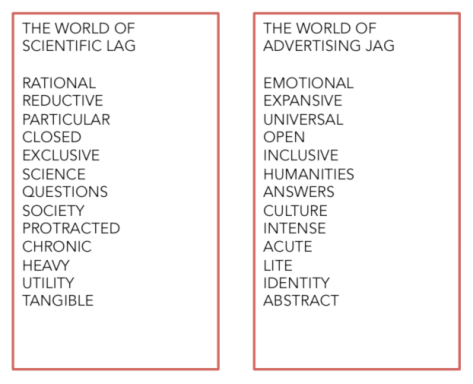
The scientists and academics simply communicate in a different language to the everyday people they are trying to reach. Their particular languages have different vocabularies, inflections, idioms, energies and vernaculars – which is unsurprising given that both parties live in very, very different worlds.

In one world we have the ‘splendid isolation’ of existence required to nurture intense, interrogative and highly rational scientific thought and action – and the codified, particular language and almost impenetrable texts, dissertations and white papers that accompany and support it.

In the other world we find the hyper-connected and hyper-socialised immersion of our emotionally charged everyday existence, fuelled and accelerated by smart devices and sprawling digital platforms of human interaction filled with billions of TXTS, tweets, emojis, memes, slang and banter.

One exists in a mode of hyper dislocation; the other in a mode of hyper socialisation.

And it seems that each speaks in riddles as far as the other is concerned.

A chasm exists between the world of academia and the sciences and that of the everyday person in the street. And as with all worlds of such different ‘atmospheres’, there needs to be a process of acclimatisation when travelling between one and the other.

In the context of Socialising the Genome (and my Living The Dream project) it is the conversational ‘syntax’ – the framing, structure, language and phrasing of these arguments – that needs to ‘acclimatise’ to the atmosphere of everyday needs and desires and the language they speak.

The highly tuned language, intense qualification and proofs of the scientists and academics need to ‘decompress’ on the way up into the ‘real world’ – otherwise they will suffer a bout of the communication ‘bends’ – where they either over compensate and try to hard – become too ‘matey’; the NBF of the person in the street… : ) : )

Or they simply come across like a geek at a fancy dress party – awkward, uncomfortable and so wrong on so many counts.

Putting deep science and academic concepts and truths through a ‘decompression and acclimatisation’ process can of course be undertaken as a one off – but realistically, if our ambition in this instance is to ‘socialise’ the conversation, we have to assume a fluid and escalating dialogue of increasing and expanding value and reach – and for that to happen we realised that we needed to keep the findings, revelations and insights of the academics and scientists constantly ‘in flow’; moving seamlessly and effortlessly between one world and the other: elastic and evolving.

To achieve this they need to be ‘sensitive’ of, keep pace with and be true to the everyday shifts and nuances in the behaviours, attitudes and language of the people whose existence they seek to improve. To be resilient and meaningful they must remain ‘relevant’ at all times.

(There is little point in deep diving for a populist answer only to find that on surfacing with one 2 years later, the question has changed. Herein lurks the danger of the academic lag.)

So, in the process of designing the methodology that would facilitate this we found ourselves with two acute questions to answer:

  • How do we create an offset strategy for the academic lag – one that allows the worlds of academia and the deep sciences to remain ‘present’ – to exist both in the accelerated and socialised Now while still mining in splendid isolation?
  •  How do we design a ‘decompression and acclimatisation’ process that enables a smarter simpler flow of ideas and findings – a ‘conversation’ or dialogue – between one world and the other?

CUE ADVERTISING JAG.

To reap the ultimate rewards that the advances in Genomic science offer us, the screening and storing our DNA as would have to become an everyday part of our health profile: it would have to become second nature to every one of us: a common place behaviour: something that we do without ‘thinking’.

But we’re a long way from a chirpy chat along the lines of:

‘hey Trish. Sorry. Can we say 7.30ish now? Running a bit late at the DNA screening clinic – mines a large glass of DWW! ; ) Jax xxx’

Genomic science tends to only enter our conversation either because we are forced to engage with it or by an accident of revelation.

Even when the more moderated conversations do occur they can quickly tip into ethical minefields around data storage and security, commercial abuses by insurance companies and self interested corporates, elitist tiers and eugenics, socio cultural stratification and the Police Database. There issues around identity privacy and confidentiality are staggering in some of their complexities and contradictions.

The complexities of genomic science are simply not ‘everyday’, not everyone’s ‘cup of tea’ and are at best incomprehensible and at worst quickly controversial.

But Advertising & Communication people spend their whole life not only trying to decipher what someone’s ‘cup of tea’ might be but also how they might get them to drink more of it

The nature of the models and frameworks used by marketing communications specialists to mine and shape insights, propositions and narratives – the intensity, speed and use of both broad stroke universal consumer insight and atomic data modelling – is driven by the voracious desire in corporates to ‘keep up’ with the fluid and ever changing nature of consumer demand and desires. These models have grown ever more agile due to:

  • The direct impact of technology and the social networks across the value chains and markets of the big corporate consumer brands:
  • The age of data big bang: an ever-expanding viral surge of relentlessly dividing and multiplying data on every aspect and dimension of how we live, act, interact and transact.

It is in the intensity, approach and most importantly the creative storytelling aspect of this ‘jag’ of activity that we believe our off set strategy can be found.

ADVERTISING SCHMADVERTISING

One of the greatest tension points in the new methodology we have engineered in Socialising The Genome is the point at which advertising exclamation collides with academic exposition.

There are fundamental and quite combative points of difference between the worlds of the Sciences & Medicine and the Humanities & Arts – in nature, methodology and application; and in their concepts of what constitutes integrity and substance (especially when the latter are of the populist persuader type – the advertising and marketing agencies and their kind).

Many wholly reason-based intellectuals and practitioners harbour a quite fixed (and many would say hugely justifiable) sense of distrust in what they regard as a moral and intellectual vacuum in the marketing communications agencies, institutions and organisations that manipulate and leverage ‘emotion’ and a lazy populism for commercial gain.

To allow the conversation around something as precious and fragile as genomic science to be driven by base desires pumped up on the wisdom of the crowds with no form of enlightened filter or curation, might well be perceived as not only risky but also irresponsible.

“Fine, if you’re just pushing another million or so 6-bladed, swivel-hipped funky junky disposable plastic razors” but matters of this level of human importance are quite a different thing entirely.

Alternately, on the other side of the conversational fence, we have the champions of ‘everyday’ people, the populist movers, shakers, creators and commentators who celebrate them, their language, their culture, their leisure and their past-times, and who shape, shade and distribute the myriad simple pleasures that they enjoy and engage with. For these people, unless science, like technology, is wrapped up in a Brian Cox-like, ‘whoops that’s my Collider’ approachability or celebrity, they are quite disdainful or disinterested in what they see as arcane and impenetrable conversations. They see no point in a dialogue that seems circular and closed in its nature and not of any use to anyone without a PhD.

Their attitude broadly runs along the lines of:

“don’t care – all a bit to serious and arch for me – lighten up, get over yourself – short time living long time dead – if you cant take the banter we’re not listening – and while you’re at it, mine’s a highly-advertised pint of unexceptional lager please!”
Screen Shot 2015-07-14 at 14.45.37

BUT, in a balanced world and all things being even – somewhere between the two polarities lies an answer – midway between the extremities of emotional populism on the one side and high-minded rationalism on the other.

Neither one nor the other can develop the conversation by itself in isolation. Each needs the other to create a full and robust conversation that is both substantial and sociable.

In our particular instance, we needed to go on a journey from the clinical utility of the genome conversation as it is now – closed alienating isolating and impenetrable in large tracts – to a one more rooted in concepts of positive identity and improved existence – open inclusive socialised and empowering.

We realised that to do that we needed to decipher how we could use the tension that exists between the worlds of science and society to most positive effect – to facilitate and accelerate that journey.

MIND THE GAP

To be clear, the absence of accelerated improvement in our human existence through Genomic science is not an issue of supply. (There are a lot of brilliant minds moving the science forwards). This is an issue of demand.

While ‘everyday’ people continue to not understand the real and substantial benefits of that science, they will not demand its benefits as a standard and inextricable part of their everyday lives

Communicating the inspirational, revelatory and highly beneficial impact of embracing our DNA to the greatest number of people in their terms in their world is central to all of this because it will fuel and fire ‘demand’ for better.

TWAS EVER THUS

Demystifying and popularising rare knowledge of a scientific, political, economic or theological nature has always been a critical step in the march of human progress (whether the scientists, politicians, economists and the theologians like it or not).

‘Dumbing down’ as some elevated minds like to think of it is actually humanity’s way of smartening up. And inspiring and wild-firing everyday conversation is a vital lever in that smartening up.

So first things first: we needed to accept that the challenges to easy conversation are substantial – the impenetrable nature of the science; a very human, provincially minded fear of the unknown; the conflicted nature of our feeling towards ‘disease prediction’; a general fear of ‘science going too far & meddling with the cosmos; the primal compulsion to ‘move away from’ any form of human flaw (our own or anyone else’s); either in the form of disability or crippling disease; or those flaws as might potentially be revealed by DNA screening.

We need to accept that none of the ‘conversation’ generated so far has enabled us to move very far beyond our current audiences – and that we have so far failed to present a set of positives that outweigh the existing negatives.

Genomic science and the subject of DNA need to be lightly dealt with or presented in such a way as to find their way into pub banter framed and informed by a ‘did you see? Did you know?’ Intelligence Lite, fuelled by lifestyle magazines, Sunday supplements and the Discovery Channel.

And given that film is the most shared currency in the socially networked world, film needs to be the base currency of our highly socialised cultural economy.

So our key objectives for success were:

  • to create a methodology that enabled us to look up through the emotionally driven human and the everyday insight – not down through the rationally driven science and the clinical language
  • to develop and distribute the seeds of a new and scaled conversation through the power of shareable film.

CREATIVE ACTION RESEARCH

My work over the last year or so with Dr. Anna Middleton of the Sanger Institute focuses solely how we reconcile the perspectives of our two worlds to shape and scale the conversation around DNA and Genomic science to greater human benefit.

And it is in the circular and iterative nature of the interaction between her world – that of the Academic Lag – and mine – that of the Advertising Jag – that we believe will deliver the language and framing for and therefore the scale of conversation that we need to transform the way people see DNA in their lives.

With CAR, we have constructed a methodology where, even when in the midst of the deep dive nature of her qualitative ethical research process, Anna is able to utilize my and my collaborator’s ability to reframe, rephrase and represent science or research fact in more populist social storytelling terms and framings to play beck into and inform the more academic process she is undertaking.

CAR – TESTING THE EDGES OF CONVERSATION

CAR combines traditional qualitative research, rooted in group discussions and in depth interviews and discourse interpretation with quantitative research that introduces fresh  creatively-framed seeds of Genome and DNA conversation into the social networks to provide a simple speedy test of whether those seeds have the ability to inspire and engage people in such a way that they might in turn share it amongst their own social network both real and virtual.

The method we have devised for creating the simple seeds of a new conversation revolves around taking an existing piece of knowledge or scientific fact and creating different types of ‘conversation’ or story telling around it.

We then use these seeds of conversation as foils and flash cards in both a quantitative socialised environment and the more in depth and metered qualitative research groups and in-depths.

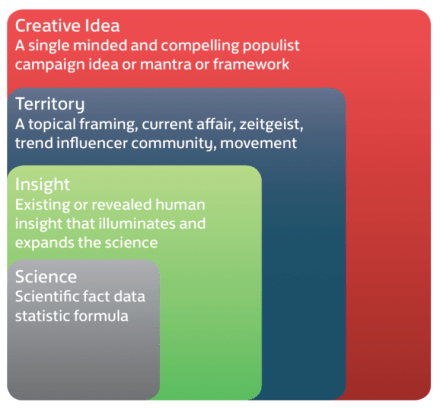
To ensure that in the migration from science or clinical insight to creative idea we did and do not fall foul of confecting, manipulating, misrepresenting and ultimately distorting or twisting the knowledge or facts we are using, every creative idea has to be rooted in an insight ladder.
Screen Shot 2015-07-14 at 14.58.47

The Insight Ladder is a simple proprietary tool that I have developed for this project that aims to lock the more creatively framed seed of conversation to the scientific fact truth or insight that inspired it: a sort of plumb line of integrity that runs through each ‘conversation’.

QUALITATIVE RESEARCH

A number of traditional qualitative research group discussions and some in depths will begin to explore some of the everyday language and insights around genome science and DNA.

A dry Discussion Guide takes each participant in the qualitative groups from a condition of lowest point of knowledge – do you know what DNA is? – through a natural arc of expanding conversation – knowledge of DNA – benefits or not to the individual – its role in improved healthcare – moral and ethical issues around the science – data privacy and security – and at its most extreme – and ultimately, the nature of improved DNA and genome science on a thriving UK PLC as a mark of global leadership in the advancement of improved human existence through scientific and social enlightenment and application.

Once the open and freeform discussion has come to a close we will use some of the seed ideas that we have developed from existing insights to see how opening doors to the subject using more creative everyday storytelling potentially changes or alters people’s disposition, perception and appreciation of the subject.

QUANTITATIVE RESEARCH

Once the qualitative groups have been transcribed we will then select the most potent insights and creative storytelling and framings so that they may be turned into simple animated pieces of film storytelling.

We will use an online research tool to see which film inspires the most attention and why with a representative UK sample, as well as sharing them in the social networks to the same purpose.

Both actions will seek simple responses and opinions through both closed and open data capture.

Ultimately we are seeking one or two ideas with the potential to develop into a greater scale of everyday conversation using socially dynamic communications and advocacy strategies to wildfire those conversations.

BONFIRE OF THE HUMANITIES

The creative jag in CAR endeavours to act like a repeated finger tap in the centre of the academic ‘chest’ – a way of bringing the science into the moment, connecting it in visceral emotional and social terms to the everyday Now – an intense injection of populist framing and storytelling for those somewhat consumed in the Academic Lag.

In that way, the advertising Jag acts as a form of ‘Mindfulness’ for the scientist, academic and clinician deep-diving into the world of the genome – providing a ‘Look Up’ orientation strategy for them to use while potholing in the caves between what is know and unknown.

Therefore Creative Action Research aims to use a complimentary fusion of:

Academic Lag – Reason – utility, interrogation & measure – resilience – the individual

+

Advertising Jag – Emotion – identity, expression & impact – desire – the crowd

to scale the conversation and socialise the Genome.

CAR accepts that there is no simple black & white answer here. It will take time and the attentions of both the Laggers and the Jaggers to get to the scale of conversation this deserves and needs.

In some ways, as with our DNA, it might just prove that the things that unite us are greater than those that divide us.

In finding a way to socialise the Genome we might just find a way to both educate the populous and socialise academia. And perhaps that is not a bad thing at all.

In the meantime lets pop on our Bordieu T Shirt – and be a great destroyer of Either/Or.

Byronic Creativity, Dances with Data & the primacy of customer-centricity.

24 Wednesday Jun 2015

Posted by Thin Air Factory in Uncategorized

≈ Leave a comment

Tags

big data, Byron, Client Budgets, Communications, Creative Industries, creative purity, data sets, dead Poet's Society, Direct Report P&L Businesses, Direct Response, Dr J Evans Pritchard, Higher Consciousness, Longue Carabine, Meerkats, old school advertising, Predictive Algorithms, Qualitative Insight, Quantitative Assertion, Risk Mitigation & Carry, ROI, Sales Promotion, Shamen, Sioux Nation, Social Networks & Platforms, The Internet Of Things, Warriors

5716508229_ff61aba4cc_b

There seems to be a reoccurring and escalating schizoid condition warping the minds of Communications agencies and clients across the capital.

And it seems to be rooted in a clash that can be particularly philosophical, practical or financial in nature (or a compound of all three) at any given time.

The conflict centres on who leads the conversation in marketing and communications land – and in turn who gets to command the greatest fees for the precious lead outputs and services and the commercial kudos attached.

Should marketing and marcomms be focused on the burgeoning socially-networked and data-rich science of customer centricity?

Or should it be fuelled by a powerful fusion of intimate qualitative insight and the white heat of creative integrity?

The creative industries have long railed against the intrusion of anyone with a slide rule and a bar chart as killers of pure creativity.

Sales Promotion & its BOGOF culture. Direct response and its channel as an idea delusions. And now the Little Big Horn of Data. As far as the average big thinking creative guru and the agency culture that serves them is concerned, all of them should take their place further down the strategic Value Chain and wait to be summoned.

This view is predicated on a belief that pure creativity is some sort of higher and immutable power unanswerable to any kind of measure and the bean counting serfs and operational barrow boys who champion them.

The creative purist quietly dismisses these metric minded jobsworths in much the same way that Dr J Evans Pritchard’s belief that one can assess the greatness of a poem by compounding horizontal and vertical measures was dismissed as ‘excrement’ by Robin William’s ‘Captain’ in the film, Dead Poets Society.

At the very centre of this belief sits the Byronic myth. That of the turbulent volatile creative tempest, stumbling through boudoir bar and ballroom in search of the ‘moment’ – the thought and the prize. The one moment of brilliance that subjugates all others.

All very good. Highly commendable. And very amusing to watch (and partake in). And respectfully, regardless of the nay sayers, this model has created some of the finest commercial creative talents of the last 40 years.

The idea of a data rich, highly measurable influencer and advocate matrix of highly connected modern living – what I like to call Data-Day living – just doesn’t cut it in the world of old school creative purity and integrity seeking to rub the raw nerve of our human condition. Fire us up, provoke us, seduce us, invoke and inspire us to buy some thing or other. A world led, coded and read by people who think that ‘there is no such thing as emotion, just sentimental data’ is to most people an abomination and none more so than the average old school creative.

I just can’t picture the towering genii of Paul Arden and Dave Trott sitting in a room thumbing their graphite pencil and chewed biro while seeking illumination in the junction points between two or more sets of data tracking the correlations between broadband renewal trends in Huddersfield and the escalating retail shopping patterns of the average 35 year old on a wet Tuesday in Tyne Tees.

Real people don’t live in a powerpoint deck or a data slide!

They live through the wholly unreasonable filter or desire and emotion.

Visceral. Vital.

Agreed.

And there seems to be something so much more powerful and connective in getting out there, pulling your sleeves up and rummaging around in the ordure of the human condition to pull out a plum.

Qualitative; attractive and highly subjective and interpretive. Finding out what people care about and feel in varying contexts of need want and desire under particular influences creates a compelling and highly intimate and personable narrative.

Emotion rules this roost.

More importantly for the creative purist, in those interwoven threads of everyday humanity brilliant creative inspiration lies: the human grist to their creative mill.

The small problem comes with the advent of the Data Insurgents and their new and far more accountable model of communications propped up by some very, very disruptive creative communities out there.

On line living, mobile technology and increasingly The Internet of Things is creating a cosmic fizz of data – live: in flow, vibrant, atomic and measurable.

A sort of a ‘socio-geo-eco-tempo-political’ Matrix capable of offering up all sorts of goodies to the miners and the excavators of the data that shape it.

Suddenly amongst this mass of code and data, the algorithms and the predictive software; and in the face of the relentless austerities and under the hammer of ROI a new sensibility rises and its not slowing anytime yet.

Quantitative. Seductive. Particular. Objective and interrogative. Finding out what people actually do and react to, in multiple modes and states of action in varying contexts over varying timeframes and multiple platforms creates a financially measurable and strategically accountable narrative that is hard to ignore.

Reason rules this roost.

So the question this new sensibility raises in the face of the old and highly revered world of pure creativity is a contentious (and financially onerous) one:

Who has primacy in regards to the Brand relationship and the client budget?

The Byronic Shamen with their incendiary creative vision?

Or the Data Warriors with their fluid numerate pointillism?

To be fair, in regards to selling in the room, it’s a hell of a lot easier to hold your hand out and ask for quite a few million Great British Pounds when you’re asking for it on the data-written and statistical evidence of delivering a projected ROI of ‘bloody hell:1’.

It’s a lot harder to justify the Ask when you’re operating on a purely qualitative ‘we’re so brilliant’ ‘done it before so we can do it again’ basis which the purveyors of pure creativity tend to rely upon all too often.

By its very nature Creativity is volatile and imperfect – lacking in the more measured artisan skills of a repetitive ability to turn out exquisite and identical things’ from a fixed or varied set of materials with a clear set of costs attached to sourcing, resourcing and processing them.

Let’s be fair here, hold up our hand and admit that the ads that followed Cadbury Gorilla and Sony Balls did not do a very good job of convincing anyone other than the agency, creative, planner and client in question that you can cookie cut incendiary creative brilliance; and equally charge the same stellar rates for very unlike outputs other than the logo on the end frame.

The first pieces? Jaw dropping, audacious, mould breaking and sublime. Problem is they made the bits that followed feel like an underwhelming Christmas special from a much loved sitcom. A little bit Almost.

Pure Creativity in the commercial cut throat world of Marcomms also seems to have lost the punchy audacious attitude to shouldering and absorbing Risk as part of the process of generating moments of creative brilliance.

Many leading exponents of creativity – artists, musicians, comedians – carry the burden of risk completely.

They commit to pour out masses of material; a lot of it utter shite to be frank, before they stumble upon or reveal the creative human diamonds they then present to the world. But that is part of the joy of it.

Risk is part of the process and they are happy to carry the risk – of failure, indifference, dismissal, ridicule and ultimately ‘just not cutting it’ – and the absence of earnings or reward until brilliance is struck.

This is the cost of generating pure creativity – massive risk. But it is personally shouldered.

Whereas creative agencies seem to be highly risk averse. They wish the risk to be carried elsewhere. They want the applause, accolades and the fame of course. Oh and Saatchi (Charles Not Maurice) scale rewards.

This is not to say that the data junkies are all good and wondrous and brilliant. Some of them confect any kind of algorithmic twaddle and stick it in a room.

Ooohh. There are numbers. And look they have patterns in them. And they get bigger.

There is as much sophistry at work in the data driven side of customer centric marketing as there is in the creative communications world.

(I am allowed to say this as I have spent 30 years in one condition and spend increasing amounts of time embracing the other.)

Yes, they can (and do) try to lose or disguise real risk in impenetrable matrices of data and assumption: BUT it’s hard to spoof it when confronted with a greater reasoning mind or in the face of data comprehension which many clients do possess

So regardless of the pros and cons and a lot of wriggling, the condition of conflict between the two firmly exists.

But when I look at the two types I am confused as to why in an increasingly enlightened communications world they are still clashing – it can only be rooted in the basic human condition of primacy and filthy lucre.

Because to slip into my Sioux Nation meets Longue Carabine* metaphor – the data warriors and the creative shamen may be very different creatures doing very different jobs but stitched together with insight and vision their fusion represents the greatest point of resilience in any brand and business marketer’s armoury.

For me, the data warriors are the hunting parties – the scouts and the trackers.

A dust swirl. Three blades crushed. One twig broken. Small pile of lightly steamed stool. Two disturbed rocks in the stream. They went that-a-way: One a shuffling Septuagenarian carrying a limp and a predilection for 4pm snacking and the other a Millennial with a fetish for on-line pharmaceuticals.

Lithe, agile, resilient – valve open – the data warriors are connected to the very essence – the very particular material and atomic nature – of the world they travel through. Precious information bleeds from every direction – out of the earth wind and fire beneath, before and around them.

They are living inside the fabric of their world – stitched into its living breathing self.

The Creative Shamen on the other hand can be found floating merrily a few miles above it. Squatting in an animal-hide hut filled with peyote fumes curling thickly around them, smoking rocks, and waiting for the arrival of the Great White Buffalo.

They are seeking and yearning a higher consciousness – a moment of divine revelation; a connection so real and of such jaw-dropping intensity and clarity that it compels everyone and everything in its presence to turn to it and drop to their knees in subjugation.

(Not quite sure how this gets us to a Meerkat script with Arnie in it but bear with me.)

Now, both groups I am sure could claim Primacy in the tribe and with fair reason.

The White Buffalo seeking Shamen educates the scouts, trackers and warriors in the ways of divine connection – seeing the higher power of things as the unifying and immutable truth – the great creative spirit at work in the world. Without them and this higher order perspective operating as a compass and north star, wise people know that civilisations and cultures lose their way, flounder, decay and diminish; they become weaker disconnected and vulnerable. They lose the ability to survive and prevail.The shamen are the highest Order and therefore could claim Primacy.

The evidentially and materially driven Warrior and tracker conversely give living authenticity, meaning and substance to the abstract notions of the shamen and the Great Spirit. Utilizing these spiritual and material tools of navigation and connectedness they seek out new lands of potential and plenty; they hunt the food that sustains the tribe; they outwit insurgent and hostile tribes that would otherwise destroy the culture and very existence of their own tribe. They are the front-line source of exceptional resilience and therefore could claim Primacy.

BUT

Basically, once the spear throwing and name calling is over, and whether these two groups like it or not, they need each other.

Squabble – fine. Fight. Probably. Bitch about the size of the pickings each deserves and should get? Of course.

Ultimately though, neither group should be so foolish, singular, arrogant and self interested as to think that either of them could survive without the other.

In a world of conflicted interest, the only piece of illumination we need should be focused on is the simple fact that their particular best relies solely on finely calibrated interdependencies existing between both parties.

A global network agency that I used to be part of defined itself by the mantra of ‘the unreasonable power of creativity’: predicated on the higher order belief that

Reason leads to conclusions but Emotion leads to action. And therefore Creativity that makes people disproportionately feel something that a data set cannot is the way to go.

Love it. Couldn’t agree more.

BUT. Proof also has it that what people respond to emotionally at a higher order level is not necessarily the greatest definer or indicator of how people will act in the moment in the everyday in a transactional need and demand context – as the data-day junkies are all to quick to point out.

There are graveyards of astonishing creativity – pieces of creativity so compelling and shareable they are capable of raising 26 million views on youtube – but sadly incapable of driving up swap out and retention rates to drive the numbers to build the volume margins and increased revenue to produce the uplifted budget investment to pay for more genius.

But if the creative shamen and the data warriors can figure out how to nurture enough respect for each other to not subsequently waste 40% of their client’s time trying to decide who gets to run the meeting and steal wooden dollars from each other, that would be good (and believe you me the clients really do notice how much of this is going on).

Is this an issue of incentive and performance criteria and measurement? Of course.

Too many Communications groups carry both types in their client service suite without resetting their rules of engagement.

The logic of maintaining Customer centric data-driven companies and Pure creative idea generation businesses rewarded inside a fiercely competitive direct report silo P&L structure makes no sense in the long term. It certainly does not best serve the client.

They waste time, energy and resource on internal market battles and jostling for pre-eminence that could be better served in the clients interest to build some real life-time value in the relationship.

The networks that own both kinds of business would better served elevating Customer (Client) satisfaction, not agency ego and return as their point of Primacy.

Apart from that who’s up for some peyote and long weekend in a buffalo hide hut?

*Longue Carabine is the character in the book and film Last Of The Mohecans also known as Hawkeye. An astonishing, inspirational and resilient warrior with some pretty awesome ethics to boot.

Criss cross, passing ships & the escalator lives of the Social Commute

30 Saturday May 2015

Posted by Thin Air Factory in Uncategorized

≈ 1 Comment

Tags

AA MIlne, Brogues, DubStep, Escalators, Fluffy Mules, Gene Pool Imperative, Hipsters, Hoxton, Identity, ley Lines, Material Girls, Medieval Royal Courts, Postcode Tourists, Robin The Frog, Shoreditch House, Sloanes, social advancement, Toffs, Trustafarioans, W11

8MartinGodwin

“Half way down the stairs is the stair where I sit.

There isn’t any other stair quite like it.

I’m not at the bottom;

I’m not at the top;

This is the stair where I always stop”

Courtesy of AA Milne & Robin The Frog

Kermit’s nephew is an inspiration for more than just folksy green-leg swinging sing-songs for small people. For anyone interested in the subtle shifts and shapes of social dynamics and advancement, the transient beauty of the place he describes is quite illuminating, being at that point between top and bottom: a moment of clarity in the space between being neither one thing nor the other.

And as the creator of this profound little ditty, the writer, AA Milne, proves how much he was in some ways far more than just a writer of children’s stories.

Outlining as he did the dynamic differences and human vibrations that exist between our grand aspirations and banal realities, the petty social jostling that pervades the space between them; and the immutable frameworks and hierarchies of life into which it all fits, he strikes me as more that social diarist and commentator.

Half way down the stairs is indeed a wonderful place: a vantage point from which to drink in the human condition and view some of life’s subtle people-powered idiosyncrasies in all their glory. Even when those stairs are of the rolling steel toothed conveyor kind.

Traveling through Shoreditch station recently I was reminded of the social ‘in through the out door’ nature of London’s slicker and more happening post-codes, especially when viewed from half way down (or up) the stairs and escalators, depending on your trajectory.

Watching the tribes of London pass like ships both in the morning as well as the night was already a quiet observer sport for me.

It was only after some time of watching though that I started to notice the fractal shades of difference between those who were commuting down the escalator and those on the up.

Both the Ups and the Downs ostensibly deliver the postcode vibe: whether that be Tech Hipsters, Money Monsters, PortoBelles, Fashionistas, Indie activists, Media Molotovs, Toff-ee Mochas, Mayfair Mules or Tattooed Love Sexys. A shared moment of complicity enacted in the fleeting criss cross at the mid point on every escalator or stair well.

Sloane Square, Shoreditch, White City, Notting Hill, Whitechapel, Brixton; these escalator moments of criss-cross spot the difference are note exclusive to one or two stations. They are legion across London (and every other thronging highly emerged metropolis on the planet for that matter). Waves of social similarity washing up and down the escalator in both directions; little to choose between them – all card carrying citizens of their particular postcode vibe.

(That Postcodes tend to attract particular types and tribes is unsurprising; and for that very reason they are able to successfully deliver and maintain their ‘vibe’ or atmosphere. Much of what orientates this ‘oneness’ remains unspoken. This points to something of the Ley Line at work in these postcodes.)

So at first glance there is little to separate those commuting either up or down these escalators on any given morning.

But look a little closer and there the similarity ends. Look closely and you will see small differences start to appear between those on the morning Down stroke and those on the Up-ward claw.

What is that? There. Barely discernible but yes, just there. That! Is that… a quiet swaggerdaccio we see in some of those who commute down and away from the postcode?

Perhaps. After all they carry with them the self assurance of being The Real Deal: no neighbourhood tourists these. They don’t work here. They live here. The pubs restaurants brasseries boutiques and cocktail bars scattered before you are their locals – firmly untouched by them in the day or for early doors drinking. That’s for the postcode tourists. This is their back yard. No drift home to some more sub–urban existence at the end of the day or last orders for them. They will never experience the burden of carrying the creeping disappointing of having ‘been there, done that, bought the ridiculously overpriced T Shirt’ with you back down into the tube tunnels like a cheap fading fragrance.

That quiet, centred and softly confident sense of belonging in the Down the Escalator Morning commuters emanates an aura that the Up The Escalator arrivistes simply cannot and will never be able to match. They remain both literally and spiritually the Upwardly Mobile in every sense of the phrase.

But up they come, day after working day (this is a Mon – Fri affair) – relentlessly, happily, expectantly; something oh so enervating about working somewhere smart or cool. And every day they get to come up that escalator and be in that postcode, is another day they managed to not get found out or set aside. They are cutting it and they’re going to enjoy every second lest it gets ripped away from them by some unseen arbiter of what constitutes being the real deal.

And every day somewhere, the Scuffing-Downs stumble tunnel-ward blissfully unaware of this tension lurking opposite them…  ish.

Perhaps a small frisson percolates through them every now and then, when they look up from their gorgeousness reflected in an oh so déshabillé, slightly beach-bruised smart phone for just long enough to remind themselves that they are going down the escalator, with the quiet luxury of knowing that they belong there; up there, in that place up the stairs behind them; written into the property and social fabric of it – rooted. They belong there even when they’re not there: so by day, the Sloane happily inhabits a dingy warehouse in E1 or the W11 Trustafarian a bland vanilla office in Acton in the full and certain knowledge that eventually she or he will return home; climb back up the escalator to ‘being’.

And with this laissez faire acceptance of the Downs place in the world comes a relaxed attitude to those who ape them to the point of genetic similarity. Mimicry is and will always be after all the most profound and absolute form of flattery; especially to those coming down from on high every morning.

So criss-cross; the moment of invisible reverberating collision – where the cultural ‘what is’ meets the social ‘what could be’.

But look again, closer still and you will reveal more layers in this social puppet theatre.

One such layer is amply provided for by the human penchant for living so far beyond our means that we need to buy a home in a different postcode to house our aspirations in.

This human truth of this scale of self-delusion and aggrandisement plays nicely into the theatrical complexity of this criss-cross escalator moment.

And in doing so points to a third ‘ type’ we haven’t mentioned yet – the cuckoos; those pretenders to the postcode throne. Yes, they obey the laws of similarity: as they should. They aspire to this demise so therefore should be respectful of its dress & styles codes. But therein lies the difference. Perhaps they are a little too over respectful? Too attentive to the detail and churn or what the postcode demands? Too vocal about what’s soooo amazing about Postcode x or y. A little too hung up on breathing in and out with every infintesimal more of belonging.

How do you spot them? With difficulty. Their rather overly self-conscious attention to postcode fashion detail can sometimes be a giveaway. But it demands a forensic knowledge of sartorial detail and minutiae and a instinct for trending.

A more illustrative litmus paper can be found hosted just behind their eyes – and on it you will find the dark reactive stain of being ‘almost’. Local -ish. But far from indigenous. Close but no cigar. And the pressure fostered by the pretence can be suffocating. Their intensity of purpose is just a little too pointed. There is an absence of Scuff & Amble in their gait. And under their demeanour behind the safety curtain of their laissez faire an arch pensiveness boils. Clinging to the edges of their Scuffing-Down life (and the over-leveraged mortgage and credit card tsunami that makes up the bulk of it). There by the grace of bonuses, the odd windfall, and an ability to juggle a comedic level of credit go they. A small desperate voice in the back of their mind relentlessly flip flopping them between the distant luxuriant basso profundo embrace of an eventual inheritance and the hysterical alto soprano anxiety fuelled by the immutable fact that their parents have no intention of dropping off this mortal coil anytime soon and those credit card statements simply wont go away.

(These are the urban silent-screamers, who other than their location, are much the same as their sub urban cousins – all shiny largesse and thriving conversation – locked firmly in the hi tensile rictus smile of their fragile success.)

Anomalies in the criss-cross world provide a couple of variants just to keep us on our toes.

There are the visiting cohabiting friend from somewhere exotic and equally zone/zip/post obsessed– staying for a couple of months – and bringing a confusing and very different zone/zip/post vibe to the daily commute.

And then there are visiting siblings. They can really throw you. They look the same, so familiar, so similar in so many ways BUT totally different post-code vibe. The academic or the soldier visiting their banker sibling. The golf club gold card local business person visiting little brother or sister in the Hoxton massive. Baby brother Uni-Boy in the Sloaney Hen House. The normal weight normal life teacher sister in the W11 cat house of eating disorders.

They can completely shift the dynamic of any morning criss cross BUT thankfully, we can broadly agree that the Ups, Downs and perhaps the Cuckoo Types are where the heat and fun is at.

The cross cross moment is also a rich source of information and illumination.

For example the mid point tension between these types of faux similarity on the escalators might remind us why we’ll continue en masse to be material girls and boys in pursuit of Kardashian flash and gold-plated everything.

As someone pointed out to me recently: find me a poor person who doesn’t want to be rich!? The gene pool imperative applies. And the smart rich person; whether escalated there from a poor beginning or born there with a clear vantage of how life is so much better up in the rare air; knows this.

The anomaly is the educated liberal academic elite in the middle, flush with intellectual riches and a sneer for anyone in any way materially driven: and unlike their asset laden, cashed up contemporaries they are profligate with their own riches, motivated to little commercial purpose: and with societal equilibrium and fairness their cause.

Rich people and poor people have no time for this ‘posturing’ as they see it: life is simple.

One is either super rich – counting in BNs – loaded £50M and up – minted £10M+ up – Rich – £5M-ish – or comfortable – the euphemism for being worth £1M+ or more.

Or you’re stiflingly poor. And always just one scratch card away from £1M or a lottery ball away from £26 M and a bloody good life (familial and social consequences of staggering wealth aside).

And a huge pointer to what you’ve achieved or been handed and your subsequent position in life lies in the post codes you both live work and hang out in

For the ordinary people in between, happiness lies in the grey middle ground of ‘almost’. The space between Not Being and Being someone who belongs in that postcode and all it purveys.

Most  in-betweenies (whether they choose or care to admit it or not) would like the chance to aspire: to hang out with the big dogs, the cool kids, the upper echelons. Every now and then they want to lounge where the money is and bask in the reflected glory of what its like to be someone who actually lives in the postcodes that the stations serve: to feel  ‘happening’: ‘minted’; ‘in flow’.

People want to be part of those post codes that house who they wish to be, even if just for a moment; even if just to spend 8 hours a working day creating a seismic atmospheric tipping point by spraying fragrance at already terribly over cologned passing shoppers in Selfridges before returning to Sutton on the 6.35.

Some of our political parties are in fact the living constitutional embodiment of that right to aspire – by fiercely conserving and protecting the sanctity and very existence of those individuals that so many of us are so desperately trying to stand in the shadow of, even if just for a moment. The Medieval Royal Courts positively thrived on this desperate need to be part of the elite: and the large number of crimes of acquisition used to fill their coffers and expand their lands and the crimes against humanity that usually accompanied them remained more than adequately fuelled by aspirational types and their preparedness to do anything to court the favour of their ‘betters’.

So it comes as no surprise that if there was one thing that many of us would love to sustain, to make last forever; it’s those moments where we are in the thrall of and breathing the same air as the powerful. The only downside one might point to is that in those moments alongside the passing glitter of ‘being’, is the crouching genesis of disingenuous identity, delusional social affectation, crippling personal debt, cheap money, living beyond ones means, profligate waste and a self confident disregard for those less better off than ourselves.

Don’t look down the human condition says to itself. I’m not going back down there. It took me a bloody age to get just half way up the stairs. I’m looking up, to the point were Ill need a neck brace. I’m commuting up into the demise of glory and a better life.

But the fragility of it all is hard to deny.

All that social ‘shimmer, glimmer and glitter’ fades all too quickly after leaving the cocktail bar on Sloane Street to catch the tube back to Finchley or Tooting.

The ageing taste of that last Shoreditch House mojito takes on a less ‘happening’ tang as the Overground wends its way to Highbury.

And that slamming DubStep club night that got you so pumped up fades into the distance when you have to trawl back up the Piccadilly line to Cockfosters.

Perhaps. though therein lies its greatest attraction – its fragility and fleeting brilliance. A precious volatility; such that it all might burst into flames at the drop of a well-turned fashionista hat. Perhaps that is what makes it so delicious. And sordid. And gratifying.

So what they hey!

For a moment, in the prism refraction of the brightly lit morning commute – half way down the stairs; clutching your over priced cappufrappocrappachai-ccino, sling backs or sockless brogues clacking, at a point neither up nor down; not at the bottom and not at the top: for that golden moment everything stops: and you belong: you are one with the ‘vibe’. And life is beautiful.

So postcode anyone?

Big Bags, travelling light & the escalator of life.

04 Monday May 2015

Posted by Thin Air Factory in Uncategorized

≈ Leave a comment

Tags

Conspicuous Consumption, Evolution, Hand Luggage, Identity, Kevlar, Kings Cross Station, Lighter Living, technology, Wall-e, Wheelie Bags

76892314_63aa1dc047_b

There I was. Kings Cross station. Coming up from the fusty depths of the Northern Line. The station is a little, lets say, mobbed. I see a young woman. A tourist. Spanish I believe. A scientific wonder wheels along at her side.

Its a wheelie bag Jim, but not as we know it!

This bag she wheels is staggering. Its shiny pearled finish is a disingenuous mirage to belie its capacious interior. You could murder people and transport them in this bag.

These are the luggage children of the ergonomic performance fetish. This is the world of the Snugpack Roller Kit Monster 120L. And Kipling’s Youri Spin Suitcase. This is the world of the behemoth ‘hand luggage’ wheelie case.

The super strength outer casing owes more to the military industrial complex than a bag-maker: the box mounted swivel wheels ergonomically balanced in 4 corners bring the soft polymer whoosh of a hi-end Venice beach skateboard to the airport and railway terminus. I half expect there to be some form of skype wall and an MP3 player tucked in the seams somewhere.

I can see the advert now:

Hand luggage has evolved. The New kevlar frame Darwin Wheelie Bag with smart pocketing, GPS, X-ray friendly tech lining and Panic Room. Hand luggage will never be the same again.

Correct.I am uncertain as to whose ‘hands’ this luggage was scaled for? Chewbacca? The Yeti? Bruce Banner’s slightly grumpy alter ego travelling companion? Jack The Giant slayer will be not too far behind this piece of conveyance.

Hand Luggage was originally designed for those that needed to travel lightly through the world. Uncluttered by cumbersome and barely needed debris and the pillars and stones of faux domesticity. Hand Luggage was going places. The athlete of luggage. Striding past the suitcase and the trunk and the ‘Oversize’ Luggage Conveyor. Svelte and lean, packed for speed and efficiency. Slipping effortlessly and seamlessly from plane train to automobile. Not any more.

For some reason I found the girl’s  case a wonderful metaphor for the over-sized, over cranked life we lead. The was no shadow of smarter lighter living going on here. The light effortless art of living we once may have known seemed, in her case (pardon the pun) to have been obscured by an enormous weighty bag.

We live lives enabled by all kinds of ingenious brilliant stuff. Feats of engineering abound. Technology haring along at light fibre speed. Apps that wipe our backside for us; and remind us to tell people we love that we love them. Networks that create friends for us. Platforms that plan our virtually parallel lives for us. Algorithms that predict when we might think something all by ourselves. We use the technology to deny the weight we carry. The burdensome, leaden heaviness of it all – made light and effortless by technology – the standing stones of our consumption rendered feather like by an ingenious system of credit weights, tech levers and identity pulleys.

And while the technology works: everything’s great; everything’s cool. Until it doesn’t.

Then watch our little worlds collapse.

Evidence of the increasing stress of our speed of life?

Or is the big bag theory simply proof that we are being rendered about as resilient as an odour eater by our own evolutionary progress?

We seem increasingly to have moments of utter cluelessness about what constitutes a real life lived within a human existence and context.

We are slowly becoming the human race in Wall-e. Spiritually and digitally obese, rendered inert by the kit we surround and submerge our lives in.

The systemic failure that greeted the young woman at the bottom of the escalator was a beautiful demonstration of this truth.

Yes, the genius of the escalator, on any given day, is in its ability to move millions of tonnes of human cargo up and down very steep inclines.

The problem with this one was that it wasn’t working.

Chaos. The expression on her face was one of absolute incomprehension.

While every escalator and lift and travelator works – genius.

And I am certain that the life she carried in one bag like some retro-chic refugee had until now moved effortlessly through the world on its small punk skate polymer wheelie wheels. But suddenly this massive pile of pointless and unnecessary chattels – the debris of a consumer look at me look at my stuff world – stuffed into a bag more commonly used to breezing through the planes trains and automobiles of life, was brutally bought up short.

The absence of movement in the escalator raised a tricky question.

Was she actually capable of carrying (revolutionary thought I know) her own ‘shit’ (to coin a Midwest phrase) up the stairs?

Simple answer. Not a flying chance in hell.

Not in God’s own wildest will could she lift the enormo-bag and carry it up a rather long and currently fixed staircase.

And this to me was a perfect summary of the lives we lead.

The bag and its contents the perfect metaphor for the ridiculously over burdened delusional load we carry either in some blind attempt to ‘show off’ in the gene pool imperative department: or because we’ve actually allowed ourselves to believe that we need all of that stuff to ‘survive’ on the road.

We’re kidding ourselves. Our lives, every square inch of them, from our purses, to our shopping trolleys to our homes, to our wardrobes to our workplaces are over packed to bursting: our every waking hour in fact is over stuffed with a tsunami of stuff we just don’t need.

But its fine while the ‘escalator’ works. Of course we can carry it. We’ve nailed it – sorted. Look at me. Look at me ‘operate’. Look at me ‘work it’. Look at me carry my bounteous life.

Yuh, right.

Until the ‘escalator’ breaks down.

And suddenly there we are. At the bottom. With a spiritual, financial and material ‘credit’ bag that suddenly feels like it’s the size of a small third world economy.

And those little spinny wheels are no good to anyone any more.

And suddenly we’re looking for help from a stranger who might ‘get’ us up the stairs.

And what should that stranger think?

“There, there; we’ve all been there: its tough: let me help.”

Or

“Screw you; grow up; live within your means and learn to carry your own ‘shit’.”

Discuss.

But we seem incapable of ‘letting go’ of all out stuff. Mores the point, we wield it everywhere we go. We bully and tyrannise those around us with the receptacles of our ‘stuff’.

Not enough to blindly turn around and let some of those train and bus passengers ‘eat my velcro kevlar glory

Our funny wheelie bags that we stuff into overhead lockers, poking other travellers left and right. The wheelie bag assertion of ‘I’m here – eat my Me’.

Like the uber baby buggies we’ve all been convinced to buy – the panzer regiments of primary creation: going ‘look at my buggy: look at my progeny: hear me roar” as we cut a swathe through bus restaurant and airport with their ankle snapping, thigh bruising uber-carriage.

These wagons and trucks and freight liners are a like a blunt weapon of our consumptive selves. The shinier the finish. The larger the capacity. The more ergonomic the wheel technology: Christ we’re amazing. And we’ll wheel the bastard at your ankles until you get out of the way.

And lets not forget the underlying logic that validates any size of bag to carry with.

‘I bought a big one ‘cos I’m going shopping when I get wherever I’m going: and I’m going to buy more Me stuff to put in my ‘wheelie’ bag. ‘cos I can.

(Stick it on a card that’ll help!)

Retail therapy is one of those things that represents the gift that stops giving the minute its on credit. The feeling never gets better. It’s simple. You are using someone else’s capital to buy stuff. And when you do, you give them permission to control you. Make you feel bad.

“I just bought some smart knickers, and a bottle of Prosecco: So shoot me”.

Problem is, you did it on a credit card that has 4 grand stacked up in the corner and you’re barely making the payments you’ve got.

Like that super home cinema set up he just HAD to have. Mmnnn. So the sensibility is? You couldn’t pay for the plug with real money: what are you doing buying the set on a card?

But we all need some rewards don’t we??? Its really tough out there working hard for the money to pay the credit card bills. Life is stressful!!! Bleat Bleat.

So we’re going to buy some stuff and make ourselves feel better. And we’re going to put it in a wheelie bag. A great big lumbering barely moveable wheelie bag

And there it all is – in a wheelie bag of joy trundling along side us: shiny. Pearlescent. Spacious. International. Wind-swept and interesting. Until we get to the escalator of life that is – and there’s an engineering fault.

Damn.

Geezers, Home-grown Jihadis, & the distant death of teenage angst.

30 Thursday Apr 2015

Posted by Thin Air Factory in Uncategorized

≈ Leave a comment

HEALTH WARNING: Please note – this blog piece uses the common ‘vulgar’ vernaculars for ethnic minorities, the disabled, the imperfect, the educationally stunted, the deformed, the impaired and a sprinkling of a few others. This is not to shock or provoke. It is simply to point to the fact that these vernaculars are close to if not on the tip of many people’s everyday tongues. And if society chooses to use them or condone them or stay silent in their presence, we must find ourselves culpable in the potential impacts and consequences of their sustained use in our society at what ever level or to whatever degree

59825416

Jihadi John.

The tabloid name for the now infamous home grown IS jihadist has always struck me as something better placed in a Guy Ritchie movie, or one of the slew of razor bottle shooter coke slag blag nonce geezer movies that followed Lock Stock and Two Smoking ‘aitches. It’s exactly how I’d expect the ‘big man’ in the pub to refer to him, regardless of what John actually did.

“…Jihadi John was in earlier – in a right state he was about something – getting all Taliban about some fella who’s ripped him off on some carpets”.

At its most basic it simply says that John is both of middle-eastern extraction and a bit of a hot head – a man both a little ‘trip trigger’ and messianic.

In that way the name Jihadi John has the blunt prosaic brutal logic that is regularly applied by ‘geezers’ for those they know or are familiar with.

Turkish. Cos he’s Mum’s Turkish.

Razors ‘cos he uses one.

Tone the Poofter, because his name’s Tony and he’s a poofter.

Heavy Metal Dave, ‘cos his name is Dave and he likes heavy metal.

And Three Fingers Micky ‘cos… well, you get the idea.

Gangstery name calling; usually done with a very twisted form of respect is just one shade of a far wider reaching cultural phenomenon that is something of a rite of passage in our Great British culture.

We love calling people names. Our tabloids are simply the imprint of the name caller writ large.

We have lots of kinds: names for physical traits. Names for reduced mental agility – and then the really acidic sleights for those with a physical disability.

Regional name-calling requires slighty less creativity A 4-letter word suffix is placed after local tribal delineations like Scouser, Jock, Geordie, Taff, and Cockney. As in “What are you looking at you Cockney *%@* ?”

And let’s not forget the delicate chimes of North South divide – a blunter delineation still of regional nuances – Northern Basstard meets Soft Southern Shite.

And we of course reserve a small pocket of affectionate cultural shading for our ANZAC and Commonwealth cousins – e.g. the Australian ‘Criminal’ – who have shackle marks on their wrists.

Religion offers but a few – tellingly – usually aimed at anyone suspiciously NOT of the marvellous and stalwart CofE kind – Yid for example – though that has been twisted on the terraces of Spurs to turn a slander into a bellicose clarion call – observe the chanting of Yid Army by Spurs fans on the rampage. And the Papal spites of the Catholic Left Footer.

Sexual orientation offers up a host of them.

And then of course we have the more racist name-calling! Mick. Frog. Wop. Paki. Coon. Bub. Chink. Spic. Dago, Towel Head.

The punchier ‘foreigner’ names are still openly and shamelessly used by ‘grown ups’, often in front of their kids, who in turn think its completely normal to refer to someone that way. The children know the words are meant to hurt, upset or denigrate the recipient. Just like the playground spleen of Gingger or Big Ears. They know that broadly, bar a few exceptions (the double edged shadings of Loser for instance can be both a direct put down and a strange form of affectionate dissing between close mates), these are not meant to be a sign of affection.

(Though saying that I have at times been lovingly, though incorrectly, referred to as Spic by some friends of mine in reference to my Italian [WOP] heritage.)

But what takes someone like a ‘Jihadi John’ from being no more than just a chirpy market stall nomer for a hot-tempered young English bloke of foreign extraction to being the nom de guerre of a fierce, sadistic, righteous murderer of hostages.

What is the cause and effect of him?

Is it straight down the line good old-fashioned psychopathy? Poverty? Lack of opportunity? A paucity of decent education? Or is it the staggering power of their religious fervor at work?

Is it that simple? The standard ticker tape list of the victim turned aggressor with a little theological top spin?

Or is our society just a little more culpable than it would like to admit in shaping to even the smallest degree the Jihadi Johns of this world?

Is there something in the nature of how we ( and all other over-confident highly emerged ‘arent we terribly civilized’ Christian societies for that matter) see and treat foreigners or anyone with a flavor, shade or spice of something other than our Anglo Saxon Beige that acts as an invidious yet powerful propellant towards something much darker and more dreadful?

For someone of a different hue, the claustrophobic and quietly demeaning nature of living in what I like to call our ‘Fareige’ culture (in homage to the parochial camel-haired mediocrity of Nigel) might perhaps create a far deeper problem that we imagine.

Being relentlessly on the receiving end of the nastier end of great British banter can get a little tiresome at the best of times for even the strongest of people. But, one imagines that if you are overly sensitive or psychologically dysfunctional, these relentless mantras can inflict invisible rips in already fragile identities. We are becoming all too aware of how the spiteful side of this ‘singling out’ can cause terrible psychological trauma in teenagers blighted by the worse of on line bullying: suicide as proof of how brutally this can affect and degrade the mind of the recipient.

Add to this a broader cultural schism of someone already feeling marginalized or for that matter wholly disrespected or demonized and it can get very ugly.

(If, for example, you have had the pleasure of being referred to – or no; let’s go one better: have heard someone refer to a person you dearly love; your father or mother lets say; as a ‘black’ or ‘Paki’ bastard – or perhaps had a few hundred people march down the street you live in requesting quite loudly that you and all the other ‘ filthy stinking [insert racial slang stereotype here] go home’, you might be seeing these names as something more akin to sticks and stones.

And you might wonder whether this society will ever allow you to consider this ‘home’. An therefore cease to see it as such.

This end of the banter/slur/slander/racism spectrum religiously applied at every opportunity can potentially engender a festering shame of identity – a shame that tends to carry itself on the inside.

BUT, even in that instance does this really stand as any kind of excuse?

Name calling at its cruel and tribal worst is a truly ugly little past-time that all too often gets out of hand. It can be a signifier of a far deeper social schisms and malaise but this doesn’t even begin to explain away what compels a reasonably normal human being to do a skype beheading a few thousand miles from ‘home’ while sporting an exotic headdress.

What else could pressure-cook a person into reaching far beyond what seems normal or believable? What other things might pot boil the ‘nutter’ in our midst?

Well let’s not forget that just at the point where children have had a few years sharpening their name-calling – that swiss-army knife in the toolkit of survival and belonging – providing both a form of self assertion, provocative humour, allegiance, individual and collective denigration, and of course attack as the best form of self defence – just as they have started to latch on and home in on the power of identifying and ridiculing the minutiae and differences in each other as a way of jostling for position in the playground – BANG – life plays the cruelest of tricks and adds some fuel to the fire – for either good or bad.

We should never underestimate the role of that most stalwart contender for what makes young people make dramatic reckless stupid and dangerous statements and gestures that stretch the boundaries of sanity, civility and the social norms far beyond name calling.

Puberty and the turbulence of the Teenage Angst.

Happy Day. What a confection. Imagine.

Teenage Angst. What a stock-pot to simmer all those racial sleights and dismissals and sneers inside. What a perfect cooking pot to tumble all of the clinging inner shame and self-loathing into.

Teenagedom. A stroke of cruel genius in the rites of passage department.

A ready-made treadmill of relentless discomfort, sartorial hell, self loathing, fumbling and flailing, cataclysmic social gaffs, trip wires, trapdoors and boobie traps.

Alienation; marginalization; and a lack of understanding seen in every look, gesture, word and demand of the grown up world. Add to that a yearning for identity and a collective sense of self against parents or school or authority that strikes both indivudally and collectively like hormonal tsunami and perhaps we have a glimmer of cause to our Jihadi effect.

Start with mono-sylabic grunting, surliness, sporing skin surfaces, new pungency in the depths, cracks and crevices of your fast developing body – and your stumbling identity takes on the twisted form of a messed up slo-mo Instagram app eternally buffering to no seeming end.

Your common or garden hormone rush can be relied on to deliver a rollercoaster of emotion, a dash of ‘play chicken’, some derring do and a heap of moments of utter fearlessness of the ‘I am immortal I am youth’ variety in most teenagers. That these surges and vortices of madness and inner turmoil demonstrate themselves differently in boys and girls is not really the point. The point is the immutable ‘power’ of them. The way they create compulsions of such extremes.

Simmer lightly in the social networks.

Sprinkle in some stalking fear and dark mythology of gangsta yoot lurking around every corner just to keep you on your toes. Douse liberally in a little over amplified celebrity-fuelled ‘look at me’ ness: underwrite it with stammering stuttering performance at school – a twist of crushing heartbreak/first love action and some cyber bullying for good measure and BINGO we’re really running on high.

And let’s not forget that ‘Jihadi John’ is a boy. So he’s already primed from a young age to have a predilection for the morbid study of all things bellicose, military and martial. (Yes, there is the issue of Jihadi Brides, but by the standard of fast food propaganda that seems to be being tweeted currently I will not dwell on them right now as it seems a long way from beheading; though complicity is a powerful thing.)

Boys have a strange attraction to all things uniformed death and armoured mayhem at the best of times – pumped up as they are by a kaleidoscope of inspiration: war books and documentaries; artillery, cavalry and soldiery; the great warriors and battles of Lord Of The Rings, the techno-morph petrol head madness of Transformers; X Men and the epic clashes of Marvel & DC; and of course the chance to play at violent attrition through the likes of Titan Fall and Call Of Duty. And that’s before we even get to the really grown up and darker spaces. As The Dark Knight cocktail of good and evil swirls; and the gamer and comic characters evolve and age; the complexities of them multiply: scarecrow psychosis and inspiring fear becomes a thing of pride, and being a baddie seems like a good thing to do.

We have enough examples in the Mid West of troubled youth harbouring and acting on shoot’em up fantasies of revenge against some sleight of society – and using the symbols characters and tics of their heros as their calling card.

One could posit and many do that The Joker or Marilyn Manson is not responsible for the crime – that is the sole responsibility of the fractured mind that commits it.

Mmmmnnn. Sounds like a load of lefty excuses coming our way

No: its just that if you mix a teenage boy, and all that comes with that with a fractured or fragile mind and the stealth stigmas of second-generation child of an immigrant and their need to reassert themselves in a society that actively demonises them can take on drastic and sometimes horrifying proportions.

Compounding extreme identity issues, a little introversion, cultural alienation – some learning difficulties? A likelihood of bullying perhaps? Just might open a small door to some kind of reason why a young man might feel so marginalized, troubled and insecure that he would even consider for a moment to do what he does,however insane we might find it.

Hang on! Hang on! Sorry I have to say something here. Insecure! Marginalized. Don’t start getting all bleeding heart liberal now. You’ll be telling me to hug a Jihoodi next.

Look, that a disenfranchised second-generation immigrant youth wears a headscarf and carries the flag of IS is only a pointer to which shade of manipulator is using his incendiary passion and aggression to do their dirty work. The ‘costume’ could just as well have been a Joker mask or a Helter Skelter lyric T Shirt. Same misdirected madness. Different Dressing up box.

And anyway, what do you mean by immigrant? There are loads of bloody immigrant families in the UK that lead utterly decent, respectable lives and offer an enormous boon to the UK. And they certainly don’t go around losing their own or anyone else’s head for that matter.

Fair point. Lets be really clear here. Not all immigrants fit the ‘ladder of madness’ profile that might even begin to end at a Jihadi John.

Lets focus on those most vulnerable and predisposed to radicalization – teenagers of of Southern European, Middle Eastern, North African or Asian descent then.

That’s better..

So, we’re talking a teenager with all the incumbent emotional and physical angst of puberty and ‘growing up’; with some twisted fantasist version of boyish military obsession PLUS all the extra baggage that comes from being of a very particular immigrant stock: not from here: and obviously so.

Gotcha.

Young, sensitive, impressionable men who have weathered small embarrassments – like that of being bought up eating what their school friends and families might call ‘filthy foreign muck’.

You’ve got it now. ‘You stink. Your house stinks. You smell like that foreign slop you eat’. But whats this got to do with a psycho maniac chopping people’s heads off?

Granted, the alien nature of exotic aromatic food and a Grannie who cant speak English is a really good foundation on which to build a gnawing inner embarrassment, sense of marginalization and even an indelible stain of shame – but it doesn’t really stack up as an excuse for what a Jihadi John chooses to perpetrate.

No shit Sherlock. ‘course not. That’s his mentalist religion? Bloody Islam! He’s a towel-head nutter. It’s religion’s your problem. Like that lot at the Paki shop? Wasn’t that Dusty Bin Laden a paki?

No. Osama Bin Laden was from a wealthy Saudi Arabian background and educated in the United States. He operated from both within Afghanistan and Pakistan some say with the collusion of the Pakistani military.

Alright smart arse – so, not a Pakistani – but Dusty Bin was just the same – a weird, odd, geeky or dweeby teenage bloke living with issues – ours just happen to live in in the UK but from a slippery Towel Head Muslim culture.

Well no, to be precise, ‘towel head’ is a derogatory slang that refers to the Arabic head wraps favoured by the desert tribes. Arabs can be all kinds of faiths. Not all Arabs are Muslims.

Don’t care. They’re all rag heads.

Make your mind up. Rag head or Towel head

Shut Up. Where were we? Muslims. Terrorists the lot of them.

Which ones in particular?

Whaddya mean?

The filthy terrorist Muslims you speak of: apart from the aspersion regarding their hygiene and potential tendency towards forms of insurgency, when you say Muslim, do you mean Sunni or Shia? As there are different schools of Islamic theology and sub groups of followers to particular shades of the faith.

And the school of Wahabist extremism is very, very particular with fierce adherents.

This is starting to do my head in. ‘just saying that they’re Arab rag head dodgy Muslim murdering filth the lot of them.

What even that nice boy that lives next door?

Especially him. Spends too much time on his computer if you ask me. Probably watching beheadings. You want to watch him. Bit of a creep. Never talks to girls. Something right shifty about him. Said as much on twitter. Weird the lot of them. And as for that bunch outside the mosque.

So to be clear about this, you’re saying that every socially inept boy playing war games in his room; a boy from, what was it you called it, ‘ a filthy towel head terrorist’ culture or background is not to be trusted and preferably asked to leave the country

Yup. Violent, cruel, vicious. And they’re home grown. The worse kind. Went to school with them. They’ve been to my house. Eaten my food …they’ve turned against their home and the culture that they belong to. They are all foreign scum and should all be sent ‘home’.

But that’s the point. Sent ‘home’. Which you cite as somewhere other than here. Haven’t a very vocal part of our society spent a lot of time and money trying to tell them to go ‘home’? So what are they betraying? We’ve told them that this is not their ‘home’; they’re not welcome and made it clear they’re from somewhere else we’d like them to go back to it.

No I don’t think they should ALL be sent home. But you know. Live in our country live by our rules.

But thousands of them do, everyday.

Not the point. I’m talking about the likes of those two fellas that chopped that fellas head off in the high street. I mean the violent bastard that thinks it Ok to do that to a British Soldier – in a British street!!! It’s not on.

What, you think its unprincipled – not on – for a foreign party or agent to use units of terror to unleash extreme violence in someone else’s country?

Bloody right I do.

What’s a drone?

That’s different.

So what separates the motivations of the Jihadi Johns out there and their violence from the dozens of nasty acts of violence undertaken everyday by crime gangs and street gangs in every city across Britain?

Well there you go. They’re all the same. Bunch of bloody foreigners the lot of them. Either your West Indians – your Yardie gangs; the ex IRA paddies up in Archway; and the Turkish mob bringing the Smack in – and your Albanians – now the Somalis – even the bloody Ruskis are at it. Its like the League of f*%*ing nations over here.

What happened to your old school British Crims: at least they had some honour, some codes – they were nothing like this lot.

Oh hang on: feels like we’re moving towards the ‘Kray twins had a code of honour’ cliché excuse for all home-grown white local thuggery, murder and sadism. It was OK to screw someone to the floor with a power tool as long as you loved your mum.

No; granted that’s just sick. But there’s no proof.

And what about the film captured on every CCTV camera in every provincial town across the nation every week? Where young men try and stamp on anther’s head to see if they can make it ‘pop’. And glass someone so hard they almost remove half of their face.

Quite a number of them are old school white working class men: marginalised and futureless. And their violence was ever thus. That’s a whole lot of violence and cruelty without the excuse of theology or religious fervour.

Dunno. You’re getting weird and arsey now.

So, perhaps in the end all the tabloids are doing is helping us (the British public) digest the staggering horror of this all by presenting it in a form more akin to Danny Dyer on Gangs with a sprinkle of East End ‘treacle’ – because the deeper truth is perhaps more unpalatable than we choose to accept or could ever contemplate.

Just a thought…geezer.

One Rusting, creaking planet, Repo Men & the Hipster ET.

03 Friday Apr 2015

Posted by Thin Air Factory in Uncategorized

≈ Leave a comment

Tags

1977 Ford Bronco, 3rd Rock From The Sun, Aliens, Classics, Daily Mail, Downton Abbey, ET, ET Hipsters, Family Guy, Fast Radio Bursts, global warming, Hubble, HUman Existence, Intelligent Life, James Webb Space Telescope, kepler, NASA, Phone Home, Planetary Degradation, Repo Men, reposession, SETI

repo-man-emilio-estevez-gun-e1384396594813

 Are these mystery radio bursts messages from Aliens?

You have to give it to the Mail On Line. We underestimate their facility for tabloid ‘Phew What A Scorcher’ headlines at our peril.

The feature was around a series of 10 or so Fast Radio Bursts and the surprising revelation that they all form unexplainable multiples of 187.5 – colliding neutrons or signs of alien life?

The discovery of ‘communication’ from outer space is indeed amazing.

And listening for extraterrestrials or ‘intelligent life’ is a wonderful thing – impressive in a ‘Massive dishes pointing skywards in opening X-Files sequence’ kind of way.

SETI listens but hears nothing. Then Patterns appear. Wow! But from where? And Who? And What are they after? And How can we connect?

We have been clearly told to not expect ET. Even if alien life does exist it is apparently far more likely to be of the single cell amoeba variety as opposed to a complex multicellular organism with a light source in its longest digit.

But whatever they are, they have to come from somewhere (or do they?).

The James Webb Space Telescope, Hubble’s grand successor, combs the galaxies for bio signatures (evidence of Not ET) by reading infinitesimal variations in light.

And what of the exoplanets we have already found with NASA’s Kepler Space Telescope? Like Kepler 438b – an earth-like planet capable of hosting life. We’re not sure whether it has an atmosphere but if it does, there’s the potential for it to have a surface temperature of 60 degrees Celsius and the potential for water to flow as a liquid – and therefore a source of potential life (and, let’s be optimistic here, a water park of sorts?).

But ET? Highly doubtful (but in all fairness, one must allow for ET believers in the absence of solid proof to that fact).

My question is less about ‘Who?’ and ‘What?’ And ‘Where?’ And ‘How?’

I am more focused on the Why?

We have lots of vibrant and robust discourse and debate on the former – usually complemented by sometimes wholly specious assumptions of the type, form and intelligence of the ‘alien’. But ‘Why?’ they would bother is a question I hear raised far less often.

I find this especially surprising as it is hardly going to be to invade, rape, pillage and plunder us. For that they would have to have ignored or been in ignorance of the patently obvious and immutable nature of the fact that the universe (and the multiple universes beyond that) is packed with planets stuffed with resources of every particular kind. Also, being smart, they would have assessed the condition of ours, so why travel all that distance to secure a substandard source of anything.

So what other motivation? Loneliness? For that we would need to arrogantly assume that the said intelligent alien organism had a moment of crashing deep space isolation and claustrophobic melancholia and thought, “Come On…its good to talk. Lets communicate with another organism. What’s the worse that could happen?”

(Given our shabby track record in the planetary stewardship department the answer to that closing remark doesn’t bear thinking about.)

Do we really believe that intelligent life elsewhere in the cosmos have got through all the Intelligent Life antidepressants on their current planet/s and whatever the Intelligent Life equivalent of every full boxed set of Family Guy, 3rd Rock from the Sun and Downton Abbey might be before they really hit the emotional skids?

For that we are also having to assume that they interpret their existence in something as clumsy as Emotional & Rational intelligence. And that in turn assumes that they are comprehensive or cognitive of the fact that they ‘exist’ in some form that we might even begin to understand.

So perhaps it’s simpler than that. Perhaps it bears more relation to the mind and vision of Douglas Adams.

Perhaps there is some planetary Repo Man at work in the Universe. Perhaps someone somewhere thought “Right. Not only are they a bloody disgrace as a universal species. More importantly they have just NOT a) kept up the payments on their planet and b) respected the conditions and obligations of the lease therein.”

The amount we invest, collectively, civilly and individually, in ensuring that our planet remains a resilient and habitable environment in which to sustain our desired state of existence is desperately wanting on every level. Even achieving some form of decent consensus on what the level of that investment might be and how we all can contribute to it seems to be beyond the wit of Man.

And as for the damage we inflict on the rock we live on I can see the clause like it was printed in front of me.

Contractual Conditions and Obligations of Planetary Leases –

Clause 12. Sub section 9: Paragraph 5: Damages & Dilapidations: Fines, Extraordinary Damages & Repossession.

The Lessee agrees to keep [planet ref goes here] in both reasonable working order and within the desired state and condition in which it was received from the Lessor at at all times throughout The Term – and to make all endeavours to mitigate the possibility of or make immediate amends for the damages and dilapidations thereof to said planet.

For the removal of any doubt and/or conjecture to this condition:

Any Dereliction, Degradation or Damage to the material nature and integrity of the Lessor’s property found to be the cause of willful abuses in the maintenance of said property

Or

Any devaluation and diminishment of the Lessor’s property to that effect that might be caused by the neglect, evasion or avoidance of the required attentions and supplementary maintenances and provision of said maintenance or actions by the Lessee that might justly be found to stand in breach of said Conditions will result in the immediate application of penalties, fines, or, in extreme circumstance, the immediate repossession of the said planet – which might allowably be undertaken with any force thought necessary.

Put that way. We’re Busted. Bang to rights guvnor. Lease nulled and voided.

Perhaps that is it – we have been found wilfully in breach of contract as the extant and dominant species on said planet. And the Intelligent Life is hunting us down to repossess it.

But then again perhaps intelligent life is more (or less) advanced and sophisticated than we think. Perhaps there is no universal interest in us and our planet – only a small interested community in the midst of that Intelligent Life.

If that were the case, who would be interested in Planet Earth as a possible ‘win win’ scenario?

When we’re not ripping, butchering, gouging, shooting, stabbing, bombing, mutilating, raping, brutalising, enslaving and generally degrading our own species we’re merrily dispatching the others we share this rock with and the environment in which they live; all to our own selfish benefit.

In fact if there was an accolade for general planetary mismanagement we are over achieving both in the roll of indolent tenant and tyrannical landlord.

We would undoubtedly win Universal Gold for our exemplary works in pursuit of acidifying our oceans, plundering every resource we find far beyond its ability to renew itself while sending our planetary existence up in a plume of terribly cheap highly convenient and ultimately very damaging smoke while turning every blind eye we can find (and making some more when we run out) to that fact.

So when we take the space-eye view of the planet seen from an IL Point of view, maybe the answer lies in the truth of that.

We’re the planetary equivalent of that rusting, primer-patchwork, bent-axled, one bald tyre 1977 Ford Bronco one might find in the corner of an old barn on the forgotten farm at the end of the Universe.

A ‘dog’ of a planet, neglected. Forgotten. BUT…

To the right person, somewhere in that heap there’s a glimmer of vision – a spark of potential – of something really, really special. Just in need of a little TLPC

To the Universal ET Hipster with an eye for a classic perhaps? Sure, there are newer fresher more efficient planets out there – Kepler 438b with its fancy fecund and seductive atmosphere for example – but hey, where’s the individuality? They are devoid of planetary personality. Where are the dents, rents and marks? No life scars. It’s alive yeah but has it really ‘LIVED’? Does it have a ‘story’?

So that’s my punt – when SETI do identify those wave patterns, I reckon there’ll be a Universal ET Hipster at the end of them – with an eye for a wheezing rusting Classic.

Which with the ridiculously childish finale to an overworked metaphor leads me to one thought.

If you were to think, even for a moment, that that pile of rusting wheezing junk in your back yard ‘might’ be a Classic – would you allow someone to come and take it off you for close to nothing – knowing that with a little investment in its reconditioning: a little love and attention – they would find themselves in possession of a beautiful highly individual and priceless thing?

Or would you find a way – any way possible – of doing the same yourself – and reaping the reward for yourself and for everyone you passed it down to subsequently?

Bleep ptrrrzzzpppp farp bleep bleep ptrrrzzzpppp

I know what I’d go for.

#voom, voices & the murmurations of the twitterati

31 Tuesday Mar 2015

Posted by Thin Air Factory in Uncategorized

≈ Leave a comment

Tags

#voom, A.I., beauty, Communications, desire, dynamic data, ecosystems, entrepreneurship, flocking, geolocation, mobile, murmurations, nature, Old Street, ornithology, phenomena, pitch to rich, recognition, Social, social brand, social mapping, Social Purpose, starlings, Twitterati, Virgin Media Business, voice

Screen Shot 2015-03-31 at 10.11.37

There’s something rather magical about the fluid shape shifting phenomena of social media.

And it has reached far beyond the slangy codified data dynamics and scale numbers thrown around Old Street hot desks of doing.

Dependent on the context and the lens through which you view them, there is something truly phenomenal in the surges swoops and sweeps of the numbers and the geophysics of how where and when they occur

Having just launched the Virgin #voom/Pitch to Rich campaign (not personally of course but as one of a very large team) I have started to view social phenomena through this lens and things are looking quite beautiful. And revelatory.

The staggering social reach and the dynamics of flocking in the social media networks around the campaign and some of the numbers being achieved (45.2 Million social media reach in 6 days-ish) has for me stretched far beyond the need for collective nouns.

(How the #voom/pitchtorich campaign reached this scale of impact is a much larger thing to consider. But the finger points to the spirit, mood, exceptional impact and revelatory nature of the Branson films Bruce Goodison of Sundog Pictures created from the various pieces of paper and email chains – supported by some leading media thinking and doing across a substantial number of interrelated and interdependent media channels, partners and audiences)

The wave of furious activity #voom/pitchtorich has inspired in the social networks bears a closer look. The irony is that the further back you stand the closer you can observe the ‘nature’ – the physical virtual dynamics – of its social phenomena.

Originating in a clumsy joke of mine about twitter and birds flocking – I slowly came to the quieter joke of murmurations of twitterati. I am always astonished and in awe of murmurations of starlings. There is an ‘otherness’ to them – as if they are in thrall to a different dimension of existence – to the magnetic turbulences and older forces at work in the world that remain otherwise unseen.

It is also incredible to think that we as humans get to observe them in ways they will never know from the white heat heart of their furious purpose.

Perhaps the same is true of ourselves in relation to our virtual otherness and the collective behaviours and actions in which our virtual selves participate.

I have always sensed that the shape shifting mass of a murmuration carries its own ‘voice’ within it; a relentlessly changing imprint of cadences, inflections; sharp punctuations and sublime emphasis – an ornithological oratory written across the sky.

It then occurred to me that if we mapped our social murmurations – by numbers and actions across time and space we could perhaps visualise our own greater voice carried within them.

For example if there was a social campaign that could be plotted not only by number of participants (flock) but by intensity (altitude) geolocation (topography) and time (horizon) – perhaps we could create animated murmurations of social phenomena.

If we could do that we could then perhaps study the patterns and nature of them in much the same way that we study sound waves and voice recognition patterns.

And perhaps with the wider ambition of attribution, we could begin to recognize traits and characteristics in each pattern that helps us to define the real voice at work and its source and integrity.

Just a thought that I would love to explore a little more.

Brands, old-school Diplomacy & the New Humanities

26 Thursday Mar 2015

Posted by Thin Air Factory in Uncategorized

≈ Leave a comment

Tags

7 Revolutions, Adaptive Governance, Al-Indirsi, Back to the future, Brand Diplomats, brand futures, brand Influence, Business Schools, Castlereagh, Consumerism, corporate leadership, Cosmography, CSIS, DAVOS, Diplomacy, ecosystems, geopolitical leadership, Human resilience, Humanities, Napoleon, resilience, WEF

Screen Shot 2015-03-26 at 14.06.29

We’re up to our ‘proverbials’ in Brand Advocates, Influencers & Champions. The social shock troops have to no little degree saved a lot of the big consumer multinationals from themselves. They have proved themselves both central in driving relevance and a vastly improved and far more respectful model of customer service. They are to that end critical in securing the survival of relevance in many multinational brands who until quite recently had acted with old school impunity and arrogance when called to account.

But the blunt grass roots tool for creating better is just one of two required to secure an improved human existence in the face of our stratospheric levels of consumption and the brands who feed it.

The other (just as important as its grass roots cousin in shaping what better looks like) is though of a more nuanced and rarified nature. It is subtler, sharper; multi-faceted, fluid; intricate.

To build the more resilient and adaptive form of governance and influence that multinational businesses are increasingly going to require will take more than just a an MBA upgrade on the usual business school thinking and doing.

It will demand a new creature.

“The effective leader will jettison vertical integration information hoarding and dogma in favour of optimization, recalibration and negotiation.” (CSIS 7 Revolutions).

To navigate the ever-greater complexity and turbulence of our accelerating world, Leadership must be augmented by a new kind of executive corps.

The cats-cradle of interdependencies, interrelatedness and infra-connectedness of global business and the ascension of global brand potency in regards to global acts of responsibility demands more than a just ‘a faster executive horse’.

“A well-run business that applies its vast resources expertise and management talent to problems that it understands and in which it has a stake can have a greater impact on social good than any other institution or philanthropic organization” (CSIS 7 Revolutions).

Execs are increasingly finding themselves participants in and the conveners of dynamic and diverse conventions of actors and agents within the sphere of their commercial and social interests.

This new and more fluid model of engagement in the scale challenges that face both their businesses operationally and systemically and the communities in which they seek to thrive will become the norm.

Strategic coalitions consisting of governments, corporations, NGOs, and academic institutions will be necessary in mounting effective responses and capitalizing on important opportunities (CSIS 7 Revolutions).

The brutal truth is that they will be ill-prepared and increasingly incapable of managing and orientating these groups to any great degree.

This is because they simply do not have the skills and the training to do so.

To be brutally frank, the Davos & Done school of global stewardship needs a hearty and well placed kick up the arse.

Watching the currently fitful and flawed nature of a new world brand conversation should be all the proof we desire.

Current 21st Century Brand dynamics demand that Brand Leaders be capable of meaningfully engaging in a conversation that often spans a staggering breadth and depth of subject matter:

  • operational and systemic excellence, innovation and advancement
  • geopolitical sources of volatility and influence
  • the impact of global and local financial governance & volatility
  • the evolving nature and mandate of labour rights & the social contract
  • enlightened and reasonable understanding of adaptive governance models
  • the impact of technology both systemically and socially on global Value Chains
  • clarity and influence on relevant local, national and transnational regulation
  • a clear understanding of the value of enlightened sustainability practice and value
  • resilient growth modelling that embraces both quantitative short term and qualitative long term objectives

Add to these the escalating nature of responsibility and the multinational businesses ability (and more importantly its obligation) to focus all of its skills on improving both its own systemic nature and ecosystems as well as that of the societies, cultures and environment in which they are rooted and the need for a master-class in Brand Diplomacy quickly becomes critical to the successful evolution of our human existence.

The new leader and those that advise them will not only require an audacious breadth and depth of understanding but also, even more importantly, the artistry to navigate the nuances, multiple agendas and cultures of the multiple actors and agents operating within their realm.

This is what leads me to believe that this is the dawning of what I like to call The Age of Global Brand Diplomacy – and the rise of The Brand Diplomat.

Real diplomacy is a rare gift of the few that exists usually only by accident, quirk or happenstance. It requires a very particular education: a highly diverse immersive and passionate pursuit of breadth over fashion, depth over trend. It demands a real investment of purpose and person – a commitment of measurable integrity.

Given the scale and importance of the challenges they will be faced with and in which they will need to have a profound impact, the new breed of leader will at best be schooled in both the arts and discipline of geopolitics, anthropology, civilisation & culture, the Arts, the history of diplomacy and the intuitive Social Sciences.

So the question for me is not whether a Business School of global merit and stature should do this; but which School? Which business school is going to rise to this challenge and embrace the task of shaping this new creature more formally?

Which school can credibly host the Master-class in Brand Diplomacy?

It requires access to and the benefit of an environment that enjoys an effortless multi-cultural aspect. It requires exceptional immersion in a dynamic accelerating ‘living’ throng, not splendid isolation. It requires an audacious fabric of skills and disciplines to be stitched together into one compelling proposition.

But mostly of all it requires people steeped both in the commercial marketed and applied world and that of the NGO the government think-tank and the venerable institution.

It will also I sense require a new trajectory and term of influence and engagement: a longer and greater arc of nurture and devwlopment coupled and a more interdependent quality of rolling assessment and dispositional measurement from a far earlier point in the shaping of a mind.

It will also demand a clarity of purpose sparked and elevated at an early age – in much the same way that the British Public Schools of old shaped the disposition and the ascent to position of boys from their prep school years – through the study of War Craft, the Classics – a living, breathing understanding of how one fits into and then, if in your interest, how one starts to run and lead a ‘mini me’ hierarchical society; through the use and leverage of various tools at ons disposal – the pride and allegiance of the House system, Corps duty, prefecture and eventually the position of Head of School.

The only difference now is that having stepped through that system – the rest was quite straight forwards – based upon an assumption of position underwritten by an impenetrable right of entitlement.

The modern world has different demands. The fierce competitive nature of it cannot be dissuaded simply by an accent and a tie anymore. Quite the opposite. The brutally mercantile nature of it allows no easy options of rides. resilience and adaptability are critical in the survival of the Brand Diplomat.

In shaping the curriculum of the new Brand Diplomacy we also have the benefit of hindsight and the sensibility of foresight

We have the advantage of knowing that setting foot in the real world beyond the hypothesis and the theory is what ultimately shapes an exceptional leader so we are already one step head of the old model; the raw talent pouring into the world is more connected, engaged, Worldly and far more rounded. We also have the welcome addition of living in a time of the female competitive advantage is in its ascent (something the British Public Schools could have done well to embrace a lot earlier than they did).

The Business School that chose to accept the challenge of Brand Diplomacy would need to very clearly set their sights on those at a school age with the potential to fulfill their potential in this rare space where global politics, commerce, finance and cultural anthropology collide.

I believe that a course in Brand Diplomacy would need to be designed to be the culmination of a journey to enlightenment. And enlightenment is the word here.

No posturing blue-tooth slide show talker will be able to busk or bluff this. We already see in the sustainability and social purpose ‘game’ the limitations of the stage walker: too many rooms: too may panels: too little progress: their ceiling all too apparent to everyone but themselves.

This will demand true leadership skills from enlightened and measured minds.

A meaningful course in Brand Diplomacy should plumb not only the usual texts and case studies to hand but also look beyond the 20th Century scholars and Students of Diplomacy to the Birth of it in the Italian City States of the Quattro Cento and amongst the Bourbon Courts of the Southern Mediterranean. It should look to the life work of the likes of Castlereagh (the subject of Henry Kissinger’s thesis I believe), the much maligned but now redeemed British Foreign Minister from the era of the Napoleonic Wars: a master statesman who shaped much of the best of the interrelated and more stable nature of European politics – but only by virtue of combining foresight and the subtlest of diplomatic arts to everyone from Tsar Alexander and his own Regent to the masterful Austrian, Prince Metternich et al.

To shape the a more resilient future the business world needs to look past the lazy interrogation of the same old business school tenets and brand pillar thinking to the expansive landscapes of the Humanities and the depths of Geopolitics – to look beyond the One Size Fits All model and embrace the diversity of an Renaissance perspective.

idrisi2

Brand maps and models should begin to resemble more the cosmographic maps of the middle ages and the early powers – where character, tribe, geo-centrism, chronology and purpose exist on one plane seen as a whole.

This would be respectful of the new broader more complex and dynamic world that superbrands exist in and in which they have enormous influence on.

And to be frank, I sense it would be a damn fun course to attend.

So my original question stands: which business school?

← Older posts
Newer posts →

Subscribe

  • Entries (RSS)
  • Comments (RSS)

Archives

  • April 2026
  • March 2026
  • November 2025
  • September 2024
  • June 2021
  • December 2020
  • August 2020
  • April 2020
  • March 2020
  • January 2020
  • October 2019
  • June 2019
  • April 2019
  • November 2018
  • August 2018
  • June 2018
  • February 2018
  • January 2018
  • December 2017
  • November 2017
  • August 2017
  • July 2017
  • June 2017
  • May 2017
  • March 2017
  • January 2017
  • December 2016
  • November 2016
  • October 2016
  • September 2016
  • August 2016
  • June 2016
  • May 2016
  • April 2016
  • March 2016
  • February 2016
  • December 2015
  • November 2015
  • October 2015
  • September 2015
  • August 2015
  • July 2015
  • June 2015
  • May 2015
  • April 2015
  • March 2015
  • January 2015
  • December 2014
  • November 2014
  • October 2014
  • September 2014
  • August 2014
  • June 2014
  • May 2014
  • April 2014
  • March 2014
  • February 2014
  • January 2014
  • December 2013
  • November 2013
  • October 2013

Categories

  • Uncategorized

Meta

  • Create account
  • Log in

Create a free website or blog at WordPress.com.

Privacy & Cookies: This site uses cookies. By continuing to use this website, you agree to their use.
To find out more, including how to control cookies, see here: Cookie Policy
  • Subscribe Subscribed
    • thinairfactoryblog
    • Join 28 other subscribers
    • Already have a WordPress.com account? Log in now.
    • thinairfactoryblog
    • Subscribe Subscribed
    • Sign up
    • Log in
    • Report this content
    • View site in Reader
    • Manage subscriptions
    • Collapse this bar
 

Loading Comments...