• ABOUT

thinairfactoryblog

~ A topnotch WordPress.com site

thinairfactoryblog

Monthly Archives: April 2026

The ‘Now’ Trap: AKA how the ‘Money’ weaponised carpe diem against us.

22 Wednesday Apr 2026

Posted by Thin Air Factory in Uncategorized

≈ Leave a comment

Tags

contentment, life, presentism, the-money, the-now

Has modern capitalism weaponised the ‘Now,’ exploiting our all-too-human psychologies to lock us into a dopamine loop that cannibalises our future for corporate profit?  Seems like it just might have.

Love Love Love

Love the Now. In the moment. Feeling everything. 100% Present. No distraction. No past. No future. No noise. No clutter of what was or will be. Just what is – this feeling.

You cannot control the uncontrollable – just the moment you’re in. Approach each day as your last, immerse yourselves in what is happening now, and you’ll be healthier, happier, and more content – a powerfully simple and often fruitful philosophy for life.

It is also anchored to one supreme and very human insight and logic: “ Tomorrow, I may be dead.” 

But:

What if I’m not? What if tomorrow comes, as is often the case, and continues to be so over a rather protracted period of time? Living every Now to the max can get pricey. When we remove the brake of delayed gratification, the eventual bill for all those fully lived Nows can be staggering; in some instances, bankrupting.

Time is precious.

One thing: if your Now doesn’t allow for long reads, or if things longer than 300 words fill you with existential dread, see the short summary below. If not, dive in; you might like it.


The ‘Now’ Trap – summary.

The ‘Money’ [the modern capitalist neo-liberal mindset] has successfully weaponised living in the Now [or Presentism] against us. By detaching the immediate moment from both historical context and future responsibility, they have created a socio-economic construct carefully designed to accelerate consumption by eroding the friction of memory and the discipline of foresight.

There are 3 key dynamics at work in the midst of this socio-cultural sleight of hand:

  1. The Erosion of Continuity: By framing the past as ‘done and dusted,’ the Money delegitimizes any thrifty Mend & Make Do constructs of sustainable living. Durable, legacy-based existence is replaced with a ‘Groundhog Day’ of ephemeral experiences and disposable goods.
  2. Algorithmic Predation: Brands like SHEIN, Klarna, and DraftKings leverage evolutionary psychology on algorithmic steroids. They exploit the human drive for status, rebranding high-velocity consumption as savviness and financial precariousness as lifestyle agility.
  3. The Temporal Schism: Society is splitting into a Patient Class, who possess the will to delay gratification, and an Impatient Class, for whom the Now is a survivalist bunker against perceived volatility and struggle (the ‘I might be dead tomorrow’ mindset).

The Financial Engine:

The ‘money’ remains the primary architect of this trap. Driven by short term capitalism and zero-effort extraction, financial systems prioritise short -term gains over long-term stability. This systemic short-termism infects culture, presenting thrift not as a rebellion, but as a failure of competitive spirit.

The Conclusion

The Now is a civilisational feedback loop. Until the financial ‘operating system’ is reshaped to value durability over velocity, the Now will continue to function as an accelerant for unbridled consumption, leaving individuals in a state of permanent infancy—perpetually ‘snacking’ on the present while cannibalising their future.


If that sufficed, thank you for reading. But, if you’re up for it, and time is on your side; let’s dive into a longer exploration.

Ah, Duh!

It’s not hard to see what might drive a desire for the Now – the doom bell of history, the cyclical warnings, the crash bang wallop of market collapses, the hot air of bubbles, pensions evaporating, grenades of instability and volatility going off all around us. Everything feels like it’s squeezing the past and the future out of us. Everything seems to be compressing us all into one feverish Now. The past is dead. The future is uncertain. What am I left with? Exactly. Fill your boots.

With the best will in the world, most of us exist in the tumble dryer of the uncontrollable; those things beyond our agency or influence: so our solution. A Shein binge, a spa weekend, a triple mochaccino boba latte; a leased car, those trainers.

“What do I need right here right now to make me feel like I’m thriving, winning, alive? Now give it to me.” On which point:

Saviours of the Now

All I can say is thank GOD for the banks and the tech companies and the purveyors of fast everything. Where would we be without them? Our Now would be a desert! How lucky are we that they are there to help us serve our deepest needs, in an instant, and mostly on credit. It’s almost like they knew it was going to happen – clever people.

Once the drag of the past with all its inconvenient clutter of continuity, knowledge, wisdom, materiality, legacy, history and belonging has been disposed of, and the future cast into a pit of doubt, the Now can demand everything of us, again and again, in some Groundhog Day of unfettered consumption and the pursuit of exhilarating experience. Damn the cost. The Now demands things right now. It’s very very needy – and staggeringly profitable it seems, well, for a few. at least.

Dark synergies

It wouldn’t be a wild leap of logic to suggest that some of the more self-interested parties in tech and banking are lighting bonfires under our Now to their own rather voracious ends.

Why wouldn’t they? We’ve given them free rein to do so. In fact, we’ve actively promoted them to the top of the ‘do whatever the f*** you want’ tree, as long as they give us what we want NOW. Make it happen. Twiddle the system, tweak the code, free up the cash, do me a deal, but do it now.

One click purchase. Buy. Now. Pay. Later. It’s just a small thing. One more. Top me up. Hit me up. Love me. Make me feel better. The dealer deals and the junkie fixes. God that feels good, for the moment at least.

Permission Slips

As with all addictions, the small flaw that we’d all rather ignore is that in doing so, we have given them license to colonise our future to feed our needy present – we have given them ‘permission to predate.’ Things on finance, buy now pay later, storage upgrades, discount coupons, free trials. We’re loading the financial dice, and almost exclusively in their direction, but hell, we don’t care: we’ve got stuff and things.

The Global Cheerleader

Depending on your politics, this brings us to the matter of the current ‘golden child’ or ‘enfant terrible’ of neo liberal capitalism – and he’s on steroids and running riot. Trump has a simple job in all of this. Fan the flames of global volatility and its subsequent market shifts and turbulence, stand back and reap the rewards. [Given the Billionaire-shaped company he keeps and his obsession with money at any and all cost, this is probably a bad sign]. The more precarious he makes things, the more press-ganged into the Now we all feel; which is useful, to a rare few at least.

When we feel like we’re being constantly dumped back onto the battle ground of life, with the future collapsing all around us, why wouldn’t we retreat to the bunker of the Now? In the Now, I’m in charge. You may degrade the future and manipulate the past, but in this moment, I ROCK.

Slow Slow.

Annoyingly, the logic predicts that the more we consume in the Now, the more unstable the world becomes both environmentally and economically – just one great ‘big, beautiful’ feedback loop with impatience as the currency. 

“But the Now is energised, agile, fast! Is there any other way to be?”

“What about the Slow Movement?”

“Hell, they’re just a side show populated by a niche of socially privileged asshats with their smug certainties. No-one wants any Slow with their Quick Quick any more. What do they mean; ‘Patience is a virtue.’ What do they mean; ‘Good things come to those who wait?’ Bullshit. I haven’t got time for Slow. I mean, look at me, naked in my Now. Clothe me, feed me, guide me, finance me. Just make sure that you do it today. I ain’t waiting. The purveyors of ultra fast Now things get me. They know what I need. And they give it to me. Slow can eat me!”    

Seize the what?

It’s a stroke of genius really, if you think about it. Large often faceless businesses have weaponised the spirit of carpe diem against us, cue ‘flamenco dancer, flamenco dancer, party popper, party popper, champagne, star rainbow, unicorn’ emojis.

Does this sound gloomy? Well, not really. Anyway: Who cares? This blog is already the past: a previous perception or observation recorded for some kind of posterity – a flotsam of ‘then’ thought floating on a vast ocean of far smarter historic ‘then’ thinking and observation.

Francois Hartog’s Presentism, Zygmunt Baumann’s Consumerist Syndrome. David Harvey’s Time Space Compression, Jean Baudrillard’s Hyper Reality: the list of brilliant minds who have in some way or another pointed to our current trajectory is extensive – but, it’s all a bit wordy and worthy for most folk. The general response to them all would most likely be “I can’t be arsed. No time for that: flick me a funny meme with a hyper link.” 

The Now Cartel

But it’s worth identifying some potential players in this increasingly grubby space to add some more objective, studied meat to the subjective bones.

To be clear, the examples I’m going to reference are nothing like the devotees of the philosophical Now. In these examples, the devotion is to a wholly profit-focused end. [Also, please note, as my time is precious, I’ve dobbed in the ultimate tool of Now thinking, AI, to help me expand on this theory in nano seconds. Well, I’ve got a Now to attend to!]

The Magic Number

So, let’s take a look at three distinct industries that have perfected the Now business model for gain. Each one uses a specific psychological hook to compress the consumer’s timeline, making the past seem irrelevant and the future non-existent. 

First up, SHEIN – masters of what we’ll call Ultra-Fast Fashion. Their hook is The Disposable Aesthetic, or throw away fashion with a small f and no F’s to give. SHEIN is the apex predator of Baumann’s ‘Liquid Modernity.’ While traditional fast fashion (like H&M) might release collections every few weeks, SHEIN adds thousands of new items daily.

  • Cynical Leverage: They target lower-income Gen Z and Millennial demographics with ‘hauls’ that cost less than a single meal. By making clothing cost less than the labour of washing it, they frame mending or keeping as a ‘drag’ on gratification [‘temporal friction’].
  • The Now Mechanic: Their app uses ‘Dark Patterns’—fake countdown timers and ‘low stock’ alerts—to trigger an urgent ‘buy now’ response.
  • The Result: It creates a cycle where the consumer’s identity is updated every 48 hours. The past (last week’s outfit) is dusty, and the future (sustainability) is sacrificed for the immediate dopamine hit of a £5 dress.

Second up, Klarna & Afterpay – and their ‘Buy Now, Pay Later’ [BNPL] offering. Their hook is Financial Time-Travel. These Fintech giants provide the necessary infrastructure for our theory. They are the literal mechanism by which the future is cannibalized to expand the Now.

  • Cynical Leverage: BNPL services are disproportionately used by sub-prime or low-income borrowers who may not qualify for traditional credit. By breaking a £100 purchase into £25 instalments, they psychologically ‘trick’ the brain into seeing only the immediate cost.
  • The Now Mechanic: Unlike a credit card, which feels like a ‘debt,’ BNPL is marketed as a ‘lifestyle tool.’ It removes the ‘pain of paying’—the healthy friction of checking one’s bank balance—replacing it with seamless gratification.
  • The Result: It trains its users up on Hyperbolic Discounting. By the time the fourth payment arrives (the future), the product is often already worn out or discarded (the past), leaving the consumer with a ‘debt for a ghost,’ forcing them to borrow again to feel the Now once more.

Third up, DraftKings & FanDuel and the morass of Micro-Betting. Their hook? Let’s just call it The Gamified Instant for now. Sports betting has moved from ‘who will win the game’ (a long-term vaguely informed narrative) to micro-betting (a short-term punter world of ‘who’ll score in the next 10 minutes?’).

  • Cynical Leverage: These apps use aggressive data harvesting to target individuals in lower-earning brackets with ‘risk-free’ betting. They leverage the “I might be dead tomorrow” mind set, offering a lottery-style escape from economic precariousness.
  • The Now Mechanic: By allowing bets on every single play, they collapse the three-hour experience of a game into 100 Nows. This creates a ‘prop-bet’ loop where the user is never reflecting on their losses (the past) or managing their bankroll (the future), but is instead locked in a frantic present.
  • The Result: It turns a pastime into a snacking addiction. As recent lawsuits in 2026 have alleged, these platforms use AI to detect when a user is ‘cooling off’ and push a notification to pull them back into the immediate betting Now.

The Table of Exploitation

If we put these observations into a Comparison table of Now exploitation, it is blunt and revealing

Brand/IndustryCommodity SoldPsychological TollSocial Impact
SHEINNovelty & IdentityDecision FatigueEnvironmental Decay
KlarnaPurchasing PowerDebt NormalizationFinancial Fragility
DraftKingsAdrenaline/EscapeImpulsivityErosion of Savings

These brands don’t just sell products; they sell an ‘exit from time and materiality.’ By making the Now so loud, so cheap, and so fast, they ensure the consumer never has the reflective pause or the silence required to look in the rear-view mirror and realise how much they have lost.

It’s in our genes.

So is this all some financier or tech bro’s fever dream? Mostly, but: a little more digging moves the theory from a piece of purely economic criticism into the realms of evolutionary psychology and sociological signalling. They’re not off the hook entirely but there’s deeper stuff at work here, and, annoyingly, it’s on us.

There’s more than a small waft of the ‘Red Queen’s Race’ about the Now, a space where we must consume at an accelerating rate just to maintain our relative social standing.

Now that concepts of frugality and the idea of ‘living within one’s means’ have come to signify a lack of imagination or a failure of ‘savviness,’ the money has successfully rebranded financial instability as ‘lifestyle agility’ – and their allies have helped them to apply algorithmic steroids to it and our all-too-human status-seeking.

However evolved and civilised we may think we’ve become, so much of what we do is still driven and directed by quite primal concepts of the mating game and what signals status within our pack or tribe.  

1. Signaling Theory and ‘Conspicuous Consumption’

Much of the academic discourse and observation around ‘mating value’ and ‘social status’ is rooted in the work of Thorstein Veblen.

The Theory: Veblen coined ‘Conspicuous Consumption’ in The Theory of the Leisure Class (1899). He argued that people buy expensive, often useless things to signal wealth and social power.

The Now Update: In the modern Now, the signal has shifted from possessing (which is slow) to displaying (which is fast).

Reference: Miller, G. (2009). Spent: Sex, Evolution, and Consumer Behavior. Miller, an evolutionary psychologist, argues that we use consumerism to signal ‘fitness’ (intelligence, openness, conscientiousness) to potential mates and peers, but the market ‘hacks’ these signals with cheap, fast proxies.

2. The ‘Savvy’ Consumer as a Neoliberal Construct

Now that, for the masses at least, ‘living within one’s means’ is seen as suboptimal, the concept of Homo Economicus can be taken to an extreme.

The Theory: Michel Foucault and later Wendy Brown discussed ‘Neoliberal Subjectivity.’ In this world, the individual is seen as a ‘firm’ or a ‘brand.’ A firm that doesn’t grow or take ‘calculated risks’ (debt) is failing.

The ‘Gaming the System’ Delusion: Marketing for high-interest credit or ‘savvy’ snacking portrays the consumer as a ‘hustler’ who is too smart to wait.

Reference: Brown, W. (2015). Undoing the Demos: Neoliberalism’s Stealth Revolution. She explores how every human drive is converted into a market metric, making ‘thrift’ look like a failure of competitive spirit.

3. Social Comparison in the Digital Age

Those ‘algorithmic steroids’ we alluded to are best explained through the lens of Relative Deprivation.

The Theory: People don’t measure their success by an absolute standard, but by their ‘reference group.’ Social media expanded the reference group from ‘neighbours’ to “the entire world’s top 1%.

Reference: Schor, J. (1998). The Overspent American: Why We Want What We Don’t Need. Schor’s research demonstrates how the Now is fuelled by an ‘aspirational gap.’ We see others ‘thriving’ (even if it’s a facade of debt) and feel a survivalist urge to match that visible status immediately.

 4. The ‘Precarity’ Paradox: Why We Spend When We’re Poor

How the “I might be dead tomorrow” mindset is supported by ‘Life History Theory’ in biology.

Fast vs. Slow Life Strategies: When an environment is perceived as unstable or ‘harsh,’ organisms switch to a ‘Fast Life Strategy’—early reproduction and immediate resource consumption.

The Predation: Banks and tech firms simulate or exacerbate this sense of ‘harshness’ (volatility) to trigger the biological ‘Fast Life’ response.

Reference: Griskevicius, V., et al. (2011). ‘The Influence of Mortality and Socioeconomic Status on Risk and Delayed Gratification.’ This study proves that when people feel their survival is fragile, they don’t save; they ‘snack’ on resources now to secure immediate social standing.

Summary of the ‘Savvy’ Façade

User PerceptionThe Market RealityAcademic Concept
“I am gaming the system.”You are paying a 30% interest premium for a $20 dopamine hit.False Consciousness
“Thrift is for the stuck/uninformed.”Thrift is the only way to build independent power.Temporal Agency
“I am increasing my social value.”You are renting a temporary identity that expires next week.Commodity Fetishism

By positioning the Now as a playground for the savvy, companies have turned the very act of being preyed upon into a badge of honour. You aren’t being scammed by Afterpay; you’re leveraging your cash flow. You aren’t addicted to SHEIN; you’re simply curating your aesthetic. What’s not to like?

Well, quite a lot.

End Game

Wherever you might land in this sea of thought and observation, for the moment, I think my main point stands.

As to question: are we working our Now, is our Now working us? the answer seems to be the latter. Someone’s making massive gains from inciting us to cannibalise our future stability in favour of our fleeting Now.

There is a highly motivated heavily financed cabal of people making a ton of cash out of our increasing need to celebrate and engage with our Now. And they’re helped out immeasurably both by the algorithmically driven tech platforms and applications that fuel our Now, and the manufacturers and brokers of products, experiences and services who’ve embraced the cultural trope of Now in  their advertising and gleefully sell it to us across every channel and screen.

They are not brokering our Now in some selfless act of organisational altruism or pursuit of the greater good and our wellbeing. They are far too aware of our psychologies, the science of the dopamine hit and our social need to pretend to be ‘thriving’ while all about us burns. In that way they are nothing other than dealers spotting a weakness and predating on it, junking us up to fill their coffers. 

Who knew?!  Well, we did. But it seems we might be too busy living our best Now to do anything about it. Just saying.
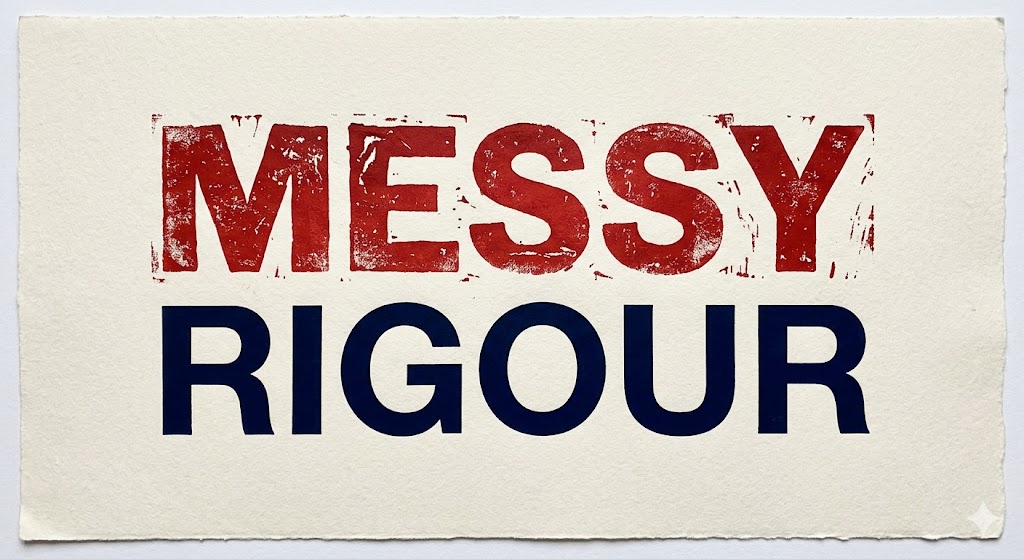
Messy Rigour: A ‘You say to-may-to; I say to-mah-to’ guide to Creative Duality.

17 Friday Apr 2026

Posted by Thin Air Factory in Uncategorized

≈ Leave a comment

Tags

Artificial Intelligence, creative-innovation, human-creativity, messy-rigour

It’s messy out there; well, in human world at least.

But for our AI cousins, knee deep as always in an accelerating flurry of optimisation and efficiency metrics: tokens per second, accuracy scores, and RAG precision [you know who you are], not so much.

Unlike us, our algorithmic cousins are all about losing the noise, not seeking it out.

In answering the simple question of “where the **** are my car keys?” an LLMs hyper rational answer would be unlikely to bundle in the supplementary processing inputs of ‘work’s shite, a grumpy teenager, feeling crap after yesterday’s argument, a Lego Rammstein video, the fat Orange Baby, too many coffees, a large unpaid bill, why these jeans suddenly look weird on me, random meme & Etsy side hustle ideas, that unhealthy clunking sound on a just serviced car, war & suffering, existential angst bought on by MAFS Australia, an empty fridge, a fleeting phone fed memory of ‘this day ten years ago’ and its attendant realisation of “Christ I look so YOUNG!”, mortality, in-law disdain, burned toast and new trainers joy. 

It would just join its algorithmic dots and offer a spectrum of possibilities, prioritised from most to least likely location given past events. All in all far more efficient and instructive than a messy minded human in a flap whose gone ‘blind for seeing.’

But in some instances, like that of creative innovation, the noise can be everything. When it comes to creativity, we need as much of the messy, random, lateral, irrational, emotionally charged, seemingly irrelevant beauty of the human mind as we can get.

Yes, of course we’ll be answering the creative exam question; we’re solving for X. But in human world, that process is coloured by a kaleidoscope of interference: of secondary and often arcane, seemingly irrational randomised feelings, inspirations, influences, turbulences, effects, data points, coordinates, environments, and information, most of which have sweet diddly to do with the actual creative task in front of us.

BUT, this attendant randomised human noise and flux is often a critical component in many moments of ‘creative’ breakthrough thinking – even in the empirical sciences [cue distracted scientist leaving petri dishes to accidentally transform modern medicine]. Yes, ultimately a meticulous and rigorous mind must harness a serendipitous discovery or unexpected anomaly to secure the breakthrough and make it applicable. But the spark? Often, good ol’ human messiness.

It’s mostly subjective, but for me, in certain contexts, making everything AI and machine minded is a zero-sum game – joyless is another word. I’m not convinced that a solely right-brained world is necessarily a wholly good thing; especially when it comes to creativity. It needs an offset, a counterbalance. It needs some friction; something to rub up against. It needs some messiness to pop its hermetically sealed logic and processing.

So, I’m all about the messy rigour, especially in environments where AI is touted as the significant tool or engine of exactitude, retrieval, efficiency and execution in any task. [Personally, I find it not only quite likes human noise, it needs it to evolve.]

Messy Rigour is a mindset that seeks to embrace and elevate the tension between AI’s ability to map the velocity and trajectory of an idea and our human ability to comprehend the impact of it; the weight of meaning of the same idea. Resonance is not something AI is constructed to understand let alone act upon. Thought and feeling are still two utterly distinguishable things and are currently set to stay that way. Until AI has a biological ‘self’ to protect, nourish and love amongst the messy. banality, distraction and noise of existence in real time, place and space, its hyper acute mind is firmly on other more linear things.

So what is Messy Rigour’s role and weight in the everyday of creativity?

Well, if you’re looking for optimal in seeking breakthroughs, Messy Rigour is not a nice to have: I’d say it’s essential. I would go as far as saying that it would be suboptimal not to include our messy protein supercomputer with all its attendant ‘noise’ in a process that is seeking breakthroughs and the remarkable.

This is where the real potency of Messy Rigour lies for me – in the tension between human and machine and how applying their differing world views and behaviours to the same challenge can be illuminating.

That you say to-may-to and I say to-mah-to is no reason to call the whole thing off. It’s certainly no reason to over value one to the detriment of the other. It’s the exact reason why we need both.

The whole point is that, inside the same idea, theory or concept, fundamentally opposing universes of thought and feeling can co-exist. There’s the friction. There’s the rub. There’s the generator of good things:

That your to-mah-to might be a rigorously engineered industrially scaled, supply chain optimised, community supported tomato paste product using genetically modified tomatoes, sustainable aluminium and by product recycling, and my to-may-to comes smeared on a pizza slice, eaten standing up with a pint of ‘football juice’ grade lager after an Amyl & The Sniffers concert on a wet summer Saturday night in Kings Cross is exactly the point.

This is the stuff of life. Light and dark. Ying and Yang. Chiaroscuro. Call it what you like, but optimal needs both. Welcome to Messy Rigour

So far so reasonable: but meme-y phrases like ’Messy Rigour’ and jolly tomato analogies need some scaffolding to secure them in practical, applicable reality.

More importantly, given that the right-brain inclined are often dismissive/suspicious/terrified/disdainful/wary/incapable of processing theories or concepts they regard as ‘fluffy’, or in more specific terms, unfalsifiable, we need a simple applicable construct or methodology to test the edges.

Smells like we need a methodology! 

For example: we might propose that to formalise and systemise the interplay between AI’s computational ‘oomph’ and our human creative chaos, we must first dispense with the ‘All Seeing AI’ mindset [where AI always ultimately answers the question regardless of the degree of human intervention] and replace it with let’s call it a Symmetric Sandbox model.

This allows us to balance the intentional, reductive degradation of AI’s hyper precision with the intentional, expansive enrichment of human critical analysis [what I’ve previously framed as a dual ‘Loop in the Human, Human in the Loop’ strategy].

Sounds good: but what exactly might that look like?

Messy Rigour is rooted in engineering two distinct [symmetrical] parallel sets of actions around dissonance and meaning – and they break down something like this:

1. Forcing AI Messiness (The High-Entropy Input)

To prevent AI from defaulting to average or safe outputs, we first need to systemise Algorithmic Dissonance. This involves:

  • Stochastic Prompting: Intentionally introducing ‘poison’ tokens [their words not mine] or non-sequitur constraints into the prompts to force the model out of its standard probability distribution.
  • Multi-Model Jousting: Running the same query through three models with vastly different training biases and forcing them to debate the contradictions.
  • Temperature Modulation: Systematically oscillating the ‘temperature’ (randomness) of the AI during a single session—starting high to generate Mess and gradually lowering it to find Rigour.

2. Training Human Rigour(The Curatorial Filter)

As AI becomes more messy, the human must become a more disciplined Architect of Meaning. This can be systemised through:

  • Socratic Interrogation: Instead of accepting an AI output, the human must apply a Three-Filter rule: Is this output cliché, is it factually grounded, and most importantly, does it pivot the original idea?
  • Fractured Synthesis: Training the user to take fragments from five different ‘failed’ or ‘messy’ AI outputs and manually stitching them into a coherent whole. This forces the brain to perform the heavy lifting of logic and curation.

Picture This:

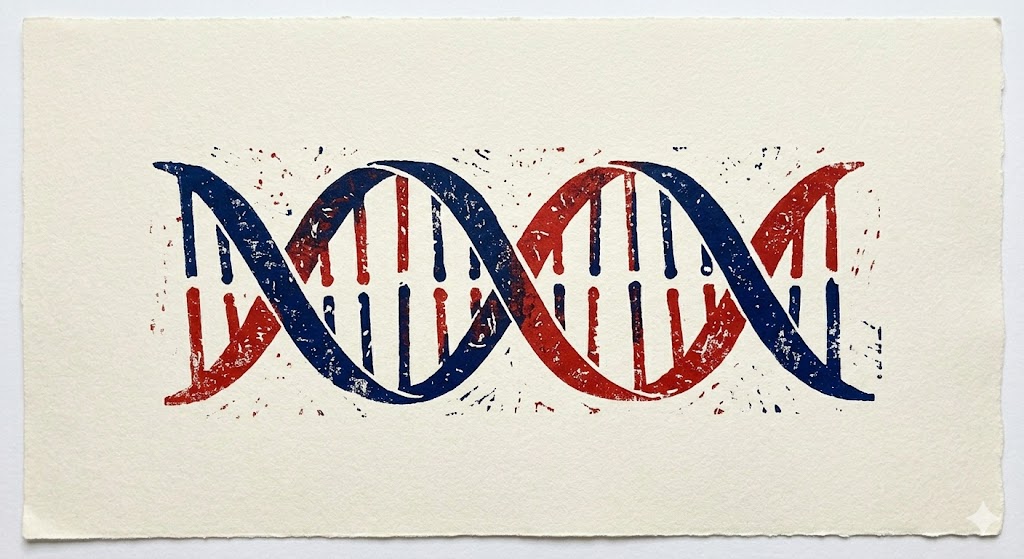
Now, in regard to communicating this concept, I felt it was worth developing a simple visual encapsulation to help things along. Even the simplest construct can get quite wordy so at this point a diagram or illustration can help enormously. Usefully one comes to mind that presents the spirit and construct of Messy Rigour as a continuously evolving flow.

Inspired by all things DNA and genetics, we can encapsulate how the system functions using a Double Helix visualisation: The first strand – AI – provides the “fractured” variety (the Mess), while the second strand – the human – provides the “selective” pressure (the Rigour).

By formalising this—treating the AI’s errors as features rather than bugs—we just might transform the AI from a replacement for thought into a catalyst for it. If we can do this, the goal then moves from ‘clean’ outputs, to rigorous insight drawn from the friction of two very different types of intelligence. That would be good.

Interestingly, when I asked a deep reasoning AI tool what the mathematical probabilities of optimal look like when comparing the Messy Rigour construct to either a pure AI or pure human reasoning approach to creative breakthrough thinking, after some formulating and interrogation [available on request] it simply answered thus:

The Mathematical Conclusion: By systemizing the interplay, you aren’t just adding AI to a human; you are multiplying the human’s ability to be “wrong in the right direction” by the AI’s ability to be “right at scale.”

So, the next time someone’s wielding their AI absolutism and delusion of best outcome, or trumpeting pure human creative serendipity over all others, suggest exploring it through some Messy Rigour, whip out your double helix and go for gold.

Bon Chance.

AI Winter or Creative Summer? You Choose. A DBS&C view on where Creativity goes next.

02 Thursday Apr 2026

Posted by Thin Air Factory in Uncategorized

≈ Leave a comment

Tags

AI, Creative Industries, Creativity, prediction, thinking-tools

For someone who has mostly worked in what some of the business grown-ups perceive to be the realm of Crayons and Colouring-in [AKA Creative Comms and Strategy, Advertising, Brand, etc], some of the more meta strategic and trend questions I’m asked in any given workday can seem a little abstract or grand:

So, what’s your take on an AI Winter?

Is AI the new creative alpha? [and Yes; someone actually used those words!]

Is anyone paying top dollar for creativity anymore?

When these kinds of questions arise, I tend to revert to my Dreamers Believers Soldiers and Cynics [DBS&C] model to both interrogate the questions and explore any potential answers. Not just because it’s convenient, but because it works.

One quick note on language and understanding on ‘AI Winter.’ Now there are some who seem to interpret this as a professional deep freeze created by the onslaught of AI hoovering up jobs: a sort of freezing mass retreat from employment due to finding one’s skills suddenly redundant. Though offering a rather dramatic Napoleonic visualisation, this is in fact incorrect.

For the purposes of clarity, this trough of despondency they imagine has many names currently. ‘The Great Decoupling’ – where productivity and profit cease to be dependent on human labour; ‘The White Collar Bloodbath’ – more of a ‘Does what it says on the Tin’ encapsulation of the problem; ‘The Precariat Age’ – illustrating how human workers will exist in an increasingly precarious employment landscape due to AI; rounded off with the odd jaunty more positive, meme-minded summary, such as the ‘Superworker Era,’ more intent on bigging up humans and their superior though now augmented protein computers.

Just not AI Winter. On that, AI happily and correctly describes its wintery fall from grace thus:

An AI winter is a period of reduced funding, interest, and research activity in the field of artificial intelligence. These periods occur when the high expectations—or “hype”—surrounding AI advancements fail to live up to reality, leading to disappointment and a “freezing” of investment

So, with what kind of winter and for whom clarified, to rummage around in these topics a little more, let’s start with conflating the Seasonal model that sits behind statements like AI Winter and the four personas that make up the Dreamer, Believer, Soldier & Cynic model

First off I need to assert the bleeding obvious: that we’re seemingly in the sunny highlands of an AI Summer right now. The continued tsunami of investment churning towards AI is staggering, the hyperbole undiminished. And the call to AI arms by most every organisation shows no sign of slowing. AI Joy is all about us. Every organisation wants an AI glow up!

With these two coordinates clear, I can start to map all things AI onto a DBS&C framework. When I do, it reveals a very simple and aligned model.  

The Dreamer persona is an AI Spring personified. Moon-shot minded, everything was possible in this period of ‘What if’ for the Dreamer. Transformative. Life changing. World changing. The future. The binary mind on steroids was unstoppable.

The Believer is the perfect persona for our current AI Summer. We’ve got AI. We’ve got a team. We’re on a mission. We’ve got more cash than we know what to do with. Build. Build. Build.

Which brings us to the matter of Autumn. This is the domain of the Soldier persona. Directional. Applied. Practical. This season exists at the crunchier end of the spectrum of proof, reaching far beyond the proof of concept of the Dreamer. You may have an audacious AI strategy, but ‘Does it Work?’ Really? To find evidence of that, you need to apply it; in every quarter on every front. Test and learn. Fail fast. Keep moving forwards. What could possibly go wrong? This is the season where we might start to hear and feel the voice of the Winter Cynic at work. It is in this tipping point of Autumn that whisperings begin. On which point:

Some experts have made murmurings about us having already stepped into our AI Autumn, with an AI Winter being closer than we might like to think.

This isn’t just about cultural and ethical push back. The astronomical costs of training models ($100M+) and the diminishing returns of simply ‘adding more data’ have led some to wonder in their quieter moments whether the current AI bubble might eventually pop or at the very least, deflate. If it does, hello Winter. If AI’s hyperbole and overpromise starts to bite and the shortfalls, disappointments, increasing tech debt and plain snake oil slipperiness of it. all take hold and multiply, the retreat from AI will be significant.

Which brings me to the contradictory inflection point we seem to find ourselves at now.

Why is that of interest to a ‘creative jonny’?

Well, the answer to that question lies in the word creative.

The current trend in the creative industries in which I work is very downward, and not in a life affirming yoga-dog-like way.  A closer look reveals that the slash and burn strategy being undertaken by the big Global holding companies will hit mainly in administrative and research roles – but that doesn’t deflect from the fact that large numbers of previously premium value creative resource are being tipped into the marketplace where roles are evaporating before our very eyes.

The big multinational companies like Omnicom, Dentsu, WPP and Publicis have stopped just leaking talent. The word Purge is trending. And all those smaller agency brands that once flourished in their sunlit lowlands, bringing energy and innovation and differentiation, are being absorbed into the great blancmange of Consolidation, Simplification, Cost Cutting, Transformation, and the almost satirically named Horizontality.

To some this feels like a Managed Decline strategy hiding inside a Relevance and Growth strategy.

Its the inflection point between AI and Creativity that I want to interrogate a little more.

If we apply the Seasonal DBS&C model to Creativity in Communications land, given the overarching strategic trajectory of. the big. global holding companies, the Cynical Winter appears to be upon us.

And therein lies the contradiction – the current Cynical wintery Knives Out approach to the creative industries seems to fall counter to what the big consultancy commentators are advocating.   

If you listen to the Deloittes, Forbes, Harvards, and PwCs of this world, Creativity is about to enter a Dreamer-like spring, reborn, with a rejuvenated sense of ‘what if.’  The story goes that the proliferation of AI, in the creative process at least, will lead to homogenised thinking, content ‘slop’, and the lowering of our cognitive creative ability – our killer app – in the process. Given this, they predict that, as AI drives the cost of the horizontal ‘good’ to zero, the value of the exceptional ‘great’ (human-driven creativity) skyrockets. Curiously, from that viewpoint at least, it seems that the very consultancies that spent decades trying to ‘rationalize’ marketing into a maths problem are now the ones waving the flag for ‘Creative Empathy.’

But that’s good for us Creatively minded folks surely?

Well, yes, but only if we’ve evolved. If we’ve climbed out of our Mad Men fever dream and learned some lessons and skills along the way, the new dawn looks exciting and desirable. Creative people armed with relevant and appropriate AI tools will be the secret sauce in sustaining and elevating unique differentiated business and brand propositions, communications, and identities in an increasingly vanilla world.

The only potential flaw in that glorious plan will be that the propaganda machine that fuels C Suite decision stays stuck on ‘Horizontality’ for a while longer yet. The Buyer will need a case proof argument to realise where the value lies before we spring into a new Summer of Creativity any time yet. Until they do. Blancmange it is.

But. But. But. The upside is that there is definitely a place for smaller, more agile consultancies of like-minded, AI powered Creative minds to fight the good fight for originality and differentiation. It’s just going to be a bumpy Winter exit.

The further upside for me is that this simple exercise has revealed to me that my DBS&C model has a role to play as a predictive tool, not just a diagnostic thinking one.

I’ve discovered that when applied to questions such as these, DBS&C can use its four personas to paint a simple picture of the psychological cycle of Innovation in which a category, sector, business or brand exists.

In helping them identify which ‘season’ they’re in, DBS&C can then help them to assess whether they have the right ‘persona’ people in place to understand, lead and optimise that phase in their seasonal cycle. Once DBS&C has helped to ground them in their seasonal cycle, it is also possible to predict with a reasonable degree of certainty where they might be going next – and build for it, defining immediate practical and applicable actions to make it happen.

Which brings us back to AI Winters and Creative Summers. The reality as always most probably lies somewhere between their polarities and possibilities of both, with an option to smudge the two into some uncomfortable yet exhilarating parallel existence.

So, Snow shoes or Bikini: You Choose

PS. & FYI If you want to explore how the Dreamers Believers & Soldiers tool might help your brand or business, email me at julian@thinairfactory.com  

Subscribe

  • Entries (RSS)
  • Comments (RSS)

Archives

  • April 2026
  • March 2026
  • November 2025
  • September 2024
  • June 2021
  • December 2020
  • August 2020
  • April 2020
  • March 2020
  • January 2020
  • October 2019
  • June 2019
  • April 2019
  • November 2018
  • August 2018
  • June 2018
  • February 2018
  • January 2018
  • December 2017
  • November 2017
  • August 2017
  • July 2017
  • June 2017
  • May 2017
  • March 2017
  • January 2017
  • December 2016
  • November 2016
  • October 2016
  • September 2016
  • August 2016
  • June 2016
  • May 2016
  • April 2016
  • March 2016
  • February 2016
  • December 2015
  • November 2015
  • October 2015
  • September 2015
  • August 2015
  • July 2015
  • June 2015
  • May 2015
  • April 2015
  • March 2015
  • January 2015
  • December 2014
  • November 2014
  • October 2014
  • September 2014
  • August 2014
  • June 2014
  • May 2014
  • April 2014
  • March 2014
  • February 2014
  • January 2014
  • December 2013
  • November 2013
  • October 2013

Categories

  • Uncategorized

Meta

  • Create account
  • Log in

Blog at WordPress.com.

Privacy & Cookies: This site uses cookies. By continuing to use this website, you agree to their use.
To find out more, including how to control cookies, see here: Cookie Policy
  • Subscribe Subscribed
    • thinairfactoryblog
    • Join 28 other subscribers
    • Already have a WordPress.com account? Log in now.
    • thinairfactoryblog
    • Subscribe Subscribed
    • Sign up
    • Log in
    • Report this content
    • View site in Reader
    • Manage subscriptions
    • Collapse this bar
 

Loading Comments...