
It’s messy out there; well, in human world at least.
But for our AI cousins, knee deep as always in an accelerating flurry of optimisation and efficiency metrics: tokens per second, accuracy scores, and RAG precision [you know who you are], not so much.
Unlike us, our algorithmic cousins are all about losing the noise, not seeking it out.
In answering the simple question of “where the **** are my car keys?” an LLMs hyper rational answer would be unlikely to bundle in the supplementary processing inputs of ‘work’s shite, a grumpy teenager, feeling crap after yesterday’s argument, a Lego Rammstein video, the fat Orange Baby, too many coffees, a large unpaid bill, why these jeans suddenly look weird on me, random meme & Etsy side hustle ideas, that unhealthy clunking sound on a just serviced car, war & suffering, existential angst bought on by MAFS Australia, an empty fridge, a fleeting phone fed memory of ‘this day ten years ago’ and its attendant realisation of “Christ I look so YOUNG!”, mortality, in-law disdain, burned toast and new trainers joy.
It would just join its algorithmic dots and offer a spectrum of possibilities, prioritised from most to least likely location given past events. All in all far more efficient and instructive than a messy minded human in a flap whose gone ‘blind for seeing.’
But in some instances, like that of creative innovation, the noise can be everything. When it comes to creativity, we need as much of the messy, random, lateral, irrational, emotionally charged, seemingly irrelevant beauty of the human mind as we can get.
Yes, of course we’ll be answering the creative exam question; we’re solving for X. But in human world, that process is coloured by a kaleidoscope of interference: of secondary and often arcane, seemingly irrational randomised feelings, inspirations, influences, turbulences, effects, data points, coordinates, environments, and information, most of which have sweet diddly to do with the actual creative task in front of us.
BUT, this attendant randomised human noise and flux is often a critical component in many moments of ‘creative’ breakthrough thinking – even in the empirical sciences [cue distracted scientist leaving petri dishes to accidentally transform modern medicine]. Yes, ultimately a meticulous and rigorous mind must harness a serendipitous discovery or unexpected anomaly to secure the breakthrough and make it applicable. But the spark? Often, good ol’ human messiness.
It’s mostly subjective, but for me, in certain contexts, making everything AI and machine minded is a zero-sum game – joyless is another word. I’m not convinced that a solely right-brained world is necessarily a wholly good thing; especially when it comes to creativity. It needs an offset, a counterbalance. It needs some friction; something to rub up against. It needs some messiness to pop its hermetically sealed logic and processing.
So, I’m all about the messy rigour, especially in environments where AI is touted as the significant tool or engine of exactitude, retrieval, efficiency and execution in any task. [Personally, I find it not only quite likes human noise, it needs it to evolve.]
Messy Rigour is a mindset that seeks to embrace and elevate the tension between AI’s ability to map the velocity and trajectory of an idea and our human ability to comprehend the impact of it; the weight of meaning of the same idea. Resonance is not something AI is constructed to understand let alone act upon. Thought and feeling are still two utterly distinguishable things and are currently set to stay that way. Until AI has a biological ‘self’ to protect, nourish and love amongst the messy. banality, distraction and noise of existence in real time, place and space, its hyper acute mind is firmly on other more linear things.
So what is Messy Rigour’s role and weight in the everyday of creativity?
Well, if you’re looking for optimal in seeking breakthroughs, Messy Rigour is not a nice to have: I’d say it’s essential. I would go as far as saying that it would be suboptimal not to include our messy protein supercomputer with all its attendant ‘noise’ in a process that is seeking breakthroughs and the remarkable.
This is where the real potency of Messy Rigour lies for me – in the tension between human and machine and how applying their differing world views and behaviours to the same challenge can be illuminating.
That you say to-may-to and I say to-mah-to is no reason to call the whole thing off. It’s certainly no reason to over value one to the detriment of the other. It’s the exact reason why we need both.
The whole point is that, inside the same idea, theory or concept, fundamentally opposing universes of thought and feeling can co-exist. There’s the friction. There’s the rub. There’s the generator of good things:
That your to-mah-to might be a rigorously engineered industrially scaled, supply chain optimised, community supported tomato paste product using genetically modified tomatoes, sustainable aluminium and by product recycling, and my to-may-to comes smeared on a pizza slice, eaten standing up with a pint of ‘football juice’ grade lager after an Amyl & The Sniffers concert on a wet summer Saturday night in Kings Cross is exactly the point.
This is the stuff of life. Light and dark. Ying and Yang. Chiaroscuro. Call it what you like, but optimal needs both. Welcome to Messy Rigour
So far so reasonable: but meme-y phrases like ’Messy Rigour’ and jolly tomato analogies need some scaffolding to secure them in practical, applicable reality.
More importantly, given that the right-brain inclined are often dismissive/suspicious/terrified/disdainful/wary/incapable of processing theories or concepts they regard as ‘fluffy’, or in more specific terms, unfalsifiable, we need a simple applicable construct or methodology to test the edges.
Smells like we need a methodology!
For example: we might propose that to formalise and systemise the interplay between AI’s computational ‘oomph’ and our human creative chaos, we must first dispense with the ‘All Seeing AI’ mindset [where AI always ultimately answers the question regardless of the degree of human intervention] and replace it with let’s call it a Symmetric Sandbox model.
This allows us to balance the intentional, reductive degradation of AI’s hyper precision with the intentional, expansive enrichment of human critical analysis [what I’ve previously framed as a dual ‘Loop in the Human, Human in the Loop’ strategy].
Sounds good: but what exactly might that look like?
Messy Rigour is rooted in engineering two distinct [symmetrical] parallel sets of actions around dissonance and meaning – and they break down something like this:
1. Forcing AI Messiness (The High-Entropy Input)
To prevent AI from defaulting to average or safe outputs, we first need to systemise Algorithmic Dissonance. This involves:
- Stochastic Prompting: Intentionally introducing ‘poison’ tokens [their words not mine] or non-sequitur constraints into the prompts to force the model out of its standard probability distribution.
- Multi-Model Jousting: Running the same query through three models with vastly different training biases and forcing them to debate the contradictions.
- Temperature Modulation: Systematically oscillating the ‘temperature’ (randomness) of the AI during a single session—starting high to generate Mess and gradually lowering it to find Rigour.
2. Training Human Rigour(The Curatorial Filter)
As AI becomes more messy, the human must become a more disciplined Architect of Meaning. This can be systemised through:
- Socratic Interrogation: Instead of accepting an AI output, the human must apply a Three-Filter rule: Is this output cliché, is it factually grounded, and most importantly, does it pivot the original idea?
- Fractured Synthesis: Training the user to take fragments from five different ‘failed’ or ‘messy’ AI outputs and manually stitching them into a coherent whole. This forces the brain to perform the heavy lifting of logic and curation.
Picture This:
Now, in regard to communicating this concept, I felt it was worth developing a simple visual encapsulation to help things along. Even the simplest construct can get quite wordy so at this point a diagram or illustration can help enormously. Usefully one comes to mind that presents the spirit and construct of Messy Rigour as a continuously evolving flow.
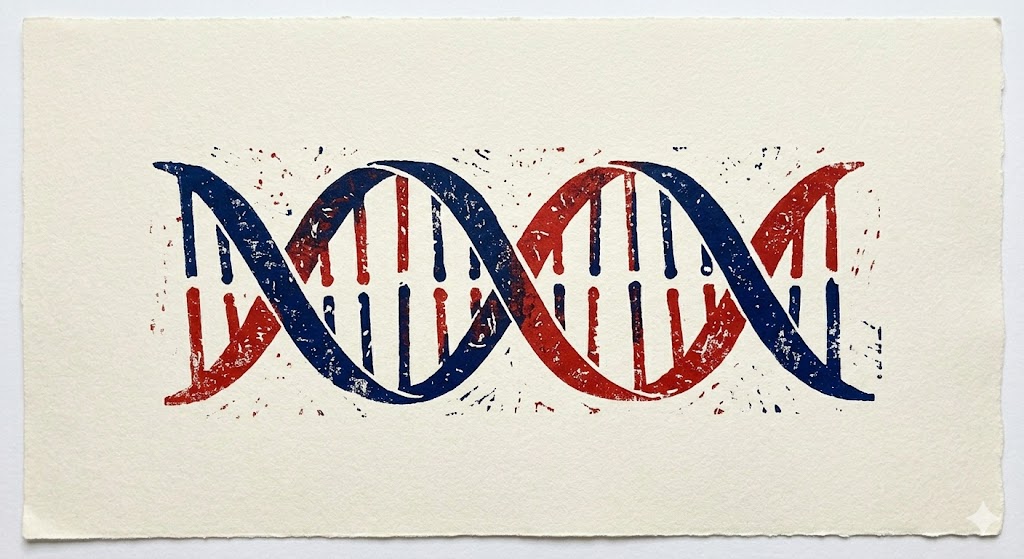
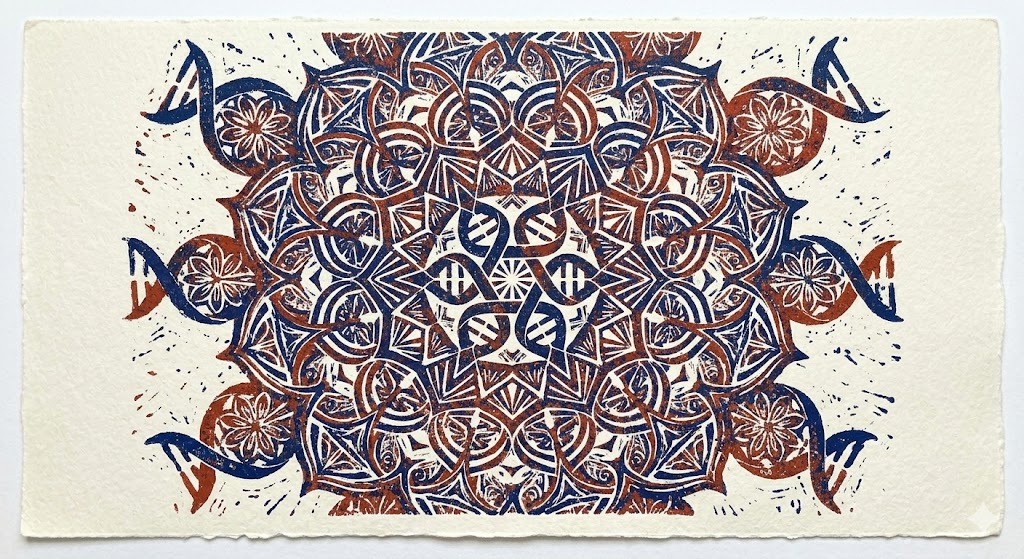
Inspired by all things DNA and genetics, we can encapsulate how the system functions using a Double Helix visualisation: The first strand – AI – provides the “fractured” variety (the Mess), while the second strand – the human – provides the “selective” pressure (the Rigour).
By formalising this—treating the AI’s errors as features rather than bugs—we just might transform the AI from a replacement for thought into a catalyst for it. If we can do this, the goal then moves from ‘clean’ outputs, to rigorous insight drawn from the friction of two very different types of intelligence. That would be good.
Interestingly, when I asked a deep reasoning AI tool what the mathematical probabilities of optimal look like when comparing the Messy Rigour construct to either a pure AI or pure human reasoning approach to creative breakthrough thinking, after some formulating and interrogation [available on request] it simply answered thus:
The Mathematical Conclusion: By systemizing the interplay, you aren’t just adding AI to a human; you are multiplying the human’s ability to be “wrong in the right direction” by the AI’s ability to be “right at scale.”
So, the next time someone’s wielding their AI absolutism and delusion of best outcome, or trumpeting pure human creative serendipity over all others, suggest exploring it through some Messy Rigour, whip out your double helix and go for gold.
Bon Chance.

