Hoover bag, fish-tank, trophy cabinet & the art of wearing your intellect lightly.

Tags

, , , , , , , , , , , , , , , , , , , , , , , , , , , ,

vacuum-bag1.jpg$_35.JPGTrophy-Cabinet1.jpg

Hoover bag, fish tank or trophy cabinet? Which one describes your model of intellectual self-awareness and demeanour best?

I spend a lot of time suspended (the animation part is discretionary) between two worlds where intelligence chimes very differently and how it is worn can speak volumes:

One brims with an ‘earthy’ scrum of normal people with their pop populism, non p.c humour, fun food formats, all things sporting, inappropriate music lyrics, sudoku and simple telly pleasures:

The other teems with a rare, heavenly throng of ‘visibly’ smart people (staggeringly smart actually) whose weather eye rests not just on Gogglebox but also on the material and scientific threads that stitch us in to our universe at a sub atomic and particular level from both the inside out and the outside in: a sort of Hubble-scope meets microscope universal view. Which takes some cells, grey or otherwise.

Whilst suspended between these two worlds I have come across a myriad of different shapes and shades of accidental, expressed or demonstrable ‘intelligence’.

But for the sake of this piece I have gathered them into three buckets.

These buckets are purely based on how people ‘wear’ their intelligence, knowledge and learning. They do not seek to make points of a sex, class, race, regional or tribal nature.

Intelligence, smarts and book learning are as likely to be mocked or marvelled at in a stately home in Cumbria as they are in a mock Tudor Semi in Southall and a single-parent council house in Cleethorpes.

So the three buckets are as follows:

Hoover Bag:

The majority of us, though our intellectual reserves have been honed to some degree in our childhood and teenage years through some form of formal education, spend most of our time applying a needs-must, auto didactical approach to the appropriation, collection and storage of any information, data, knowledge and the subsequent exercising of it via what might loosely be called intellect and its reflex inventive cousin ingenuity.

We just hoover up what’s in front of us at the time; all in the moment and for little reason other than to get through, survive, overcome, complete (or avoid) the tasks that life sets in front of us. Most of it tends to be transient: pockets of old knowledge from schoolbook rote and favourite teachers, the history channel, anything ever said by Sir Richard Attenborough, the odd TV show theme tune, an ex-lover’s ‘hot tunes’, news stories, sleeve notes off albums, film quotes, holiday resort locations, train times, exam questions, sweet names, bus numbers – the majority of it utterly random and seemingly disconnected – fluff and drivel: insubstantial, frivolous, fleeting. Only of meaning in the cats cradle of life and experiences in our head. All hidden deep in the bag unless we’re compelled to have a rummage.

But in that intellectual Hoover bag somewhere, amongst all the dust and atomic grains of everyday life – with a little rooting around – and if pushed – there are brilliant little treasures to be found: nuggets; the intellectual version of shiny marbles, lost lego characters, the odd ear ring, the missing washer off that clock, and a rare coin from somewhere exotic.

It’s not that we’re incapable of being a Fish Tank or Trophy Cabinet. On the odd occasion we can be very intellectually forthright. But. We’re just not that interested. Intelligence for most is directly linked to and in relation to what we must and need to do. Work. Earn money. Buy treats. The odd holiday. Survive. With Stickers. Intellect does not represent anything of value for us to wield in the world. Exams are for getting through. Real stuff is about what books cant teach and accolades cant fake: common sense, nous, drive, smarts.

Many people remain deliriously untouched by the compulsion to scale ever- greater heights and plumb ever-deeper depths of their intellect to pull out a plum.

There is in fact a running suspicion amongst a lot of people that too much learning is bad for you. Like fatty foods and alcohol.

Referring to people as being intellectually obese or an academoholic probably hits the referential nail on the head.

A lot of people feel an antipathy to the ‘too clever by half’ bunch, not too dissimilar to the feelings people harbour for the overly fat and the commonly drunk. Fat drunks take it to a whole new level of course.

Getting above yourself is one of the most common malaises they point to in the overly smart.

Fish Tank:

Go up just one notch and things change for the shinier. This is not yet the domain of the public academic, but certainly we are now in a realm where intellectual and academic possessions are going on show – they are becoming socially important not just to the trajectory of us as a person but also to our sense of self – our core identity. Their value isn’t hidden any more.

Fish tank intellects are suddenly about visibility: about being seen to be smart. It can start small. Quipy; witty. Ripostes. Razor sharp. ‘Quick wittedness’ gets bolstered with facts and bite sized pieces of knowledge not found on the history channel or in the newspaper. Suddenly we’re utilising our intelligence not just as an evolutionary survival mechanism but as a status marker, courting tool, and social lever.

However small, simple and under-populated the fish tank might be (We’re all quietly fond of the singular fish bowl inhabited by that gold fish) there is still a shiny attractive thing to look at.

Now fish tank intellect land is the bucket that provides the most flex and room for manouvre. Because you can go from one small intellectual goldfish in a clichéd bowl of water on a window sill to a multi-atmosphere self cleaning super sized wall set super tank with teeming shoals of exquisite, rare and increasingly expensive creatures.

From Intellectual Ahhh! to intellectual WOW! At the super scale end we find ourselves in the world of the serial collector of intellectual pursuits – reaching far beyond what they will ever need for their day job. The role of intellectual curator and collector of brightly coloured intellectual exotica as a matter of projected identity is a big deal for big fish tankers. But the big difference between these and the Trophy Cabineteers is the stealth nature of the presentation. However bright, gregarious and attention seeking the various and increasingly valuable baubles are, they are not presented ‘directly’. This is a world where proofs and demonstrations of intelligence are refracted through a prism of tangential referencing – obtuse, sophisticated, shrouded – usually hidden inside some trojan horse of life learning or experience story: presented simply as a new piece of the expanding fabric of their life.

But however subtle the presentation – these brightly coloured attractive and seductive entities are most definitely for show and for effect.

These ‘exotic splashes of colour have been plucked from the sea of knowledge to aggrandise us: to decorate our lives and create conversation focused on us through them.

Trophy Cabinet

Smashed it. No time or interest in discretion or subtlety. I’m smart. I’m bloody clever. And competitive. An intellectual winner. I’ve got more degrees and PhDs than I can shake a stick at. Doctorates are just the beginning. I probably have a few Honorary Executive positions as well. Sciences. Arts. Humanities. Classics. Don’t care. Whatever it takes. I am not in the business of doing a topic. I’m in the business of being really, really clever – and wearing it on my sleeve. If anyone’s up for a Nobel Peace Prize it’ll be me. Via national and then global recognition. I am professionally clever. Love academia. A wonderful pursuit. But please keep your intellectual generosity and shared collectivism of the mind to yourself. This is the expanding me show of cerebral fabulousness.

Simply put, you’ll all come to realize that you are cerebral dwarves and I am resplendent in the glow of my own brilliance. I am Alpha Meta.

A harsh caricature? Perhaps. But the dissonance between what we consider intellectually valuable in the more rarified halls of first world academe and what humanity actually requires to live thrive and survive on this planet can sometimes make us look at the trophy cabinet persona and their exceptionally competitive and vaguely sociopathic behaviours with a not necessarily benevolent eye.

For many, especially those struggling to make ends meet and having to work all hours to do it, and for those with a natural aversion to people who speak ‘in riddles’, it is hard sometimes to see the greater value in  relentless and unquenchable pursuit of ever greater learning. To many it is hard to see why anyone should support or laud someone wanting to remain the ‘eternal student’, wrapped in ever decreasing intellectual circles on arcane subjects that owe more to human ego than evolution.

The Trophy Cabinet model of flamboyantly worn intellect is mostly seen for what it ostensibly is: a tower of self-impression: a monument to ones ego. Questionable. Perhaps.

BUT, before we start measuring how many hands high the horse is we’re leaping on to sound off about the super bright, it must be remembered that these stratospheric arrogances of the mind and the intellect (as some see them) bring much to be thankful for: scientific advances and revelations that make enormous tranches of humankind more healthy and more resilient.

Some of these people have opened doors in the fabric, nature and story of human kind and the multi-verse we exist in. And we are better for it. And for them. Whether we think they’re too smart by half or not.

Witch hunting and pointing fingers at the nerds and the super bright people is a lazy pursuit. Existing, as many do, ‘on the spectrum’, dislocated from and uncomfortable around what most like to see as ‘normal’ people, they have their own crosses to bear: crosses that many of us would never countenance let alone endure. Brainbox baiting also smacks of being ‘chippy’. Take a swing ‘cause you make me feel bad! Thankfully now that Stephen Hawking is officially rock n roll, with his own Hollywood movie to boot, and the new tech hipsters are to all effects bearded and brogued members of the Nerd tribe, the old Beano comic view of school swots is changing – slowly.

Learning, the knowledge it brings and how the individual mind processes and leverages that knowledge to best and personal effect, to inspire and engage us may be a divisive topic; but we need to celebrate and embrace every type of intellect we have if we are to continue to live, thrive and survive.

And whether the gems of insight, idea and illumination that improve our everyday lives get shaken out of a hoover bag, netted from a fish tank or taken down from the trophy cabinet, I couldn’t care less.

Now where did I put that nozzle…?

Sea Cruises, Finding Nemo & the power of a floating social network

Tags

, , , , , , , , , , , , , , , , , , , ,

Mackerel-Ball

The Cruise industry is projected to launch 21 Million+ passengers on to the Oceans in 2015, delivered by ever-bigger ships with more on-board facilities.

And Royal Caribbean Cruises are leading the trend with the launch of their state-of-the-art 4000+ capacity liner, Quantum Of The Seas.

So no one seems to be struggling to bring the People to the Oceans But is their growth strategy resilient?

Resilience demands that we balance the Opportunity already identified with the Volatility* the category has to manage and absorb over time.

Interestingly the one volatility that seemed to be missing in the conversation is that of the oceans on which cruise companies ply their trade.

And by recent reports, oceanic degradation* is one volatility that offers both the greatest challenge and the freshest opportunity.

Our human wellbeing is inextricably linked to the well-being of the oceans in ways most of us do not realise – why would we? Oceans are ‘out there’ – far beyond our scope of interest – and Ships like Quantum of The Oceans will only go to exacerbate that increasing emotional and rational dislocation.

The bigger the ship; the further away from the sea you’re floating on you become.

But consider for a moment how a simple shift in brand focus:

FROM: Bringing the People to the Ocean

TO: Bringing the Ocean to the People

might offer a fresh source of innovation and differentiation.

Suddenly each ship becomes a floating social network with a bigger purpose – to influence a more sustainable relationship between humanity and the oceans.

Lightness of touch is essential.

There’s nothing quite like a guilty conscience to sour a hard-earned holiday.

Far too many ethical holiday companies forget that the mindset of the average holiday-maker is: ‘I’m going on a holiday, not a crusade’.

So make it fun. Gamify it. Build the oceanic equivalent of Farmville.

And let’s get Google to map the oceans and build a My Drop In The Ocean Pixel Platform while we’re at it – name a pixel of ocean after a loved one.

Who knows: 22 Million Drops could make for a new ocean.

Just a thought.

Deeper notes behind the ‘thought’ below.

* Volatility – a complex interdependent value chain supply chain model manages a number of volatilities – fluctuations & pressures on cost of serving the increasing expectation of experience at decreasing cost – the cost and resource required to managing sustainable fuel sources, innovations, costs and regulation (specifically the low-sulphur emission targets required by 2020) – the increasing pressure of cruise line passenger numbers on destinations infrastructure, environment and socio-cultural dynamics – the impacts of natural disaster and terrorism on general tourism trends and specifically in destination – itineraries shifts.

* The impact of Ocean Acidification, increased acidity caused by run off from ocean side cities and farming and its impact on global warming, sea life and colonies; and the blight of Trash Vortexes – in tandem with over fishing – has bought the condition of the oceans to a point of crisis – so much so that a number of special committees set up to deal directly and specifically with the impacts ad the management of them

The Global Ocean Commission – According to research reviewed by the Commission, this major proportion of the global ocean is under severe and increasing pressure from overfishing, damage to important habitat, climate change and ocean acidification

UN Oceans – In September 2003, the United Nations High-Level Committee on Programmes approved the creation of an Oceans and Coastal Areas Network (subsequently named “UN-Oceans”) to build on SOCA, covering a wide range of issues and composed of the relevant programmes, entities and specialized agencies of the UN system and the secretariats of the relevant international conventions, including the International Seabed Authority and the Convention on Biological Diversity.

Rugby, Hemispheres & the zen art of flight.

Tags

, , , , , , , , , , , , , , , ,

maori ball 1a-500x500

Watching yet another decimation of a northern hemisphere side by a southern hemisphere side; the All Blacks to be precise, I found myself and a very old friend of mine, Robert Calcraft, contemplated WTF is the problem.

My punt, pardon the pun was this. That in watching three replays and the speed of hands and feet from the All Blacks, something became suddenly and conspicuously obvious. The leaden man-to-man game of the northern hemisphere was being rent asunder by a higher order of game that mesmerised for very good reason. And in the the hypnotic focus lay the answer.

I realised that in every replay I was transfixed by the passage of that beautiful white elliptical object as it traversed the field on its way to (99.9%) certain grounding. I paid no heed to the player whose hands it passed through. They were unimportant, Simply stewards of something greater than them.

And the way of the Zen archer came to mind: exceptional precision made true and absolute by obsessing on every influence on the flight of the arrow – the tensile nature of the bow, the tension of the gut string, the cleat at the root of the arrow, the integrity and nature of the wood shaft, the exception of the feather flight, the perfect symmetry and the weight of the arrow tip – no interest in what comes before -the archer – or what will follow – the target. Everything centred on one pure exception of flight.

Suddenly against our Northern obsession with player, cult of personality, physical engineering and endless ruminating on position and play  – everything rooted in a pedestrian passing from hero to zero – their pure focus on the passage of that elliptical god from one end of the field to the other made absolute sense to me.

Perhaps the real gift of the islanders and the Maori to the world of Rugby is a zen connectedness with the passage of everything other than the mortal through time and space. A oneness that every tribal member shares. A connectedness to the great spirit, the cosmic fizz, the sky warrior. Where every man is subject to the greater forces – a mere tourist for a moment or a lifetime in their ability to capture the North and West winds in their palm – to turn them and shape them to some purpose on their way forth.

In this way perhaps they are spiritually unfettered from the need to render school boy heroes from each player, to sculpt and set up for adulation. The tribal and war like islanders remain untouched by the need to create Victorian Boys Annual giants of endeavour from their ranks.

They keep squaring a circle that we have long forgotten how to draw. We once believed that great battles were won before they were fought. We understood that, like the war games of Spartan youth, ones greatest war like prowess is explored and exercised in a childlike or bloodless (ish) game – by the future warriors and leaders of our tribes and people as a proxy for real war.

But the warriors of the southern hemisphere do not and never have succumbed to the industrial arrogance of the pre Victorian military idyll and pomp that we turned that belief into – as Waterloo being won on the Paying Fields of Eton. Each man stands both individual and inextricably connected to the atomic and spiritual world in which they exist – as a continuum of existence in adversity – simplest the latest in a long line of warriors.

There is something almost other worldly in watching the islanders at their best playing fluid and breathtaking rugby. Each is capable of becoming part of the warrior elite but they seem consumed by something greater. You cant play at this. To us in the Northern hemisphere it might seem very self conscious and over worked BUT it is complete and creates complete rugby in its wake.

Southern Hemisphere players (and I focus on the islanders here as in them and in their fierce open style are the root of the southern hemisphere advantage) do not need the status of born leader to raise themselves up.

One of their heroes, Te Kooti Arikirangi Te Turuki, a maori of good family but not of chiefly stock, was renowned for his fierce warrior abilities and powerful personality. This collision between the tribal model of greatness – earned seized vital active – and the old Empire model of greatness – gifted entitled applied assumptive – sits like a thorn betwixt many of the Southern and Northern Hemisphere conflicts and partnerships.

The Empire minded industrial colonial machine is at work in English rugby. We are not set free by Jerusalem but imprisoned by it – damned by the leaden machines of its satanic mills. When the Lamb of God does appear in our secular England it usually to be seen leaving the green and pleasant field to be salted rubbed in oil and sprigged for the oven on a Sunday.

The parts of Britain which still make room for and celebrate their pre Christian selves still seem to find something ‘magical’ in their game that I just cannot see in ours.

Their players seem rendered from a different clay. Ours are shaped by the Boys Own Annuals that celebrated the predominance or our great British (for which read Norman English but with a Scottish Bank and Merchant Class, and Welsh Scots & Irish armies) cultural authority over ‘voodoo native cultures with their ‘dreadful’ barbarism: an ethnic snobbery that began with the sneery dismissal of the barbarous Welsh and pagan Irish and heathen Scots.

So with The Maori culture – a tribal culture that celebrates the elemental mysticism myths and legends of its past in the present.

In this way the Maori (mortals) and the Wairu (Gods) enjoy a similar relationship to the Mythic cycles of Nordics, Celts (Gaels) and the native Red Indian. Cultures and societies who are still meaningfully connected or unprepared to dismiss or decry the Elemental mysticism or supernature of their people

There have been times recently when the ‘magic’ that occurred between the Leinster and Munster players when on the field playing for Ireland takes on the nature of a living myth. (Unsurprising that the epics of Fionn mac Cumhaill were played out across the lands and ranges of Leinster & Munster.)

These moments for me capture the pure spirit of them; when the long shadow of their prehistory and the mystical nature of their people rises up for even but a moment. A moment when we see the Tuatha Dé Danann at work in the world – as they take a journey from Gods into kings and heroes

The Welsh similarly in the Four Acts of the Mabinogi track the journey from pre-christian deities into heroes and Kings. And behind their Christianity lies a well head of something far deeper and rooted in the rocks, caves and valleys of their past.

It is much the same with their celtic gallic cousins. We can’t fail to be inspired in those brief moments when the ancient gallic super-nature of the French rises up and over the ‘intellect’ of their more recent aristocratic revolutionary selves to rip across the field.

Indomitability over the machine – the engineered society rent asunder by something more primal – is a reoccurring theme enjoyed the world over. Indomitability for many French lies in the characters of Asterix and Obelix. Their ability to rip up the best of the Roman Empire’s legions through a mystical potion prepared by the druid, Getafix, is played out again and again on rugby fields when the All Blacks meet the English on the field. We represent the arrogant machine and they the elemental spoilers of our party. And the difference that lies between a team that is rooted in its elemental mystical culture and one rooted in its slightly jaded right of entitlement to rule is plain to see.

The Maori and islander races look like they are stewarding the great north winds through their hands from the mountains to the sea.

The English look like they’re moving the farm machinery from the barn to the lower field.

Christian cultures especially those of the Empire minded colonial kind have created a culture that – though it can dig deep to achieve its ambitions and objectives – is incapable of reaching into the super nature of the very earth on which it stands – because we’ve written out and over the Pagan that rooted us in that land and its spirits and then written off the Christian that obscured the pagan.

The Haka may well have become for all intents and purposes a simple piece of brand theatre (I feel the hand of Kevin Roberts of Saatchi & Saatchi in there somewhere), the one thing it does is simply remind every All black at the commencement of every game that their starting point – their focus and their ‘super-nature’ – starts from a different point to everyone else.

One only had to look at some of the Idents in the World cup coverage that featured the Kiwi players in their local club environment. It does not surprise me that behind them stand Mountains better placed in the mystic swirl of Lord Of The Rings, as opposed to the smoke stacks of middle England.

In fact some would say that the New Zealand version of heart of darkness has delivered an indomitable foe. That the Richie MaCaws and the Dan Carters are effectively the descendants of Northern hemisphere farmers who have ‘gone native’ – who have rendered themselves Maori in heart through some cultural Colonel Kurtz moment of revelation. (Delusional? perhaps. But something is going on in there!)

What of the Tri-Nations cousins one might ask, Surely Southern Hemisphere rugby football is not just about the All Blacks and maori tribal mysticism?

Perhaps not. But the shifting nature of the game in the southern hemisphere has been shaped by a relentless succession of All Blacks victories. And in the end even the Dutch Boer farmers of the Transvaal and the red dust farmers of middle Australia will eventually apply the ‘if you cant beat them join them’ rule. And if you’re playing them often enough you’ll learn very quickly. As they have.

So where does that leave us? Way behind.

What’s the answer? My punt? Hire Time Team to rekindle the Briton inside English rugby football. (It’s unsurprising to me that the West Country and the Northern reaches provide us with some of our greatest and most spirited players! – strongholds of regional cultures rooted in something more akin to the mystical, mythical and druidic.)

There was a time when we happily concurred with the old beliefs – that the people and the land are one. And in turn the greatest of those people – the King – is capable of effecting the nature and spirit of super-nature itself. We believed in our connectedness and elemental one-ness with the earth under us.

Cue Bluffers guide to Arthurian myth part 1. The Fisher King (English rugby) is wounded. The Fisher King is in trouble – impotent as is the land around him. We need Percival and a super druid to sort this shit out.

Our issue will be that we ignore The Fisher King of English Rugby football at our peril.

There was a time when we gladly recognized the deep roots of our connectedness – our supernatural selves – to the land beneath us and the myths and legends it spawned.

But unlike our Celtic and Gallic cousins and certainly all of the other world tribes who still happily ascribe to their supernaturally rooted selves, we are incapable of wearing this connectivity lightly. To us the Stonehenge scene in Spinal Tap gives a good bearing on what the average Brit Rugby player thinks of mysticism.

We dismiss as voodoo or hippy crap anything that smacks of it. Because our ascendency was marked by the control of nature not the respect and communion with it – in the mining of our dark satanic empire mills and the tilling of our distant colonial plantations and fields.

We need to let lose the Merlin in our people – especially those on the rugby field.

They need to ride the dragon’s breath. (And that isn’t a euphemism for the fug that floats around inside the scrum 73 minutes into any given game.)

To find our own version of the Zen Archer – to reveal the part of us that acts intuitively, rooted in a fluid understanding of the metaphysics of matter as it passes through the world we inhabit – we need to be respectful of forces we cannot see hear nor comprehend.

Which brings us back to the view of a team where every player is in service to the passage of something greater than them.

To them it seems like a dream is being passed along and down the line of their ancestors from player to player. To us it looks like a pasty just hot out of the microwave at GREGGS being passed along the bus-stop.

Anyway. If we’re lucky the super-nature of the Maori inspired All Blacks might just fall apart under the weight of some Dutch Afrikaans tractors and we can breathe a sign of relief and re assert our gentleman farmers guide to rugby football.

If we’re lucky all this mystical cobblers is just that – a rumination on a cloudy friday afternoon; meaningless under the towering auspices of what northern hemisphere and English rugby in particular are yet to unleash

But then again it just might not be.

TRUST, Values & turning up in the I’m Funny T Shirt

Tags

, , , , , , , , , , , , , , , , , , , , , , , ,

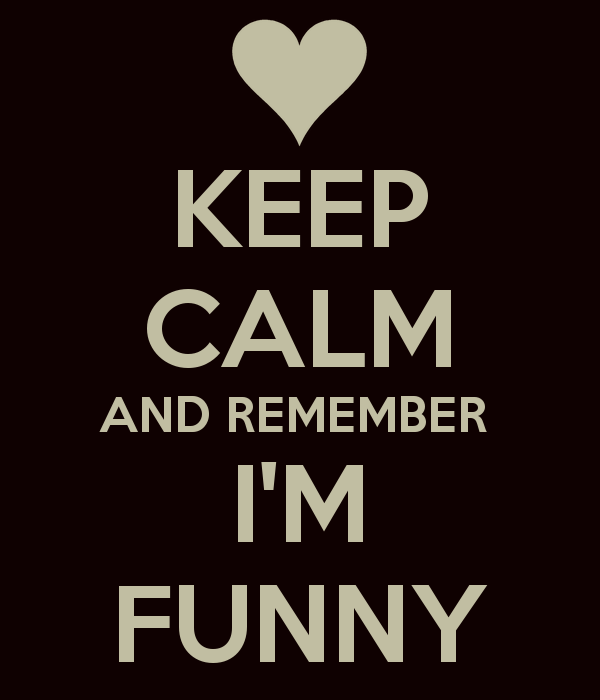
keep-calm-and-remember-im-funny

… I maintain that trust is irrelevant to commercial exchange and that reference to trust in this connection promotes confusion.

— Oliver Williamson

 Trust. Small Word. Massive Impact.

But which ‘Trust’ do we actually mean when chiseling the word for the umpteenth time onto the Values Plinth? There are a few versions out there – and none more corrosive that faux TRUST or the TRUST that comes from the dressing up box of corporate affairs – fancy TRUST – a word draped in Savile Row charcoal cashmere, or beautifully typeset and set high on the wall – yet inert – made moribund at the moment of its stitching and forging.

Then there’s buttoned up TRUST. Ironed repressed imprisoned – bear baited into a contracted commitment between one actor and another.

In these contractual prisons, the real power of TRUST; as a proof that liberates people to act decently and respectfully and with singular purpose at all times, gets twisted and shoved; and roughly cut away to fit into the self interested margins of the contract it supposedly underwrites.

Then there’s the TRUST of the podium, the BIG TRUST of soundbites and ‘our journey’ and the soaring oratory of perseverance and endeavor – an ephemeral fleeting TRUST that fills both the chest of the corporate speaker impugning it and the hall into which they decant it, only to wash out of the back doors into faint memory and insignificance – sullied and cheapened by having ever been bought there in the first place.

And then there’s the TRUST that protests too much from the statements and the releases of those who have traded, stained and manipulated it most. (Yes, banks and financial institutions, that will be you, and your FMCG and retail friends there on the bench next to you; with their palm oil and indentured labour hidden in some foreign field that is forever England: or the provider of its pants at least.)

If you wish to speak of real TRUST, speak in hushed respectful tones; speak rarely; in fact, come to think about it, we’d rather you didn’t speak of it at all.

Much like the exquisite blue guitar in Nigel Tufnel’s Guitar room in Spinal Tap, there is a sense that to even point to TRUST would be to destroy it.

“its special, look, see, still got the old tagger on it, never even played it”

“you just bought it”

“dont touch it”

“…was just looking at it…wasn’t going to touch it”

“…well, dont point …even”

TRUST is a dream that so many institutions crave but in that craving lies the source of self deceit. In their idolising of it lies the greatest measure of how fragile it is in their world: and how often and easily it can be compromised, corrupted and set aside.

In one of the opening scenes of the film Gladiator, Marcus Aurelius explains to Maximus that Rome is not a place but a very very fragile dream:

“There was once a dream that was Rome. You could only whisper it. Anything more than a whisper and it would vanish…”

TRUST is that fragile. So it is best kept safe and sound and away from prying eyes under purposeful lock and key. It is made all the greater by remaining invisible and unreferenced.

But invisibility and absence are two very different things. The absence of TRUST renders every other corporate buzzword insignificant. Rigour, openness, expertise, integrity, promise, commitment and guarantee – all are simply conjuring tricks if not underwritten by real TRUST.

Real TRUST, the silent knowing kind, is the one that walks through relationships and partnerships without braggadocio or pomp.

Real TRUST never speaks its own name, claims its own accolade or states its own credential.

Much like its culturally-rooted cousin – ICONIC – it is an accolade for others to apply.

To state it is to turn up in the I’m Funny T Shirt. Don’t tell me that you’re funny, tell me a joke. I am wholly capable of deciding whether to laugh or not all by myself.

Real TRUST is not an academic concept or an intellectual exercise; much to the irritation of pretty much every business school, who seem to see TRUST as a compound fraction as opposed to the complex chaotic collision of context, circumstance, tangible and intangibles that it really is.

Real TRUST is felt, sought, fought for, prized, pursued, missed, believed, encountered, received, gifted, hard won, quickly lost, broken.

Real TRUST is to some professions a supply chain issue – the most critical systemic element that needs sustaining above all else – the securing of its source, its protection of its integrity, the sage management and application of its use, the zero waste and optimal energy processes that support it – all mandatory for its continued and unadulterated presence and role as the primary tool in the mitigation of risk for those professions

Real TRUST draws its potency from its paradox – from its staggering strength and precious fragility – while whole, real TRUST moves the hearts minds and mountains that find themselves in its thrall – but it can be shattered irreparably by a look, a word, the flick of a pen, the click of a mouse, an act sometimes so small as to be barely noticeable.

Real TRUST is the UNICORN of professional endeavor. While it exists in the world, all is well – but if it is forgotten, mortally wounded or set aside, the dark side will prevail.

A MATTER OF EMPHASIS

Real TRUST The assured reliance that someone else will do everything in your best interests and to the best of their ability.

Real TRUST The faith that they will, even in your absence, act faithfully and respectfully in regards to you and the things you hold most precious

Real TRUST  The sure knowledge that no exceptional, proprietary or empiric expertise knowing insight or skill will be held back or remain obscured in their undertakings for you.

Real TRUST  The singular base fabric of any profound relationship: woven from myriad strands and threads of multiple and relentlessly reoccurring and improving emotional and functional transactions of every shape size and hue

Real TRUST The invisible certainty that allows rigour to act unfettered in the room and in the moment

Real TRUST The slingshot of integrity: the champion of authenticity: the springboard of exception:

Real TRUST the most dynamic currency in the assurance economy: selectively invested but never traded or brokered.

Real TRUST the only critical investment worth making in any and every relationship no matter how big or small.

Real TRUST the unquestionable and immutable truth of any profession

Real TRUST is a market shaker, a world turner, an opinion shifter and a deal breaker – the one precious thing that cannot be bought or begged.

Real TRUST cannot be faked, cannot be belittled, cannot be impugned and will not be sold.

Real TRUST is more than a flat inert word on a values plaque or a commitment in a corporate mission. Real Trust is a living extant dynamic and irrepressible thing.

You cannot put real TRUST down, diminish it, demean it or set it aside.

It is the silent ROAR – the mighty Yawp – in every meaningful conversation: and cannot be talked over or shouted out

In the space between TRUST and WORTHY

TRUSTworthy is a simple word to describe a process person or material thing that can be relied upon to fulfil particular tasks time and time again with little decay or degradation in performance or effect –and in doing so make themselves worthy of trust.

It usually involves an incremental journey undertaken by two parties towards belief in each others ability to ‘do what they say they’ll do’ – a journey that is mostly undertaken via proof – measurable evidences great and small – of each’s ability to engender trust in the other.

The levers and pulleys of TRUST?

TRUST seems to be most often engendered by people with an unshakeable sense of Purpose to effect good things in the world – for both themselves and others: People with an irrepressible belief in the simple authenticity of what they do, doing the right thing and keeping their promises. These people regularly demonstrate an inappropriate degree of naked courage – effortless and comfortable in their transparency. They relentlessly apply this belief, commitment trait and nature in everything they do. They are meticulous in their approach – rigour never far from their mind. And they value integrity above all else.

UNSHAKEABLE                 Purpose

IRREPRESSIBLE               Belief

NAKED                           Transparency

RELENTLESS                   Application
METICULOUS                  Rigour
TRUE                              Integrity

I TRUST you to have an opinion

I TRUST you to have the right intention in proffering it

I TRUST you to design your particiaption  in commercial ethical and value terms acceptable to all parties

I TRUST you to price what you do fairly

I TRUST you to do what you say you’ll do

I TRUST you to not compromise the relationship or other interests while doing it.

I TRUST you to reconcile fairly and in good time

I TRUST you with my interests

I TRUST you

Chocolate Instagram, digital consumption & the sweetening of social memory.

Tags

, , , , , , , , , , , , , , , , , , , , , , , , , , ,

a808cba992a3a2f4f25634f6de7e3475

Could chocolate provide a simple low cost off set strategy to the impact of repeated use of technology, devices and the internet both on our individual long term and our collective social memory?

Could an old school tablet of a particular chocolate offset the dulling of our deeper human conscious software bought on by hi tech devices and surfing the net?

Nicholas Carr’s The Shallows pointed to the neurological impacts of constant and intense internet usage on us – with evidence that suggests that how our brain works – the way we think and in deeper terms how we retain and internalise our experiences both immediate, short and long term – is directly affected by how we experience life through the lens of our digital age.

We use technology to accelerate and expand both the speed, reach and the expanse of our lives.

But we rarely stop to consider the impact of using technologies to do so. Any negative consequence of doing so would simply ‘get in the way’ of the immediate gratification and the life enhancing abilities of fully submerging ourselves in a stream of tech derived stimuli.

Its just cool kit right? That helps us be our fabulous expansive selves.

But as we are coming to realise, technology and all it brings has far deeper resonance on our humanity. It always has, regardless of type, culture, epoch and era. Let us not forget that, at one point, alphabets and writing were an exterior technology. But their impact on how we retain, process and express our most profound human selves has been immeasurable.

Carr cites Walter J Ong in that “Technologies are not mere exterior aids but also interior transformations of consciousness”.

Modern digital and social technologies, in rewiring how we think, are changing our capacity for retention of information – especially the kind that feeds our deeper long-term memory – in ways that may seriously affect how we remember – both individually and collectively.

Contrary to the previously held belief that “it played little part in complex cognitive processes such as thinking and problem solving”, long-term memory is more than just a warehouse for ‘stuff’, according to Australian educational psychologist, John Sweller – “long term memory is actually the seat of understanding. It stores not just facts but complex concepts or “schemas”. These schemas are the very things which give depth and richness to our thinking.

So how our working memory – the short term immediate variety – works and its ability to transfer information to our long term memory has a massive impact on and is central and fundamental to the ‘health and dynamism’ of consciousness.

So where does the Chocolate Instagram connection come into this?

Last year I had the pleasure of being party to a number of research groups across France, Germany and Russia run by the inestimable Justin Kent.

The research in question focused on deciphering the true ‘emotional’ heart and hook of an iconic Swiss chocolate brand. The theory was that the chocolate seemed to be rooted in a deeper sense of emotional well being and connectivity of a particularly tender variety. (I know, go with me on this one: its surprising what a group of supposedly sane adults can come up with in a room when they’re exercising their intellect and protecting their school fee paying salary and smart holidays.)

That the taste and experience of the chocolate might build an instant bridge between the Now and the deeper long term individual and collective social memory bank was to be fair not that ridiculous an assertion.

In two of the countries researched, millions of people had grown up with the chocolate, so its role in golden-fringed and highly personal memories of childhood and of naive simpler times was to be expected

But interestingly the research also revealed that this was a reoccurring theme across both the countries where the people had grown up with it and in those where it was a new arrival (albeit using very small highly qualitative samples – and with only one ‘new’ country in the mix).

Something in the chocolate’s sweet emollient nature – its texture and melting properties – and the way it made you play with the square of chocolate in your mouth (a quite childlike think to do)seemed to create a brief momentary sense of wellbeing that seemed to be rooted in taking people to a naïve and simpler place in their head, regardless of whether they had ‘grown up with it’ or not.

To be clear this was not a retro, nostalgia moment that lifted them up and out of the moment into a reverie removed from the here and now. It seemed to bridge the space between their ‘Now’ – their working memory – and their ‘Then’ – their long term memory.

Much like the Kodachromatic filter on Instagram that immediately makes any picture just taken look like a memory; plucked from some old family photo album (for those of you who can remember them), the chocolate was making instant snapshots in the family album of the Now, saturating and staining the living moment in a deeper simpler kodachromatic emotional mood.

This inspired me to badge this momentary product effect as Chocolate Instagram.

But in linking something as simple and old school as chocolate to something as advanced and rooted in the burgeoning digital age as a social app, a thought popped into my head.

That Chocolate releases chemicals like anandamide and theobromine to stimulate neurotransmitters that affect our mood and effect how we think is a well proven ‘given’. It has a singularly positive effect on our disposition (unless you are on 3 bars a day and diabetic of course). Could the positive act of consuming chocolate off-set the potentially stunting, shallowing effect of our consumption of relentless digital stimuli on the well being of our brain and ultimately our consciousness?

Chocolate is certainly one of those rare compound experiences that seem to elicit both highly individual and deeply set emotional responses while also triggering immediate and ‘shared’ moments of equal emotional vivacity between people who have otherwise no connection to each other: much the same as the social apps and networks we fill our lives with.

If chocoholics are to be believed it certainly fulfils Ong’s task of being a technology that transforms interior consciousness.

Therefore it was interesting to me to ponder the possibility that the simple act of eating a piece of chocolate might be opening a synaptic connection between wells of feeling (sentimental data) in our deeper consciousness (our long term and social memory banks) and the immediate working memory of the Now, measured in seconds and moments.

Beyond the pleasurable feeling in the moment of playing a sweet melty square of chocolate around in your mouth, could chocolate create a parallel yet opposite effect? Heightening the receptors that shape how we consume the moment and subsequently how we process it? Perhaps we could build a complementary ‘conscious cloud’ computing system for our emotions predicated solely on the eating of chocolate?

That the low-fi technology of chocolate might have a similar yet potentially opposite effect on our conscious existence to the one provided by an super hi-end App used in the recording of that existence felt intriguing and in some ways complete – circular.

It certainly felt worthy of further exploration: especially by a chocolate business looking to off-set its avaricious peddling of more of its fat sugar compound pleasure with a higher purpose of sorts.

Even the simplest test might be revealing. What if we were to wire the brains of two sets or samples of people – and then have both sets undertake social networking and web surfing in isolation – the only difference being that one set undertook these tasks with the supplement of chocolate and the others without.

We could test them ‘in play‘ – eating as they undertook the tasks. We could also perform a secondary and tertiary set of tests – with consumption of chocolate happening prior to undertaking the tasks and finally one where the chocolate was consumed after the fact.

What would the brain scans reveal I wonder? No effect? Some effect? Would the activity be complimentary, conflicted; or would one either elevate or negate the other?

Who knows: but it would be fun to find out.

In the meantime, I suggest we break out the Whole Nut: oh, and a bag of Maltesers please. (And a Wonka Triple Chocolate Whipple) and consume heartily. And then perhaps tweet the empty wrapper picture to an waiting audience!

You know you want to.

Minions, miniturization, anthropomorphia & a smarter lighter life

Tags

, , , , , , , , , , , , , , , , , , , , , , , , , , , , ,

Tic-Tac-Sweets-Minions-Banana

BLUE STEEL

I’m not quite sure when the time of old school Miniature passed.

But the last micro nail in its super miniature coffin arrived with the face of blue steel

Derek Zoolander’s phone marked the absolute end of old school miniaturization as cool. The moment he takes out the teeny tiny phone and flips the tiny weeny lid we know the old world of miniaturised anything is so last year – certainly in the electronics department.

It was different once. Miniature electronic devices were once the height of slick modern technological chic. Advances in technologies powered by space programmes and the cold war rendered cameras, screens, phones, mics, recorders and files and documents invisible (who could forget Microfiche).

When tethered to Bond-like fantasies of kit from Q undertaken by Men From Uncle and underwritten by the futurist accessories of Joe 90’s briefcase, miniature everything was overwhelmingly stitched into the military industrial complex and the spy networks of the 50s 60s and 70s – and subsequently into the wish list of every dreaming boy.

But the world turns.

Now, nano technologies of ever greater invisibility have kicked visibly Miniature technological anything into touch. That we can now view the world through both sub-atomic God Particular and super-expansive Hubble Spectacular lenses has taken our concepts of inner and outer space to whole new dimensions. And the espionage aspect of miniaturization seems a little old hat.

Suddenly, in that particular bright and cruel light, products like Derek’s super mini cell phone seem almost ‘quaint’ – folksy. He may as well have whittled it on the porch.

MINIATURE IS DEAD. LONG LIVE MINIATURE.

So is miniature dead? Is micro done? Are we all so super nano chip technology friendly that the old school miniature anything doesn’t cut it any more?

Well I say a big fat No and the reason lies in a recent airport shop excursion with my 8 year old daughter

The drudgery of a late easyjet flight home was illuminated in brilliant splendour by my daughter’s beaming face. The thing that almost made her pop was this: a massive tic-tac box full to the brim with diddly little tic tac boxes – baby tic tacs as she called them.

That a receptacle for mints of any size can elicit from her the same ahhhhh usually reserved for when we are google searching ‘the cutest spider in the world’ (a particular favourite); And Bob the Minion (the one with the teddy bear) is remarkable.

The big tic tac box filled with mini tic tac boxes is to be fair a stroke of anthropomorphic genius.

It’s as if, in a moment of fading brand share and slipping distribution the grand Tic Tac fromage has shouted down the corridors – get me Disney on the line.

And in a flash they have come up with the idea of a painfully, immutably cute merchandisable tic tac mini series. Smiley face. Smiley face. I heart you.

 (I can already see the diffusion and content brand play – a new set of collectibles with cultural cache in an animated short – Tic Tac High School featuring a punked cover of the Ramones Rock N Roll High School –  shifted to a more euro punk pop ‘tic-i-tac…tic-i- tac High school’ – a place filled with tic tac tweenagers – the loner rock-n-roll tic tac mini; a goofy one; a punky girl one, a geek science girl one and one from a [please choose from one of 6 positive discrimination ethic sub groups].

The ability to anthropomorphize is not the sole domain of the Disney Corporation. We all do it. That’s why they do it. Because we like it. We’re suckers for it. Mini dinky versions of things we know and love are astonishingly attractive.

LARGER THAN LIFE SIZE

We still love love love mini versions of stuff. Why?

Is this just the old myth and folklore traditions of the little people: the elf, the pixie and the leprechaun writ new? (There is more than a touch of folklore, Grimm’s fairytales and the Singing Ringing Tree at work in Dr. Evil’s Mini Me.)

Or do we simply find the ‘scale of life’ we lead or feel pressured to lead over-whelming – and yearn for a simpler more childlike time – a time these things remind us of?

Do we have some deep-seated yearning for a more manageable dolls-house version of the life we have? One where all of the outrageous consumption is suddenly reset – shrunk – made more manageable and therefore meaningful by reducing all that heavy burdensome stuff that we cant bear to admit is suffocating us? Suddenly, the idea that we might have the opportunity of creating a new Honey I Shrunk the Household Bills/Work Stress/Performance Anxiety/Social Dislocation/Environmental Degradation life seems very attractive at 3a.m when we’re wrestling brain worms and goes bump in the night anxieties about making ends meet.

There is certainly anecdotal evidence enough to say that miniaturized versions of everyday things seem to appeal to a quiet and vaguely inexplicable corner of our psyche.

We seem to often apply a Minion-like personality to anything we see as having been miniaturized. They are immediately made playful, mischievous, naive, clumsy, goofy flawed and wonderful. And we can do it with anything.

Watch people’s faces when a Kellogg’s variety pack is popped onto the table. We love them! These small, diddy, boxed versions of our full-sized favourites and the small piles of cereal that pop out of their waxed paper interior, the perfectly weighed statistical baseline RDA to which all those calorific and vitamin figures apply.

The compelling seductive nature of mini dinky things is at work everywhere, not just in the larder or snack cupboard.

I challenge anyone to pretend they did not LOVE mini Fish & Chips finger food the first time they came across them at some party of Do. And the Mini Sunday Roast. BOOM. Mini genius.

We’ve even got a soft spot for alcoholic miniatures. A perfect dolls-house measure for more meaningful consumption. An alcoholic Tinkerbell-treat best served in a very, very small petal shaped glass.

We have even built a mini socio cultural fabric in and around them. The poet, John Cooper Clarke, was inspired to anthropomorphise miniatures and the mini bars they come in:

You know you’re in the wrong hotel when a fight breaks out in the mini bar

WINDSWEPT & INTERESTING

Some might say that the International or Traveller’s miniature fixed the idea of little things into the psyche of the curious and the eternally childlike human being. Since the dawn of the explorer and intrepid traveller, things have been made travel-friendly by re-modelling, re-engineering and reducing items to make them more portable. Miniature versions of your everyday stuff – all specifically ‘shrunk’ to fit the traveler’s demands.

Scattered in and around hold-all of the worldly traveller we now find miniature pack sizes of shampoo, body crème, toothpaste, toothbrushes – and an array of miniature things pilfered from distant hotels or the rarified cabin class in-flight offerings – small silver utensils – mini salt and pepper pots – all of it evidence of people who ‘travel lightly through the world’ – hopping from plane to hotel room to slope to beach to boat.

Long before the existence of miniature or compressed proucts driven by smarter more sustainable strategies for a reduction in primary and secondary packaging; and the subsequent innovations in dispersal technologies they spawned, there was already a world of dinky mini travel sized everything out there – and to the increasing number of children and child like adults who find themselves on planes trains and automobiles to far flung places, they present a wonderland of child-like, child sized things.

(Though it has to be said there is a dark side to travel miniatures – some people use these items as a form of social jewellery, scattering them around their homes and hold-alls. In that way these are being used as the product equivalent of speaking very loudly in public places about skiing holidays – but that’s for anther time)

21ST CENTURY TAPAS

The clamouring affection many seem to hold for these miniature things is powerful indeed but perhaps it obscures an even deeper and more powerful and more particular culture at work: one which we might turn to good effect.

I believe that these are in fact a much-overlooked form of cultural tapas – a small dainty platter of elegant 21st century consumables.

In the same way that tapas takes what is a fairly robust and sometimes coarse set of food ingredients and diminishes them into small fine and elegant mouthfuls, perhaps all of these miniatures are our way of taking the coarse vulgar edges off the galloping excess of our consumption?

This for me creates an opportunity to have a bigger conversation in a fun and very non hectoring way.

If the first thing their very size and miniature-ness triggers in people is this Minion Effect, then perhaps we could celebrate a more life size, planet sized mode of consumption by elevating the Minion Effect to a national day of consumption consciousness.

A LITTLE BIG DAY

Perhaps we should have a Miniature day. A day where we celebrate the larger than life lives we lead but in miniature. A day where we take a Minion approach to life – a day filled with dinky things – small brilliant – perfect.

A day full of miniature everything:

Wake up

Shower – 2 minutes maximum – using miniature shampoo and conditioner

Miniature breakfasts – variety pack – mini croissant – very small tea cups –

Go to work with miniature lunch pack – or snacking utility belt – cool pockets of time staged miniature snacking

Equally – we should compel some enlightened food retailers to miniaturise their servings and prices for one day – e.g. Subway to serve a Baby Foot Long Sub – measured to the length of an infants foot.

Then – a Miniature chocolate cereal crisp like afternoon snack

Close the working day with minature drinks at the mini bar

and then a miniature dinner – in plane meal trays of portion controlled servings – using very small cutlery (in a fit of fashionista homage to Liz Hurley’s much maligned and probably hugely apocryphal weight watching ritual of eating with children’s cutlery)

Finished off with a fractual mini House Of Cards short watched on a mini wind up device.

Could be fun.

Everything shrunk to a play-size.

Pop a quick Cadburys Hero and make a shrink wrapped 50 character tweet.

Playfamily sized Family buckets from KFC – sponsored by playmobil.or Fisher Price.

Downton Abbey Special played out by Sylvanian Families.

A one page miniature copy of VOGUE.

And a short News At Ten all rendered in LEGO

So hands up who wants to take a run at applying the Minion Effect – and thinks charming people into reducing what they consume instead of boring them into submission through a love in with miniature stuff might be worth a go?!

I’m in.

Mutual desire, shared resilience & A Stairway to Heaven

Tags

, , , , , , , , , , , , , , , , , , , , , , , , , , , , , , , , ,

2014-08-13-Stairway_TO_Heaven_by_InToXiCaTeD__StOcK

There are many perfect things in the world – but some would venture that the most precious of them are those perfect things that can directly affect the nature of our human resilience.

Luckily, there seem to be lots more people fixated on creating good things we can all share in.

With the advent of a more Shared Value, stakeholder-centric view of the world, we find increasing numbers of enlightened CEOs and MDs, social activists, enterprisers and entrepreneurs, sustainability practitioners, CSR and Human resources directors spending increasingly large amounts of time ‘designing’ new collective, swarm-like, crowd-fuelled platforms, communities and initiatives in which we can all benefit.

Which is good.

The only small thing to bear in mind while applying all of that highly tuned brain power to great collective ends is this: most of those perfect things that compel multitudes of people towards a shared moment or community of like minds and hearts are of the ‘accidental’ variety – rarely originated, planned or conceived for the direct purpose of shaping a good thing. Mostly they begin as very particular and individual acts of self.

Music for example.

Much of music is created as an externalisation, amplification and expansion and of our highly individual inner human ‘voice’ in the world.

Our internal cadences and the rhythms of our conscious self are released through a sonorous fabric of sounds, notes, and chords strummed, struck, fingered, rubbed, pressed, plucked, picked and blown to resonate and reverberate through and across the myriad materials tribes and cultures have found to hand.

Abstracted human ‘feelings’ are moulded into personal protestations of human existence – of love, wonder, sadness, joy, recrimination, premonition, politic and destruction.

But none the less, music has given us many ‘perfect things’ that have directly affected our ability to collectively create better lives– clarion calls for better and moments of shared joy that transcend cultural generational and social barriers and definitions.

Music is both universal and particular in the ‘perfect things’ department – and one of the greatest levers for galvanising collective good stuff (as the guys and girls at Rockcorps have demonstrated to both local and global effect).

As a singular ‘universal’ concept, music is one of the most transcendent and primal forces that can be put to work in and on our human condition: a rhythmic syncopated celebration of the ‘vibration of life’ itself – shaped by the hands and instruments of our ever-evolving species.

It also delivers many highly particular ‘perfect things’. Things rooted in highly specific local and cultural mores and rituals and the social idioms that underwrite them.

I was reminded of this while overhearing three people of quite different cultural, generational and social background discuss the Led Zeppelin song, A Stairway to Heaven.

(One, I believe, was a musician, one a chef and the other a DJ.)

To many, Led Zeppelin’s Stairway to Heaven is one of those ‘perfect things’ – a jewel of absolute, inviolable synchronicity; between a medium (music), talents, era, emotion, social comment, context, culture, politic and the human condition: a jewel that sparkles with a quite resilient beauty.

It’s fair to say that it’s definitely got something pretty big going on there: some potency or mysticism that has made it globally famous – a piece of music loved the world over.

But does that make it universal? Does that make a song like this a prized tool in the super powered socio-cultural toolbox of rubbing along better in the global village?

What seems to reveal itself on closer inspection is that sometimes the universally transcendent only become so because they are so particular in their nature: so fiercely authentic to and of themselves.

This seemed a philosophical paradox worthy of a rummage at least.

At face value the song is based upon a startlingly simple narrative structure: a combination of a Stairway, a Lady ‘who’s sure…’, and Heaven.

Now, in semiotic and cultural referencing terms, the first two can be rustled up pretty easily in most every culture the the world over.

We all know where we are with a Stairway or some form of step system. And as for ‘a Lady who’s sure…’, greed, avarice and the machinations of the venal are indeed universal.

Both easily make the transition from a British rock culture rooted in the industrial Midlands or Black Country of the late 1960s and 70s to a broader waiting white western culture (of Christian foundation) and ever outwards along the lay lines of the old imperial and colonial powers.

But Heaven. Mmmnnn. Tricky.

In the world in which we currently exist, you need to ‘mind your language’ when it comes to the H word.

You can’t just go bandying words like heaven about willy-nilly without expecting some flack.

There are many different (and fiercely held) ideas of what constitutes a higher existence or plane of being – either spiritual or intellectual. In some, heaven doesn’t feature at all. They are in fact quite anti-heaven.

And if it isn’t God v. Science, it’s ‘my heaven’s better than your heaven ‘cos my Book says so’.

Three steps sideways and suddenly you’re up to your proverbials in pro-life protests, making love through sheets, fundamentalist settlers, abuse cover ups in the clergy, pogroms, public stoning; a light sprinkling of intifada, flag burning and explosive jihadi polemics.

But we can’t just bin the H word. Heaven is not a negotiable element in this song – the song must have it. Pardon the lateral Zeppelin referencing here BUT for the song to remain the same, Heaven is vitally important.

Without it, we’re grounded in a material and physical world focused on structural models and frameworks of habitation and modes of access and ascent, either of internal or external application and construction.

With the addition of Heaven, the ascendant become transcendent. Tick. Heaven endeavours to expand and elevate the spiritual spatial perspective and vista of the listener.

It is also there precisely because it offsets the materialism of the Lady who’s sure…

(Though far more aligned with the avarice of her materialistic certainty, Stairway to Mammon would make for a dreadful reprise and entreat.)

So; Heaven. How does that travel as a universal concept?

Let’s start by gently exploring and dissecting the types and versions clattering about in the global consciousness.

We have of course Heaven as a place adored and yearned for in the theologies of the universal Christian church.

If that’s all we’re worried about, Hosanna! Cue the works of Titian et al and begin the hearty daubing of seraphim, cherubim, chapel ceilings, lush clouds, spirited holiness, bearded men, the startling brilliance of the sun’s rays – and a lot (and I mean A LOT) of heavenly thronging.

But what of the broader version instituted across all the Abrahamic faiths?

And while we’re contemplating whose heaven in whose book, we must also take into consideration that it’s not just the cultural and theological shape or type of heaven: the number is also in question.

It is singular in our song title but in the realms of the eastern faiths that a lot of western rock stars were becoming advocates of in the late 60s and 70s, the single Heaven is replaced by heavens, the plural: or even as far as to count them – 7 Heavens.

And then there’s the issue of the nature of the Heaven or Heavens you are alluding to.

Heaven or its multiples is theologically and literally all over the place.

Dipping even the smallest toe into the subject of Heaven reveals every good reason to keep it wooly in the specificity department

In some teachings, Heaven is framed as being a plane or realm of actual existence that has physical properties and ‘exists’ in a complex intra-related and mostly interdependent set of dimensions in which ours is but one transient floor, corridor, elevator or pipe.

At its most particular, we find either the Seven Heavens of Jewish Mysticism where the seventh is the ultimate realm in which God dwells, or the 5 major types of Heaven in Tibetan Buddhism with the Akanisththa

For others Heaven is a state of being: one shaped and influenced by one’s proximity to one’s god or gods, their teachings and their ‘way’.

Heaven is in this instance therefore both relative and proximal: the closer to god you are the closer your heaven becomes. And therefore the further from god you are the more equally and appositely hellish your state becomes.

And then of course we have Heaven simply as an atomic abstraction – an expansive sub-atomic particular state of otherness – a place and state of existence other than the one we are in but still ‘of it’.

This is the realm of the Cosmic Fizz.

(see https://thinairfactoryblog.com/2014/08/09/celebrating-our-human-existence-the-big-beautiful-boomerang-of-science-and-faith/)

This is a ‘heaven’ that has not been ‘captured’ or appropriated – geo-located or physiologically and physically rendered in any artistic representation or personification – and therefore is the most ‘other’ of them.

The Cosmic Fizz is predicated on the basis that if an atom never dies, then we will continue to exist materially in some particular form after our immediate death – and exist expansively and potentially eternally. In this realm, Heaven as a state of otherness, becomes closer in its nature to the abstraction of the soul than the construction of the body.

This ‘heaven’ is also perhaps closer to the more scientific view of particularity, multiple dimensions of time space, and an infinite number of expanding, contracting and colliding universes. A world of (to punk another prog rock band of the 60s and 70s) quarks strangeness and charm.

(An article in the Economist recently pointed to the fabulous fact that in the realm of the multiverse, we’ve barely a clue as to the construct of the single one we’re currently reading this blog in – given, they tell us, that 96% of matter in our universe passes unseen through the 4% of matter that we can see. So. Is that heaven? The 96%?)

Right. All getting a bit complicated. So let’s go back to practicalities.

What kind of stairway? And where do you want it?

Umm, good question.

Well, if we’re going for heaven as an actual plane or realm from the culture of the band that wrote the song, let’s have a spiralling stairway hewn from the ancient oak wreathed in bluebells, and etched with runic symbolism, looping up and into a West Country sunset.

As for the Where? – pop it over there, on that cowslip-covered Tor: the one with the Druid’s Oak on top. Yup. There. To the left of the winsome, flaxen-haired girl playing tenor recorder.

Great. But, what if we’re in the proximal state-of-being version of heaven? The heaven as defined by the distance between us and god. Does that mean the Stairway is further away from us and, ergo, closer to god; or is it closer to us? This can surely only be answered by first defining whether the particular heavenly theology in question defines you as innately pure at birth or as born with taint (cue original sin) – and then assessing whether you’ve done anything of any substance betwixt birth and death as to shift yourself towards or away from said stairway.

Knowing what form of heaven we’re building a stairway to is key in regards to not only making structural, material and design decisions for our stairway; but more importantly in deciding whether we need a stairway at all

A stairway that ascends to a singular place makes complete sense; but in a realm of multiple heavens we must assume that multiple stairways are required (unless some form of multiple directional Hogwarts stairway can be popped in there). A heaven of multiple realms and destinations would potentially require more of a wonkavator than a stairway.

And heaven as a state of multiple interwoven planes and particularities might preferably require more a beam me up Scotty form of transportation device for ascension.

If you’re clear on where you’ve netted out on this there hopefully is just one other small hurdle. Is your universal concept of a cosmic metaphysical plane within or without?

As the funk prog-rock band Funkadeic and its master blaster George Clinton opined – “Free your ass and your mind will follow – the kingdom of heaven is within”.

If the Kingdom Of Heaven is indeed within, some form of internal stairway is in order. But then, to be punctilious for a moment, wouldn’t that be more likely to be a stair-well? One where we could peer over the edge of the balustrade up or down and spot some other traveller ascending towards a higher existence.

So, ermmm, where was I?  Yes.

The question of whether Stairway To Heaven; a very socio-culturally particular piece of music, has transcended all barriers and idioms to be one of those cultural assets that can be put in the big, sharing, feel-good box of our most resilient humanity?

Dunno. Heavens apart, we can only answer that through the witnessing of its application and effect in the world at scale across myriad cultures.

Do they play it on the radio in The Gaza Strip and Damascus? (My assumption would be that at least one of the settlers from the U.S. will have bought some of their college radio loves with them!)

How does it roll in the Far-East?. I am certain that there are many bars in Korea and Vietnam that feature this on their juke-box.  And given the tsunami of Australians surging through from the other direction, I cant imagine that even the distant hills of Tibet and the northern Chinese provinces are immune to its charms.

In terms of its authenticity and integrity, would a lover of the song in Bhutan just be ‘pretending’ to know its meaning and sub-text just because they’re not from West Bromich and have absolutely no clue as to who the ‘Baggies’ are?

Bridget Jones Diary and the women’s prison in Bangkok comes to mind. The original lyrics of Like A Virgin swapped out for something that just sounds more ‘right’ to the singer in their own cultural opinion.

There’s a lady whose nose only tickles if cold.

In the end it doesn’t really matter. If the feeling is right, does anyone care how it thinks or reads?

All that matters is that there is a piece of music in the world, one of tens of thousands of them, that can bring the most diverse groups of people together in the bat of an eye with no need for social engineering, complex structures, trending language or roundtable debates.

A piece of music that can collectively lift peoples hearts and spirits to expect and demand better. Created for joy and expression. Not utility.

When shaping narratives of collectivism and shared value we should remember the joy part of that. The lightness it brings with it. Because we make a lot of these collectivist and shared initiatives far too serious and far less human because of it.

As Robert Plant asks us directly:

“Do you remember laughter?”

I’ll sing badly in the shower to that.

Now, where’s that ABBA album?

Everything is connected & a brief journey through two kings, blue eyes, 1970s posters and Alice Cooper

Tags

, , , , , , , , , , , , , , , , , , , , , , , , , , , , , , , , , , ,

Screen Shot 2015-07-15 at 11.26.07  BurtonL1402_468x624imgres-1$_12imgres

TWO KINGS

let’s start our journey of connection at the film Lord Of The Rings: The Return of the King – and lets take ourselves to the final reckoning at the Black Gate – and Aragorn’s rousing speech in the final battle scene.

It teeters on battle speech perfect. And that’s amongst some stiff opposition:
Spear shall be shaken, shield be splintered,
A sword-day, a red day, ere the sun rises!

Theoden’s rousing speech is about as good as they get (leaving aside every transcendent quote from Gladiator you care to mention.)

But Aragorn’s speech goes to a different level. And it is due to something beyond mere content. Something rings (sorry) more deeply here: something is different: his voice: the gruffness of before – the hoarse whisper of Strider, the ranger’s voice, has taken on a more measured passion – a more kingly tenor.

Suddenly there is a new stature present: that of a King in waiting. It seems as if Aragorn in his speech finally rises through his oratory to the challenge set by Elrond: to “Put aside the Ranger. Become who you were born to be.”

But this kingly voice sounds faintly familiar. Whose voice echoes down through the celluloid corridors to sound out through the lips of Viggo Mortgensen?

And then it struck me.

Richard Burton: Hamlet. 1964. Produced and directed for the stage and screen by the immutable Sir John Gielgud.

And What a piece of work is a man

Glorious.

Viggo’s voice, whether by prescription or accident sounds out the spirit of Burton’s Hamlet through the mouth of a different King.

Strangely, another more abstracted, wholly subjective and subtle connection exists for me – through Gandalf or should I say Sir Ian McKellen: whom has always reminded me of Gielgud.

GOING FOR A BURTON

On the matter of Richard Burton, when asked recently whom I thought, beyond Bond et al,was the yet to be discovered Look in gentlemen’s sartoria – for me, it is Richard Burton.

Apart from the fact that, he already achieves 11 out of 10 on a blokey rating just for marrying one of if not the most beautiful women of the age (shallow is the new deep), Burton also found himself a famous sporter of fashion signature pieces like the toweling polo shirt – three button, splayed collar, sun burnt colours – which he sported in American Bars from Portofino to St Tropez to Mustique.

But look further and his look expands into multiple sartorial shards from the broken glass of 50’s 60’s and 70’s fashion. The ‘almost Elvis’ suit and collar combos off set by slicked back hair and powder-white sideburns firing across rippled sun drenched skin. The smokey southern deconstructed suits of a very twisted George in Who’s Afraid of Virginia Woolf. To the beat generation black of Hamlet and the stripped back Medusa Touch.

So Burton is The Man for me when it comes to the next British Look.

BROWN EYES BLUE

It’s amazing how a still from a movie can invoke a memory that rockets you back to a moment in time with such a breathtaking ferocity and such clarity.

While looking at stills of Richard Burton in the film The Medusa Touch, I was reminded of the depth and what I can only refer to a the particular ‘blue’-ness of his eyes – not bright crystal like O’Toole’s – more a deep mined blue with graphite shades and green eddies.

Regardless, the song that rushed to the back of my mind while looking at the stills was Crystal Gale’s Don’t it make your Brown Eyes blue. Now disregarding the fact that I had a massive crush on her for a while (though nothing will EVER outshine the tenure of my teenage crush on Debbie Harry – currently still burning brightly), and playful word recognition and threads aside (Blue Eyes – Brown Eyes) it was the ‘time’ that played up into my head – that moment of being in the world through which that song floated. The clothes I wore. The music I loved. The posters on my cork tiled patch of wall. All those discomforts of self: the intensity of passions and uncertainties. The smell of cut grass on school playing fields. The face of a girl that I liked but couldn’t even fathom how to look at let alone try and speak to. Dislocated parents. Dislocated body (nothing my body did bore any relation to what went on in my head – it was a law unto itself). A time made as viscerally present as it is past. All through a song and a film still.

1970s POSTERS

Speaking of posters from the 1970s – one of the posters that hung for years on my wall was a Lord Of The Rings poster Illustrated by J Caulty.

The poster’s central characters are, I believe, Gandalf and Frodo Baggins. Around its periphery we see Aragorn, Gimley, Legolas and Gollum amongst others, interlaced with twisting pathways, and realms like the distant Lothlorien, and the Shire – all topped with a curling embellishment on which hung a golden crown.

Around the poster ran a border embellished with men, elves, dwarves, riders and assorted others. But dead centre at the bottom of this border lay the magic: a small iris that looked into a mysterious land: as if we are peering out from the dark innards of the great Mirkwood to the lush lands beyond.

And I remember looking deeply, almost trance like into this aperture and wondering what world existed beyond there. (Preferably one more seductive than the one in which my highly conflicted teenage self lived currently.)

And I remember thinking that the character I thought to be Aragorn (but it is actually probably a darker character from the stories) midway up the right hand side of the poster looks like a mash up of Alice Cooper, Mick Ronson, Manhatten Transfer and a Cramps flyer – which just about summed up my musical confusion through the mid to late 70s – a troubled collision of heavy rock & pomp metal, disco, punk, greaser rock and psychobilly.

Confused perhaps. But Lord Of The Rings nonetheless.

Which brings me back to the return of the king: a virtuous circle of being.

So heres to a goes around comes around world where everything is connected – past present and future through sight smell taste touch and sound wound into a cat’s cradle string that we merely reform and reshape depending on the memory doorways we enter through, and to whichever passing thought kicks the embers from the back of our mind into sparks at the front.

Academic Lag, Advertising Jag & the task of Socialising the Genome

Tags

, , , , , , , , , , , , , , , , , , , , , , , , , , , , , , , , , , , , ,

LAG:

A period of time: a noticeable delay between action and reaction –                         Failing to keep up with another or others in movement or development

JAG: 

A short period of overindulgence in an activity: a shopping jag: a crying jag          A stab; an intense and concentrated movement or action

Screen Shot 2015-07-14 at 12.39.29

I increasingly find myself at a very particular and exciting intersection.

I find myself there not by accident but by design: having helped build a methodology that reaps its greatest rewards at the point where applied science and commercial creativity collide.

(The creativity is commercial in that the point of collision is designed to generate pieces of communication to a specific end and utility – functional with tangible benefits – as opposed to a piece of pure art or some material assemblage generated to no end other than to create feeling and effect through its aesthetic – experiential with intangible benefits.)

Over the last year and a half I have been working on a project that seeks simple answers to some quite complex questions rooted in deep science:

  • How do we scale the ‘everyday’ conversation around genome science and DNA beyond the scientists, academics, clinicians and the rare interested civilian party?
  • How do we illuminate the scientific mysteries and wonder of our DNA in such a way that everyone can understand them, embrace them, engage with them, and reap the rewards that come from them?
  • And ultimately how do we help the greatest number of us to enhance the nature, quality and duration of our human tenure through informed choice and enlightened action in regards to our DNA?

This search for a more compelling narrative and conversation at the point where science and everyday humanity meet is not an isolated pursuit.

It is also true of the ‘Living The Dream’ project I am currently helping to steer. The project also seeks to scale the conversation around what constitutes a more enduring model of prosperity and sustainable consumption by finding a more ‘human’ narrative to replace the existing one, rooted as it is in the science, engineering and ‘reason’ of sustainability as opposed to human emotion of it.

In both cases we need to find a way of communicating complex concepts and constructs in the simplest way possible to the largest number of people without destroying the integrity of the scientific truths in the process.

In both cases there are untold rewards for society and humankind both individually and collectively if we can scale these conversations.

So I find myself working at this intersection of multiple collisions: between scientific integrity and human sociability: between depth and structure and lightness and elasticity; between applied science and commercial creativity.

MAKING CONVERSATION

To reap the untold rewards we simply need the communities of science and academia to meet the man and woman in the street and have a good ‘chat’:

And boy do they have some great stuff to talk about: life changing, existence enhancing stuff.

In the case of genomics, simply put, if enough of us embrace the advantages that the advances in the science offer in our everyday lives, using the revelations of DNA in an applied manner both individually and for the common good, we could eventually move ourselves from the old curative model of health care to a new and far more dynamic preventative model: one that will not only just change the way we live but also alter the duration of that living.

Making smarter and easily comprehensible lifestyle choices informed and underwritten by a deeper and more intimate understanding of what makes us who we are can help us to embrace a more positive approach to the lives we lead. Those choices made en masse will equally inform and illuminate how best the health service of the future can better sustain its ability to continue to serve our society both systemically and financially.

Now logic would predict that given the enormous impact and beneficial nature of those potential outcomes, everyone should already be ‘all over that conversation’: chatting away furiously, listening intently, sharing the conversation with friends and reaping the rewards of a better life.

SPEAKING IN TONGUES

The problem is – we’re not.

Why?

The greatest barrier seems to be one of simple comprehension and understanding.

The scientists and academics simply communicate in a different language to the everyday people they are trying to reach. Their particular languages have different vocabularies, inflections, idioms, energies and vernaculars – which is unsurprising given that both parties live in very, very different worlds.

In one world we have the ‘splendid isolation’ of existence required to nurture intense, interrogative and highly rational scientific thought and action – and the codified, particular language and almost impenetrable texts, dissertations and white papers that accompany and support it.

In the other world we find the hyper-connected and hyper-socialised immersion of our emotionally charged everyday existence, fuelled and accelerated by smart devices and sprawling digital platforms of human interaction filled with billions of TXTS, tweets, emojis, memes, slang and banter.

One exists in a mode of hyper dislocation; the other in a mode of hyper socialisation.

And it seems that each speaks in riddles as far as the other is concerned.

A chasm exists between the world of academia and the sciences and that of the everyday person in the street. And as with all worlds of such different ‘atmospheres’, there needs to be a process of acclimatisation when travelling between one and the other.

In the context of Socialising the Genome (and my Living The Dream project) it is the conversational ‘syntax’ – the framing, structure, language and phrasing of these arguments – that needs to ‘acclimatise’ to the atmosphere of everyday needs and desires and the language they speak.

The highly tuned language, intense qualification and proofs of the scientists and academics need to ‘decompress’ on the way up into the ‘real world’ – otherwise they will suffer a bout of the communication ‘bends’ – where they either over compensate and try to hard – become too ‘matey’; the NBF of the person in the street… : ) : )

Or they simply come across like a geek at a fancy dress party – awkward, uncomfortable and so wrong on so many counts.

Putting deep science and academic concepts and truths through a ‘decompression and acclimatisation’ process can of course be undertaken as a one off – but realistically, if our ambition in this instance is to ‘socialise’ the conversation, we have to assume a fluid and escalating dialogue of increasing and expanding value and reach – and for that to happen we realised that we needed to keep the findings, revelations and insights of the academics and scientists constantly ‘in flow’; moving seamlessly and effortlessly between one world and the other: elastic and evolving.

To achieve this they need to be ‘sensitive’ of, keep pace with and be true to the everyday shifts and nuances in the behaviours, attitudes and language of the people whose existence they seek to improve. To be resilient and meaningful they must remain ‘relevant’ at all times.

(There is little point in deep diving for a populist answer only to find that on surfacing with one 2 years later, the question has changed. Herein lurks the danger of the academic lag.)

So, in the process of designing the methodology that would facilitate this we found ourselves with two acute questions to answer:

  • How do we create an offset strategy for the academic lag – one that allows the worlds of academia and the deep sciences to remain ‘present’ – to exist both in the accelerated and socialised Now while still mining in splendid isolation?
  •  How do we design a ‘decompression and acclimatisation’ process that enables a smarter simpler flow of ideas and findings – a ‘conversation’ or dialogue – between one world and the other?

CUE ADVERTISING JAG.

To reap the ultimate rewards that the advances in Genomic science offer us, the screening and storing our DNA as would have to become an everyday part of our health profile: it would have to become second nature to every one of us: a common place behaviour: something that we do without ‘thinking’.

But we’re a long way from a chirpy chat along the lines of:

‘hey Trish. Sorry. Can we say 7.30ish now? Running a bit late at the DNA screening clinic – mines a large glass of DWW! ; ) Jax xxx’

Genomic science tends to only enter our conversation either because we are forced to engage with it or by an accident of revelation.

Even when the more moderated conversations do occur they can quickly tip into ethical minefields around data storage and security, commercial abuses by insurance companies and self interested corporates, elitist tiers and eugenics, socio cultural stratification and the Police Database. There issues around identity privacy and confidentiality are staggering in some of their complexities and contradictions.

The complexities of genomic science are simply not ‘everyday’, not everyone’s ‘cup of tea’ and are at best incomprehensible and at worst quickly controversial.

But Advertising & Communication people spend their whole life not only trying to decipher what someone’s ‘cup of tea’ might be but also how they might get them to drink more of it

The nature of the models and frameworks used by marketing communications specialists to mine and shape insights, propositions and narratives – the intensity, speed and use of both broad stroke universal consumer insight and atomic data modelling – is driven by the voracious desire in corporates to ‘keep up’ with the fluid and ever changing nature of consumer demand and desires. These models have grown ever more agile due to:

  • The direct impact of technology and the social networks across the value chains and markets of the big corporate consumer brands:
  • The age of data big bang: an ever-expanding viral surge of relentlessly dividing and multiplying data on every aspect and dimension of how we live, act, interact and transact.

It is in the intensity, approach and most importantly the creative storytelling aspect of this ‘jag’ of activity that we believe our off set strategy can be found.

ADVERTISING SCHMADVERTISING

One of the greatest tension points in the new methodology we have engineered in Socialising The Genome is the point at which advertising exclamation collides with academic exposition.

There are fundamental and quite combative points of difference between the worlds of the Sciences & Medicine and the Humanities & Arts – in nature, methodology and application; and in their concepts of what constitutes integrity and substance (especially when the latter are of the populist persuader type – the advertising and marketing agencies and their kind).

Many wholly reason-based intellectuals and practitioners harbour a quite fixed (and many would say hugely justifiable) sense of distrust in what they regard as a moral and intellectual vacuum in the marketing communications agencies, institutions and organisations that manipulate and leverage ‘emotion’ and a lazy populism for commercial gain.

To allow the conversation around something as precious and fragile as genomic science to be driven by base desires pumped up on the wisdom of the crowds with no form of enlightened filter or curation, might well be perceived as not only risky but also irresponsible.

“Fine, if you’re just pushing another million or so 6-bladed, swivel-hipped funky junky disposable plastic razors” but matters of this level of human importance are quite a different thing entirely.

Alternately, on the other side of the conversational fence, we have the champions of ‘everyday’ people, the populist movers, shakers, creators and commentators who celebrate them, their language, their culture, their leisure and their past-times, and who shape, shade and distribute the myriad simple pleasures that they enjoy and engage with. For these people, unless science, like technology, is wrapped up in a Brian Cox-like, ‘whoops that’s my Collider’ approachability or celebrity, they are quite disdainful or disinterested in what they see as arcane and impenetrable conversations. They see no point in a dialogue that seems circular and closed in its nature and not of any use to anyone without a PhD.

Their attitude broadly runs along the lines of:

“don’t care – all a bit to serious and arch for me – lighten up, get over yourself – short time living long time dead – if you cant take the banter we’re not listening – and while you’re at it, mine’s a highly-advertised pint of unexceptional lager please!”

Screen Shot 2015-07-14 at 14.45.37

BUT, in a balanced world and all things being even – somewhere between the two polarities lies an answer – midway between the extremities of emotional populism on the one side and high-minded rationalism on the other.

Neither one nor the other can develop the conversation by itself in isolation. Each needs the other to create a full and robust conversation that is both substantial and sociable.

In our particular instance, we needed to go on a journey from the clinical utility of the genome conversation as it is now – closed alienating isolating and impenetrable in large tracts – to a one more rooted in concepts of positive identity and improved existence – open inclusive socialised and empowering.

We realised that to do that we needed to decipher how we could use the tension that exists between the worlds of science and society to most positive effect – to facilitate and accelerate that journey.

MIND THE GAP

To be clear, the absence of accelerated improvement in our human existence through Genomic science is not an issue of supply. (There are a lot of brilliant minds moving the science forwards). This is an issue of demand.

While ‘everyday’ people continue to not understand the real and substantial benefits of that science, they will not demand its benefits as a standard and inextricable part of their everyday lives

Communicating the inspirational, revelatory and highly beneficial impact of embracing our DNA to the greatest number of people in their terms in their world is central to all of this because it will fuel and fire ‘demand’ for better.

TWAS EVER THUS

Demystifying and popularising rare knowledge of a scientific, political, economic or theological nature has always been a critical step in the march of human progress (whether the scientists, politicians, economists and the theologians like it or not).

‘Dumbing down’ as some elevated minds like to think of it is actually humanity’s way of smartening up. And inspiring and wild-firing everyday conversation is a vital lever in that smartening up.

So first things first: we needed to accept that the challenges to easy conversation are substantial – the impenetrable nature of the science; a very human, provincially minded fear of the unknown; the conflicted nature of our feeling towards ‘disease prediction’; a general fear of ‘science going too far & meddling with the cosmos; the primal compulsion to ‘move away from’ any form of human flaw (our own or anyone else’s); either in the form of disability or crippling disease; or those flaws as might potentially be revealed by DNA screening.

We need to accept that none of the ‘conversation’ generated so far has enabled us to move very far beyond our current audiences – and that we have so far failed to present a set of positives that outweigh the existing negatives.

Genomic science and the subject of DNA need to be lightly dealt with or presented in such a way as to find their way into pub banter framed and informed by a ‘did you see? Did you know?’ Intelligence Lite, fuelled by lifestyle magazines, Sunday supplements and the Discovery Channel.

And given that film is the most shared currency in the socially networked world, film needs to be the base currency of our highly socialised cultural economy.

So our key objectives for success were:

  • to create a methodology that enabled us to look up through the emotionally driven human and the everyday insight – not down through the rationally driven science and the clinical language
  • to develop and distribute the seeds of a new and scaled conversation through the power of shareable film.

CREATIVE ACTION RESEARCH

My work over the last year or so with Dr. Anna Middleton of the Sanger Institute focuses solely how we reconcile the perspectives of our two worlds to shape and scale the conversation around DNA and Genomic science to greater human benefit.

And it is in the circular and iterative nature of the interaction between her world – that of the Academic Lag – and mine – that of the Advertising Jag – that we believe will deliver the language and framing for and therefore the scale of conversation that we need to transform the way people see DNA in their lives.

With CAR, we have constructed a methodology where, even when in the midst of the deep dive nature of her qualitative ethical research process, Anna is able to utilize my and my collaborator’s ability to reframe, rephrase and represent science or research fact in more populist social storytelling terms and framings to play beck into and inform the more academic process she is undertaking.

CAR – TESTING THE EDGES OF CONVERSATION

CAR combines traditional qualitative research, rooted in group discussions and in depth interviews and discourse interpretation with quantitative research that introduces fresh  creatively-framed seeds of Genome and DNA conversation into the social networks to provide a simple speedy test of whether those seeds have the ability to inspire and engage people in such a way that they might in turn share it amongst their own social network both real and virtual.

The method we have devised for creating the simple seeds of a new conversation revolves around taking an existing piece of knowledge or scientific fact and creating different types of ‘conversation’ or story telling around it.

We then use these seeds of conversation as foils and flash cards in both a quantitative socialised environment and the more in depth and metered qualitative research groups and in-depths.

To ensure that in the migration from science or clinical insight to creative idea we did and do not fall foul of confecting, manipulating, misrepresenting and ultimately distorting or twisting the knowledge or facts we are using, every creative idea has to be rooted in an insight ladder.

Screen Shot 2015-07-14 at 14.58.47

The Insight Ladder is a simple proprietary tool that I have developed for this project that aims to lock the more creatively framed seed of conversation to the scientific fact truth or insight that inspired it: a sort of plumb line of integrity that runs through each ‘conversation’.

QUALITATIVE RESEARCH

A number of traditional qualitative research group discussions and some in depths will begin to explore some of the everyday language and insights around genome science and DNA.

A dry Discussion Guide takes each participant in the qualitative groups from a condition of lowest point of knowledge – do you know what DNA is? – through a natural arc of expanding conversation – knowledge of DNA – benefits or not to the individual – its role in improved healthcare – moral and ethical issues around the science – data privacy and security – and at its most extreme – and ultimately, the nature of improved DNA and genome science on a thriving UK PLC as a mark of global leadership in the advancement of improved human existence through scientific and social enlightenment and application.

Once the open and freeform discussion has come to a close we will use some of the seed ideas that we have developed from existing insights to see how opening doors to the subject using more creative everyday storytelling potentially changes or alters people’s disposition, perception and appreciation of the subject.

QUANTITATIVE RESEARCH

Once the qualitative groups have been transcribed we will then select the most potent insights and creative storytelling and framings so that they may be turned into simple animated pieces of film storytelling.

We will use an online research tool to see which film inspires the most attention and why with a representative UK sample, as well as sharing them in the social networks to the same purpose.

Both actions will seek simple responses and opinions through both closed and open data capture.

Ultimately we are seeking one or two ideas with the potential to develop into a greater scale of everyday conversation using socially dynamic communications and advocacy strategies to wildfire those conversations.

BONFIRE OF THE HUMANITIES

The creative jag in CAR endeavours to act like a repeated finger tap in the centre of the academic ‘chest’ – a way of bringing the science into the moment, connecting it in visceral emotional and social terms to the everyday Now – an intense injection of populist framing and storytelling for those somewhat consumed in the Academic Lag.

In that way, the advertising Jag acts as a form of ‘Mindfulness’ for the scientist, academic and clinician deep-diving into the world of the genome – providing a ‘Look Up’ orientation strategy for them to use while potholing in the caves between what is know and unknown.

Therefore Creative Action Research aims to use a complimentary fusion of:

Academic Lag – Reason – utility, interrogation & measure – resilience – the individual

+

Advertising Jag – Emotion – identity, expression & impact – desire – the crowd

to scale the conversation and socialise the Genome.

CAR accepts that there is no simple black & white answer here. It will take time and the attentions of both the Laggers and the Jaggers to get to the scale of conversation this deserves and needs.

In some ways, as with our DNA, it might just prove that the things that unite us are greater than those that divide us.

In finding a way to socialise the Genome we might just find a way to both educate the populous and socialise academia. And perhaps that is not a bad thing at all.

In the meantime lets pop on our Bordieu T Shirt – and be a great destroyer of Either/Or.

Byronic Creativity, Dances with Data & the primacy of customer-centricity.

Tags

, , , , , , , , , , , , , , , , , , , , , , , , ,

5716508229_ff61aba4cc_b

There seems to be a reoccurring and escalating schizoid condition warping the minds of Communications agencies and clients across the capital.

And it seems to be rooted in a clash that can be particularly philosophical, practical or financial in nature (or a compound of all three) at any given time.

The conflict centres on who leads the conversation in marketing and communications land – and in turn who gets to command the greatest fees for the precious lead outputs and services and the commercial kudos attached.

Should marketing and marcomms be focused on the burgeoning socially-networked and data-rich science of customer centricity?

Or should it be fuelled by a powerful fusion of intimate qualitative insight and the white heat of creative integrity?

The creative industries have long railed against the intrusion of anyone with a slide rule and a bar chart as killers of pure creativity.

Sales Promotion & its BOGOF culture. Direct response and its channel as an idea delusions. And now the Little Big Horn of Data. As far as the average big thinking creative guru and the agency culture that serves them is concerned, all of them should take their place further down the strategic Value Chain and wait to be summoned.

This view is predicated on a belief that pure creativity is some sort of higher and immutable power unanswerable to any kind of measure and the bean counting serfs and operational barrow boys who champion them.

The creative purist quietly dismisses these metric minded jobsworths in much the same way that Dr J Evans Pritchard’s belief that one can assess the greatness of a poem by compounding horizontal and vertical measures was dismissed as ‘excrement’ by Robin William’s ‘Captain’ in the film, Dead Poets Society.

At the very centre of this belief sits the Byronic myth. That of the turbulent volatile creative tempest, stumbling through boudoir bar and ballroom in search of the ‘moment’ – the thought and the prize. The one moment of brilliance that subjugates all others.

All very good. Highly commendable. And very amusing to watch (and partake in). And respectfully, regardless of the nay sayers, this model has created some of the finest commercial creative talents of the last 40 years.

The idea of a data rich, highly measurable influencer and advocate matrix of highly connected modern living – what I like to call Data-Day living – just doesn’t cut it in the world of old school creative purity and integrity seeking to rub the raw nerve of our human condition. Fire us up, provoke us, seduce us, invoke and inspire us to buy some thing or other. A world led, coded and read by people who think that ‘there is no such thing as emotion, just sentimental data’ is to most people an abomination and none more so than the average old school creative.

I just can’t picture the towering genii of Paul Arden and Dave Trott sitting in a room thumbing their graphite pencil and chewed biro while seeking illumination in the junction points between two or more sets of data tracking the correlations between broadband renewal trends in Huddersfield and the escalating retail shopping patterns of the average 35 year old on a wet Tuesday in Tyne Tees.

Real people don’t live in a powerpoint deck or a data slide!

They live through the wholly unreasonable filter or desire and emotion.

Visceral. Vital.

Agreed.

And there seems to be something so much more powerful and connective in getting out there, pulling your sleeves up and rummaging around in the ordure of the human condition to pull out a plum.

Qualitative; attractive and highly subjective and interpretive. Finding out what people care about and feel in varying contexts of need want and desire under particular influences creates a compelling and highly intimate and personable narrative.

Emotion rules this roost.

More importantly for the creative purist, in those interwoven threads of everyday humanity brilliant creative inspiration lies: the human grist to their creative mill.

The small problem comes with the advent of the Data Insurgents and their new and far more accountable model of communications propped up by some very, very disruptive creative communities out there.

On line living, mobile technology and increasingly The Internet of Things is creating a cosmic fizz of data – live: in flow, vibrant, atomic and measurable.

A sort of a ‘socio-geo-eco-tempo-political’ Matrix capable of offering up all sorts of goodies to the miners and the excavators of the data that shape it.

Suddenly amongst this mass of code and data, the algorithms and the predictive software; and in the face of the relentless austerities and under the hammer of ROI a new sensibility rises and its not slowing anytime yet.

Quantitative. Seductive. Particular. Objective and interrogative. Finding out what people actually do and react to, in multiple modes and states of action in varying contexts over varying timeframes and multiple platforms creates a financially measurable and strategically accountable narrative that is hard to ignore.

Reason rules this roost.

So the question this new sensibility raises in the face of the old and highly revered world of pure creativity is a contentious (and financially onerous) one:

Who has primacy in regards to the Brand relationship and the client budget?

The Byronic Shamen with their incendiary creative vision?

Or the Data Warriors with their fluid numerate pointillism?

To be fair, in regards to selling in the room, it’s a hell of a lot easier to hold your hand out and ask for quite a few million Great British Pounds when you’re asking for it on the data-written and statistical evidence of delivering a projected ROI of ‘bloody hell:1’.

It’s a lot harder to justify the Ask when you’re operating on a purely qualitative ‘we’re so brilliant’ ‘done it before so we can do it again’ basis which the purveyors of pure creativity tend to rely upon all too often.

By its very nature Creativity is volatile and imperfect – lacking in the more measured artisan skills of a repetitive ability to turn out exquisite and identical things’ from a fixed or varied set of materials with a clear set of costs attached to sourcing, resourcing and processing them.

Let’s be fair here, hold up our hand and admit that the ads that followed Cadbury Gorilla and Sony Balls did not do a very good job of convincing anyone other than the agency, creative, planner and client in question that you can cookie cut incendiary creative brilliance; and equally charge the same stellar rates for very unlike outputs other than the logo on the end frame.

The first pieces? Jaw dropping, audacious, mould breaking and sublime. Problem is they made the bits that followed feel like an underwhelming Christmas special from a much loved sitcom. A little bit Almost.

Pure Creativity in the commercial cut throat world of Marcomms also seems to have lost the punchy audacious attitude to shouldering and absorbing Risk as part of the process of generating moments of creative brilliance.

Many leading exponents of creativity – artists, musicians, comedians – carry the burden of risk completely.

They commit to pour out masses of material; a lot of it utter shite to be frank, before they stumble upon or reveal the creative human diamonds they then present to the world. But that is part of the joy of it.

Risk is part of the process and they are happy to carry the risk – of failure, indifference, dismissal, ridicule and ultimately ‘just not cutting it’ – and the absence of earnings or reward until brilliance is struck.

This is the cost of generating pure creativity – massive risk. But it is personally shouldered.

Whereas creative agencies seem to be highly risk averse. They wish the risk to be carried elsewhere. They want the applause, accolades and the fame of course. Oh and Saatchi (Charles Not Maurice) scale rewards.

This is not to say that the data junkies are all good and wondrous and brilliant. Some of them confect any kind of algorithmic twaddle and stick it in a room.

Ooohh. There are numbers. And look they have patterns in them. And they get bigger.

There is as much sophistry at work in the data driven side of customer centric marketing as there is in the creative communications world.

(I am allowed to say this as I have spent 30 years in one condition and spend increasing amounts of time embracing the other.)

Yes, they can (and do) try to lose or disguise real risk in impenetrable matrices of data and assumption: BUT it’s hard to spoof it when confronted with a greater reasoning mind or in the face of data comprehension which many clients do possess

So regardless of the pros and cons and a lot of wriggling, the condition of conflict between the two firmly exists.

But when I look at the two types I am confused as to why in an increasingly enlightened communications world they are still clashing – it can only be rooted in the basic human condition of primacy and filthy lucre.

Because to slip into my Sioux Nation meets Longue Carabine* metaphor – the data warriors and the creative shamen may be very different creatures doing very different jobs but stitched together with insight and vision their fusion represents the greatest point of resilience in any brand and business marketer’s armoury.

For me, the data warriors are the hunting parties – the scouts and the trackers.

A dust swirl. Three blades crushed. One twig broken. Small pile of lightly steamed stool. Two disturbed rocks in the stream. They went that-a-way: One a shuffling Septuagenarian carrying a limp and a predilection for 4pm snacking and the other a Millennial with a fetish for on-line pharmaceuticals.

Lithe, agile, resilient – valve open – the data warriors are connected to the very essence – the very particular material and atomic nature – of the world they travel through. Precious information bleeds from every direction – out of the earth wind and fire beneath, before and around them.

They are living inside the fabric of their world – stitched into its living breathing self.

The Creative Shamen on the other hand can be found floating merrily a few miles above it. Squatting in an animal-hide hut filled with peyote fumes curling thickly around them, smoking rocks, and waiting for the arrival of the Great White Buffalo.

They are seeking and yearning a higher consciousness – a moment of divine revelation; a connection so real and of such jaw-dropping intensity and clarity that it compels everyone and everything in its presence to turn to it and drop to their knees in subjugation.

(Not quite sure how this gets us to a Meerkat script with Arnie in it but bear with me.)

Now, both groups I am sure could claim Primacy in the tribe and with fair reason.

The White Buffalo seeking Shamen educates the scouts, trackers and warriors in the ways of divine connection – seeing the higher power of things as the unifying and immutable truth – the great creative spirit at work in the world. Without them and this higher order perspective operating as a compass and north star, wise people know that civilisations and cultures lose their way, flounder, decay and diminish; they become weaker disconnected and vulnerable. They lose the ability to survive and prevail.The shamen are the highest Order and therefore could claim Primacy.

The evidentially and materially driven Warrior and tracker conversely give living authenticity, meaning and substance to the abstract notions of the shamen and the Great Spirit. Utilizing these spiritual and material tools of navigation and connectedness they seek out new lands of potential and plenty; they hunt the food that sustains the tribe; they outwit insurgent and hostile tribes that would otherwise destroy the culture and very existence of their own tribe. They are the front-line source of exceptional resilience and therefore could claim Primacy.

BUT

Basically, once the spear throwing and name calling is over, and whether these two groups like it or not, they need each other.

Squabble – fine. Fight. Probably. Bitch about the size of the pickings each deserves and should get? Of course.

Ultimately though, neither group should be so foolish, singular, arrogant and self interested as to think that either of them could survive without the other.

In a world of conflicted interest, the only piece of illumination we need should be focused on is the simple fact that their particular best relies solely on finely calibrated interdependencies existing between both parties.

A global network agency that I used to be part of defined itself by the mantra of ‘the unreasonable power of creativity’: predicated on the higher order belief that

Reason leads to conclusions but Emotion leads to action. And therefore Creativity that makes people disproportionately feel something that a data set cannot is the way to go.

Love it. Couldn’t agree more.

BUT. Proof also has it that what people respond to emotionally at a higher order level is not necessarily the greatest definer or indicator of how people will act in the moment in the everyday in a transactional need and demand context – as the data-day junkies are all to quick to point out.

There are graveyards of astonishing creativity – pieces of creativity so compelling and shareable they are capable of raising 26 million views on youtube – but sadly incapable of driving up swap out and retention rates to drive the numbers to build the volume margins and increased revenue to produce the uplifted budget investment to pay for more genius.

But if the creative shamen and the data warriors can figure out how to nurture enough respect for each other to not subsequently waste 40% of their client’s time trying to decide who gets to run the meeting and steal wooden dollars from each other, that would be good (and believe you me the clients really do notice how much of this is going on).

Is this an issue of incentive and performance criteria and measurement? Of course.

Too many Communications groups carry both types in their client service suite without resetting their rules of engagement.

The logic of maintaining Customer centric data-driven companies and Pure creative idea generation businesses rewarded inside a fiercely competitive direct report silo P&L structure makes no sense in the long term. It certainly does not best serve the client.

They waste time, energy and resource on internal market battles and jostling for pre-eminence that could be better served in the clients interest to build some real life-time value in the relationship.

The networks that own both kinds of business would better served elevating Customer (Client) satisfaction, not agency ego and return as their point of Primacy.

Apart from that who’s up for some peyote and long weekend in a buffalo hide hut?

*Longue Carabine is the character in the book and film Last Of The Mohecans also known as Hawkeye. An astonishing, inspirational and resilient warrior with some pretty awesome ethics to boot.