• ABOUT

thinairfactoryblog

~ A topnotch WordPress.com site

thinairfactoryblog

Author Archives: Thin Air Factory

The Dimensions of Desire & The Human Ghost in the Value Chain Machine

22 Tuesday Apr 2014

Posted by Thin Air Factory in Uncategorized

≈ Leave a comment

Tags

Consumption, corporate efficiency, Employee activation, Employee rewards & recognition, Green Ips, Hobbes, i-phones, Identity, mammoths, McMansion, Philosophy, prosperity, psychoanalytical motivators, resilience, samsung TV, sonos sound systems, storytelling, Tai-Bo, the American Dream, thriving, Value Chains

Image

I mentioned recently that I felt that the resiliency of a company’s storytelling: its ability to tell a singular differentiated, robust and authentic story through its value chain, across its social reach and around its stakeholder constituency, is one of the greatest factors in defining that company’s resilience.

The ability to tell a story that fuses the nature of Mutual Desire and Shared Resilience in the company – one that ignites and feeds the Desire of every stakeholder embraced within its parameters – not just some precious few – is critical to capturing and securing value in every link in the chain.

So, having said that, I thought I might just unpack the Satchel of Desire so to speak. Then I shall follow up with a like-minded piece on Resilience.  

Now when I talk about desire at its basest level. I am talking about the ‘core motivator of all human action’  version: the psychoanalytical one, where desires are fundamental to human existence because they are directly attributable to bodily organs and their needs.

Belly empty. Gonads full. Get club. Hit Mammoth. Mammoth dead. Woman eat mammoth. Man eat mammoth. Woman like man. Man like woman. Belly Full. Gonads empty. Repeat as necessary.

This seems terrifying bleak and basic to our terribly self-aggrandising and civilised selves.  Thankfully, things have moved on a little (ish – a night out in your average Harvester or TGIFridays might say otherwise!)

There is also the philosophical nature of the word desire. Hobbes (1588–1679) proposed the concept of psychological hedonism, which asserts that the “fundamental motivation of all human action is actually the desire for pleasure’.

(Some might go further and say that desire at its most basic physiological level is an addiction to the dopamine surges that we interpret as ‘pleasure’ or a pleasurable feeling.)

But dopamine addiction aside – somewhere between the psychoanalytical, physiological and the philosophical lies the basic nature of desire. My particular interest is in regards to the consequence of it on us individually, collectively and communally: especially in context to what motivates out working personas and culture and our concepts of recognition and reward.

As we get further up the civilizing ladder – and the increasing skills/increasing value axis of measurement – the relationship between desire and motivation and emotion and action increase in their levels of sophistication and complexity.

I stated in the previous piece that I had chosen the word DESIRE because it carried within it two profound and powerful dimensions, notably those of IDENTITY and UTILITY.

I believe that developing compound indices around IDENTITY and UTILTY could allow us to set DESIRE up as a rich yet defined enclave within which to further calibrate far more nuanced degrees of relationship between the functional nature of something being desirable and the aspirational nature of its desirability.

I also ventured that to qualify these dimensions with any authenticity we would need to appreciate that there are positive and negative versions of both.

The positive and negative dimensions would help stop us being too over simplistic in our assumptions.

They would allow us to make (and measure) the point that it is possible to choose a Desirable lifestyle that is very heavy on IDENTITY but suffer none or perhaps very few of the negative aspects that we have come to associate with ‘shiny living’ as an assertion of IDENTITY

The usual suspects in our current version of ‘a shiny life’ are traditionally based upon a toxic rendition of the old ‘American Dream’ – a dream of having infinite everything.

The positive/negative axis would allow us to view IDENTITY not only in the terms of the old aspirational underwriters of what constitutes a ‘thriving life’: McMansions, disposable fashion, gas guzzler vehicles, industrial food consumption, endless consumables, palm oil rich beauty regimes, and the accompanying incontinence and profligacy of water and energy use that accompany them. 

(This is where we see Desire as motivator run riot – too many mammoths, overstretched belly, shrunken gonads & Viagra – a delivery system for negative impacts on individuals and society.)

It allows us to see and recognise that a life of IDENTITY includes positive choices – one constituting a state-of-the-art neutral footprint apartment in a carbon savvy city, punked-up electric super-bike, up-cycled fashions, Tai-Bo regime, smart ‘block’ phone, green IP run on renewables, smart meters, and a diet of locally grown and raised foods and stay-cations. DESIRE, if you are that way inclined, can be rendered wholly positive and regenerative.

Equally you could view UTILITY, through an explicitly negative filter. Utility as a word which, whether it is associated with basic infrastructure supply stuff like water and power or alternately in product and lifestyle terms, delivers an ‘aspirational’ state of Amish-like dour and sparse ‘being and doing’, rooted in plain unadorned functionality.

This stripped down approach to aspiration is very fashionable, especially amongst those who celebrate a caustic weathered and slightly cynical view of the world. Everything other than a withered utility is simply hyperbole, sophistry and myth-making.

UTILITY can be a magnet for those quietly terrified that someone is hiding something from them, and a terror of not being taken seriously – people who prefer a candour sparse and stripped down in manner, emotion and function.

This economy of mysteries is the Naturists Camp of Aspiration. Naked. Unfettered by slogans promises and abstract benefits. Does what it says on the tin. Boxy and ugly but safe. It’s big. It’s red. And it eats rocks.

BUT even in this stripped down space the positive nature of your stripped down, no-bullshit utilitarian view of the world can lead you into the ‘negative’ corners of Desire.

Even if you’re being terribly smug about NOT a having a android friendly Sonos system, Samsung TV, i-phone, Primark bag or Walmart carton in sight, you could still sink the whole carbon offset global metric calculation in one small drive from A-B in your 50 year old breaker-salvaged pick up Bronco truck; especially if A runs on an oil fired generator, and B is an abattoir!

ULTILITY can still house a world of ills to both society and the environment. Some would argue that ‘lowest price’ itself is the purest form of negative UTILITY

A lot of stuff that supplies a need – for greatest functionality/delivery matched with cheapest price – is the greatest blight on society.

Take the humble fast food franchise burger with its industrial and environmentally punitive beef farming and logistics distribution supply chain – or those slinky brightly coloured Primark stretch pants shot with petrodollar synthetics for ten bucks a pop – shipped from Pakistan across increasingly emphysemic oceans by the mega tonne.

So, suffice to say, DESIRE framed by the dimensions of IDENTITY and UTILITY qualified by positive or negative impact seems a reasonably simple yet sympathetic baseline framing to start us off.  

It creates a simple tool within which to look at the tasks, roles or stakeholder groups with a direct ability to impact on the performance of a Value Chain through a more finely calibrated social lenses  – the employees of a company for example – to explore any socially or culturally shaded differences, dissonances or hidden similarities between those who might work in payroll and those in IT and on the production line.

Desire Testing the Links in the Value Chain

It allows us to look at the essential and inextricable Stakeholder Groups – the links of people whose compound performance defines and directs the whole – Supplier Company and Employees, Local Regulatory Bodies, Distribution Partners, market audiences – to see if we can reveal exceptional points of integration and disintegration.

Which all sounds kind of fancy but the journey across the marshlands of consumption as its make-up re-calibrates from a purely functional need to one that is more coloured by more nuanced social and cultural measures of wealth and status comes down to some reasonably simple stuff.

People need stuff to live. That stuff is either still viewed at a basic functional level – and they live a utilitarian life in utilitarian housing with utilitarian diets and jobs. Or they have started to ascend the ladder from Surviving into Thriving – and suddenly the degree of cache around the stuff increases.

Take food: it moves in a circular manner – starting with a move from the sparsely populated bowl or plate to stable consistent access to it, then to the volume of it, then to the quality of it, the badge of it, then the diversity of it, then the provenance of it until everything falls away at the ‘Being’ stage – at which point food deconstructs back to three bean shoots, a mung bean and some agedashi tofu washed down with delicious h2o.

So being able to measure the nature and effect of Desire at a mutual level, across a group of stakeholders along a Value Chain might be quite illustrative. It may reveal flaws in the culture of the Value Chain one would otherwise not have noticed. It may reveal that especially in multi national structures that the subtle shifts in socio cultural concepts of prosperity DO impact on the stability and of the company and its ability to ‘rally the ranks’ around a unified strategy for the business

But more importantly it may well reveal some commonalities inherent in that desire that point to a hidden mutual strength or sense of purpose.

And there the real resilience lies: because it is rooted in something more profound and far beyond the analysts strategists and planners segment frameworks.

storytellers, trust & the power of simple sincerities.

02 Wednesday Apr 2014

Posted by Thin Air Factory in Uncategorized

≈ Leave a comment

Tags

Caring about what people care about, changing the language of sustainability, Commercial & Civic Alignment, Copenhagen Film Company, Corporate Integrity, Credentials, Emotion vs. Reason, Intellect worn lightly, Mads Ovlisen, Maya Angelou, people Powered Change, Setting the Agenda, Stakeholder power, storytelling, Sustainability Pillars, Tone Of Voice, Trust. Sustainable Strategy, UNGC

Image

I watched a film today. A discrete film. An understated film. A short film.

No popcorn. No slash cut dash glut editing. No highly confected verite cutaways. No corporate schlock horror probe. No desperately arch atavistic activist paddling in their own propaganda.

The film, by the Copenhagen Film Company, focused all of its attention on one man.

The camera is unwavering. A set up shot. A few discernible cuts. One push in. Otherwise, clean, clinical and respectful of the subject.

Sitting in a sparse elevated office, we see incidentally through the window behind the subject that life relentlessly trammels on behind and below, regardless of us and our elevated conversations.

The man, Mads Ovlisen, a Senior Advisor at the United Nations Global Compact, speaks of running sustainable businesses. He speaks of the UNGC, committed to setting the agenda and aligning policy around sustainability issues – Energy, Water, Agriculture, Renewables, Food, Transportation, Building and Pharmaceuticals: most every pillar and issue one might ever imagine turning up on a company’s sustainability strategy slide.

He speaks of a discrete yet powerful stakeholder group who collectively make astonishing impacts in the world through their brands and businesses. He speaks of how much fortitude it takes to merge civil and corporate interests.

The man speaks of things that still fall far from the ears or the offices of the average Brand Jonny or Jane (and probably far from their frame of reference or, to be blunt, self interest). Though, to be fair, they would I hope understand the emotion that the film evoked in me.

Maya Angelou’s exposition on the transformative power of emotion versus reason – “I’ve learned that people will forget what you said, people will forget what you did, but people will never forget how you made them feel”-  is a powerful philosophical sound bite for an ad man or woman looking to do more creative and insightful storytelling.

It is one I respect, as I do spend most of my time seeking to make very complex things simple through creative story telling.

But the storytelling here is not some confected theme or hashtag slogan mantra being played out. The storytelling here is in the nature of the Storyteller.

It is not the dry content of his words that I particularly remember: though there is one axial moment in his discourse that did fix itself in my memory.

“This is about how a company makes its money, not about how it spends it”

The scintillating simplicity of the statement enables one to view a company’s resilience strategy with a powerful philosophical clarity.

If a company finds that its focus resides in the first part of the phrase – the pursuit of a more sustainable business becomes seemingly infused with a richer seam of intentions – of purpose beyond profit, ethical perspectives and corporate morality – and it gives a clear measure of the degree of humanity that might be enshrined within that company.

If the focus is on the second part, then the company errs on the side of rational efficiencies and economies and smart procurement – potent and very very necessary but a far less compelling and more importantly far less desirable mantra in attracting the right people towards that company.

The reason why this subtle difference is or should be so important to companies is rooted in the part of their resilience strategy that demands best possible future talent be attracted in to the business.

I sense that the leadership and purpose at play in the first shading is vastly more attractive to Millennials than the second, which suddenly feels quite ’90s Business School in comparison.

Its not about which one is right or wrong. It is about which one is more powerful and compelling: and fit for the purpose. And though the ability to sustain itself financially is paramount and primary to any business’s success, its ability to relentlessly and profitably attract best in class new and enlightened talent has to be the only strategy for purposeful future growth and stability.

As I have said, for me, though powerful, it is not ultimately this axiom that made me ‘feel’ something to remember beyond the words. It was the man that I found more compelling. He was the story. The storyteller as the living embodiment of the story he tells.

It was not what he was saying so much as how he said it: his demeanour in the telling.

Simply put, his easy intelligence held lightly, the fixedness and the quiet purpose of his delivery were what drew me in. His eyes and his voice where in some ways hypnotic. A ruse perhaps the cynics might say. Or is he just another modulated technocrat? Maybe.

But the simple fact for me is that his demeanour, delivery and my sense of the integrity of his intention created license for me to find his arguments both authentic and trustworthy.

I would go and listen to him speak again. I WANT to find out more of what’s in his head and heart. And therein lies the emotional killer insight.

Why is this so compelling to me?

Having spent a large amount of time around the professional cabal of the sustainability world and the consultancies that advise them, I find the thing this man seemed to hold within him all too often surprisingly lacking in the room.

I realize now that the sustainability scene is populated with the same kind of politicking sociopaths and psychopaths as the financial and advertising worlds that the sustainability crowd so often deride. A realisation which to be fair simply throws a sharp light on my naivety.

The messianic fervor of righteousness is never far away. One need only scratch a little to find it. This should at best be a powerful driver towards a success. But all to often it can equally become blinded and corrupted by its own sense of righteousness and lose sight of all that it has consistently fought for

I said once that I was stunned by the amount of self interest I found in what is vaunted as a shared interest space. In the 3 years between that observation and today that feeling has only strengthened. (As someone who has spent near on 30 years in the Ad world that’s starting from a fairly low expectation base and heavily tinged with black, kettles and pots but bear with me.)

BUT the sudden clarity the film gave me around the simple human levers and pulleys: of a voice and eyes that I trust. And the sudden realization that when imparting a world view, it really does matter if the storyteller’s smile seems to barely penetrate past the retina, or simply fixes like a grimace slung under cold eyes. It really does matter whether I find the storyteller sympatico or antipatico because if I don’t trust the messenger or the storyteller, the message is utterly lost to me both rationally and more importantly emotionally.

Playing ones intellect and credentials before you into very carefully prepared rooms like a buttered juggernaut full of Bona Fides to ensure the room is won before it is entered takes us nowhere – other than to the next room.

Does that mean I think we should all grin like an idiot or play the touchy feely ‘down with the people’ card? Or not deploy fierce intellects when they are needed for fear of intellectual bullying?

Not at all. I would be the first to say that the way in which intellect is wielded, whether in arch seriousness or as playful banter is more a matter of style, circumstance and empathy than a measure of integrity.

I am the first to admit that my own flippancy and ‘lightness of touch’ brings the veracity of my deeper values and beliefs in this space into question amongst people who do not see levity as even faintly endearing.

I am certain it annoys the crap out of some of the more esteemed minds of the sector, especially if they feel people such as I are seeking only to trivialize their cause.

BUT I am on a populist agenda: I want us to find the language, the demeanour and the presence that makes more people turn towards us, listen and find what we impart desirable and accommodating of the real life they lead.

So for me there needs to be creative storytelling based upon what people care about to illuminate sustainability truths. And there needs to be humanity. But mostly there needs to be trust. Trust that is human and effortless; not something we demand via an attrition of rationality and polemics.

It’s a simple human mechanism: Do I trust the person imparting the ‘wisdom’ to me. Do they make me feel bad and stupid? Or good and smart? If its good and smart: Great. Thanks. Two of those please.

Who knows. Perhaps I am far too one dimensional for all of this and I miss the complexities and subtleties inherent in the thrust and parry of the polemicists.

All I do know is that the average man or woman trying to get to the end of the month and have a nice life without bankrupting themselves and the planet need some Trust in there to even begin to listen and change tack.

Degrees, conferences, credentialing, linked in profiles or executive steering committee positions are great to set the agenda but not to democratise it. They just don’t cut it with the 85+% of the people out there. That’s your dinner party conversation. Not their life.

So I return to the film. And the man who speaks discretely. Sets out his stall: his beliefs, and the benefits of what he does.

At the end of it he gets my vote. I’d put him in a pub with a load of people I was trying to bring round to the cause.

He might not be their cup of tea. They might even find him boring.

But I think they’d trust him.

The film can be found at http://thisistouch.com/this-is/the-news/

Me-Shaped, You Choose!-style Insurance & the 21st Century business of securing all of our identities.

24 Monday Mar 2014

Posted by Thin Air Factory in Uncategorized

≈ Leave a comment

Tags

AC/DC, Black Ops, data protection & valuation, digital currencies, farmville Coins, Identity, identity theft, insurance, Liquid Modernity, new insurance products, on line personas and PINs, possessions, precious items, Rewards Cards, trading personal data, valuations, virtual lives, You Choose! Nick Sharrat, Zygmunt Baumann, Zynga

Image

With the relentless and dynamic shaping  and reshaping of our criss-crossing, inter-lapping, over-weaving worlds and the multiple identities we present in the spaces in which we now exist, the old simple silos of identity, property, chattels, finance, vehicles, travel and health and the old actuarial model of valuing and securing them has all shot straight out of the window.

In an increasingly complex world perhaps the insurance actuary and the new product designer should move to the simplest Newtonian equal and opposite – one of an Insurance Product and service offering that owes as much to the children’s book You Choose! by Nick Sharrat as it does to Zygmunt Baumann’s concept of liquid modernity and its fluid, flexible and evolving needs.

For the insurance companies this is not really discretionary – with the newly assertive persona of the consumer activist and the people power of the networks, if you don’t build it, the customer will simply demand it!

Because I’m standing here in the long shadow of big data, t’internet of things, multiple device living and tracking, physical monitors and behavioural metrics all tied up with super hi-speed fibre-optic string thinking I WANT BETTER!

And I don’t mean, ‘hey could someone aggregate a few more insurancy things for me?’

Rock my world. Blow the bloody doors off.

I want Me Shaped Insurance, what ever shape Me might be. I want insurance that breathes in and out with me. I want mutant super powered insurance with shape shifter abilities – one that tailors itself to my identity – or to be truer to the shape of our multi dimensional multi platform highly connected on and off line lives – my Identity Cluster

Identity Clusters are the bundled collection of identities that embrace the real time, online, any time, any place any where’ version of me – from my formal ‘show us your passport-registered-driving-license-that’s my address where I live’ Identity to my device enabled spiritually GPSd, online shopper, social networked, reward points, nectar drinking, Farmville-coin collecting, Call Of Duty/Black Opps massacring self.

So I want Insurance that radiates out like my wonderful self – starting with Me. And I want it simple – a sort of You Choose for adults (You Choose! is a perfect product service selector/aggregator hybrid model for any Insurance company wishing to recreate the whole product sector!!)

Right.

So. Here I am. I need the stuff covered off that secures me as I stand here. Health & Well Being stuff. Yup. Based on age, general condition and a few top facts and life style truths about me. So general health cover. A bit of dental in there (we live in a celebrity teeth whitened world and Austin Power’s stumps don’t roll any more). Oh and family planning: lets be fair there’s a whole lot of ‘struggling to get pregnant’ stuff going on out there so lets get a bit of cover for that. And I can pop some monitors on me just for good measure to ensure that my real-time monitored, healthy living regime drops my premiums at an almost inappropriate speed. (Bar the odd lager kebab frenzy where I slip in my own excitement outside the Underworld Club in Camden Town and break my neck!!)

Speaking of which, along with general health I need some grown up stuff – critical illness and Life Insurance layered in there. But I want my breathe in breathe out insurance to make sure that they’ll adjust the premium accordingly depending on where I live without me having to ask!!

Then there’s the next big question to insure for and secure: is it just me who’s being insured or am I in good or otherwise company?

Who’s that person next to me? Is that my: partner? Spouse? Shagbuddy? GF? BF? Flatshare? Civil partner? Intimate lodger? Turkish wrestling partner? platonic’ friend’? one-night stand? (Please Tick box accordingly.)

And while we’re at it, are those small people mine as well? And that small terrier?

That’s the next bit I want the breathe in breathe out insurance to cover for: health and life policies for my precious loved ones – even those of the furry, scaled or beaked variety. And don’t forget that with the cost of university fees and such out there why don’t you build in a premium top-up that on maturity pays out an interim dividend to help secure my kids access to higher education!?

I also want the family to enjoy a sliding scale of insurance premium wonder. Mainly so that I can chip away at that premium with a few healthy family weekends and general well being regimes. Hell, you can link straight into my nectar card data and reward me for healthy shopping baskets as ‘data day’ living proof of why I should pay less – no big macs and child waistlines pouring over over-priced kiddy denim like melted cheese in this home! And if we’re members of a health club or a gym you can reward us for the regularity with which we visit it.

Then its time for the Me Shaped policy to breathe out further and insure general ‘stuff’ – so that starts with the close to me stuff, the stuff that’s in my every day – the intimates, trappings and wrappings – valuables, devices (with valuable data caches or access to them), clothing (the good stuff anyway) and family heirlooms or meaningful stuff – antiques, pictures and paintings.

NOTE If uncertain and you need more clarity; apply the ‘a little piece of me died when that xyz got lost/burned/eaten/broken/ravaged/soiled’ filter to see whether it qualifies.

Importantly, this bit needs to be virtually complete, able to encompass all of the ‘valuables’ of the my online persona. That includes all that Identity Cluster stuff I mentioned earlier – and the super-fast fibre-optic bandwidth its travelling on. One small glitch in that and my life needs contingency planning built into the policy.

My data and its protection should be included in this – identity theft and on line PIN theft for financials, etc. should be attributed a value and insured for. C’mon insurance companies! I’m a revenue stream here! Value my personal data – and register it – and if you find that someone has jacked it for personal gain – sue them and compensate me. Sounds like a lovely little earner in our modern hijackable on line world.

Also any currencies that I have that exist should be covered – the latent value of my on line reward cards, saver cards and reward points schemes should be calculated in along with standard on line bank account details.

Then there’s the ‘other’ stuff – general contents. Suspiciously styled mirrors. Kitchen Tables. Spurious prints. Capricious curtain fabric. Barbie Boats, a grand’s worth of lego pieces in various boxes, one slightly self consciously striped grand sofa, a rather battered pouf, soft furnishings, plasma screens, shoe collections and blah. All of it. The stuff that’s a shame to lose or damage but it falls into the no one died category.

Got that?

Great, so that’s the human and the physical close to me stuff ticked off – with some reassurance and peace of mind built in!

Now what wrappers am I choosing – where do I live? What do I live in? Flat, house, shed, tent, bivouac, doorway, canal boat, crack den, skip, log cabin, castle, space station, volcano, cottage, tree, cave?

In my perfect world I would just tick the box with a small calibration to clarify whether I own it/rent it/stole it/squat in it/married into it – and if it’s ‘Own’, then to what percentage.

After that the policy just opens its doors to the big wide world and the planes trains and automobiles part steps in.

The minute I step out of the front door, whether I choose to take a train to work, a hybrid to the farmer’s market, a rocket to the moon, a bike to the seaside, shank’s pony to the library or a death star speeder to oblivion, my Me Shaped policy should just recalibrate to allow for it.

And if I even think of crossing state or national borders, or consider entering slightly more treacherous terrain or taking up a trickier mode of trajectory, its should adjust and cover me accordingly.

So European cover should kick in the minute my GPS position shows I am abroad, and more importantly should rack up accordingly if it shows I am both in an supercar and in the Brenner Pass – especially if the satellite using point-to-point speed assessment and my cloud content monitor show that I am in fact tanking it along at 210 KPH listening to AC/DCs Highway to Hell.

So Me Shaped Insurance on a You Choose model. Simple. Fluid. Evolving. Efficient. Make it happen please.

BUT when you do, please remember my sense of identity ; what’s valuable to me right now, and in the future; and that the concept of what’s precious to me straddles the real and virtual worlds in amazing and complex ways. So give me a simple way to deal with them.

Sure, swing me a dash-board I can tinker with BUT given the sophistication of the technology out there, I would rather the smartest thing if did was to disappear from sight.

You measure it, value it, and secure it so I can just get on with doing lovely stuff safe in the knowledge that Big Brother is actually acting as just that – looking after me even when I might not be doing so myself as I am far too busy hurtling through the Brenner Pass with my pants on fire singing Whole Lotta Rosie. 

Storytelling, the Circular Economy & uncovering the marks of desirable identity

17 Monday Mar 2014

Posted by Thin Air Factory in Uncategorized

≈ 1 Comment

Tags

Authenticity, back to the future brand strategies, Bottle Refunds, Caring about what people care about, Coca Cola, desire, Identity, Integrity, Management Consultancies, Second Hand Stuff. The Profile Bottle., Social Strategy, storytelling, The Circular Economy, The Happiness Factory

Image

A year of so ago someone at an unnamed Management Consultancy asked my opinion on why a very rigorous and robust case for a premium beer manufactured wholly on a circular economy model might fail to light a consumer’s fire.

All the ingredients for success were there. A more than decent liquid product with a little room for some tweaking. Simple reuse strategy of bottles, a clear distribution network to run a reverse logistics offering across; state of the art cleaning and preparation process of the used bottles; no loss or tainting of liquid content or loss of quality guaranteed.

Furthermore there had been clear segmentation to suggest that there was a well disposed audience waiting in the wings to consume an intelligent beverage as defined by an interest in purpose beers, smart production and the socialisation of exception and personal identity –  the fun stuff like mass customization of the beer brand experience as pioneered by social network fuelled personalized label offerings. “I liked the beer so much they put my name on it”

The ultimate kicker was the maths. Wholly sound. Geared to grow. Great figures. Nice curve. Everything was sweet.

EXCEPT.

Some lunatic had taken the idea into a consumer research space and asked the average beer drinker what they thought; with no thought given to the story of the product and how it tied into the identity of the drinker.

Doh!

I know little, and increasingly less – but the one thing I have realized as a beer drinker and a watcher of consumers for some time is that once the base line need and accessibility issues are overcome and the financial bridge crossed:

I’m thirsty. I need a lift. There’s a bar. I have a fiver.

The last thing is the ‘lip smack moment in the 10 seconds before the order. What label on that shelf or pump head with all of its reserves of delivery, friendliness, cache and identity will hit the spot?

The matters of identity become elevated to near religious proportions especially in the realm of lager lager lager and the race to the middle (or bottom as some would frame the quality of industrial scale lager production and the brands they deliver).

To walk into a room with a load of drinkers and simply take them through the rational functional concept of circulating glassware and refilling, all backed up by a zero water strategy delivered through off setting simply isn’t going to do it.

There is no desire in the spreadsheet and rationality of a production line; even a circular one – only in what it promises, transports or delivers.

I’m feeling the beer and drinking the beer before I’m thinking the beer.

If it was real ale that would be different. If it was micro-brewery panache that would be compulsory. But not in this instance.

All I could do was to respond to the consultant with the simple question: where’s the storytelling? Where’s the everyday human insightful ‘it’ that every stakeholder can seize upon and unify around? from the brewer employee, to the bottle blower, the water strategist, the production engineer, the hop grower, the distribution partners and most importantly the drinker

Where I asked does the storytelling that draws from the circular truth of the product meet the circulating needs of and storytelling of the drinker’s identity?

If I am to drink from a recycled and reused bottle what am I to think of the bottle I hold and the beer that it carries. It’s not a smart beer. I don’t want a smart beer. I want a beer that’s ‘me’. Or a beer that ticks the badge box of the Me I’d like to be; and goes down nicely on the way to the heart of my repertoire.

So we explored a little more the idea of recycled and reused bottles and the storytelling of a ‘goes around comes’ around world.

For me, the reused bottle is etched into my psyche via the memory of the Coca-Cola bottles I used to see racked up by the side of the bars on the continent (Italy France & Spain were my direct experiences).

Their surfaces mottled pitted and misted by thousands of the tiniest scuffs, scratches and scrapes, these bottles merrily wended their way back to the bottler to be washed and refilled and resold to me and the myriad millions of others who happily consumed from them again and again.

Those bottles with their multiple rewards experience – anticipation, grasp of the bottle, the glass to the lips, the taste, the finish and the return and rewards in the shape of a deposit refund pricing system. These were complete little eco systems of joy.

(I still believe to this day that the Happiness Factory traded touching millions of hearts for touching billions of lips in their transition away from glass to the can and PET or now PLA varieties of packaging. Nothing says summer in the heart like grasping the profile bottle. If Coca Cola ever wanted to take a trip back to the future, re engage in what made them great and differentiate themselves once more they could do worse than figure out the circular logistics and shift everything back to glass. Full Stop.)

I digress. So the marking of multiple life cycles like those on those bottles is a rich texture of story telling. And sets the bottles out as something with an innate integrity of multiple existences.

This is something that we already value as human beings. We consciously or subconsciously rate and measure people by the marks life leaves behind and the marks they choose to make on themselves. The marks they carry on the outside are testament to the lives they have lived and the richness of experience therefore that may reside on the inside.

A beer that travels in such a receptacle might be viewed as a richer brew much like the human being with the abstract unexplained scar, the post operative welt, the skateboard injury, the tattoo, the tribal motif.

SO if I were to have to go into a room tomorrow and set out the story telling of a beer founded on a goes around comes around circular production system I would probably tell it thus:

A real beer comes in a bottle that’s lived a little.

It starts to tell me a story into which I the drinker am to be inextricable woven.

But more importantly it compels you the brewer to create a better product: to fill that bottle with a liquid that is defining in some way – differentiated – not a homogenous wash but a picante brew. With some spice and edge. Disquieting and memorable – but ultimately that shines some light on a grey day.

The circular compound nature of the bottle that’s lived a little also compels you to write a more interesting social nature and behaviour into the fabric of it – and to build a ‘reward’ in at every round.

Perhaps there is a trademark mark that is applied every time it goes through. Perhaps there is a diary of life for the bottle – of the lips and lives it has touched.

Crass or unpleasant to some – but to those towards the edges, looking for something with more chutzpah; perhaps a more desirable story.

So scar my glass with a promise that reaches beyond peddling same old same old. Set the spirit and authentic product truth of the product at the heart of the story: a story that elevates the fundamental brilliance of a wholly circular concept in bottled beer.

Then I might be inclined to take up that beer and tattoo it on my heart.

For a while at least.

ABBA, Anamnesis & social memory in the 21st Century.

14 Friday Mar 2014

Posted by Thin Air Factory in Uncategorized

≈ Leave a comment

Tags

70s & 80s Music, ABBA. Social memory, Anamnesis, Bowie, Christian Theology, Dancing Queen, Dylan, Ga Ga, Gamification, i-pad, Incarnation, IPv6, Madge, mamma mia, memory, multi-generational, peta-flops, Reinvention, social networks, Socrates, Swiss Army Knife, The Day Before You Came. Ibiza, Tour Of Duty

images

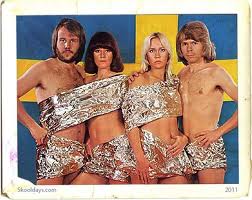
By my reckoning ABBA and the philosophical Socratic theory of anamnesis will finally meet somewhere along IPv6, just at the crossroads where peta-flops of ’70s and ’80s pop tune mash-ups collide with the PDF of the Ga Ga/Madonna/Bowie Manual of Reinvention.

Given that there’ll be 6 billion online personas (giving the current 2Bn + users a very conservative 3 online personas each to play with) using the crossroads at the same time, its going to get messy out there.

Now ABBA, fine, got that bit – and the Lady meets Madge meets Thin White Duke stylie for reinvention and the death of discarded personas, yup. Got that but Anemwhat?!

Anamnesis. A simple philosophical Socratic theory – and a pretty powerful one. Which is why it was quickly air-lifted into Christian Theology as a fabulous way to frame an infinite eternal re-incarnate soul running through all of humanity over time, with Christian teaching merely being a way of ‘recovering’ pre-existing yet dormant spiritual knowledge within us to accompany the soul we are born with. Nice.

Wikipedia cites the following descriptor: Socrates…   …suggests that the soul is immortal, and repeatedly incarnated; knowledge is actually in the soul from eternity, but each time the soul is incarnated its knowledge is forgotten in the trauma of birth.What one perceives to be learning, then, is actually the recovery of what one has forgotten.

So what on earth have ABBA got to do with it?

I reference ABBA in this piece because, for me,  they represent one of those entities that have transcended standard memory and entered a longer, denser living framework of collective or social memory – one with multiple and complex networks of interrelated life times.

They have also reached far enough into the future from their heyday to touch the hem of the skirt of the Infinite Digital Now and all that it brings. And I have a feeling that, through their burgeoning role in the global fabric of social memory and the furious sharing psst! pass it on culture of the social networks, ABBA are hurtling  towards a state of anamnesis.

OK, in the realm of philosophical profundity ABBA’s Waterloo doesn’t quite set the same bar as perhaps Dylan’s ‘Times They are a Changing‘ but that does not exclude them from becoming something that a classical philosophical text might describe.

How they do this is another question entirely. Maybe they’re just so wrong they’re right. Perhaps the unique fusion of chirpy and deceptively engineered pop music and the flip-flop nature of their lyrical content: from the charming euro-nonsense lyrics of Waterloo to songs like The Day Before You Came, sung with the long shadow of Leonard Cohen and Der blaue Engel hovering over it, seems to have allowed ABBA, like all music of increasingly mythical status to become one of the more powerful threads stitching together the fabric of our social memory.

ABBA, like Mozart, Piaf, Elvis, Bowie and Ga Ga, have come to be both perceived and used as a sort of socio-cultural swiss army knife. They are a lever, a key, a signpost, a mapping point, a cork-screw and an emotional cattle prod in the ever-expanding and lengthening fabric of social memory. Music like ABBA’s fixes points of social memory into a particular context, thus creating a door through which we can access them.

But just a great song doesn’t cut it. That’s just a memory – a time machine to what was. To become part of social memory – the stored, dormant library of evolution strategies that we draw upon when life’s challenges open out, shut down, twist, stutter, or fail around us – the music must be potent enough, rich enough and loaded enough to be capable of regeneration – of itself creating a living, constantly-reincarnating relentlessly-reinventing self to qualify.

Whatever it is, and whether you like it or not, ABBA have done an amazing job of creeping under the skin and into the psyche of multiple moments, moods and generations. ABBA. The moves. The powder-blue eye shadow. The melancholy. The show. The Movie. Meryl Streep!. Madonna!! The spiritual and social halo of ABBA is immense. And the ley-lines of its cultural, social and generational impacts fall across every shape and form of social group and individual typology.

For me, being a divorce child of the 1970s in southern England, living the bleak video musical backdrop of The Winner Takes It All; and with most summers spent partly on the White Island amongst Scandinavians of all hues (long before the football hooligans and pill head fraternity turned up) I can attest to ABBA being a great example of the social big bang theory – from its very particular era specific explosive beginnings to hurtle outwards in an exponentially increasing mass of social knowledge, reincarnated and recovered across many lifetimes.

The second I hear those words. “I don’t want to talk…  …cos’ it makes me feel sad…”  I am hurled into a cement lorry of memory and feeling. That’s already more than just a memory. It is a living recollection that occurs with feeling and context – a trojan horse of social memory: an echo of its first incarnation. On hearing it I am immediately primed to mitigate all manner of degrees of emotional distress

But also, if I am on a dance floor and hear Madonna’s Hung Up, it’s the ABBA sample and the latent recovered feeling carried in the Trojan horse of it that lifts my heart, not Madge’s new self conscious re-fabrication of it. But the complexity of emotion that the music evokes is layered by the moment in which it is now being recreated and in which I am enjoying it. It is reincarnated.

But in the same way, the surprising joy I get when I watch Mamma Mia with my 6 year old daughter is transcendent. In this way it is incarnated again with additional and highly complex additions of light and shade for me.

This to me is a good demonstration of how music moves from being an anthem for a time past to being a source of energy, revitalisation, reassurance and guidance, transforming itself as it evolves into a burgeoning strand of social memory.

It is at this evolutionary level that music moves from being a linear recollection of a bunch of chords and stuff you liked – a piece of sentimental data as someone once chose to describe emotion –  to being a living evolving strand that entrenches itself in cultures communities and tribes across multiple generations, drawn on as a social tool and in doing so, becoming reborn again and again.

My daughter will internalize the Mamma Mia experience, along with my own recollections about ABBA, music, the 1970s and my parents as part of that recollection, and it will create emotional triggers and feelings that will continue to exist, carried within her  – only to be reborn every time she hears the opening chords and voices of Dancing Queen.

The enriching memory and the spiritual and emotional information and knowing carried within it is evolving, becoming more dense and complex, developing a mythology of its own as opposed to simply reflecting that of the people who carry it.

It is in that way that something as trite as “I don’t want to talk…” or the first 4 chords of Dancing Queen, a shard of popular culture from 30 something years ago, begin to transcend normal memory, and become living social memory: a source of emotional intelligence and evolutionary experience that the same tribes cultures descendants can draw on to keep reweaving resilient communities, navigate turbulence and upheaval and ultimately manage change. This is much the same journey as that of pieces of philosophy, spirituality, faith and religion, continuously regenerated retold and proselytised across tribes, regions, cultures and generations to expand to cover the world.

To demonstrate the process in action, and of how the ripples of impact and emotional knowledge grow both more complex, and abstracted the further they get from their original source we might set an experiment:

If we were to play the opening chords of ABBAs Dancing Queen to a massed variant audience – a mixture of 8 years olds, 18 years olds, 30 year olds, 50 year olds and 70 year olds, both in villages and cities in different regions and parts of the world – and then, subsequently record the emotions raised, feelings felt, wisdoms recovered, the light and dark of their deeper emotional reflections; to reveal the texture and richness of social memory being stirred and potentially drawn on – I think we would be staggered at the scale, breadth and depth of social memory: the ‘recovery’ of deep rooted emotional ‘knowledge’.

More importantly, I believe the rarified theory of Anamnesis will help us to explain and navigate some of the more complex philosophical dimensions of social memory as they develop in the new landscape of the hybrid virtual and actual 21st century lives we live.

And we’re going to need all the help we can get in the moral maze of the multi-device ‘me’.

My point is this: in the modern world we are expected to live many more ‘lives’ than our forebears. In our post-modern world we re constantly reborn: professionally, personally, materially. It is seen as part of thriving.

I might also venture that consumerism, locked as it is in a relentless round of reinvention of the self through a continuous stream of new identities purchased – cars clothes homes holidays – is creating a truncated state of anamnesis – an expanding universe of reoccurring rebirth across ever decreasing periods of time.

But that is not where the tension will occur.

The tension will come from the fact that underneath all of this new multiple selves we still carry with us a far more one-dimensional primal, living memory. One bound by a much longer thread of continued existence; that gets passed down socially through nurture and the cultural context we find ourselves in, from generation to generation.

But the concept of generations is being rewritten by the modern world. Generations used to be a simple descriptor to identify the progeny of humanity in such as way as to mark them out by the fact that they exist within the same age frames in the same time frames. To be 16 in 1968 for example sets out a generational viewpoint and compass from which to define and explore many different dimensions of self. Generations were a linear thread that dropped down through history tying the past to the future.

But our new world of tech induced multi-persona living is exploding the concepts of generation sideways, upwards, outwards. There are now multiple generations of individuals, communities cultures and mindsets housed in each generation

Ancestors and descendents and the linear relationship between them and the threads of social memory they carry with them have been shattered into a glittering constellation of existence virtual, real or otherwise.

They do not just stand behind and in front of us any more. Our own multiple myths and histories scatter all about us in varying forms of existence – some live, some dead, some decaying dismissed or forgotten.

In a socially charged world of the multi-persona person: whose face-book profile might accent their personal ‘myth’ or story one way or tell of one very siloed professional individual Linked In one in another: their Sim city or Tour Of Duty persona another again – add in a few Farmville coins, on line shopper profiles and PIN numbers, multiple email tags and a twitter account and you’re up to 7 personas as it is. Each one ‘born’ and nurtured and raised to fulfil its immediate social need in the context of the device or channel it exists within.

So I would venture that social memory as it used to be, framed either by classical concepts like anamnesis or more recent frameworks like nationalism, versus how we have begun to frame and explore the dimensions of social memory in the last 10 years makes for a very different creature.

The next time Dancing Queen comes on – and a herd of 50 something’s, 8 year olds, 23 year olds and the ironic 41’ers charge the wedding dance floor, the old model of social memory is at work in the new world – a linear pass the parcel of collective and compounding memories, feelings, in the context of multiple pieces of data embracing occasion, company, personal fulfillment and development, fluid time and fixed geographies.

The same one that amortises their elder’s wisdoms in a box, repeats parental aphosrisms and behavioural tics. Where the work ethics and behaviours of 3 hundred years ago have been passed from Tofflers First Wave to the Second to the beginning of the third with everyone using the mistakes of the past to try and reset the opportunities of the future in an evolutionary line.

But now, where ABBA, the classic concepts like anamnesis and our 21st century multi-dimensional and multi-existence models of social memory meet, playing out across our twittering Id Ego i – pads, there’s something altogether new and far more complex happening.

Social memory is fracturing at light speed into a hydra of persona channels – the social memory as embraced in the virtual world will evolve in a different manner to its real world cousins. The social memory of gamers will have both gamer specific dimensions as well as real world ones. The time machine of music and the ever referable digital filing systems of the cloud will create a fractured concept of temporal existence.

This is no different to what was before – just multiplied. Young men who went to war developed a parallel social memory to those of the families at home. Exclusive of of but not inextricable to the everyday lives they returned to. One they could reach in and out of as they needed to. The same stands for us. But we tend to be reaching into our parallel social memory not of trenches, gas, camaraderie, distress and man’s inhumanity to man – but that of hot dog and champagne restaurant reviews and download recommendations from last year and an blog archive!

And Philosophy, truncated by the new concepts of existence, the socially networked virtual landscape and the multiple life-strands technology offers us outside the old linear temporally locked life span, is being jugged, butter patted, creamed and squeezed through the piping gun to spell out something new: but what?

Money Money Money? SOS? Take A Chance? Dum Dum Diddle? 0r Bang-A-Boomerang?

CLYDE: a short story about Palm Oil & the curse of orange fur

28 Friday Feb 2014

Posted by Thin Air Factory in Uncategorized

≈ Leave a comment

Tags

Aunt Bessie's Yorkshire Puds, ecosystems, Fiat UNO, Frank N Furter, Galaxy Chocolate, i-phones, Louisville Sluggers, Not in my name, orangutans, palm oil, Pot Noodles, Rainforest degradations, Rainforests, Responsible sourcing, Texan Weed, toxic consumerism, Vegetable Oil

orangutan-feet-monkey-suit-costume-accessories-for-halloween

Jeezus!! ‘thought fancy dress parties were meant to be fun.

The blood pouring from the cavernous wound striping across his forehead soaked the viscose orange ‘real look’ fur of Jake’s ape suit hood.

His head hurt. Bt this was no hangover. Even though they’d nailed the booze last night to be fair; and come the strike of midnight, the post spliff-munchies madness had set in. The Pot-Noodle-dunked Pringles were just the beginning.

They’d nailed every snack in the flat: Aero Bar: 1, Quality Street: 13, Ben & Jerry’s: 4 spoons, Jammie Dodgers: 7, half Dave’s Galaxy – and they even dug out the Aunt Bessie’s from the freezer, microwaved and then smeared peanut butter on them.

Nice. That ‘s Texan weed for you. Leaving no snack opportunity left unturned. But his sweetly moisturised forehead was not in great shape. Though skin tone was the least of his problems right now.

The post-binge morning had demanded the special forces of facial forgiveness and some heavy grooming to get him ‘meeting-ready’. Once he’d Gillette’d the iron fillings off his chin the cabinet beckoned.

He could still taste the vague glimmer of the Total Care Colgate at the corner of his lips, but it was overshadowed by the metallic taste of his own glottal blood.

At least he smelt great.

Trish’s smelly Body Shop soap always worked a treat; with three squeezes of her Herbal Essence shampoo just to bob things along – though this morning he could barely muster a whimper as he rinsed the foam out of his hair; let alone a half decent orgasmic screech.

He felt like screaming now though. His right leg seemed to be twitching all by its self.

And a strange needle like pain was working its way out from a pooling red stain around a large gash in his over-foamed orange belly fur.

This morning he had even nicked Trish’s smart Clinique and Elizabeth Arden crèmes (that Olay stuff of hers always made his face feel like he’d rubbed acid in it). His skin felt great!

And he didn’t throw up his Nut Clusters and over-Clovered Hovis toast at work this time so last night’s excesses were obviously being held in check, much like the rest of him slopping about inside his dressing up box outfit right now.

He looked to the side. His other leg was still twisted up and caught between the car sill and the adjustable driver’s seat. They must have got him just as he was stepping back in to the car.

He hadn’t noticed anyone in the street. Clueless. Minding his on business.

He’d told the lads he’d pick them up en-route and then they’d drive to the fancy dress party together. There was something funny about Darth Vadar, Frank N Furter (Jez would be secretly over-egging his sister’s Great Lash Mascara) Clyde the Orangutan (Toby’s one sop to his hero Clint Eastwood’s more populist cinematic oeuvre), and the uncomfortable majesty of Phil’s Elmo ensemble, all stuffed into a Fiat Uno.

He’d stopped to use the ATM next door to the RAINFOREST SPA. Hadn’t noticed a thing. He certainly hadn’t see it coming.

The first blow had knocked the bolus of Wrigley’s and one front tooth out of his mouth.  After that the blows just rained down on him. Bats of some sort he reckoned. And by that he meant the blunt Ash of the slugger variety and not the flappy midnight in the rainforest kind.

His new baby, his I-phone, was smashed to pieces scattered across the pavement around him: bastards.

What had he done to anyone? Ever? His right eye went blind.

God, could murder a Mars bar right now. This thought was swiftly followed by another; the last in fact that would ever cross his conscious mind.

 Last time I’m going anywhere dressed as an orangutan.

AUTHORS NOTE: This short story was written to illustrate and challenge the dislocation that exists between what is done in our name in the pursuit of industrially farmed Palm Oil and the everyday products that we use – written along the thin orange line between us and our simian cousins

Every product bar the Fiat UNO mentioned in this short story contains Palm Oil. If we were to personally pay the same bill our Simian cousins do for its place in our convenience, perhaps we’d think twice about the products we used with convenient ignorance.

Hip bone’s connected to the i-phone & the evolutionary curve of a trouser pocket.

27 Thursday Feb 2014

Posted by Thin Air Factory in Uncategorized

≈ 1 Comment

Tags

American Eagle Jeans, behavourial change, efficiencies & economies, Evolution, Hot Sexy Love Strides, Human resilience, Ilipsoas muscle, RSI, smart phones, software programmer, upgrades, Wired

pocket-iphone-jeans-650x0

Okay; hands up who recognises this everyday irritation:

You’re faffing about, and then suddenly you need to crouch down or lean over: to tie a shoe-lace, pick up a child, smell a flower or rescue a shish kebab you’ve dropped on the pavement.

As you tip forwards, the space between your upper thighs and abdominal muscles decreasing, you are suddenly aware of the top and bottom of the glamorous, chic, multifunctional atmospherically connected smart phone tucked into your front jean or trouser pocket digging into your hip and thigh with perfect synchronicity.

Whoa! No thanks.

Ping. Up you go again, straightening up, digging out and transferring said chic smart phone to a, well, slightly smarter storage place – a back pocket or perhaps a surface near by.

And down you go again to complete the original action.

(This particular form of RSI – Repeatedly Stupid Inclination – is not to be confused with the lavatory based RSI suffered while turning and leaning over to flush said lavatory and watching said glamour phone slide out of your top pocket to plunge into the satanic stew below you for the fourth time in 3 weeks.)

So let’s have a closer look at this particularly ‘drinking bird’ RSI – three aspects of it to be precise: specifically; the efficiency, ergonomics and evolution of it.

Firstly, efficiency.

The repetition of the action of bending down, straightening up, reordering the phone to a back pocket or some other place, and bending down and straightening up again in pursuit of one simple action is simply inefficient.

Any Time-and-Motion or statistical geek will clearly set out in no uncertain and equated terms how, regardless of from which vantage point you view this: either that of time and motion or that of consumption of physical energy (body muscle mass and the liquids salts and sugars required to ignite and drive them) it’s simply a waste of time and energy.

Secondly, in ergonomic terms, it is all wrong, in so many ways. From a physical design aspect, having something repeatedly digging into your iliopsoas muscle at the top of your hip joint creates imperfect motion, impairs good posture, decreases cognition, creates irregular or anomalous strain on lower back muscles and therefore, ergonomically, it is flawed.

It is bad design: from the point of view of the phone design, the trouser pocket design (position) and ultimately the design of the human body.

To be fair the latter only really becomes an issue if the two former design concepts render themselves impervious to change, immoveable in their conceptual (and physical) position due either to some crushing fashion mantra insisting on the pocket’s placement being ‘just so’ or our digital compulsive-obsessive need to view ever increasing amounts of content of ever decreasing quality and charm on increasingly bigger screens continues unabated.

Yes, for the observant out there, the science of ergonomics does collide with that of human behaviour at this juncture. The behavioural scientists would point to the fact that, if we keep putting our phone in ‘that front pocket’; if we continue to simultaneously squat and bend forwards to try to pick up the pair of discarded whatevers off the floor, said smart phone will continue to jag into our hip, continue to hurt and irritate and frustrate us; the chances are we will eventually stop doing it.

Current subjective research group of one (me) and some close friends seems to point to the opposite of the evolving learned behaviours law occurring though.

So, this all brings us nicely to the third aspect of discussion: Evolution.

The question in this pocket-meets-mobile-meets-human triangulation is not so much how it will evolve but rather which pillar of it will evolve.

So, one might suggest that the phone tech companies should be the ones to evolve (given that they spuriously upgrade stuff once a week roughly as it is so why not). Perhaps they could look to ‘soften’ the line of the phone, round the shape out, or perhaps even go the extra mile and create some breakthrough flexible tech – a mobile with a flexing hi res super screen set in a pliant, rubberised polymer with built in ‘give’: but I doubt it.

So what about the apparel companies? What about the fashion brands? American Eagle developing mobile friendly slung-front pockets jeans? Patched pockets constructed specifically to off set the jagging mobile mauling? Only if you could convince the mass wearer that they were still going to look as hot as a Hawaiian chilli and be able to sashay along life’s catwalk with no loss of WOW.  Otherwise, open stitched slung pockets might get a little niche action from the software programmer in Shoreditch but otherwise Uh! Uh! I don’t think so.

So if we can’t rely on human intelligence to offset the problem, and for some reason the tech companies and the apparel companies get in cahoots with each other, and apply an intransigent and frankly fascist line in the sanctity of their existing design, the impacts on the human body could get kind of funny and kind of expensive kind of soon.

Given that 5 or 6 years typing from a bad keyboard position with an imperfectly height adjusted screen is about to plunge most developed economies, employers and insurance providers into a mire of RSI absence, claim and therapy (Last year 5.4 million days were lost in sick leave due to RSI and, every day, six workers left their jobs because of RSI) underwritten by a particular crisis in generational diversity (most of these sufferers are under 45, and just over half of them are women.) imagine what this could auger for the mobile mauled hip.

If the we continue to turn a blind eye to this issue what are the consequences for us physically, spiritually and culturally?

What would happen to our bodies? How would the iliopsoas and gluteus muscles adapt given that the gluteus alone connects the ilium, sacrum, and coccyx to the femur? What would happen to their shape and muscle type?

Would our core muscles adapt to compensate? OR become corrupted in their current form?

What would the offset or ‘referred’ symptoms and impacts be? Given that, especially in the hip and lower back, conditions induced by ‘referral’ from pre-existing conditions elsewhere is quite commonplace.

Would the impaired compression and twist incurred in every repetition of the action lead to greater likelihood of prolapse discs?

Would there be an indentation, or a coarsening of the hip bone just at the point of contact developed over time? Would that coarsening be so particular as to able to be identified in the skeletal remains we leave behind? One hundred years from now would a cold-case pathologist be able to know whether Jane Doe wore a particular style of American Eagle jeans and used a Samsung Notes III just by the nature, bevel and texture of a dent in her hip?

And then we have the socio-cultural impacts!

Would there be a new development of specific Pilates and Yoga instruction and Courses for sinus coxae, or ‘Pocket Hip’ as it would become colloquially known.

Would a cache develop around having or not having Pocket Hip? (or i-hip as the Apple Disciples would call it). Would i-hip suddenly be honoured with a Double Page Spread in Wired magazine?

The mind toggles!

Anyway, just putting it out there for you.

Brand weavers, strategic threads & finding your future brand fabric.

24 Monday Feb 2014

Posted by Thin Air Factory in Uncategorized

≈ 1 Comment

Tags

algorithms, brand design, brand experience, Digital Connectivity, Human Networks, human protocols, Living In The Now, multi-dimensional brand mapping, old school Ad Land dinosaurs, relentless revolutions and reinventions, Strategic Resilience

Image

The old world of brand dimension, mapping and engineering is way past its sell-by and use-by date.

Which is why the majority of organising ideas and campaigns and even some of the movement thinking generated by agencies on their clients’ behalf fall short.

The relentless evolution of the brand experience at every touch point through every advocate and carried in every stakeholder in the brand multiplied by every value added moment that can be either created or captured in those strands and threads, repeatedly and in an evolving manner DEMANDS that the north stars, organising ideas and movement minded slogans we create to galvanise the stakeholders are fluid evolving and compelling (i.e. they compel us beyond reason to act within the desired state of the relationship to mutual benefit and effect).

The digital state of myriad-being-and-doing has shifted the nature and architecture of the brand experience for better and wiped the one-dimensional smile off its face.

Lets here is for the ‘–ing’ and the ‘–ish’ – the ever-evolving nature of the brand revolution.

No absolutes, no emphatic solid sided imperatives (unless it’s the promise you underwrite your offering with – which should be immovable immutable and non negotiable)

BRANDS AS PATTERNS FABRICS ALGORITHMS AND TEXTURES

The age of the Ivory tower plinth and altar brand is dead.

Digital citizenship and our newly connected world has rewritten the terms and rues of engagement between customer, the brand and the business that delivers it

In real terms when one takes into account the measures and dynamics of Reputation, the transactional and interactive relationships (emotional, functional and financial), the criteria of NPS and advocacy models, the culture of intense, CRM and customer-centricty, multiple channels and touch points, proliferation of content rich engagement, activation tools and the rise of the consumer activist:

The shift is more than inevitable: it is compulsory – the cost of doing great business and building a resilient company in the process.

SHIFT

FROM:

Brands as top down cascades with the dressing up boxes of marketing and communications to play with:

TO:

Brands as a relentless repetition of millions of tiny meaningful intentions, moments experiences, transactions, interactions, gestures, rituals and acts played out across time, platforms, spaces, containers, messages, between every customer, employee, supplier, partner and wider participants

Each brand presents itself in real-time and terms as an endless and evolving kaleidoscopic pattern, fabric algorithm or texture into which value must be threaded and woven to secure it and capture it.

This is where real brand resilience and saliency meet.

Through this state of being, rare experience will come.

It’s here, in and around this relentless evolving fabric of experience where leadership stories will be told – and keep being told of you.

Sshhh. Your ears are burning!

Pandora, The Big Box of Trust & The long shadow of our digital Dorians.

20 Thursday Feb 2014

Posted by Thin Air Factory in Uncategorized

≈ Leave a comment

Tags

Big Brother, Collective Psychosis, Corporate Ethics, Corporate Trust, CRM, Data Day Lives, Data Security, Digital Lives, Dorian Grey, Hidden Lives, Identity, Indiscretion, Integrity, Meaningful Brand Relationships, Misplaced trust, Multiple Personalities, New Virtual Currency, On line Personas, On line Rewards, Psychopathy of the virtual self, Sanctity of personal Information, Smoke-screening data use, Spider Software. The Virtual Tsunami

trinity-of-sin-pandora1

“I’m not sure when it all began – the butchers, the bailers the lynchers and the faith killers

I know that the crazy happened in June. Because June’s my birthday and mum and dad got really busy and mum missed my birthday, which she never does.

But the killings and the jumpers and the religious nuts I think that came a little later

My name is Pandora and I’m 12 years old. But people say I’m quite grown up for my age.

I live in a house which is kind of big but a bit higgledy-piggledy with my brother Jake and our dog Slipper

I’ve got a hand me down 3DS from my brother but our i-pads and kindles went long ago. And all the internet stuff got burned in the garden – dad lost it when mum and dad were having a barbecue. Embarrassing.

I call all the crazy people the butchers and bailers and lynchers because that’s what my mum and dad called them.

Not sure what they were all getting so weird about. I mean WTF! have they been doing?

There used to be just one of two of them; on the news; nutters dad thought. Even when there was loads he still thought it was just some hysterical bunch of muppets. But when the boy next door set him-self on fire, dad stopped taking the piss out of them.

My mum is called Jane and my dad is called Mike

She’s a doctor at the local hospital and he’s a Paramedic. Now they’re what you call busy.

OVERARCHING NARRATIVE

Let’s start with the end. There’s a date – the day of reckoning – that never comes – futile and banal but true.

06:6:16

The date surfaced one day on a blog thread tracked to some blog in the mid west they say; the blog was on something weird like Vintage Tyres or something! Just popped up. And then everyone on one IP got the notification email. That was the beginning.

Then the usual bollocks: different people in blogs and chat rooms all over the place, decoding it and giving it different meanings: trying to tie it to their belief systems – some coded Book Of Revelations schtick. Piss off Dan brown. It’s the number of the beast yeah, bow wow woof woof, bow wow wow wow, its a Diamond fucking Dog. Grow up.

Some called it a future point after the closing of the Mayan calendar – an echo of previous catastrophic incidence – yuh! right, but mmmnnn, how did they manage to turn that into an editorial piece on the birth place of chocolate and the new One & Only resort.

What would the Scientologists make of it?…Islam?…Stephen Hawking? Dawkins? Deputy Dawkins? Scooby Doo? Those darned kids?!

Watching faith leaders and scientists throwing shit at each other makes you laugh.The scientist saying the last time someone threw this much misplaced trust into the world they called it Christianity. The fight was mental. Never seen a Bishop gouge!

The whole thing was like some online practical joke – really small, popping up here and there with funny little cartoons – like Shrigley had done an April fools day digital terrorism thing with a smile.

But then the date started to scare people. Some bloke said that society will turn on and consume itself.

Then the ‘infestation began’ – date counters popping up, unannounced and uninvited – locking everyone’s device to it – that date –  toxic countdown Davina!! – and then the small overly chirpy and chilled Instruction messages appeared.

No-one was laughing any more. And then the bodies started to rain down. Who’d have a Wii!

 —————————————————————————————

SAVE THE DATE! Do Not reply!

 6.06.16

Hi Pandora!

We have reason to expect a massive reverse feed flow or first wave ‘spill’ of all personal data and content generated or searched on your device back to the registered user at 6am GMT; 06:6:16.

We believe that the individual data caches spilled back into your device (and any further device coupled, tethered or sync-ed to it) will include all data threads from every primary device including lap tops, tablets and smart phone devices as well as institutional work email systems secured and unsecured from 2006 – 2016.

They will also include all thread and integrated platform data of the registered user from all linked and shared data sources – including but not restricted to social networks, content share platforms, site memberships

We have identified three super Global caches of data-intel and data-history – including search histories, downloaded content, hard drive back ups, data stored in universal HISTORY and CLOUD platforms, banking security data, and medical records – which have been infected by Virii which have preset the caches to start ‘evicting’ and ‘spilling’ data back through the feeds from which they came.

It is also predicted that on this date there will also be further ‘second wave spill’ of the first wave data content to all coupled and synced devices and receivers within a 10 metre area of the user and the device. Please be aware that data, stored content, live social network activity and prior browser information may spill through any of your connected appliances or through open app access areas.

If for any reason you have any reason to mitigate the occurrence of spillage or are concerned about privacy security and the potential legal legitimacy of any materials pertaining to you and your device, click here and a CODE PIN will be sent to you within the next few days giving you details of your personal Data Nurse, a trained and certified professional who can advise you on how to manage the impacts of any content or materials of yours on your personal life or professional career.

NEXT STEPS – URGENT

Download the Dorian folder & App provided onto your principal device and copy over onto any other devices synched with your principal computing device

In the event of spill Please drag all ‘spilled’ materials – both content and data files’ from your live and stored browser, email, voice/skype into the folder name Dorian. Once activated these folders will automatically empty every hour.

Thanks for your attention. More Soon.

—————————————————————————————-

TREATMENT NOTE ‘Pandora’ was originally written as both a provocative polemic and an illustrative story to test the dimensions of TRUST in the digital domain: particularly concerns around Big Data and the questionable status or privacy and identity security: and ultimately the sanctity of everything that we happily entrust to the mouthpiece, camera, keyboard and cache of our digital lives.

IMAGINE

Imagine a day when the fractured data-daubed picture in the attic of every connected mobile human being suddenly poured it guts back into the world around them – on to interactive bus stop posters, trans-vision screens, bus announcements, live emails, txts, digital TV’s, lap-tops, tannoys in airports, speakers at gigs.

Imagine the living writhing turbulent psyche of the collective digi-sphere suddenly throwing its indiscrete guts up through every device that had ever touched it

Imagine if the digital history of every illicit conversation, betrayal, desperate moment, flight of anguish, inappropriate txt; every white, red and black lie uttered, every indiscretion reported, every secret shared, every questionable purchase, every sadness and painful exclamation made public, every grubby search, predatory stalk, invasive squint and questionable image and moving picture ever considered, spilled in to the bright white light of public scrutiny?

Imagine if every piece of it played up in bits and bytes on to every live device within 100 yards of you – with no ability for you to control delete or obscure it? Imagine this following you like a data jet stream everywhere you went. Unshakeable!

A buzzing phosphorous halo of the dull, the petty and the imaginable intertwined with the inexcusable and the unspeakable  – all hidden until now in some cloud attic, rendered on the living connected canvas of you.

Imagine our TRUST being thrown back in our face like that and then in looking back at it imagine that we could ever say that we should have ever done anything other than see it coming.

Funny thing, trust. Sometimes we never really think about how much of it we invest in things with little real proof whether the receptacle of it is deserving of what we invest in it.

Trust us they say. Trust is our business. Trust is the currency we trade in; Trust what we do for you – and the social networks allow us to test the trust they peddle, put it through its paces, act against it if it is found wanting. So we think we’re the puppet masters of trust.

Trust is the new Funny: and every corporation and brand is wearing the I’m Funny t shirt. But what are we entrusting them with? The linear and primary dimensions of what they promise to deliver for us and for which we hold them to account: from soap and fashion to legal services to gamification to test drives, nappies and food – are all scrutinised to the nth degree.

But what about the stuff they are hoovering up along the way. The maps of our data day selves: our highly personal tics and behaviours; the intimacies of our banality; preferred top up days, favourite days for stepping beyond our financial means, the join the dots nature of our virtually invisible online shopping basket, the routes we take home, the time we surf, the things we buy, the relationship between when we read a news article or watch a movie and what it inspires in us: social angst and need for connection? reassurance shopping? comedy youtube clips? tech porn browsing the latest upgrade? All that behavioural stuff we lovingly entrust to them. Its what enables them to ‘predict’ us, our likes, our preferred offers and in which day part, format, colour and context we wish to receive them.

Every time we invest the most intimate of information into any device, I sense we think little of the integrity of the host at its journey’s end. Sometimes, when a PIN number goes walkies or some card details get lifted, we feel stung, burned by it. Scalded by its betrayal and the sudden loss of security in our little bubble

But think of every indiscretion, every indiscrete share, message, intimacy, personal detail search, obsession, amateur stalk, desperate seeking, inappropriate image shared or searched. Every site we dwell within, the online decisions we make. And that’s before we get anywhere near the new cowardly, shitty little social art of trolling!

The history of our digital lives, lived in the ether, is in effect our Picture in the attic: and we are all the new Dorian Grey.

Luckily for us, there is little occasion for us to stare that picture in the face and see in its glistening, glorious digital technicolour every scar, pustule, sore and canker: evidence of the indiscretions, small horrors, corruptions and cruelties of our digital lives. Rarely do we ever have to comprehend the fabric of our real-time dysfunctional selves.

To point at the porn industry and the bomb makers as exemplars and leaders of the singular toxicity of on line lives lived is to make this all far too one dimensional.

Imagine if we scoured and cross-correlated the underbelly of big data along very bleak human threads: betrayal, cruelty, spite, indifference, entrapment, lying, duplicity, complicity. Imagine the swirling fabrics of our own penny dreadful data knitted together into one long spool of stuttering humanity. Imagine how each one would wrap itself around our naive model of trust and asphyxiate it in seconds.

So why do we explore trust issues in such depth in every other sphere: relationships, consumption, financial diligence, ethics in science to name a paltry few: yet this massive petaflop blind spot, this clouded issue just sits there. And we pour the smallest and most vulgar details of our lives into it shamelessly and relentlessly.

We trust that the people collecting this data are trustworthy and respectable. We trust them to only look at what they’re allowed to, as if they will coyly look away when huge tranches of data that lifts the skirt on our illicit humanity comes their way.

But that’s where the money is.

And as every cautionary tale will tell you: that’s where your problem is; the venal nasty ‘it’ of life.

Everything that you entrust to the ether; every bit of your hidden self is covered with your digital fingerprints. And that’s how money, spies and slaves are made.

I’ve got something on you, sonny. Now, all I’m asking, for us to be square, is that you do this small, perhaps slightly improper act for me and we’ll call its quits-ish.

It’s how every criminal King, twisted Queen, gangster, despot, tyrant, emperor, and oligarchy has ever controlled anyone and kept them in their thrall.

And we just keep plying our human behavioural trade through every data-grabbing geo-caching GPSisng search-saving image-hosting money-shifting elephant-memoried bit-coining device we can get our hands without the slightest thought of whether we trust the trafficker of this complex revealing and darkening data and what its real value is – both to them and us.

That is where I think the issue is. Not that we are knowing and complicit: I allow my data day self to be monitored measured tweaked and collated; and I get benefits. Sure you do.

And it’s not that we don’t trust these people to both manufacture and deliver the soap, the car, the burger, the shoes, the cheese slices, the whatever, in a manner that is both transparent and trustworthy.

All I am venturing is that perhaps, while we are being handed transparency and the ability to test the integrity of our trust in that action, we are gifting away the more important and most precious coins in our pockets.

I would venture that the rewards are relatively quite small, given what you’re giving away. If the real currency is data: our data; then perhaps the new breakthrough brand will not be another online currency; the breakthrough will be the aggregator that allows us to define a market price for our data against its lifetime customer value to these brands and businesses, liberating us to invest it where best suits us and manage the returns we make on it.

There’s a algorithm challenge. But until then, mine’s a TRUST Me! I’m a BRAND t.shirt.

Creativity, the Cosmic Fizz & the storytellers of science and faith

14 Friday Feb 2014

Posted by Thin Air Factory in Uncategorized

≈ Leave a comment

Tags

Cosmic Fizz. Atoms Never Die, Creativity, Evolution, faith, Greek Philosophy, Human resilience, Infinity, Life Of Pi, Morality, Mythology, Nihilism, Nirvana, Omar Khayyam, Optimism, Oscar Wilde, Philosophy, Romanticism, Rubaiyat, Science, Sentimental data, Spinal Tap, Story telling, Sustainability Experts, Transcendental Meditation

imgres

Adult Pi Patel: So which story do you prefer?

Writer: The one with the tiger. That’s the better story.

Adult Pi Patel: Thank you. And so it goes with God.

Writer: It’s an amazing story.

I love this piece of writing from the Life Of Pi – because it goes to the heart of everything I believe in as a storyteller by trade and by passion.

It also points to the most sublime collision of existence and creativity for me.

The brutal truths of everything we are, that we come from, exist amongst, experience, endure and prevail upon are in themselves poetic and beautiful. But there is something so human about our need to embellish the flat dry expanse of these truths; to make them greater, more fantastic: our need to story tell around them. There is for me a perfect conflicted symmetry: of both hubris and humility in our need to do it.

That we want to use our consciousness, and the gifts of existential self-perception that it brings to ‘big ourselves up’ in the species department is par for the course. The ascending arrogance of increasing predominance is so expected as to be almost dull.

But in seeking to story tell around such profound and all enveloping concepts: of existence, creation, death, belief, faith, survival – we are also admitting that the base nature of them is simply too overwhelming to us to comprehend in their pure form, too complex and exceptional for us to divine without reduction and simplification. (Sustainability experts take note!!)

So story-tell them we have. Between Reason and Faith, the scattered facts and dynamic data of our human condition and the absolute nature of our relationship with the world in which we bear it are rendered.

In the parables, cautionary tales, prophesies, miracles, fairy tales, wisdoms, mythologies, metaphors, legends, monoliths and dream catchers, we find storytelling that is wonderful, hopeful, brutal, yet optimistic – transforming the data of our reality into ‘the one with the tiger’.

The giddying ascent of some of these ‘tiger stories’ as I will now call them into regional and world movements of dogmatic faith inevitably has seen them dragged into service as the spiritual slings and arrows of marauding armies. In doing so they have both exported a negative arrogant shading of their ‘tiger story’ while importing a culture of cruelty, violence and division into the heart of it.

It is unclear to me whether this conflicted nature is inherent within the cosmic fizz or purely a product of it. Regardless, in the evolution of these ‘tiger stories’, they have proven themselves wholly capable of extreme polarities of positive and negative outcome: the Atomic Bomb and The Inquisition being two such glorious (western) examples.

I would venture though that it is the base corruption of the storytelling concepts – and the flags and actions that they are seen to have resided over that despoils them, not the nature of the story itself or the faith or reason upon which they are built.

As Oscar Wilde pointed out quite rightly – there is not such thing as a moral or an immoral book. Books are well written or badly written. That is all. The storytelling is not where the problem lies.

It is the questionable moralities of human interpretation and subsequent actions undertaken in the name of something; be it science, faith or any other where the spoiling starts. A wantonly childish and proprietary approach it seems: It’s my toy so I’ll smash it if I want to.

I believe that if we took the smashers from all sides – the pedants, the inquisitors, the lunatics and the absolutists – the ‘my book’s better than your book and oh, by the way it’s the only book’ crowd and the equally intransigent and nihilistic ‘faith is the great cop out, the great excuse’ polemicists and shoved them in a large room and closed the door we might start the conversation again.

If we did, I think we might find that the people of science and the people of faith are connected at a deeper level than either their rigour or dogma would like to admit – and the immutable truth of that fact is being obfuscated by what is in fact on deeper interrogation a stylistic disagreement – like the one that exists in the land of storytellers between the purveyors of muscular contemporary prose and those of classic highly mannered poetry.

There is a tremor of violent agreement that runs between them that remains unnoticed (to themselves certainly) probably due to the deafening and cacophonous nature of their own ‘combative noise’.

When particular men of science call religion a fiction the only issue that arises in that emphasis for me is the inference that it is a fiction rooted in no factual or reasonable truth. Well, I am currently jury’s out on that absolutism and here’s for why.

In my wish to not polarize or propagandise my children and in answer to the question “what is heaven daddy?” (the inconvenient inquisition of children is the most brutal of examinations) I have netted out at this story-teller’s logic, and it begins with science:

Atoms never die. They just reassemble re-task and reintegrate themselves in a new form.

So, we are all one great big mass of finite circulating particles. Amazing.

In which case, if we were, theoretically at least, able to pull focus on the physical world in which we exist to reveal that great big mass of finite chaotic swirling particles; to reveal its sub and supra atomic nature, we would perhaps reveal a singular phenomena – the cosmic atomic fizz of everything. (Eat that challenge Google Glass!)

133,000,000,000,000,000,000,000,000,000,000,000,000,000,000,000,000 atoms swirling around dynamically, condensing clustering conflating and coagulating for a brief while in every visible and invisible material thing we know and many we don’t, before deconstructing and reconstructing themselves somewhere else along the way.

Now your brain might be so huge as for there to be little issue for you in contemplating the jaw dropping magnitude of this, but (certainly for my tiny self absorbed brain) this is a concept so vast so complex and so overwhelming to the average human being that we would struggle to grasp its meaning.

And we hate that, us humans, the ‘can’t quite get it’ thing. It makes us feel a little small, stupid and out of control, so, we use storytelling to simplify and sort the problem. To order the cosmos. Bring ourselves closer to it.

In this instance I think we’ve effectively taken the jaw dropping magnitude of the cosmic particular mass, stuck a beard on it and called it Norman.

This is not to say that the creation of the mass, how it got there, what drove it and what the point of it all is doesn’t exist in the pantheon of life’s big questions, but I’ll leave that to David St Hubbins of Spinal Tap to ask that question for all of us:

“If the universe is indeed infinite, then how…what does that mean? How far is all the way, and then… if it stops, what’s stopping it, and what’s behind what’s stopping it? So, what’s the end you know, is my question…to you”

The moment where human interpretation and the nature of our existence meet is at the moment we decide to call the infinitely finite cosmic particular fizz a name, embody it in some divine yet recognizable (like us) form, allow it to take human form, or simply see itself at work in ourselves and in all things around us.

But if we’re tooling down the storytelling pathway of the immortal atoms, lets round out the characters first shall we.

That the breath of Moses, The Christ, Buddha and the prophet Mohammad are still in the world, atomically speaking, is an incredible, philosophically charged and mind-boggling thing. But in that we must also accept that so too are the breath of Hitler, Genghis Khan and Jack The Ripper.

Our simple survival evolutionary selves have spent millennia trying to identify filter and prioritise the data of danger, relentlessly, restlessly seeking clarity around what might hinder or hurt us. So even the earliest storytellers will have been thinking of and framing our existence in very simple structural terms predicated on understanding the simple signs that guide us:

Crisp bright coloured plant: tasty and makes me feel perky = GOOD

Dark brown stinking plant: Whole village dead from soup of it = BAD

Large Screaming Drooling Sabre Tooth: Ate my mother. Ugh = BAD

Small trembling rabbit like creature: Ate for supper. Yum = GOOD

I sense the same simple storytelling principle has been applied to the cosmic fizz.

That the particular nature of the cosmic fizz can cluster and form into larger entities beautiful, brutal or otherwise inane and inert (read Turner, the Terror, Trousers and Taramasalata) demonstrates that the cosmic atomic fizz is indeed nuanced positively and negatively in ways far more cognitive and philosophical than just how those particles are charged

So, it’s no surprise that some of the earliest storytellers will refer to similarly complex concepts in the simplified form of perhaps good things and bad things, nice place not nice place, or a heaven and a hell perhaps.

We have ample evidence of where the commonalities of our beliefs, philosophies, reasoning, values and mantras – the cultures of science faith, culture and philosophy – meet, in turn finding little to differentiate or choose between them. In The Picture Of Dorian Grey the collision of ancient greek texts and philosophy, Christian morality, Islamic beliefs, eastern mysticism, Romanticism and the mind of the scientist and mathematician we find in the author’s use one of the texts from the Rubaiyat Of The Omar Khayyam (translation: the shoulder of Faith) is to me the most perfect of examples:

“I sent my soul through the invisible

Some letter of the afterlife to spell: 

And by and by my Soul return’d to me, 

And answer’d: ‘I Myself am Heaven and Hell”

Storytellers from every shape and shade of tribe and belief have either knowingly or unknowingly reshaped and molded the brutal nakedness of this atomic dynamism into concepts of things, beings, feelings, spirits or forces, eternally alive within everything, including ourselves.

Over time we have come to believe that our ability to connect with these forces – the ability to feel them, see them, understand them, call on and capture the essence of them – is representative of a higher state of being and existence – something to aspire to and yearn for – as an elevation out of the brutal reality of survival.

Trans-substantiation, The essential Fire, The Holy Spirit, Nirvana, Reincarnation, The Great Spirit, Sacred texts. Every one of them resides at the junction where the storyteller sits. But to simply dismiss them as ‘spun’ fictions is to mitigate what they intend to communicate, the beliefs they contain or what they are seeking to point to, however clumsily or fantastically the critic might feel they are doing it.

I believe that these stories are part of what makes humanity more resilient (not always a good thing). They exist because our evolutionary gene-pool need to prevail and the traits and tools that we need to endure in extremis require far more than just physical attributes.

It demands a strength of mind that perceives itself far greater than the sum of the physical parts it controls. An absolute belief in ones ability to complete an action, test or challenge, come what may, is what enables us to prevail against all odds.  These examples of shared and disseminated storytelling enable human beings, social by nature and with an innate sense of collectivism, to transcend the confines of their physical truth. To prevail is to be optimistic (a form of positive delusion or illusion perhaps but no less powerful because of it), disposed to expecting the best of things.

But Optimism needs to be written, because it is not innate.

We all understand the brutalities of existence. Fight or Flight is innate. Primal ferocity as a predatory or defensive mechanism is innate (learned gleaned or forced over time) a living echo of all previous experience of our ancestors. We all understand that science is emotionally inert: it carries no sentiment other than through the emotional human impact of its comprehension or application.

Our emotional nature as seen through the scientific lens is simply a transportable cache of sentimental data – a form of big human data collated and conflated over millennia; cross related through social memory and learning by us to create what we believe to be a conscious, feeling aware creature with inbuilt reflexive and intuitive responses.

But the positive halo of optimism – a mannered elevating way in which we choose to capture the positive outcomes of the brutal innate truths – is in itself a lever and generator of resilience in regards to human existence and our ability to prevail.

Story telling, especially that which is designed to be passed down and around is a massive factor in predisposing fractured scattered battered tribes and communities towards constructing more positive outcomes for themselves. The shared beliefs that storytelling can engender is testament to that.

Storytelling is where the resilience of humanity lies. Even in the realm of science and the learned institutions, I would venture that there is a marked difference between those professors who light a fire in the heart and minds of the students who seek to learn from them and those that don’t regardless of both academics singing from the same curricular song sheet. The education that stays with you is that which is shaped to be remembered, not learned to be forgotten. It is only through the stickiness of more enlightening communication that we ascend and improve and bolster ourselves against the odds.

Is the culture of ‘stories spun’ open to abuse? Yes: The speed at which storytelling can moves from parables, myths and cautionary tales of improving and guidance, and of things greater than ourselves to being a corrupted propagandised text with the sole intention of suppressing, controlling and excusing untold inhumanities and predations is all too clear across history.

Should it, for that very reason, be set aside and simply forgotten? Should we make do with the less dramatic, less shiny, less embroidered version of our existence? What surrounds us and is within is us is certainly beautiful and amazing enough (though some would argue even our driest concept of self has been brilliantly inked to some extent by millennia of human storytelling)

Should we look at ourselves in the mirror without gods, tigers, and miracles to obfuscate the view? Some would argue most certainly.

Nonetheless, I would not (and given my trade could not) dismiss the story teller from the court of human existence. I could not contemplate a life without ‘tiger stories’. I believe that humanity would be less capable of great things and less resilient without them.

And rest.

← Older posts
Newer posts →

Subscribe

  • Entries (RSS)
  • Comments (RSS)

Archives

  • April 2026
  • March 2026
  • November 2025
  • September 2024
  • June 2021
  • December 2020
  • August 2020
  • April 2020
  • March 2020
  • January 2020
  • October 2019
  • June 2019
  • April 2019
  • November 2018
  • August 2018
  • June 2018
  • February 2018
  • January 2018
  • December 2017
  • November 2017
  • August 2017
  • July 2017
  • June 2017
  • May 2017
  • March 2017
  • January 2017
  • December 2016
  • November 2016
  • October 2016
  • September 2016
  • August 2016
  • June 2016
  • May 2016
  • April 2016
  • March 2016
  • February 2016
  • December 2015
  • November 2015
  • October 2015
  • September 2015
  • August 2015
  • July 2015
  • June 2015
  • May 2015
  • April 2015
  • March 2015
  • January 2015
  • December 2014
  • November 2014
  • October 2014
  • September 2014
  • August 2014
  • June 2014
  • May 2014
  • April 2014
  • March 2014
  • February 2014
  • January 2014
  • December 2013
  • November 2013
  • October 2013

Categories

  • Uncategorized

Meta

  • Create account
  • Log in

Create a free website or blog at WordPress.com.

Privacy & Cookies: This site uses cookies. By continuing to use this website, you agree to their use.
To find out more, including how to control cookies, see here: Cookie Policy
  • Subscribe Subscribed
    • thinairfactoryblog
    • Join 28 other subscribers
    • Already have a WordPress.com account? Log in now.
    • thinairfactoryblog
    • Subscribe Subscribed
    • Sign up
    • Log in
    • Report this content
    • View site in Reader
    • Manage subscriptions
    • Collapse this bar
 

Loading Comments...