• ABOUT

thinairfactoryblog

~ A topnotch WordPress.com site

thinairfactoryblog

Tag Archives: Story telling

Digital Twins, Groundhog Day, and the unreasonable power of pop cultural storytelling.

19 Wednesday Aug 2026

Posted by Thin Air Factory in Uncategorized

≈ Leave a comment

Tags

cambridge-university, digital-twins, dreamers-believers-soldiers-cynics, groundhog-day, pop-culture, Story telling, synthetic-data

Yes. That Groundhog Day: Punxsutawney, a small furry creature, ‘Phil Connors,’ the belligerent weather man, blizzards, eternal loops, and love, eventually.

But what’s Groundhog Day got to do with Digital Twins, synthetic data, and ethics I hear you not necessarily ask?

Well, to explain that I would first need to refer you to a very interesting project I was invited to join by Dr. Daniela Boraschi.

Daniela and the team were putting together an approach as part of the Creativity for Scientific Change project. The outputs resulting from that approach were eventually encapsulated in a poster Daniela and the team developed for conferences, entitled Ethics beyond compliance. Embedding dialogic reasoning in biomedical research.

The poster has now been put forward as a commentary submission to the special issue Societal Perspectives on Digital Twins in the journal Data & Policy (Cambridge University Press). An exciting journey undertaken by a wide reaching team to create something remarkable.

So let’s have closer look at the journey that bought Daniela and the team to this point.

From the beginning, Daniela and her team set out to work with a broad cohort of AI scientists, designers, and public engagement scholars to explore how ethical reflection can be embedded in the earliest stages of biomedical research on digital twins.

She had been spurred into action by some AI scientists’ ethical concerns over the lack of consultation and public debate around the development, deployment and social impact of digital twins and the synthetic data models they relied upon.

Could we use the ‘unreasonable power of creativity to move the dial on greater engagement in the ethical conversation? Could using a more creative way of speaking to and on such complex matters drive the change these scientists were seeking? 

At the heart of this exploration lay a challenge. How do we ignite open approachable conversation, reflection and dialogue around what are, to most ordinary people, highly complex and often arcane subjects.

How do we start to plumb the ethical depths of digital twins? How do we find the right framings and language to enable people to explore, debate and reconcile some of the ethical challenges that arise around Responsibility, Governance and Trust concerning the use of highly sophisticated AI models?

Unsurprisingly, most communications in science lead with the science and benefits, and rarely allow for the more banal very human dimensions of emotionally driven discourse. This required a lighter touch and far more human approach.

We needed some creative tools to unlock more compelling and engaging ‘social first’ ways of creating engagement.

Firstly we used a simple insight approach carried across from previous works on Only Human; a project that focused on sparking better conversations with the general publics around genomic medicine.

In that project, we had found that most every person, from scientists & clinicians [less likely] to general publics [more likely] bring so much more than just a rational linear understanding of the subject matter to the conversation.

They bring the accumulated ‘noise’ of their own unique personal perspectives and beliefs: shaped by upbringing, faith if any, community, culture, and the formalised societal perspectives and morals they live by and within. But importantly, they also bring with them a random collection of messy, often ill-formed, irrational, unverified, and often politicised views, ‘news’ and social apocrypha on various topics and subjects that they’ve picked up along the way [e.g. :The Nikki Minaj Effect; regarding a tweet claiming that Covid Vaccines caused impotence].

We call this insight model Myths, Monsters & Misconceptions. It offers a simple way of bucketing the morass of hopes, fears, antagonisms, concerns, confusions, conspiracies, and misunderstandings that can reside in even the most well informed person, in easier and less arcane terms. 

This insight model allowed us to explore ideas and framings that used more open, sharable, almost meme-like everyday language or pop cultural referencing to express or encapsulate the complexity of feeling on the subject of synthetic data and digital twins.

Secondly, to bring some strategic order to the communications we intended to design and create, I also applied my own proprietary thinking tool: Dreamers, Believers, Soldiers & Cynics [DBS&C] to help organise our randomised thoughts into a framework. The tool uses 4 simple, easy-to-understand personas through which teams can explore and interrogate any topic or subject matter through four different lenses to create further insight, consensus and action.

The Dreamer tends to have a more utopian vision, whereas the Believer resides more in the realistic optimism space. Soldiers by their nature are focused on practical implementation and strategy, and the Cynics are responsible for a more sceptical, critical interrogation and perspective.

I used the DBS&C model to interrogate our original messy set of language, thoughts and ideas. The tool enabled us to identify and define a tight set of four creative themes and ideas that used the insight and nature of each of the DBS&C personas to generate positions for our prospective comms assets: 

Dreamer:            Me, Myself & AI

This focused on the unlimited potential of a seamless alignment between the individual and the expanse of AI tools that could improve and elevate their human existence. 

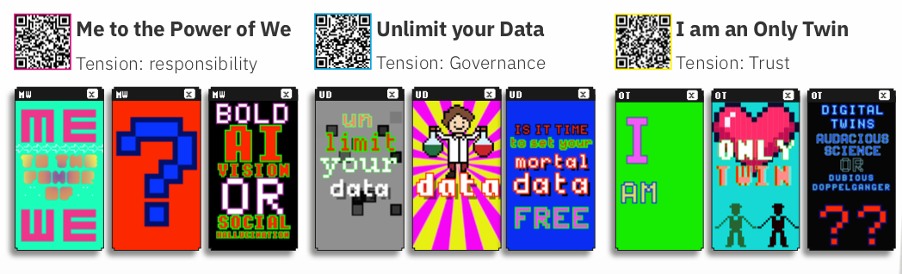
Believer:             Me to the power of We

This focused on the belief that AI can extrapolate the individual into an empowering collective force, thereby creating a people-powered movement for better

Soldier:                Un-limit your data

This focused on the practical benefit of unleashing value and possibility in your personal data in the short term while building cumulative benefits in the long term. 

Cynic:                    I am an only twin

This focused on individual agency and privacy, and the rejection of potentially misrepresentative digital twinning as a viable and secure solution for improving our existence.  

Of the four, the team chose three to develop into meme-like, highly sharable engagement assets that focused on our predefined ethical areas of Responsibility, Governance and Trust.

Working with Jonathan Barnbrook, the world-renowned designer and film maker, we developed three communications assets, each designed to be bright, compelling, playful and social. The art of them is that, though seemingly simple, each was designed to be capable of carrying the conversation to far deeper and more complex levels if the audience or conversation desired. This would be facilitated by a pre-loaded LLM-driven dialogue on the site the assets linked to. This forum allowed interested parties to test the edges of their thoughts, opinions, and observations on digital twins and synthetic data without judgement in real time.
All of which brings us to that Groundhog Day reference.

Once you’ve found ways of simplifying and interpreting complex scientific, medical, and technological subject matter into more human everyday terms, the door opens to more emotionally driven, lighter touch forms of communication. This shift in mind set helps create a new way of looking at things unfettered from the constraints of clinical rigour and ‘correct’ language.

For example: one of the core benefits of a digital twin is that it can take your real life individual health data sets, conflate them with a ‘big data’ set of similar individual data and, pretty much at the speed of light, extrapolate vast numbers of scenarios and outcomes using the same core data; rolling through a teeming succession of ‘loops’ that explore every eventuality and possibility to create a loose prediction of outcomes.

If we apply our more pop cultural mind set to this benefit to create a more engaging conversation starter, we might say that a digital twin is our own algorithmic ‘Phil Connors,’ [the name of the weather man in the 1993 movie], capable of ‘living’ through its own bespoke digital Ground Hog Day of eternal loops to arrive at a better health outcome.

This thought might in turn lead to a simple playful messaging stack:

Groundhog healthcare, or just more AI run riot?

Where’a your head at on digital twins?

Join the conversation

Sure, the example requires people to know the premise of the film to be engaging and compelling [know your audience] – but it doesn’t detract from the potential of more creative framings and stories to help us better engage ordinary people in highly complex subject matter.

That only seems like a good thing to do.

Note: The one thing I’ve realised is that, in using the Ground Hog Day metaphor for Synthetic Data and Digital Twins, I’m comparing some of the most advanced medical science we have to the solitary Groundhog or Marmota monax. Trivialising? Perhaps; but following that logic, if we’re honest, we’re all a little bit ‘Phil Connors,’ sometime, somewhere, somehow.

Creativity, the Cosmic Fizz & the storytellers of science and faith

14 Friday Feb 2014

Posted by Thin Air Factory in Uncategorized

≈ 2 Comments

Tags

Cosmic Fizz. Atoms Never Die, Creativity, Evolution, faith, Greek Philosophy, Human resilience, Infinity, Life Of Pi, Morality, Mythology, Nihilism, Nirvana, Omar Khayyam, Optimism, Oscar Wilde, Philosophy, Romanticism, Rubaiyat, Science, Sentimental data, Spinal Tap, Story telling, Sustainability Experts, Transcendental Meditation

imgres

Adult Pi Patel: So which story do you prefer?

Writer: The one with the tiger. That’s the better story.

Adult Pi Patel: Thank you. And so it goes with God.

Writer: It’s an amazing story.

I love this piece of writing from the Life Of Pi – because it goes to the heart of everything I believe in as a storyteller by trade and by passion.

It also points to the most sublime collision of existence and creativity for me.

The brutal truths of everything we are, that we come from, exist amongst, experience, endure and prevail upon are in themselves poetic and beautiful. But there is something so human about our need to embellish the flat dry expanse of these truths; to make them greater, more fantastic: our need to story tell around them. There is for me a perfect conflicted symmetry: of both hubris and humility in our need to do it.

That we want to use our consciousness, and the gifts of existential self-perception that it brings to ‘big ourselves up’ in the species department is par for the course. The ascending arrogance of increasing predominance is so expected as to be almost dull.

But in seeking to story tell around such profound and all enveloping concepts: of existence, creation, death, belief, faith, survival – we are also admitting that the base nature of them is simply too overwhelming to us to comprehend in their pure form, too complex and exceptional for us to divine without reduction and simplification. (Sustainability experts take note!!)

So story-tell them we have. Between Reason and Faith, the scattered facts and dynamic data of our human condition and the absolute nature of our relationship with the world in which we bear it are rendered.

In the parables, cautionary tales, prophesies, miracles, fairy tales, wisdoms, mythologies, metaphors, legends, monoliths and dream catchers, we find storytelling that is wonderful, hopeful, brutal, yet optimistic – transforming the data of our reality into ‘the one with the tiger’.

The giddying ascent of some of these ‘tiger stories’ as I will now call them into regional and world movements of dogmatic faith inevitably has seen them dragged into service as the spiritual slings and arrows of marauding armies. In doing so they have both exported a negative arrogant shading of their ‘tiger story’ while importing a culture of cruelty, violence and division into the heart of it.

It is unclear to me whether this conflicted nature is inherent within the cosmic fizz or purely a product of it. Regardless, in the evolution of these ‘tiger stories’, they have proven themselves wholly capable of extreme polarities of positive and negative outcome: the Atomic Bomb and The Inquisition being two such glorious (western) examples.

I would venture though that it is the base corruption of the storytelling concepts – and the flags and actions that they are seen to have resided over that despoils them, not the nature of the story itself or the faith or reason upon which they are built.

As Oscar Wilde pointed out quite rightly – there is not such thing as a moral or an immoral book. Books are well written or badly written. That is all. The storytelling is not where the problem lies.

It is the questionable moralities of human interpretation and subsequent actions undertaken in the name of something; be it science, faith or any other where the spoiling starts. A wantonly childish and proprietary approach it seems: It’s my toy so I’ll smash it if I want to.

I believe that if we took the smashers from all sides – the pedants, the inquisitors, the lunatics and the absolutists – the ‘my book’s better than your book and oh, by the way it’s the only book’ crowd and the equally intransigent and nihilistic ‘faith is the great cop out, the great excuse’ polemicists and shoved them in a large room and closed the door we might start the conversation again.

If we did, I think we might find that the people of science and the people of faith are connected at a deeper level than either their rigour or dogma would like to admit – and the immutable truth of that fact is being obfuscated by what is in fact on deeper interrogation a stylistic disagreement – like the one that exists in the land of storytellers between the purveyors of muscular contemporary prose and those of classic highly mannered poetry.

There is a tremor of violent agreement that runs between them that remains unnoticed (to themselves certainly) probably due to the deafening and cacophonous nature of their own ‘combative noise’.

When particular men of science call religion a fiction the only issue that arises in that emphasis for me is the inference that it is a fiction rooted in no factual or reasonable truth. Well, I am currently jury’s out on that absolutism and here’s for why.

In my wish to not polarize or propagandise my children and in answer to the question “what is heaven daddy?” (the inconvenient inquisition of children is the most brutal of examinations) I have netted out at this story-teller’s logic, and it begins with science:

Atoms never die. They just reassemble re-task and reintegrate themselves in a new form.

So, we are all one great big mass of finite circulating particles. Amazing.

In which case, if we were, theoretically at least, able to pull focus on the physical world in which we exist to reveal that great big mass of finite chaotic swirling particles; to reveal its sub and supra atomic nature, we would perhaps reveal a singular phenomena – the cosmic atomic fizz of everything. (Eat that challenge Google Glass!)

133,000,000,000,000,000,000,000,000,000,000,000,000,000,000,000,000 atoms swirling around dynamically, condensing clustering conflating and coagulating for a brief while in every visible and invisible material thing we know and many we don’t, before deconstructing and reconstructing themselves somewhere else along the way.

Now your brain might be so huge as for there to be little issue for you in contemplating the jaw dropping magnitude of this, but (certainly for my tiny self absorbed brain) this is a concept so vast so complex and so overwhelming to the average human being that we would struggle to grasp its meaning.

And we hate that, us humans, the ‘can’t quite get it’ thing. It makes us feel a little small, stupid and out of control, so, we use storytelling to simplify and sort the problem. To order the cosmos. Bring ourselves closer to it.

In this instance I think we’ve effectively taken the jaw dropping magnitude of the cosmic particular mass, stuck a beard on it and called it Norman.

This is not to say that the creation of the mass, how it got there, what drove it and what the point of it all is doesn’t exist in the pantheon of life’s big questions, but I’ll leave that to David St Hubbins of Spinal Tap to ask that question for all of us:

“If the universe is indeed infinite, then how…what does that mean? How far is all the way, and then… if it stops, what’s stopping it, and what’s behind what’s stopping it? So, what’s the end you know, is my question…to you”

The moment where human interpretation and the nature of our existence meet is at the moment we decide to call the infinitely finite cosmic particular fizz a name, embody it in some divine yet recognizable (like us) form, allow it to take human form, or simply see itself at work in ourselves and in all things around us.

But if we’re tooling down the storytelling pathway of the immortal atoms, lets round out the characters first shall we.

That the breath of Moses, The Christ, Buddha and the prophet Mohammad are still in the world, atomically speaking, is an incredible, philosophically charged and mind-boggling thing. But in that we must also accept that so too are the breath of Hitler, Genghis Khan and Jack The Ripper.

Our simple survival evolutionary selves have spent millennia trying to identify filter and prioritise the data of danger, relentlessly, restlessly seeking clarity around what might hinder or hurt us. So even the earliest storytellers will have been thinking of and framing our existence in very simple structural terms predicated on understanding the simple signs that guide us:

Crisp bright coloured plant: tasty and makes me feel perky = GOOD

Dark brown stinking plant: Whole village dead from soup of it = BAD

Large Screaming Drooling Sabre Tooth: Ate my mother. Ugh = BAD

Small trembling rabbit like creature: Ate for supper. Yum = GOOD

I sense the same simple storytelling principle has been applied to the cosmic fizz.

That the particular nature of the cosmic fizz can cluster and form into larger entities beautiful, brutal or otherwise inane and inert (read Turner, the Terror, Trousers and Taramasalata) demonstrates that the cosmic atomic fizz is indeed nuanced positively and negatively in ways far more cognitive and philosophical than just how those particles are charged

So, it’s no surprise that some of the earliest storytellers will refer to similarly complex concepts in the simplified form of perhaps good things and bad things, nice place not nice place, or a heaven and a hell perhaps.

We have ample evidence of where the commonalities of our beliefs, philosophies, reasoning, values and mantras – the cultures of science faith, culture and philosophy – meet, in turn finding little to differentiate or choose between them. In The Picture Of Dorian Grey the collision of ancient greek texts and philosophy, Christian morality, Islamic beliefs, eastern mysticism, Romanticism and the mind of the scientist and mathematician we find in the author’s use one of the texts from the Rubaiyat Of The Omar Khayyam (translation: the shoulder of Faith) is to me the most perfect of examples:

“I sent my soul through the invisible

Some letter of the afterlife to spell: 

And by and by my Soul return’d to me, 

And answer’d: ‘I Myself am Heaven and Hell”

Storytellers from every shape and shade of tribe and belief have either knowingly or unknowingly reshaped and molded the brutal nakedness of this atomic dynamism into concepts of things, beings, feelings, spirits or forces, eternally alive within everything, including ourselves.

Over time we have come to believe that our ability to connect with these forces – the ability to feel them, see them, understand them, call on and capture the essence of them – is representative of a higher state of being and existence – something to aspire to and yearn for – as an elevation out of the brutal reality of survival.

Trans-substantiation, The essential Fire, The Holy Spirit, Nirvana, Reincarnation, The Great Spirit, Sacred texts. Every one of them resides at the junction where the storyteller sits. But to simply dismiss them as ‘spun’ fictions is to mitigate what they intend to communicate, the beliefs they contain or what they are seeking to point to, however clumsily or fantastically the critic might feel they are doing it.

I believe that these stories are part of what makes humanity more resilient (not always a good thing). They exist because our evolutionary gene-pool need to prevail and the traits and tools that we need to endure in extremis require far more than just physical attributes.

It demands a strength of mind that perceives itself far greater than the sum of the physical parts it controls. An absolute belief in ones ability to complete an action, test or challenge, come what may, is what enables us to prevail against all odds.  These examples of shared and disseminated storytelling enable human beings, social by nature and with an innate sense of collectivism, to transcend the confines of their physical truth. To prevail is to be optimistic (a form of positive delusion or illusion perhaps but no less powerful because of it), disposed to expecting the best of things.

But Optimism needs to be written, because it is not innate.

We all understand the brutalities of existence. Fight or Flight is innate. Primal ferocity as a predatory or defensive mechanism is innate (learned gleaned or forced over time) a living echo of all previous experience of our ancestors. We all understand that science is emotionally inert: it carries no sentiment other than through the emotional human impact of its comprehension or application.

Our emotional nature as seen through the scientific lens is simply a transportable cache of sentimental data – a form of big human data collated and conflated over millennia; cross related through social memory and learning by us to create what we believe to be a conscious, feeling aware creature with inbuilt reflexive and intuitive responses.

But the positive halo of optimism – a mannered elevating way in which we choose to capture the positive outcomes of the brutal innate truths – is in itself a lever and generator of resilience in regards to human existence and our ability to prevail.

Story telling, especially that which is designed to be passed down and around is a massive factor in predisposing fractured scattered battered tribes and communities towards constructing more positive outcomes for themselves. The shared beliefs that storytelling can engender is testament to that.

Storytelling is where the resilience of humanity lies. Even in the realm of science and the learned institutions, I would venture that there is a marked difference between those professors who light a fire in the heart and minds of the students who seek to learn from them and those that don’t regardless of both academics singing from the same curricular song sheet. The education that stays with you is that which is shaped to be remembered, not learned to be forgotten. It is only through the stickiness of more enlightening communication that we ascend and improve and bolster ourselves against the odds.

Is the culture of ‘stories spun’ open to abuse? Yes: The speed at which storytelling can moves from parables, myths and cautionary tales of improving and guidance, and of things greater than ourselves to being a corrupted propagandised text with the sole intention of suppressing, controlling and excusing untold inhumanities and predations is all too clear across history.

Should it, for that very reason, be set aside and simply forgotten? Should we make do with the less dramatic, less shiny, less embroidered version of our existence? What surrounds us and is within is us is certainly beautiful and amazing enough (though some would argue even our driest concept of self has been brilliantly inked to some extent by millennia of human storytelling)

Should we look at ourselves in the mirror without gods, tigers, and miracles to obfuscate the view? Some would argue most certainly.

Nonetheless, I would not (and given my trade could not) dismiss the story teller from the court of human existence. I could not contemplate a life without ‘tiger stories’. I believe that humanity would be less capable of great things and less resilient without them.

And rest.

Subscribe

  • Entries (RSS)
  • Comments (RSS)

Archives

  • August 2026
  • June 2026
  • May 2026
  • April 2026
  • March 2026
  • November 2025
  • September 2024
  • June 2021
  • December 2020
  • August 2020
  • April 2020
  • March 2020
  • January 2020
  • October 2019
  • June 2019
  • April 2019
  • November 2018
  • August 2018
  • June 2018
  • February 2018
  • January 2018
  • December 2017
  • November 2017
  • August 2017
  • July 2017
  • June 2017
  • May 2017
  • March 2017
  • January 2017
  • December 2016
  • November 2016
  • October 2016
  • September 2016
  • August 2016
  • June 2016
  • May 2016
  • April 2016
  • March 2016
  • February 2016
  • December 2015
  • November 2015
  • October 2015
  • September 2015
  • August 2015
  • July 2015
  • June 2015
  • May 2015
  • April 2015
  • March 2015
  • January 2015
  • December 2014
  • November 2014
  • October 2014
  • September 2014
  • August 2014
  • June 2014
  • May 2014
  • April 2014
  • March 2014
  • February 2014
  • January 2014
  • December 2013
  • November 2013
  • October 2013

Categories

  • Uncategorized

Meta

  • Create account
  • Log in

Blog at WordPress.com.

Privacy & Cookies: This site uses cookies. By continuing to use this website, you agree to their use.
To find out more, including how to control cookies, see here: Cookie Policy
  • Subscribe Subscribed
    • thinairfactoryblog
    • Join 28 other subscribers
    • Already have a WordPress.com account? Log in now.
    • thinairfactoryblog
    • Subscribe Subscribed
    • Sign up
    • Log in
    • Report this content
    • View site in Reader
    • Manage subscriptions
    • Collapse this bar
Loading Comments...