
Tags
cambridge-university, digital-twins, dreamers-believers-soldiers-cynics, groundhog-day, pop-culture, Story telling, synthetic-data
Yes. That Groundhog Day: Punxsutawney, a small furry creature, ‘Phil Connors,’ the belligerent weather man, blizzards, eternal loops, and love, eventually.
But what’s Groundhog Day got to do with Digital Twins, synthetic data, and ethics I hear you not necessarily ask?

Well, to explain that I would first need to refer you to a very interesting project I was invited to join by Dr. Daniela Boraschi.
Daniela and the team were putting together an approach as part of the Creativity for Scientific Change project. The outputs resulting from that approach were eventually encapsulated in a poster Daniela and the team developed for conferences, entitled Ethics beyond compliance. Embedding dialogic reasoning in biomedical research.
The poster has now been put forward as a commentary submission to the special issue Societal Perspectives on Digital Twins in the journal Data & Policy (Cambridge University Press). An exciting journey undertaken by a wide reaching team to create something remarkable.
So let’s have closer look at the journey that bought Daniela and the team to this point.
From the beginning, Daniela and her team set out to work with a broad cohort of AI scientists, designers, and public engagement scholars to explore how ethical reflection can be embedded in the earliest stages of biomedical research on digital twins.
She had been spurred into action by some AI scientists’ ethical concerns over the lack of consultation and public debate around the development, deployment and social impact of digital twins and the synthetic data models they relied upon.
Could we use the ‘unreasonable power of creativity to move the dial on greater engagement in the ethical conversation? Could using a more creative way of speaking to and on such complex matters drive the change these scientists were seeking?
At the heart of this exploration lay a challenge. How do we ignite open approachable conversation, reflection and dialogue around what are, to most ordinary people, highly complex and often arcane subjects.
How do we start to plumb the ethical depths of digital twins? How do we find the right framings and language to enable people to explore, debate and reconcile some of the ethical challenges that arise around Responsibility, Governance and Trust concerning the use of highly sophisticated AI models?
Unsurprisingly, most communications in science lead with the science and benefits, and rarely allow for the more banal very human dimensions of emotionally driven discourse. This required a lighter touch and far more human approach.
We needed some creative tools to unlock more compelling and engaging ‘social first’ ways of creating engagement.
Firstly we used a simple insight approach carried across from previous works on Only Human; a project that focused on sparking better conversations with the general publics around genomic medicine.
In that project, we had found that most every person, from scientists & clinicians [less likely] to general publics [more likely] bring so much more than just a rational linear understanding of the subject matter to the conversation.
They bring the accumulated ‘noise’ of their own unique personal perspectives and beliefs: shaped by upbringing, faith if any, community, culture, and the formalised societal perspectives and morals they live by and within. But importantly, they also bring with them a random collection of messy, often ill-formed, irrational, unverified, and often politicised views, ‘news’ and social apocrypha on various topics and subjects that they’ve picked up along the way [e.g. :The Nikki Minaj Effect; regarding a tweet claiming that Covid Vaccines caused impotence].
We call this insight model Myths, Monsters & Misconceptions. It offers a simple way of bucketing the morass of hopes, fears, antagonisms, concerns, confusions, conspiracies, and misunderstandings that can reside in even the most well informed person, in easier and less arcane terms.
This insight model allowed us to explore ideas and framings that used more open, sharable, almost meme-like everyday language or pop cultural referencing to express or encapsulate the complexity of feeling on the subject of synthetic data and digital twins.
Secondly, to bring some strategic order to the communications we intended to design and create, I also applied my own proprietary thinking tool: Dreamers, Believers, Soldiers & Cynics [DBS&C] to help organise our randomised thoughts into a framework. The tool uses 4 simple, easy-to-understand personas through which teams can explore and interrogate any topic or subject matter through four different lenses to create further insight, consensus and action.
The Dreamer tends to have a more utopian vision, whereas the Believer resides more in the realistic optimism space. Soldiers by their nature are focused on practical implementation and strategy, and the Cynics are responsible for a more sceptical, critical interrogation and perspective.
I used the DBS&C model to interrogate our original messy set of language, thoughts and ideas. The tool enabled us to identify and define a tight set of four creative themes and ideas that used the insight and nature of each of the DBS&C personas to generate positions for our prospective comms assets:
Dreamer: Me, Myself & AI
This focused on the unlimited potential of a seamless alignment between the individual and the expanse of AI tools that could improve and elevate their human existence.
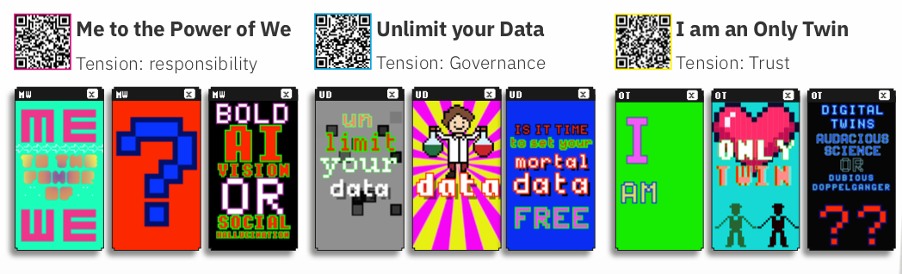
Believer: Me to the power of We
This focused on the belief that AI can extrapolate the individual into an empowering collective force, thereby creating a people-powered movement for better
Soldier: Un-limit your data
This focused on the practical benefit of unleashing value and possibility in your personal data in the short term while building cumulative benefits in the long term.
Cynic: I am an only twin
This focused on individual agency and privacy, and the rejection of potentially misrepresentative digital twinning as a viable and secure solution for improving our existence.
Of the four, the team chose three to develop into meme-like, highly sharable engagement assets that focused on our predefined ethical areas of Responsibility, Governance and Trust.
Working with Jonathan Barnbrook, the world-renowned designer and film maker, we developed three communications assets, each designed to be bright, compelling, playful and social. The art of them is that, though seemingly simple, each was designed to be capable of carrying the conversation to far deeper and more complex levels if the audience or conversation desired. This would be facilitated by a pre-loaded LLM-driven dialogue on the site the assets linked to. This forum allowed interested parties to test the edges of their thoughts, opinions, and observations on digital twins and synthetic data without judgement in real time.
All of which brings us to that Groundhog Day reference.
Once you’ve found ways of simplifying and interpreting complex scientific, medical, and technological subject matter into more human everyday terms, the door opens to more emotionally driven, lighter touch forms of communication. This shift in mind set helps create a new way of looking at things unfettered from the constraints of clinical rigour and ‘correct’ language.
For example: one of the core benefits of a digital twin is that it can take your real life individual health data sets, conflate them with a ‘big data’ set of similar individual data and, pretty much at the speed of light, extrapolate vast numbers of scenarios and outcomes using the same core data; rolling through a teeming succession of ‘loops’ that explore every eventuality and possibility to create a loose prediction of outcomes.
If we apply our more pop cultural mind set to this benefit to create a more engaging conversation starter, we might say that a digital twin is our own algorithmic ‘Phil Connors,’ [the name of the weather man in the 1993 movie], capable of ‘living’ through its own bespoke digital Ground Hog Day of eternal loops to arrive at a better health outcome.
This thought might in turn lead to a simple playful messaging stack:
Groundhog healthcare, or just more AI run riot?
Where’a your head at on digital twins?
Join the conversation
Sure, the example requires people to know the premise of the film to be engaging and compelling [know your audience] – but it doesn’t detract from the potential of more creative framings and stories to help us better engage ordinary people in highly complex subject matter.
That only seems like a good thing to do.
Note: The one thing I’ve realised is that, in using the Ground Hog Day metaphor for Synthetic Data and Digital Twins, I’m comparing some of the most advanced medical science we have to the solitary Groundhog or Marmota monax. Trivialising? Perhaps; but following that logic, if we’re honest, we’re all a little bit ‘Phil Connors,’ sometime, somewhere, somehow.

