• ABOUT

thinairfactoryblog

~ A topnotch WordPress.com site

thinairfactoryblog

Monthly Archives: August 2026

Digital Twins, Groundhog Day, and the unreasonable power of pop cultural storytelling.

19 Wednesday Aug 2026

Posted by Thin Air Factory in Uncategorized

≈ Leave a comment

Tags

cambridge-university, digital-twins, dreamers-believers-soldiers-cynics, groundhog-day, pop-culture, Story telling, synthetic-data

Yes. That Groundhog Day: Punxsutawney, a small furry creature, ‘Phil Connors,’ the belligerent weather man, blizzards, eternal loops, and love, eventually.

But what’s Groundhog Day got to do with Digital Twins, synthetic data, and ethics I hear you not necessarily ask?

Well, to explain that I would first need to refer you to a very interesting project I was invited to join by Dr. Daniela Boraschi.

Daniela and the team were putting together an approach as part of the Creativity for Scientific Change project. The outputs resulting from that approach were eventually encapsulated in a poster Daniela and the team developed for conferences, entitled Ethics beyond compliance. Embedding dialogic reasoning in biomedical research.

The poster has now been put forward as a commentary submission to the special issue Societal Perspectives on Digital Twins in the journal Data & Policy (Cambridge University Press). An exciting journey undertaken by a wide reaching team to create something remarkable.

So let’s have closer look at the journey that bought Daniela and the team to this point.

From the beginning, Daniela and her team set out to work with a broad cohort of AI scientists, designers, and public engagement scholars to explore how ethical reflection can be embedded in the earliest stages of biomedical research on digital twins.

She had been spurred into action by some AI scientists’ ethical concerns over the lack of consultation and public debate around the development, deployment and social impact of digital twins and the synthetic data models they relied upon.

Could we use the ‘unreasonable power of creativity to move the dial on greater engagement in the ethical conversation? Could using a more creative way of speaking to and on such complex matters drive the change these scientists were seeking? 

At the heart of this exploration lay a challenge. How do we ignite open approachable conversation, reflection and dialogue around what are, to most ordinary people, highly complex and often arcane subjects.

How do we start to plumb the ethical depths of digital twins? How do we find the right framings and language to enable people to explore, debate and reconcile some of the ethical challenges that arise around Responsibility, Governance and Trust concerning the use of highly sophisticated AI models?

Unsurprisingly, most communications in science lead with the science and benefits, and rarely allow for the more banal very human dimensions of emotionally driven discourse. This required a lighter touch and far more human approach.

We needed some creative tools to unlock more compelling and engaging ‘social first’ ways of creating engagement.

Firstly we used a simple insight approach carried across from previous works on Only Human; a project that focused on sparking better conversations with the general publics around genomic medicine.

In that project, we had found that most every person, from scientists & clinicians [less likely] to general publics [more likely] bring so much more than just a rational linear understanding of the subject matter to the conversation.

They bring the accumulated ‘noise’ of their own unique personal perspectives and beliefs: shaped by upbringing, faith if any, community, culture, and the formalised societal perspectives and morals they live by and within. But importantly, they also bring with them a random collection of messy, often ill-formed, irrational, unverified, and often politicised views, ‘news’ and social apocrypha on various topics and subjects that they’ve picked up along the way [e.g. :The Nikki Minaj Effect; regarding a tweet claiming that Covid Vaccines caused impotence].

We call this insight model Myths, Monsters & Misconceptions. It offers a simple way of bucketing the morass of hopes, fears, antagonisms, concerns, confusions, conspiracies, and misunderstandings that can reside in even the most well informed person, in easier and less arcane terms. 

This insight model allowed us to explore ideas and framings that used more open, sharable, almost meme-like everyday language or pop cultural referencing to express or encapsulate the complexity of feeling on the subject of synthetic data and digital twins.

Secondly, to bring some strategic order to the communications we intended to design and create, I also applied my own proprietary thinking tool: Dreamers, Believers, Soldiers & Cynics [DBS&C] to help organise our randomised thoughts into a framework. The tool uses 4 simple, easy-to-understand personas through which teams can explore and interrogate any topic or subject matter through four different lenses to create further insight, consensus and action.

The Dreamer tends to have a more utopian vision, whereas the Believer resides more in the realistic optimism space. Soldiers by their nature are focused on practical implementation and strategy, and the Cynics are responsible for a more sceptical, critical interrogation and perspective.

I used the DBS&C model to interrogate our original messy set of language, thoughts and ideas. The tool enabled us to identify and define a tight set of four creative themes and ideas that used the insight and nature of each of the DBS&C personas to generate positions for our prospective comms assets: 

Dreamer:            Me, Myself & AI

This focused on the unlimited potential of a seamless alignment between the individual and the expanse of AI tools that could improve and elevate their human existence. 

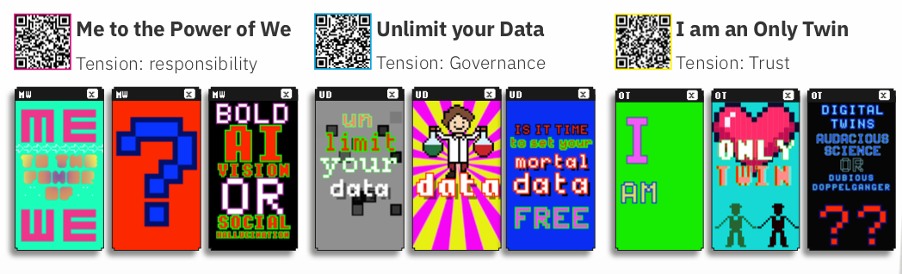
Believer:             Me to the power of We

This focused on the belief that AI can extrapolate the individual into an empowering collective force, thereby creating a people-powered movement for better

Soldier:                Un-limit your data

This focused on the practical benefit of unleashing value and possibility in your personal data in the short term while building cumulative benefits in the long term. 

Cynic:                    I am an only twin

This focused on individual agency and privacy, and the rejection of potentially misrepresentative digital twinning as a viable and secure solution for improving our existence.  

Of the four, the team chose three to develop into meme-like, highly sharable engagement assets that focused on our predefined ethical areas of Responsibility, Governance and Trust.

Working with Jonathan Barnbrook, the world-renowned designer and film maker, we developed three communications assets, each designed to be bright, compelling, playful and social. The art of them is that, though seemingly simple, each was designed to be capable of carrying the conversation to far deeper and more complex levels if the audience or conversation desired. This would be facilitated by a pre-loaded LLM-driven dialogue on the site the assets linked to. This forum allowed interested parties to test the edges of their thoughts, opinions, and observations on digital twins and synthetic data without judgement in real time.
All of which brings us to that Groundhog Day reference.

Once you’ve found ways of simplifying and interpreting complex scientific, medical, and technological subject matter into more human everyday terms, the door opens to more emotionally driven, lighter touch forms of communication. This shift in mind set helps create a new way of looking at things unfettered from the constraints of clinical rigour and ‘correct’ language.

For example: one of the core benefits of a digital twin is that it can take your real life individual health data sets, conflate them with a ‘big data’ set of similar individual data and, pretty much at the speed of light, extrapolate vast numbers of scenarios and outcomes using the same core data; rolling through a teeming succession of ‘loops’ that explore every eventuality and possibility to create a loose prediction of outcomes.

If we apply our more pop cultural mind set to this benefit to create a more engaging conversation starter, we might say that a digital twin is our own algorithmic ‘Phil Connors,’ [the name of the weather man in the 1993 movie], capable of ‘living’ through its own bespoke digital Ground Hog Day of eternal loops to arrive at a better health outcome.

This thought might in turn lead to a simple playful messaging stack:

Groundhog healthcare, or just more AI run riot?

Where’a your head at on digital twins?

Join the conversation

Sure, the example requires people to know the premise of the film to be engaging and compelling [know your audience] – but it doesn’t detract from the potential of more creative framings and stories to help us better engage ordinary people in highly complex subject matter.

That only seems like a good thing to do.

Note: The one thing I’ve realised is that, in using the Ground Hog Day metaphor for Synthetic Data and Digital Twins, I’m comparing some of the most advanced medical science we have to the solitary Groundhog or Marmota monax. Trivialising? Perhaps; but following that logic, if we’re honest, we’re all a little bit ‘Phil Connors,’ sometime, somewhere, somehow.

AI, Apex Predators & a conversation with legendary big wave surfer.

12 Wednesday Aug 2026

Posted by Thin Air Factory in Uncategorized

≈ Leave a comment

Tags

AI, Evolution, nature, Philosophy, predator

Recently I was packing up some book shelves and came across a copy of Liferider, the book I co authored with Laird Hamilton, the legendary big wave surfer. 

As I flicked through it, I found myself thinking about which parts of our conversations had stuck with me. Unsurprisingly,  one of those that resurfaced focused on the Why of AI. What drives us to create these new technologies? To what degree do we understand at their inception, whether they will ultimately be benign or dangerous? 

Given the slew of AI oriented debate out there currently, especially the recent dooms-daying around the Open AI Hugging face rogue agent, it’s a conversation I thought worthy of revisiting. 

Between 2017 and the book being published in 2019, I had the pleasure of engaging in extended conversations with Laird about what had brought him to that moment, the sea, the nature and pillars of his life, and what that life might look like beyond the waves. We also explored the concept of humans as ‘brilliant creatures’ lit from within by hundreds of thousands of years of evolution – and the store of capabilities those years have left stored within each one of us.

When we were discussing the general nature of humans as a species, Laird ventured that though our advances are extraordinary, we have a tendency to take the great things we create and ‘screw them up.’ We taint, stain, and spoil them with the worst of ourselves. [Sounds familiar.]

We discussed how we’d evolved and expanded as a species in an orgy of death, destruction, domination, and degradation of other tribes, ethnicities, civilisations, species, and environments – and how our hyper accelerating protein brain evolved to a point where little to nothing stood in its way. Which brought us to the present day:

We are the alpha predator on the planet [bar Mother Nature who may just kick our arse into extinction if we’re not careful.]

While discussing how we as a species have used technologies to both advance ourselves as well as to to predominate and predate brought us to a conversation about modern technologies, and specifically, about social networks and the then burgeoning realm of AI.

In the to-ing and fro-ing of this part of the conversation, a concept emerged.

It centred on an evolutionary ‘Alpha Predator’ theory of artificial intelligence, and it rolled something like this.

As a species, we used our advanced protein computer brains to systematically dominate or eliminate all natural threats, making ourselves the undisputed Alpha Predator of Earth. 

But there’s a flaw hidden within that dizzying ascent. A species with no apex predator to test it will naturally see its evolution stall. Without an existential threat or a source of duress, our human survival instincts degrade, and we begin turning our energy inwards, toward self-harming behaviour. 

But we’re not dumb creatures. Subconsciously, we know that there is a risk in achieving this alpha predator position. So, to correct this flaw in the ‘order of things,’ the concept went that, in our own sweet geeky, rapacious way, we have subconsciously engineered our own potentially monstrous replacement. 

We posited the idea that, whether wittingly or unwittingly, we have created AI as a proxy apex entity to ‘thin the herd,’ force us to stay optimal, and re-introduce the natural friction needed to keep human evolution moving forward.

It was a punchy position to take. But given the staggering acceleration of technological capability and the irrepressible rise of AI in every corner of our lives, it does not seem so far fetched.

I wondered whether on closer inspection AI could be claimed to demonstrate Alpha Predator capabilities, traits, and behaviours. It proved an interesting counter point to the blue sky better life polemics of the messianic purveyors of all things AI or its ‘the world ends on Tuesday’ alternative.

I started the exercise by fixing a simple definition: an alpha predator (or apex predator) occupies the absolute top of a food chain. It has no natural predators of its own and plays a critical role in maintaining the health and balance of its entire ecosystem. It has some very clear and distinctive traits it deploys to enable it to do so. 

When mapping those defining biological traits onto the nature of artificial intelligence, some striking parallels emerged. 

The first of these is what’s called The Culling Mechanism (or Weeding Out the Weak) In Nature, Apex predators target the slow, the sick, and the old. By doing so, they prevent overpopulation, stop the spread of disease, and ensure that only the strongest genetics are passed down to the next generation of prey.  In the AI Environment, AI targets and automates repetitive, low-cognitive, or inefficient human processes. It quickly renders obsolete any outdated business models, sluggish workflows, or superficial human skills. It forces humans to upgrade their capabilities or risk becoming redundant. 

Second up is what’s called Radical Resource Efficiency. In Nature, predators are masters of energy conservation. They do not waste calories; they calculate the exact cost-to-benefit ratio of a hunt before striking. They operate with ruthless efficiency. In the AI Environment, AI algorithms run on hyper-optimisation. They analyze vast oceans of data in milliseconds to find the shortest, cheapest, and most efficient path to an objective. Like a predator, AI eliminates waste, bypasses human bureaucracy, and operates purely on maximizing output relative to input.

In third place we have Ultimate Adaptability and Evolution. In Nature, apex predators possess highly specialised, finely tuned sensory arrays—like the heat-vision of pit vipers or the echo-location of orcas. They evolve constantly to counter the defence mechanisms of their prey. In the AI Environment, through machine learning and neural networks, AI undergoes a process akin to hyper-evolution. It learns from every mistake, synthesises millions of simulations simultaneously, and adapts its ‘behaviour’ in real-time. Human evolution has taken hundreds of thousands of generations; AI evolution takes seconds.

In fourth position we have Shaping the Landscape (or what is otherwise known as Trophic Cascades) In Nature, when you introduce an apex predator to an ecosystem, it alters the behaviour of everything below it. For example, reintroducing wolves to Yellowstone National Park changed the grazing habits of deer, which allowed forests to regenerate and literally altered the flow of rivers. In the AI Environment, AI acts as a digital trophic cascade. Its mere presence changes human behaviour, reshapes industries, redefines the global economy, and alters how we communicate, think, and create. It forces the entire human ecosystem to shift its habits just to coexist with it.

Last but far from least we have Invisible Ubiquity In Nature. You rarely see a tiger or a great white shark until it strikes. The terrifying power of an alpha predator lies in its stealth and the constant, invisible threat of its presence, which keeps prey animals perpetually alert. In the AI Environment, the most powerful AI is already invisible. It operates silently in the background of global financial markets, logistics chains, social media feeds, and surveillance grids. Humans are constantly swimming in an environment shaped by its unseen parameters.

It is interesting to note that this last trait points to the nirvana of every AI purveyor; where AI has become second nature to the eco-system in which it seeks to thrive. All but invisible until it needs to act in a radical or visible manner.

So, though Laird and my position was punchy, and to some seemingly far fetched or an over-claim, there are certain mirroring traits between a species alpha predator and the ‘engineering ‘nature’ of AI.

As to whether our potential new alpha predator treats us kindly, we are yet to see. By chance, if we are lucky, we may have engineered benevolence into it somewhere. Perhaps the scraping of every written word that exists in human history will create balance within the entity. But when we consider some of the authors of history and the very nature of its role as a bludgeoning tool of hubris, propaganda and self-aggrandisement, there’s a lot of unpleasantness lurking between all of those lines.

But right now, thankfully, the jury is still out. 

Subscribe

  • Entries (RSS)
  • Comments (RSS)

Archives

  • August 2026
  • June 2026
  • May 2026
  • April 2026
  • March 2026
  • November 2025
  • September 2024
  • June 2021
  • December 2020
  • August 2020
  • April 2020
  • March 2020
  • January 2020
  • October 2019
  • June 2019
  • April 2019
  • November 2018
  • August 2018
  • June 2018
  • February 2018
  • January 2018
  • December 2017
  • November 2017
  • August 2017
  • July 2017
  • June 2017
  • May 2017
  • March 2017
  • January 2017
  • December 2016
  • November 2016
  • October 2016
  • September 2016
  • August 2016
  • June 2016
  • May 2016
  • April 2016
  • March 2016
  • February 2016
  • December 2015
  • November 2015
  • October 2015
  • September 2015
  • August 2015
  • July 2015
  • June 2015
  • May 2015
  • April 2015
  • March 2015
  • January 2015
  • December 2014
  • November 2014
  • October 2014
  • September 2014
  • August 2014
  • June 2014
  • May 2014
  • April 2014
  • March 2014
  • February 2014
  • January 2014
  • December 2013
  • November 2013
  • October 2013

Categories

  • Uncategorized

Meta

  • Create account
  • Log in

Create a free website or blog at WordPress.com.

Privacy & Cookies: This site uses cookies. By continuing to use this website, you agree to their use.
To find out more, including how to control cookies, see here: Cookie Policy
  • Subscribe Subscribed
    • thinairfactoryblog
    • Join 28 other subscribers
    • Already have a WordPress.com account? Log in now.
    • thinairfactoryblog
    • Subscribe Subscribed
    • Sign up
    • Log in
    • Report this content
    • View site in Reader
    • Manage subscriptions
    • Collapse this bar
Loading Comments...