verukas, prosperity & the detritus of parental love

Tags

, , , , , , , , , , , , , , , , , , ,

images

Who pandered to her every need?
Who turned her into such a brat?
Who are the culprits? Who did that?
The guilty ones now this is sad
Dear Old Mum and Loving Dad

Is the quality of contemporary parental love destined to go down the garbage chute quickly followed by the children it breeds?

Is the structure on which it is founded becoming increasingly fragile, facile and unsustainable?

Or will our children or grandchildren eventually just turn against us; crippled by their disappointments, and their inability to repeat or recreate the same or a greater quality of life for their own.

We already know that this is the first generation in recorded history that will be passing down a diminished quality of life to their children by our current measures of prosperity.

This question of whether parental love in its current form is unsustainable first raised itself whilst I was trying to assess and deconstruct the current model of prosperity we currently embrace and pursue.

(Let’s face it, for some the highway commercial robbery of Valentines Day, the poisonous barometer of the Tiffany box, Gypsy Weddings and the reoccurring arrival of Kim Kardashian’s latest ‘one and only love’ has firmly flushed the romantic model down the spiritual khazi already)

The exercise in deconstructing prosperity is a major part of a larger one I am undertaking as part of my ongoing involvement with the Dream In A Box initiative and its UK Dream iteration – which in particular terms seeks to Re-imagine the UK model of Prosperity through the transformation of what constitutes a desirous life.

On closer inspection (hardy surprising) it seems that a large part of what makes up our current model of prosperity lies in how we imagine, perceive, measure, pursue, and demonstrate ‘love’ and attachment: to friends, family, prospective partners, spouses and most pointedly our children.

There is no greater demonstration of loving provision and the profound contract of human care it seems than that hosted within the living bond between parents and their children.

But what was once only noted and measured in mostly invisible and passing terms – the degree to which we throw money at our children’s happiness – now seems to be worn like a badge of honour by everyone from the cord-breeched pseudo-toff urban preppy and the polo-shirt & chino mini-mes of the suburbs to the highly singular estate-inhabiting parent with a Burberry buggy.

The integrity of our attendance to our children’s needs and the strength of the love we hold for them now lies in the measure of its social visibility and worth.

We must be ‘seen’ to gladly or otherwise use every scrap of ‘cheap’ money we can get our hands on to further facilitate our children’s ability to hover above the ugly brutal truths of life.

Increasingly our ‘love’ seems to be wholly predicated on the scale of our investment: and not of the balanced, grounding, attentive, affectionate kind.

It would seem that it is wholly acceptable these days for a child to be intellectually stupefied, emotionally ignored, set aside and abandoned or passed over to some one or some thing – a digital device usually or perhaps a new pair of trainers – as long as the parent can be seen to have ‘invested’ at every turn.

From the designer baby clothes they learn to stand up in, to the grotesque and engorging hoards of seasonal gifts they now receive (from skip loads of Easter Chocolate to mountains of Christmas presents) and the increasing quantity of kit they now require to ensure they’re not seen as ‘going without’ – phones tablets game consoles to name a few – the scale of society’s expenditure on the presentation of the ‘loved child’ is staggering.

This is not reserved solely for the ‘kit’ we deck them out with. It seems to infect every corner of the family model for what constitutes a thriving life.

Another hellish tyranny of loving provision embedded in our current model of prosperity is the family holiday.

Even as I typed the words ‘family holiday’ I was suddenly washed in a sun drenched, lens flared, refracted moment of azure blue sky and crystal water splashes; stress free parents and laughing children perfectly framed against a distant white villa horizon speckled and coloured with the lobster clawed, 3 types of fish, pasta, pizza and west Indian slash Asian slash Mediterranean slash Tex Mex slash barbecue buffet.

The tyranny I refer to has nothing to do with the usual clichéd hooting and wailing you hear from many modern parents about the prospect of 2 weeks locked together in some slightly disappointing family resort.

(On that particular matter it will be music to the ears of every emotionally challenged and ‘highly individual’ parent to know that there are now two good reasons as to why that tyranny will quickly become a faint memory. Firstly we are seeing (so the people watchers tell us) that the 2 week block summer holiday meticulously planned and desperately undertaken is in its death throes in the more advanced mature economies. We are taking more and shorter and more impulsive holidays (with all that extra money we all have!!!) And secondly booking.com is chirpily telling any member of the aspirational mobile middle classes who wants to listen that never again will they have to booking arrive to find themselves trapped in some booking desperate, substandard hell-hole with a pool surrounded by drawn-on people and a dodgy booking breakfast buffet – as long as they book with booking dot com that is.)

Given the tsunami of availability and astonishing social pressure to just say yes to everything, it is no surprise that we’re running up a credit-card based personal debt mountain bearing a striking similarity to a Himalayan range built out of bullion and gemstones.

If a family doesn’t get to go on an all you can consume holiday plus a few weekends away and a second holiday thrown in, then they’re not cutting it. That a family with a annual family income of circa £30-40K quietly expects itself to demonstrate its loving provision through multiple holidays abroad is both financially unsustainable and morally questionable.

Education is another ugly social battleground on which ‘love of the child’ is undertaken with everything but balance. True this is a more particular and less universal truth – something usually set aside by the worthy as a First World problem.

It is of course driven by the clawing desperation of the upwardly aspirational middle-middle classes*, (the downwardly aspirational Toffs and upper-middles being otherwise healthily engaged in a swaggering mockney-gangsta walk through White City, Hoxton, Deptford, and the arse-end of Tooting).

These parents are not the first generation to have realised that the route to securing an improving prosperity for your child is a decent education.

The role of education (and skiing holidays for that matter) in social aggrandisement is not new. Parents with a particular predilection for elevating their own narrow lives on the back of the tiniest increment of superiority have been judging their dinner party neighbour by the scale of their educational investment for many decades. But they were (and still are) of a particular rare breed, reasonably cloaked and easily ignored.

What’s particular in the new trend is the frenzy with which the greater majority pursue this madness in the blinding glare of the social spotlight.

Over subscribed schools, post code hopping parents, dodgy intake policies and the see sawing fashion for Public versus independent versus Free versus State versus ‘who said Grammar? I didn’t say Grammar?!’ schools certainly has a lot to answer for.

But that’s still no excuse for the lack of human elegance, the vacuum of discretion, and the gaping hole that seems to have opened up in their ability to circumnavigate the sensitivities of others.

They take a bludgeoning approach to improving the child that is conspicuous by its conspicuity – gratuitous over expectation, intellectual bullying, litanies of after school clubs, multiple tutors, competitive schooling and the most insidious social engineering are all worn in public like a beacon.

Educational trends currently also raise some rather interesting existential questions – of the ‘life-imitating-art-imitating-life’ kind.

The recent Disney-fication of boarding school culture via one small wizard and a place called Hogwarts has had a large number of parents who can ill afford it sending their little darlings to prep and boarding schools ‘because the child demands it’. There’s only so long you can get away with stuffing the fees on a credit card until the house of plastic cards collapses. And love is rarely proven resilient by the relentless use of the word ‘yes’. But that is how society seems to be shaping the model of demonstrable love in a prosperous life. If the child demands it – the loving parent must give it: and blatantly.

For me these are reasonable examples of how warped I believe our sense of how we demonstrate love for the child has become, and evidence of a toxic model of prosperity.

If one takes these lite examples and generously sprinkles them with tons of over packaged brightly coloured and quickly discarded plastic, £400 bikes, theme parks, and mountains of cheap cotton basics with pointless groovy graphics, the landscape of parental love, certainly that currently exercised by the average emerged economy parent, is looking sparkly, cluttered and bleak, and ultimately unsustainable in so many ways.

Is this love of ours Tainted. Maybe. Is it Human. Very.

Is this progress? Perhaps. Or is this simply the gene pool opportunistically wrapping its progeny in as much as it can get its hands on before the moment passes. Most likely.

Regardless. Navigating the modern world and the byways of fruitful love, especially that which we feel and demonstrate for our children, was never going to be easy or simple.

But re-imagination of the model of prosperity we base our life, love and dreams on: one which holds greater store by that which cannot be bought might give us a few more compass points along the way.

It may well also help clear up some of the side issues: like the increasing population of staggeringly spoilt, increasingly sociopathic children… oh and that of personal bankruptcy of course, and a sparsely furnished dotage.

So, veruka cream anyone?

FOOTNOTES

*the middle middle classes are how I refer to a very active, vocal and seemingly forever squeezed section of the British population. They are, in class terms what Mickey Flannagan’s ‘out out‘ is to going out.

The Luxury of Conscience & how the end of the month comes before the end of the world

Tags

, , , , , , , , , , , , , , , , ,

ivory_tower_defenders  There are two phrases that I use often:

The Luxury of Conscience.

The End of the Month comes before the End of the world.

They are my way of arriving at the same point: just from two wholly different ends of the social, strategic and storytelling spectrum.

The point I am usually making? That the narrative that will transform desire, reframe sustainability and re-imagine prosperity is potentially being shaped and moulded by the wrong people.

So what constitutes ‘wrong’ you might ask. And I would venture ‘those who might struggle to empathise with their audience – the 85%+ –  through a lack of real everyday insight and socio-cultural understanding into their lives, needs and desires: that of the ‘lived it been there’ kind.

The Luxury of Conscience is a phrase that I sometimes use when describing such a person – someone who has ability to sit back and engage in the bigger conversations around climate, environment and more sustainable lifestyles, their minds uncluttered by making ends meet, either spiritually or financially.

The ability to exercise and expend their energies and passions on designing a higher order human existence predicated on sustainability is indeed luxurious – proof that they exist in the upper tiers of Maslow’s Hierarchy.

They have the luxury of a ‘comfortable security’ – financial, educational, social and cultural – to see beyond the scrabble for immediate provision; for themselves and their families – of the tyranny of bills, eking out the money until the end of the month comes, trying to avoid the pay day loan light bulb in a head clouded by debt.

It is for this reason that those with the Luxury Of Conscience should never be the people who shape the final vernaculars and narrative for a populist movement towards a more sustainable life.

It is indeed a luxury to live in what seems (to the average bank worker or electrician at least) a rather pompous dislocated 6th Form debating society world, extrapolating concepts and frameworks of improved human existence more akin in discourse to the letters of Hitchens’ and the treatise of Popper and Stuart Mill than the average pub banter.

There needs to be a real understanding in there somewhere of the everyday insights, idioms, influences and irrationalities that really connect with everyday people. It is exactly these subtleties that might tip the balance on whether that new narrative flies or fails. And they seem to be desperately lacking here.

Much as the Old Etonian politician who kisses the cheek of the docker’s baby has absolutely no idea what living their life entails (and should therefore be barred from influencing or creating policy that affects their lives in any substantive way), so it goes for the CEOs, the NGOs and the Activist Academics who populate the world of Sustainability. They are amazing. But they are dislocated from the truths of people’s everyday lives to such extremity, that they should be dissuaded from taking to the soap-box or typing the manifesto on behalf of those people they have such little real understanding of.

The people living in the mode of making ends meet are those most likely to be buying products and maintaining lifestyles that offend every statute in the sustainability rule-book – and doing it at scale.

They rarely do this maliciously. The concept and detailed understanding of whether a 3-blade razor or food product threatens the ecosystem of the planet, a precious resource or a community is the furthest thing from their mind – and therefore not something they are wilfully disregarding.

Saying that, equally, they do react badly when someone steps up into their eye-line with a message that seems to expect everything of them with little immediate benefit.

Breaking the line of sight between them and the end of the month with a fairly long-termist do-less/reduce/recycle/reuse message does not go down well.

Many people – the majority bloc of the 85%+ who are currently disengaged in this conversation – are living in a bi-polar world: a world whose greater potential for immediate gratification is bluntly counterpointed by an equally great potential for immediate disappointment or failure.

And we have to respect this – and shape and present narratives and solutions that are meaningful and positive in light of the world they live in: that enlighten them and enable them to make a considered and fully informed decision for themselves and the lifestyle they the choose to adopt.

We must also remember that the idea of a diminished or diminishing lifestyle fundamentally goes against the evolutionary gene pool imperative of acquire, appropriate and accrue that most of us are compelled by. It is hard to dismiss and de-list that which you have yet to have the pleasure and experience of.

It is far less onerous task to flick off or set aside the tyranny of the gene pool imperative when you come from the elite tier – as someone that already enjoys the benefits of being at the top of the socio-cultural ladder of humanity.

Having been liberated from the striving and surviving mode, you are free to discard that which others are still struggling to acquire.

You are free to discard the clutter of beliefs, attitudes, behaviours and material things that you or those generations before you have spent so much time collecting and curating.

The populist agenda and narrative can never solely mapped by people in rare places and cocooned in a bubble of otherness, set apart from the everyday lives of everyday people. They might try and inspire it, prod it, provoke it or record it: most certainly provide the substantial sustainability truths that underwrite it – but the Great British Story Book of Enduring Human Prosperity is being written in the pub, not the library.

Laws of similarity are what work in our highly tribal stratified social world.

There are many anecdotal instances where people from marginalised and degraded tribes, cultures and communities rued and resented the day that (predominantly) white middle class liberals started having anything to do with any form of their social development or increasing well being – devoid as they are of any of the cultural background or deeper understandings of what makes these people who they are.

So one might ask the question: what in any god’s name are we thinking when we task a bunch of PHD+ super rational and highly intellectual predominantly upper middle class people to construct an emotional and compelling argument or story to inspire and convince the 85% + people out there from a C2DE background of anything: the Laws of Dissimilarity seem heavily at work here.

It is no surprise that the majority of NGO activists are seen by the average working class kid as a bunch of bleeding heart liberals without the faintest idea of what living and surviving in the real world actually might entail. Unfair? Possibly. But in the real material terms of security, environment and financial status; quite correct.

So I think we need to do a little bit of filing, framing and a whole lot of question asking – and they need to be the right questions of the right people.

To look at what the right kind of questions might mean we should perhaps look at the context and culture of the different tribes involved in this dash for the answer.

We already know that some 7-15% of people (depending on which and whose sliding scale of insight data we use) have adopted and embraced to a greater degree the idea of changing their lifestyle to some substantial degree to do their part for a more harmonious positive human existence. So focusing a new narrative on them would, to be fair, be a waste of our energy.

Them aside, the top percentiles fall in to 3 categories – there are the corporates and high net worth individuals and of course Brands

Corporates – we have all seen them; the enlightened ones – setting some form of agenda – especially those delivering the props of prosperity up into the god light of the all seeing consumer eye – the multinational FMCG, retail, Food & Beverage, tech and fashion brands. They are hamstrung to some degree by their investor relations but as Unilever has already proven, these relationship can be tested and reshaped – and their consumer perceptions changed – but they need the right narrative.

High net worth individuals – this group are either shaping mass consumption trends through shaping their own business (Kerring leaps to mind) or they are in a position to trade massive blocks of shares in such a way as to heavily influence the people running the companies on which their gaze might fall. They have a filter for seeking exceptional financial performance screwed into their psyche – but they can be the most vocal on the positive impact on Long term profitability and growth from more sustainable and inspired operations.

And we are clear about how the brands that stitch themselves into the fabric of people’s everyday lives can start to shade and shape what they do to deliver a more enduring aspiration without passing on the cost. M&S is exceptional in its ability to respect its place in the fabric of the great British way of life by repaying the society in which it thrives with a smarter lighter and kinder business offering stand out solutions without making the customer foot the bill for Plan A sensibilities in product premiums.

If we look at these super players in the luxury of conscience stratosphere – we can separate them out as demanding a particular shade of micro or ‘shadow’ narrative – linked to the whole yet very particularly tuned to the closed room conversations that fuel their world. The narrative and the ask for the top end is very specific.

If we separate them out (along with the 7-15% who are already playing nice) it enables us to get a clearer view of what I like to call the ‘End Of The Monthers’ – those whom engage their conscience on a strictly Planet Me basis – my family my tribe my community my world.

How do we bring ‘End of The Monthers’ onside?  They do not have the luxury of just turning everything in their life on its head. So how do we facilitate and enable them

Partially that should come in the form of some simple playful tools that help them  and partially in a mode of educating them in such a way as to add value to their lives.

The inspiration for one tool idea came from a UK Dream Workshop. It was a piece of language that came out of one of the workshops around the lighter brighter approach to cleaning up ones slightly dustier lifestyle and consumption habits.

Someone told the story of a Window Cleaner who explained that he had to give something away to get it all back – and to convert a street, he used to do one person’s windows randomly for free. The reason: because until you’ve had your eye’s opened to the before and after you can easily just not bother. So one bit of tasty squeegee work And they became his Word of Mouth campaign.

So we thought that perhaps to inspire a smarter lighter brighter life in a way that was helpful and easy, we could create an app or site experience where people could populate the info on things in their life – finance/insurance – food shopping – car purchase – travel etc, and then ask the site to ‘squeegee that’ – at which point the site would use an aggregated information programme to review the information put in and see whether by post code region profile etc the costs of their lifestyle could be reduced – and their consumption ‘cleaned up’. We could call it, prosaically, #Squeegeemylife.

And perhaps the next wave of apprenticeships that we develop in the UK should include internships at major brands and businesses for young people from underprivileged backgrounds – those without the Luxury of Conscience – expressly to allow them the luxury of learning the benefits of shaping and securing a lighter life: individually, communally, regionally and eventually nationally. And in such a way as to ensure that when they take their ‘stories’ back into the pub, they resonate and have meaning and integrity.

If we don’t engage the man and woman in the pub meaningfully and authentically we are wilfully passing over the clay for the new model of our more resilient and enduring prosperity to the likes of Mr Farage.

Blimey.


Complexity, simplicity & the craft of resilient brand story making

Tags

, , , , , , , , , , , , , , , , , , , ,

128313

The story goes that in a recent conversation with a large multinational client, yet again, at the mention of the S word, the brand people did everything from polite wincing to effectively spitting their coffee across the room.

Now to be fair, it was mentioned not in splendid isolation, elevated as some false god, the hero of the day, but in context to Shared Value and Social Brand, seen as a set of three pillars on which to build a more resilient, inclusive and adaptive Brand Story.

So, no Sustainable evangelism: just an eye to rigour and a wish to build something of substance; built to absorb whatever turbulence and volatility our fluid and accelerating world might throw at it without losing its shape.

Even though there is no intention to use the S word in the everyday brand world, we do have to use the S word in some rooms and in some circumstances – and hope that the brand people will not respond like someone just broke wind in the halls of the Brand Almighty.

Because, whether brand people like it (or understand it) or not, currently Sustainability is the corporate, operational and consulting nom de jour to describe a set of operational, systemic and social actions, processes and behaviours which deliver positive impacts, economies and efficiencies which in turn create enormous sources of value.

They construct the proofs of quality and responsibility that any self respecting brand story should leap to embrace.

It’s these very actions that will keep a brand still punting its wares long into the future.

They are what underwrite a brand’s ability to exist with integrity and confidence in a world of heavy and public scrutiny.

The scrutiny is not something to be ignored – the turbulence and volatility generated by the average angry consumer or activist is a sight to behold.

The problem for the average brand person still is the language that comes with these initiatives and actions.

For example, I don’t think the idea of creating a Sustainable Living Plan is going to have anyone in the pub punching the air, popping on some ‘lippy’, kicking up their heels and rushing into the street to evangelise to the kids at the bus stop drinking offer-price WKD.

Unliever have done extraordinary things to move the sustainability agenda forwards and the courage of the Exec and their leading light is both staggering and audacious.

But the Sustainability community is still speaking in tongues as far as most people’s grannie is concerned.

The complexity of detail and systemic language – what the engineers and scientists might call the language of sustainability truths – is not exactly the kind that makes for a breezy chat with a mate over some Big D nuts and a pint of lager top.

So a huge amount of every day people powered interpretation is needed. But it must be based upon the full picture, which means we have to dive into the choppy seas of complexity before we can possibly pop up the other side, gasping for breath sporting a stupendous thong of Simplicity ready for the brand beach.

Just setting Sustainability aside as ‘inappropriate’ or ‘irrelevant’ is at best lazy and at worst just cowardice.

When considering what makes a resilient brand story, we can’t honestly say that it’s ever acceptable to just shelve all of this stuff because we don’t like the way it speaks.

If we remove, ignore or ‘duck’ anything to do with S word, the danger is that we remove the need to account for its value at all in the architecture and truths of the brand story.

For my own part, I have stated very clearly that I never want to hear S language used in everyday parlance – especially that designed to try and convince any normal human being to embrace a more enduring lifestyle.

But it must be woven into the foundational layers of the story we tell them; or we’re just spoofing the conversation.

The Brand Story must capture the value the operational and systemic innovations and improvements the Sustainability initiatives create.

So were to start? At the bottom is as good a place as any.

Every story of any substance and meaning has a ladder of detail, information, meaning and context: actors and agents woven together with threads of insight and converging lines of circumstance, action, feeling and consequence.

The bottom rung creates the dense, immutable foundation of the story, the top rung its clearest and most uncluttered vantage point.

That most people tend to read from the vantage point of the top rung isn’t a reason to bin the rest of them though.

If you did, the ladder would weaken and eventually fall apart. It would also prove impossible to climb.

We’ve all read a story where we become aware at some point of the absence of some of the lower rungs – the character feels a little ‘thin’, some of the detail feels over stated or under represented: the story loses energy at some points: it is confused or its reasoning fails or falters, or simply that the narrative thread runs out of steam.

The Complexity invested in those bottom rungs is what allows the top rung to remain both so strong and so effortlessly simple.

We simply cannot get to the simple vantage point of the top rung without them.

Setting aside all the slightly uncomfortable detail and complexity of the sustainable world when considering writing our shiny brand story is simply foolish.

So my issue with the brand people (whom I understand entirely, as I am one myself) is not with their dislike of anything that cannot be said in a simple everyday language.

My concern is this: in their rush to remove any explicit trace of strategic and systemic Sustainability thinking & doing and its accompanying language from their narrative world, they inadvertently remove the need to account for any of it at all.

And that is bad.

Because in trying to shape a brand story, its truths, reasons to believe and its dynamic rhythm, everything must be considered. This is the juncture when the chinks in its armour, its weak points and its fragile links over time are exposed.

If you are supposedly building a resilient brand story that can account for them; that can reengineer the weak spots, inspire every stakeholder and innovate around the real differences, you need to uncover the ugly first.

A critical part of developing a more resilient brand story lies in rigorously interrogating the brand’s resilient nature – its systemic, cultural and social integrity, inclusiveness and adaptability.

Without this, simplicity is an illusion and potentially an expensive one.

While everything’s dandy in your brand world and there are no NGOs, competitors or horror of horrors, customer’s or consumers taking pot shots at you, you’re laughing.

Life is simple. Create great campaigns. Don’t sweat the ugly stuff. No ones interested.

Until they suddenly get interested.

Your supply chain messes up. A Labour Rights issue. Another dead orangutan. Your pre-packed beef meat lasagna turns out the be horse-shit.

Usually at this point, you call Corporate Affairs, drop off the file, and hope it’ll be OK in the end.

The one thing that the brand people seem not to have noticed is that they are in a rare position – and if they chose to plumb the complexity of all that ‘S’ stuff, they could create a far more resilient brand story and generate value for the business far far beyond the usual horizons of the CMO and Brand Director.

The gift: that they view the world through brand eyes and sensibilities. If they view the operational and systemic nature of the business through the same lens, they may well highlight a flaw in the model of the business that may not have occurred to anyone else – one that could cause expensive or irreparable damage to the brand.

There is an economic benefit to this: if you account for the sustainability truths and ambitions of the business that delivers the brand, you are far more likely to have spotted the trip wires.

Given that the reflex position currently seems to be “why would I invest brand budgets in making this stuff a priority when it isn’t for my consumer? – it is sometimes worth doing a quick sum for fun. Try assessing how much money a business or brand has invested in Corporate PR reactions hastily and expensively constructed to mitigate damage to reputation because they missed something that hindsight cruelly points to a quite glaringly obvious.

Two examples – Foxconn & Apple. Palm Oil & Dove.

If the architects of the both the Apple and the Dove brand stories had been compelled to include, scrutinize and account for every operational, systemic and social dimension of the brand, they would have realized that, in Apple’s case, Labour Abuses (however distant) don’t sit well on the consciences of the Millennials and Gen Xers you are inspiring to Go Create. Nothing dries up the creative juices faster than feeling that you are pouring them into a machine that sanctions labour tyrannies and tries to cover them up when they’re busted.

They would also have notices that The Real Beauty Campaign was carrying an ugly secret – that it takes a shed load of Palm oil to grease the wheels of the Ugly World of beauty. And that sadly all to often means depleting forests and dead orangutans. Nothing pretty about that. And if you’re spouting Real as your mantra, the first person to get real should really be you.

This is not to say that both companies haven’t made enormous amends and changed the operational world of sourcing both human labour and palm oil in the process.

The point is they could have saved themselves a lot of Corporate PR money if they had just lifted up a few inconvenient stones and rummaged under some complex bushes.

The Solution?

There are many solutions and methods to help and enable Brand People to shape a simple top rung brand story without simply shelving the detail.

In the process of developing an approach designed originally to simplify the complex world of the circular economy and used more recently on a project I am undertaking to socialize the Genome, I have created a simple laddering model.

The example shows how one can create a simple and everyday mantra to represent a deep and impenetrably complex topic – in this case the Circular Economy – in 4 simple steps from Complexity To Simplicity.

Screen Shot 2014-11-30 at 14.49.00

It demonstrates that, as you climb the ladder, the simple use of human insight and a more creative strategic approach to populist territories and topics enables you to shift from the complexity of the Circular Economy towards a more general embracing life style framing in 4 simple steps.

Complexity. Insight. Territory. Simplicity

There is no reason why a model designed to mine and shape simple yet inclusive story telling from even the most complex subjects such as Sustainability and Genomic Science should and could not be applied to the average brand out there.

As the average consumer’s ability to scratch the shiny brand surface and plumb the depths of what happens beneath it increases, along with their ability to act against or delist at the click of button or the swipe of a touchscreen, its worth more than light consideration.

Be sure that your brand story isn’t pretending to be something it isn’t.

Hell hath no fury like a consumer scorned.

Punks, Wonks & Breakout strategies for sustainability innovation.

Tags

, , , , , , , , , , , , , , ,

Screen Shot 2014-11-21 at 16.37.18

Innovation. We love it!

Especially in the trending world of sustainability.

And rightly so: the potential impact and influence of sustainability innovation in the shaping of a more positive human existence is immutable and immeasurable.

Innovation’s role in reinventing and reimagining the way the domestic, private and public sectors use, reuse and replenish the limited resources we have at our disposal is critical to our survival as a race.

So anything that inspires us to escalate our ability to innovate, whether that might be of the incremental, process or radical kind, deserves all the help it can get.

We cannot really afford for sustainability innovation to stall or fail – but it does so, all too often.

Failure is of course an occupational hazard in the innovation department: an almost welcome metric.

If you’re not failing you are most probably not trying hard enough to create meaningful breakthroughs in unchartered territory.

But often the reason for innovation faltering is not quite so grand. An all too human: stakeholder conflict; lack of communication or collaboration: or simply personal agendas and self interested gerrymandering.

So the question recently raised was this: how do we make Sustainability innovation more, well, sustainable?

One enormously powerful influence we identified at these axial moments are the behaviours and attitudes of the different actors and agents in the room.

The first step was to try and create a really simple framework and a lens through which to view those actors and agents: and in such a way as to be able to inspire and help them marshal the innovation through.

The people involved seemed to fall into two broad camps of behaviour and attitude.

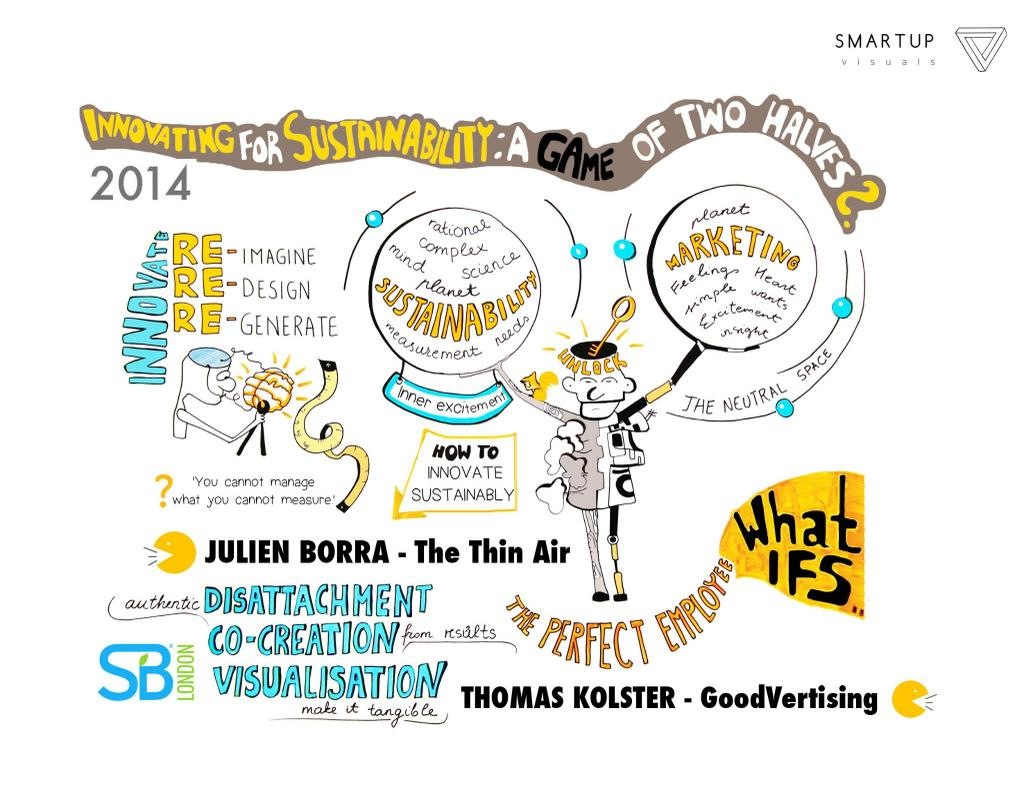
It was this simple observation that formed the basis of a recent plenary and workshop on Sustainability Innovation that Thomas Kolster of Goodvertising and I hosted at Sustainable Brands in London

Entitled A Game of Two Halves; the plenary and workshop endeavoured to use the two attitudinal behavior types we observed to set up a simple playful framework in which we might help re-inspire and reenergize the process of sustainability innovation: most pointedly in regards to human behaviour and modes of thinking.

The inspiration for these two types and they game of two halves they ended up playing was drawn from anecdotal evidence, conversation and a little light stakeholder research.

The world of Sustainability seems to be populated by a kaleidoscopic constituency of vital minds

  • the green activist agitators, ice breakers & policy shakers of the likes of the Sierra Club and Greenpeace
  • the scientists, conservationists and behaviouralists from the myriad NGOs advising and supporting communities across the globe
  • the sustainability policy and regulatory advisors, architects and engineers who operate at the point where the private sector and the public sector collide
  • the particular and labyrinthine coder programmer and systems minds of IT and rock n roll tech geekdom
  • the lateral and populist storytellers and communications professionals who advise both corporates and government on sustainability communication strategies and campaigning
  • the HR professionals who are increasingly being placed at the heart of burgeoining Social programmes being designed to evolve from the inside out and the ground up of large corporates and public sector organisations
  • the corporate actors driving sustainability agendas to improve performance, mitigate risk, attract investent or embrace social responsibility.

Many of these actors and agents are rarely advocates of an over simplified Either/Or picture of the world, and most have traces of both polarities in them.

But it did seem that as things start to go wrong or seize up there is a human tendency to fall into one or other of the camps – and revert to the type closest to ones own nature.

2 halves

Thomas and I chose to identify and explore these Either/Or moments and the attitudes and behaviours that accompany them in a couple of ways

The first was that of Venus & Mars, with Thomas viewing the two types through the lens of couples counselling, viewing the barriers to innovative sustainability thinking and doing as requiring the navigational and brokering skills usually deployed by professionals trying to help Couples climb out of the morass of familiarity and astonishing contempt – someone adept and experienced at showing warring and stagnating couples how to embrace the best of each other.

With this in mind we asked people a simple question; what is the greatest barrier to sustainability innovation?

We collected some answers from the people in the room. We then asked them to define what they felt might be the best solution to those problems. We collected these.

We then had the pleasure of Sarah Greenway from B&Q who spoke eloquently and in heartfelt terms about some of her own challenges and feelings (un-surprisingly one of those people with both aspects ascendant in her).

And then we rolled in a rainbow grenade to see if we could unlock people’s minds further.

Taking the view that in fact as well as the innate issues of intimate self-realisation that Thomas had alluded were some more extant behavioural traits that we might explore and play with to help the innovation on its way.

And I chose to label those traits as Punk & Wonk – another simple playful way of creating a tension and point counter point framework in which to exercise the innovation process to create breakouts and breakthroughs in stagnating thinking.

Punk celebrates the liberation of explosive dynamism and chaotic fluidity: Wonk that of incremental revelation and structured illumination.

I believe that somewhere between their poles: between the anxiety-inducing anarchy of blowing stuff up and the pointillist particularity or relentless rigour lies a resilience strategy for those embarking on a process of sustainability innovation. A potential answer to sustaining Sustainability Innovation.

I used the genius of Bowie and Eno as an example of how even the most complementary and inventive minds need help – need to be compelled to take a different view to break through blocks and walls in their own and others heads.

Bowie, the master of relentless reinvention – the punk dude of many lives personas and faces – and Eno, the musical scientist, and king or algorithmic cadence utilized the inspiration of Oblique Strategies – a set of obtuse cards devised by Eno and Peter Schmidt – to break their own creative deadlocks in the studio.

I asked people to envisage that we might create our own set of Breakout Strategies for Sustainability Innovation in much the same way, using the dualities of either Venus & Mars or Punks & Wonks to aid that inspiration.

We then asked the participants in the room to take one of the solutions we had identified and one of the traits = preferably the one least like themselves – and see if the application of a Punk or a Wonk mindset had helped them see anything differently.

I will leave the rest to David Harding-Brown in his write up of the session – far more complete and objective as an observer than either Thomas or I would be.

What we have left is a charming and playful set of inspirations rooted both in punk and wonk perspectives and some hybrids to help people in the fire storm of sustainability innovation.

Everyone needs to break out of their hole and reignite the minds we need to re-inspire the innovation that just might stop us all going up in a plume of consumption smoke!

Discuss.

See the links below to the event from the SB site including david Harding-Brown’s piece

http://www.sustainablebrands.com/news_and_views/organizational_change/david_harding-brown/sb14london_innovating_sustainability_-_game

http://www.sustainablebrands.com/digital_learning/event_video/collaboration/innovating_sustainability_game_two_halves


Palls – Put your political pen away for one day – because every one was some mother’s son.

Tags

, , , , , , , , , , ,

article-2494023-194B10CF00000578-711_634x494

Dance laddie dance

In your machine gun trance

As your jigger body flits

Among wired gore and bits.

Scream laddie scream

In your steel ripped dream

As clamouring shells

Ring out Death’s bells

Turn laddie turn

As the phosphorous burns

‘gainst your young boy face

In this melting place

Stare laddie stare

Through the milk white glare

Of your unseeing eye

Turned dead to the sky

Tick laddie tock

Goes the beating clock

As your body bag drops

Spilling human slops

Shush laddie Shush

In the final push

Where beauty falls

As leaves through Palls

London. 2003

Tech, Social networks and & the rise of Inconvenient Desire

Tags

, , , , , , , , , , , , , , , , , , , ,

imgres

You’d be hard pushed to find a more powerful source of human incandescence than that of Desire.

Most humans once seized upon by a fierce Desire, (quenchable, drenchable or otherwise) would struggle to not glow like embers or light up like a Christmas Tree.

But equally, incandescence is a volatile and unstable thing in its base form. It is as likely to illuminate a life as it is to burn down a house, so must always be treated with the greatest caution and respect.

A powerful and singular Desire, initially so exquisitely turned out: seductive, rich, complex and compelling, can quickly lose its form, focus and potency, becoming fleeting, deceptive, destabilising, and in some ways almost manipulative – one moment all consuming, profound substantial and irresistible: a twisted echo or hollow memory the next, whispering in our ear.

It is one of the cruel polarities of life that Desire, especially when ignored, demeaned, spoiled or thwarted, can become a very destructive force –  one of the most turbulent, psyche-ripping, heart-trouncing, confidence-destroying, life-diminishing experiences in our human condition.

We do not take it well! And it makes us act in irrational, random and unexpected ways.

So Desire. Powerful, yes; BUT its got form. Tricky. Volatile. Fluid. Uncontrollable. Fragile.

A singular Desire is of course not the only model. Desire has many forms, natures and universes. Not all Desire is so singular, egocentric, unfettered and prone to flip-flopping and flailing all over the place, at the drop of a rather existential hat. Some Desires are quiet; considered; evolving over expansive periods of time and frames of context. Others are a dynamic shifting mass: loose ecosystems of smaller desires, likes, preferences, needs and wants; splintered, fractured, fractual. A brilliant constellation with fluid and adaptive qualities.

But for now let’s concentrate on one very particular nature of Desire and the context in which it exists: that of human consumption and the systems and organisations that meet its rapacious and accelerating demands.

Desire in its 20th Century Consumer form was well served by multiple businesses and the brands they created. Most importantly the Desire was one dimensional: of a linear and modal kind. A singular Desire, in the form of an unmet consumer demand for a particular product or service, was either revealed or identified through intuition, experience, market research or in the absence of anything else, confected out of thin air in a marketing consumer insight department and then seeded in the mind of the unsuspecting consumer.

Once identified, every atom of the business was put in service to meet the needs of that one Desire. The whole operational infrastructure and systemic nature and capability of the brand and business was set into motion to against it. The sentiment and sensibility of every other person in the chain other than that of the Consumer – the font of all revenue opportunity – was set aside, ignored, or suppressed; viewed as at best, secondary, or at worst, irrelevant.

The Desires (and disappointments) of any individual or group dwelling in the Supply Chain that provided the material, resource, operational systems and manufacturing tools were also secondary – and someone else’s problem.

The Value Chains that developed around the Supply Chain to extract clear measures of additional value in every link in the chain, were focused wholly on controlling and securing in absolute terms the direct cost of resources (human and material), the executive overhead, operational running costs, the logistics of distribution and the indirect fixed contracting of supplier partners, especially when operating across multiple sites and geographies across myriad countries and cultures.

The ability to secure the base cost of delivering increasing value in every link of the chain was the way by which a company both improved its productivity and profitability. And it did it by controlling everything. Even the desires and the voices of those that worked within it.

The insular unconnected and disparate nature of the old world was highly convenient for those who wished to quash any form of desire that might destabilise that link in the chain’s ability to deliver itself at a projected and secured cost amenable to the larger commercial target and deliverable margin.

The very fact that these various sites and sources of production were localised, isolated and unconnected to every other stakeholder in the chain by anything other than their place in that chain meant that the desires of the workforce and the local communities in which they lived could be considered incidental. They remained for the most part invisible, unheard and often unmet. It is fairly telling that the managerial department allocated solely to ensuring and upholding the wellbeing of people required to populate and sustain any Value Chain were identified as a Support Activity in Value Chain models.

But those Desires cannot be ignored anymore. In the 21st century, the consumer’s Desire is not the only one that must be respected, elevated and pored over.

Technology and the social networks have unchained the value chain, giving voice and a podium to every Desire of every person (or stakeholder if you prefer) along the chain, Supply, Value or Otherwise. And they cannot be simply ignored anymore.

Now, Desire has got a smart phone, 6 email accounts, a facebook page, a twitter, instagram and youtube account. And Desire is getting busy.

Desires, individual and collective, in every corner of the globe are now connected. They’ve got access. They’ve got volume. And they are using the social networks to act with fierce purpose against brands and businesses they feel demonstrate an arrogant lack of respect for the human rights and dignities of their customers, employees, suppliers or partners. Once fired up, these consumer activists will harry and pursue the perpetrators regardless of emollient PR releases and promises – as the likes of Apple and Foxconn found out in no uncertain terms. These massed, noisy and high profile actions are now proven to have a direct impact on the measures of integrity held in high esteem by brands and businesses – NPS, The Reputation Study – and more importantly by the investors who fund their ambitions.

So the volatility, flux and turbulence of kaleidoscopic Desire is now at work in the world along very link of the Chain. And they are testing the resilience of those chains, and buffeting the previously tightly controlled and secured value and margin each link in the chain delivers. Adaptive governance must now include the ability to absorb the turbulence these points of social flux and volatility present.

In this way, the 21st Century world of accessible, affordable tech and the social networks they fuel are giving rise to a new chain – the Desire Chain – a value chain populated by individuals with dreams, expectations and rights as important and potent and ultimately as capable of creating value and growth as the old singular desire of the Consumer in the 20th Century.

So here’s to brands embracing a new chain model – the Desire Chain – one that is made incandescent and more resilient by respecting and elevating the desires of every stakeholder in its chain, to mutual benefit and a more secure future for all.

Screen Shot 2014-10-18 at 22.25.15

The essay upon which this blog is based, ‘The Value Chained Unchained‘, explores the nature and impact of technology and the social networks on the old Value Chain models and sets out the need for a new model based upon ever-evolving highly adaptive points of Mutual Desire and Shared Resilience.

The Value Chain Unchained by J Borra is to be published by Shared Value Chain Consultancy as part of a compendium of essays on Sustainable Value Chains. Editor: Michael D’heur

www.sharedvaluechain.com

uber tech, the human condition & the curse of being Super

Tags

, , , , , , , , , , , , , , , , , , , , ,

url

The juke-box was one of the old fashioned ones – none of this fancy new micro aural-fabric wall covering surround sound system stuff.

It was Old School. Renovated Wurlitzer. Vinyl. Beautiful. Real. Music you could touch and smell. Tucked in a corner. Take your 165bpm world and stick it on 78rpm.

A love-struck Romeo plays the streets a serenade…

laying everybody low…

with a love song that he made

A ripple of delight rolled up the cloaked blue back. Lois loved this song.

The PA system rudely interrupts the juke-box, and a few bright chords chime out over the heaving hall.

ABBA!!! Jesus.

He winces: just a little. Like The Man With No Name. Love those movies. To one side of the bar, on the wall, a carousel of ‘original’ movie posters flickered up. Le Bon. Le Brute. Le Truand. Everywhere you looked a screen played your thoughts back to you.

Clark sends the last pistachio shell skittering across the bar top. It scuttles and flips on the escarpment of some old bar top graffiti and spins off into space.

His wrist band buzzed. His heart rate must have increased. Substantially. Its glow took on a purple hue. Pituitary aberrations. Weird.

As if by magic, the barman comes and removes the almost empty bottle of sour mash in front of him.

“Sorry ‘Man. You know how it rolls. Can drink yourself to death for all I care. But not here. They’ll shut us down and sue our ass to next Jesus day if you die on the premises”

The irony of this statement, given that not 10 metres away combatants regularly tried to rip each others heads off and squeeze plasma out of each others eyes, was not lost on Clark. But it seemed to have passed the barman by.

Clark fingered and stretched the polymer blue-black tube around his wrist. One day he’d figure out how to turn this thing off. Ugly little spy. But needs must.  No band; no cover; no health and no welfare.

It relentlessly measured his vital signs and a number of secondary organ, enzyme and blood readings, distributing the data at super light fibre speed to everyone from his insurance company to the local hospital to the social welfare office to the barman in front of him via geo-location and face recognition. Latency certainly wasn’t an issue. The information was transmitted so damn fast it may as well have gone back in time.

Maybe he should drink inside the Cage. The bands didn’t work inside it. It blocked the signal. So much for infallible systems.

Hologram Ren belched, scraped back his stool, and stood up, kind of. He was done. Clark nodded, not that Ren really noticed. Wasn’t the same since Stimps got burned. A one man show Ren wasn’t. The music increased in volume.

Su-per trou-per

lights are gonna find me 

shining like the sun…

smiling having fun…

feeling like the No1!

One Eyed Mike thought he was real funny.

The music is Clark’s cue to move towards the tired scruffy wired cage at the far end of the bar hall – to the Cage and its sweaty bloody canvas. Made from triple-strength carbyne wire, it measured 30 feet by 30 feet by 30 feet.

What a circus. Mind you given his Victorian strong-man red-pants-outside-blue-tights look, he wasn’t really in position to comment.

The blue and red had seen better days, and the fabric looked positively ancient.

Clark shook down his shoulders. Christ he ached. He stepped up off the stool, his hand going to the site of his deepest scar, just beneath his right pectoral muscle.

The Cage on Highway Number 9 was jumping. Packed to the rafters with some ‘madness in its soul’. It was now legendary apparently; though how a straight-build tumbledown Roadhouse with a liquor & wrestling license in the middle of nowhere became legendary the gods only know.

The even bigger question was how all the other faded Supers had found him here, turning wrestling tricks for a few bucks and a free meal.

Not that it was bad having them here: just kind of crazy. They all felt happy here. Amongst their own. OK, so the Mutant Super thing kicked off every now and then but most of the time, apart from Parker’s web mess sprayed everywhere, getting on people’s nerves, it was, well, ok.

Being Super didn’t mean shit anymore. Everyone was Super now. With their airborne InfoTech, data bytes the size of asteroids travelling just as fast, virtual experiential sensosuits cheaper than a pair of sweat pants, and headspace 360 real-time vision and cyber implants.

There was time when Super meant something. Before everyone got junked up on tech.

Green Lantern was stretching off in the corner of the Cage. Bless him. Like a huge slightly jaded leprechaun.

ABBA’s super euro pop tune drifts out of the PA across the long room around the tables of assorted friends, freaks, failures.

Note to self. Take said pop song and stick it up one-eyed Mike’s new one, freshly ripped.

One Round. That should do it, Pound the crap out of him and bring a House Of Pain down on his head and then the rest of the night would be sweet.

One final super rumble at midnight and then he was free for another week.

He wondered who today’s Cage Celebrity Smack-down pairing was going to be.

Watching Ronald McDonald and The Pilsbury Dough Boy rip pieces out of each other last week, howling and hawking, covered in their own viscera, tears streaking their stage makeup and dough-eyed faces had moved to a place beyond funny.

He flexed his left arm. Shoots and pin pricks again. The Band griped on his wrist.

Clark’s focus was pulling in and out again. Gone were the days of looking through rock and steel. Could barely see through the edge of the Cage.

His vision tightened. Time to get busy. Washed up he may be in the flying universal policeman stakes but he could still rumble with the best of them.

That’s what they could smell. That’s what drew them from all over the US.

This scruffy aggregate of pseudo-super human beings with their fancy tech sophistry were here to see one thing. Good old school violence. The parochial, outside the beer-hall, looking at my girl kind of violence. Blood. Spit. Ugliness. Pain. The possibility of watching a creature suffer.

For all the experiences they could virtually replicate, the one they hadn’t nailed was the sheer excitement, the delicious thrill of seeing another creature, weakened, terrified and humiliated; buckling and writhing with the metallic taste of its own blood gurgling in its throat. Motorway pile ups, public hangings and terrorist beheadings. They just couldn’t help themselves.

And no avatar can replicate that expression: the one that flickers across a creature’s eyes when the bleak finality of knowing that its time has come in the gene pool survival game.

For all their peacocking about their virtual nirvana; and even in the face of the genocidal scale of their virtual battling and gaming, this super-human race had lost the ability to feel anything – pain; pleasure; and fear; especially real fear. This counted as a really big evolutionary Uh Oh in Clark’s book: the reverse Darwinian nature of a smart animal using its smartest inventions to make it the dumbest animal on the predatory block.

Divine obsolescence didn’t strike Clarke as a sensible plan for a species.

He scuffed around the bar, frozen for just for a moment in the light of an Ad wipe (highly annoying kinetically activated advertising curtains that mapped you and ‘robed you’ in some kitsch new designer apparel, took a pic and then immediately sent the pic to all the contacts in your band contact list across every social network in the world – With a ‘Hey doesn’t Clarke look sharp – tell him you like it’ button.)

Changing outfits was something Clarke was kind of done with. Half the telephone boxes disappeared and the ones that were left came with a drug dealer and a splash of voluptuous and rather inappropriately dressed ladies’ calling cards.

The crowd are cheering him in; but he has become deaf to it.

His gaze swings to the right of the path between the tables.

At one of the ring-side tables sits the crazy woman with her young boy. The boy was about 4 years old Clark reckoned; dressed in a forlorn super-suit from some gas station. The boy was fingering his game bar frantically.

Baby Superman. With bits of old hotdog and ketchup stain down the front. The truth always hurt.

As he walked past the boy he saw over his shoulder that the boy’s avatar was in flight mode hovering above the screen.

Christ.

Anyone can fly now. Not like the old school. At least they tried. At least planes actually understood what it was to move through the fluid air under their own power. At least a sky dive flight suit put you up there and out there for a moment, like some deranged flying squirrel. At least it was… …real.

Now everyone knew what it felt like to fly. Right. ‘Felt like’. The actual sensation. Even a so so mid range sensosuit could replicate the exact physical sensation of flying by firing millions of tiny charges across your skin, with different pressure sensors expanding and contracting the grasp of the suit on you to mimic dynamic movement in flight and G pressure. And the MeSq power implants in your head activated the relevant endorphins and adrenalin surges just to make sure you ‘felt it’.

Everyone could do everything. Everyone could see around the world in a second. Through steel and concrete. Everyone could see the future. Everyone could destroy anything with the flick of a finger. Everyone could be in 5 places at once. Superpowers was just so …everyday.

No-one needed the strength of 1000 men to topple a tall building. They could call up the strength of millions and topple a country.

The boy fingered the game bar furiously.

Could do without Diana seeing him that’s for sure

She’d looked a little shook up last time Clarke saw her. He always knew: when she played with her bracelets something was up. Like a change in the weather. When her heart was heavy, the scars on her wrists ached under her Indestructible bracelets.

She hadn’t mentioned the kids thing for awhile. He thought that maybe the pain had faded a little.

All she wanted was a kid. A normal, un-tampered with, straight DNA strand, in body baked baby. But for all the technology in the world it just wasn’t to be.

Anyway. They were cool. Clarke and Dian. Hanging out. It kind of worked.In fact the mundanity of it was a blessing; sweet liberation.

Life was simpler when you were less Super. Less wonderful. Something the new super humans with all their gadgets and advances needed to figure out for themselves.

He was in front of the Cage now. Green Lantern was looking wired. The tell tale pulsing temple and grinding jaw told Clark that he’d junked up on nano-oxgenators – small pieces of in blood technology that multiplied the effect of oxygen and adrenalin into your blood stream to boost resilience, strength and stamina.

Jesus even the Supers were at it now.

This wasn’t going to be quite as simple as Clark had previously though.

Screw it. He just needed to man up. Anyway. She’d be here soon. And everything would be alright.

The Princess and Clark: living the ditty; the Jack & Diane of the 21st Century, growin’ old in the heartland.

Clark steps up into the Cage. As he does so the sheer blue fabric of his suit catches the edge of the jagged wires. Rip.

Su-per-trou-per

Lights are going to find you

Shining like the sun

Smiling having fun

Feeling like the number 1.

Funny.

Invisible Telecoms, the looking glass & the Hidden Art of IT Qi

Tags

, , , , , , , , , , , , , , , , , , ,

images

I have become an adherent to the new martial art of business. I can now see the entrepreneurial wood for the IT trees.

And in true zen stylie, what I see is all about what is unseen.

A statement of the bleeding obvious perhaps BUT in the realm of your tech and IT systems and solutions partner who enabled them, out of sight is truly out of mind.

We should not only embrace the invisible Matrix nature of IT and tech deployment. We should grow to love it. And for good reason.

The Now you see it Now you don’t approach to best in class tech and IT – apparent only by its absence denotes a win for the business.

Invisibility is success.

Because Visibility usually means you’ve a little way to go yet.

Like the word Digital. Or the word Social. IT and tech, while still top of the conversational pile and being touted as the next best C Suite thang, are patently still under-performing.

While we still say them out loud, put them on presentations, flag them, budget for them, mention them loudly in lifts it simply means they are not yet embedded properly. They are not optimally integrated. If they were we would not need to point at them.

In certain areas of business the idea of anything becoming invisible is a measure of its success. Sustainability is a very good example also of this phenomena. While there is still a CSO, and Sustainability has not migrated up into the Marketing or Operational functions, Sustainability cannot be said to be truly integrated into the nature and fabric of the business.

Much like Sustainability, Tech and IT should, in its explicit and visible form, seek to become invisible – working towards a strategy of divine obsolescence.    

Moving from an explicit visible tangible to becoming internalized, implicit, invisible: transforming into a discrete reflex or innate ability within the business: when something becomes second nature, it means that the fluid, synchronised nature of it is seamlessly connecting and connected with the ‘flow’.

IT & Tech, much like HR, is no longer a support activity as it was in the old model of Value Chains, an administrative prop to paperwork systems and communications in an analogue world. Through intra and extra nets, digital and social service improvements and propositions, operational innovations and the new world order of hyper speed intelligence and data as a primary driver of most businesses competitive advantage, IT & tech is now woven through every dimension of a business. 

So to set out to deliver Invisible Telecoms – to make the measure of success the degree of visibility of IT & tech dimensions of the business is compelling.

If you are a solutions provider in the area and your goal is to work with clients to embed IT and telecoms to such a degree that they become invisible – transforming into the company’s systemic operational reflex, the synaptic system controlling the optimal operational ‘flow’, then your goal has exceptional commercial value.

The ambition to take it to the nth degree until it becomes the company’s ‘second nature’ if you will presets a business for greater flexibility agility and focus.

Invisibility also becomes a very clear metric of customer centricity.

If you’re in the business of selling IT and tech, in the real world of value, you need to move from pushing buttons boxes and fibre to selling the space to think and act on building a more resilient business through tech.

You need to be in the business of selling Mind-width not bandwidth: free your mind and your ass will follow as Funkadelic sang. Unlocking the entrepreneurial reflex in the business by liberating the customers mind of Tech & IT distractions – leaving them free to concentrate on creating exceptional ‘flow’.

To a customer Invisibility is about the goal of making IT & Tech less and less present in my eye-line: less of a priority: less visible in my inbox everyday, dropping away to being something that just ‘is’. The concept of turning IT & tech into a truly ethereal concept for a business is brave and powerful.

Creating the Qi model for smart businesses, changing the whole way we thing about IT, moving it from rational and engineered to being truly systemic, flow orientated and about cultural and social vitality and wellbeing – wellbeing from the inside out.

Qualitative growth is hard to see or imagine let alone define and capture through a complex maze of surface connectivity, functionality and capability. The ability to mine qualitative growth opportunity needs to be a reflex in the business facilitated by invisible technology and hyper speed connectivity. The systemic fabric and infrastructure needs to be able to act at the speed of the human mind and work well in advance of it.

Time to remove the IT bandages and unsee what is beneath. The degree of how much is left unseen will be down to the mastery of the CTO and their digital partners in crime. 

This truly is the looking glass and the wormhole rolled into one. A world of infinite possibility only recognisable in each successful step towards a wholly more resilient and differentiated business – one focused on unleashing minds to do what they should be doing. Walking the talk is not an app that you buy; its a disposition that you live.

White rabbit anyone? 

crimes of fashion, loose suits, bad shoes & the dark art of sartorial premonition

body-guard_10463112_250x250


So a thought crossed my mind, of well-dressed men with violent hearts.

Strangely, it happened as I wandered through Regents Park. Perhaps it was the glance to the right through the trees to the security personnel standing outside one of the park’s beautiful regency residences – a member of ‘staff’ with a distinctly eastern bloc special-forces tilt to their gait, posture and physical presence.

Even weirder, the trigger was not the mallet-like, box-thumb hands that could squeeze the life out of me in a heartbeat (a stalled one that is); or his potential tightly-wound, to unleash unholy and highly trained hell armed or otherwise on any kind or number of assailants.

It was not even a sudden turbulent curiosity cloaked in too many spie films about special ops backstories; or on what continent or continents his personal attritional signature might have been developed.

It was actually the cut of his suit.

Yes, amidst the wealth of possibilities for curiosity to be pricked, it was the sartorial that leapt to the top of the pile for me.

The reason it did so was held in the fact that there was the shadow of something terrible about him. But it was not held in his potential for murderous activity or at the very least, its highly painful and vaguely psychopathic cousin, maiming.

I realised that the most disturbing thing about him was the shadow of death that was cast across him – and not that of anyone else’s. It was the shadow of his own.

The suit was the signature of his own demise. His whole sartorial self, was stained with a destiny more aligned with the dusty bottom of a builder’s skip behind some grand hotel In Budapest, than it was the baize surface of a blackjack table in the Sporting Club in Mote Carlo.

Now, to be clear, the look I am describing is not to be mistaken for just plain bad, really cheap or misguidedly chosen clothing and everyday wear.

This also should not be seen to stumble into the wardrobe of the ill-fitting porter’s uniform, the one size too big overcoat of the hotel doorman (with give away chasm between the back of the coat collar and shirt collar). And this absolutely should not under any circumstance be mistaken for the shambling borrowed suit look, quite popular at weddings and court appearances (thought the latter might come the closest). 

The suit was dark blue – almost black. But the vents were a little too over stated; the lapels a little too obvious. It was slightly ill fitting. His shoes were exceptionally well polished.

There was nothing of the stealth-wealth class enshrined in the uber-discretion of Commander Bond’s suit, personally cut by Gieves, an open stitched silk shirt, shod in a well turned pair of Lobbs, a understated pochette off-setting the breast pocket.

The benefit of the minutiae of class correctness and breeding and having been around money and its vestiges all one’s life, means that invariably smart clothes are worn comfortably, a cloth skin which the wearer is happy in, regardless of whether they are loose or tight, cheaply accessorised or expensively purchased.

(Though to be frank some might think otherwise having spent an afternoon in the company of the finer, older end of the British aristocracy: where one could be forgiven for thinking that the ladies from the tills at Sainsbury’s had popped on a frock and picked up the male vagrants from the local AA meeting on the way round to the Manor House.)

Having spied this man, and as my mind wandered through a picture album of gangsterdom and thuggery I realised that it was the same reoccurring theme.

Everyone looks like they’re dressed in their funeral suit.

To be fair these types of men are built for attrition. Built to haul, bludgeon, rip, cut, break and prevail – whether that is with a sharp plough across a barren field, with a sledgehammer about the head of fence post, with a weighted crane wire on a Rig, with the brittle fingered winching of a north sea haul, or with a hand, knife, gun, grenade or club across another human’s being.

But unlike their forebears, whose best suit only came out for a wedding and a funeral, these men wear the wrapping of wedding and funeral as their work clothes.

Perhaps it is because their lives are marked on a potentially much shorter trajectory than everyone else’s that they need to live (and wear) all of their lives at once.

But there suddenly was the striking truth of it for me.

Theirs is a look of the open-coffin funeral. They have the look of a dead man walking.

The Security personnel had that way of letting their arms drop in a V in front of them, crossing at the wrists, with one hand placed across the other at hip height.

It takes little for those same wrist-crossed ‘hand-over-hand’ arms to move upwards towards the middle of their chest to a point of eternal peace and repose – like some stone hewn sculpting of the great knight at their final rest atop the crypt.  

So, the open coffin look; that of a corpse in slightly ill fitting suit they rarely or ever wore, shoes over shined, plasticky and new. The body deflating before one’s eyes, collapsing back into the folds of the suit as the last sub atomic vestiges of their living self leave the cadaver.

And now that I think back to everything from pictures of the Rat Pack and their ‘Italo-American’ Minders, to Russian secret policemen around the Kremlin, to bouncers in any city, to the petite gangsters of any over cologne cocktail bar, the look is the universal look of the Funeral.

I realized that these men seem to have raided the dressing up box of the funeral home, and perhaps there is something bleakly fitting in that they are dressed for a funeral that might given their job come to them, far quicker than you or I.

At a more rarified level, the relationship between men of violence (be they Kings, Tribal Warlords or Gangsters – there is little difference to be fair in their differing shades of socio-psychopathy) and the sartorial plumage of success is long established.

It seems that preening either pre or post violent Armageddon seems to fulfill a number of roles.

CIVILIZATION – To cloak the generator of said violence is some form of cloth grandeur and reward – like an animal skin post the brutal hunt – wrapping oneself in the prize of your violence is quite a primal past time.

ACQUISTION Equally, plunder in the shape of Cloths of gold and silk embroidered with gemstones were the first thing the status-thirsty barbarian would plump for post massacre of the innocence or après a little light butchering of the fat pigs of mercantile avarice.

UTILITY It is worth also remembering that filching a rather natty pair of strides, boots or a well made greatcoat has been the historic stock in trade of most everyone from gunslingers in the wild and rather badly dressed West to soldiers traipsing through thirty below along the Eastern Front – both the Napoleonic and WWII versions.

So the idea of clothing in some shape or form as trophies of violent conquest or subjugation has ‘form’ one might say. 

But most particularly, it is in the suits shirts shoes and accessories – the lizard skin belts, Gucci shoes, encrusted Rolex watches – of the modern day gangster that we see the preening version most vividly adorned – a modern take on the look passed down through the folklore and photographic record of the Italo-American mobster and those that aped their fashionable aspirations – of the poor kid done good; taking their place besides the senators, sages and celebrities of their age.

(Note I have not included the Afro- American and Anglo-Jamaican street gangs in this note as their sartorial aspirations broadly lie in the polar opposite direction – drawing from the dime store sports clothing rip offs and cheap synthetic shirts of their poor streets and the ghetto penitentiary look of the slung trouser inmate of the US Penal system.)

The UK mobsters of the late 40s 50s and 60s were little different to their American cousins and their middle european counterparts. London gangs sported a similar uniform of gaudy suits, over stated silk shirts, razor sharp ties and shoes – over styled and over cut.

Sartorially obsessing men with violent hearts.

To make such an observation may seem flippant in such times, when the news is filled with so much unholy (or for many and to their eternal shame) holy murderous brutality being unleashed on so may innocents by dreadful mobsters, warlords, politicians, tyrants, sovereign states and laughably-lauded Royal Houses.

But maybe in doing this I am searching for a way of easily identifying all of those who have this easy brutality in them.

My reasoning being that if one was able to pinpoint them that easily, and on a global scale, perhaps, and just perhaps someone’s god or gods somewhere, or some form of omnipotent being, or even a calamitous act of science (think Big Bang but on a smaller more human scale, with laser like targeting, really nasty Kevlar piercing particles and an eye for badly dressed violent men) would wipe their faculty and kind from the face of the earth.

But the first problem with this fantasy is that there are also a whole heap of sartorially challenged men out there who might get offed along with them which would constitute a bit of a whoops ( and a rather immediate resource issue for most financial services sales departments out there)

The other problem is that in promoting that scale of vengeful murderous ugliness, I would become just like the men in bad suits with violent hearts: which is a nightmare.

Next thing I know, it’ll be Officers Club, Oxford street. Dark blue wool suit. Over sized vents. Bad lapels. No real button holes. Synthetic yoke and quarter lined. ‘Invisible’ rayon stitching. footballer fat long knot silk tie.

Stage two: a light criminal conviction for mild affray – followed closely by escalating madness with power tools.  

Final destination: a box which, as Ted Moult put so beautifully for so many years, is fully air tight with hard wood surround.

Here’s to well dressed gentle people.

Trust Me Im a Sustainability Practitioner: storytelling, storytellers & the emollient art of not seeming ‘slippery’


I watched a film today. A discrete film. An understated film. A short film.

No popcorn. No slash cut dash glut editing. No highly confected verite cutaways. No corporate schlock horror probe. No desperately arch atavistic activist paddling in their own propaganda.

The film, by the Copenhagen Film Company, focused all of its attention on one man; a gentleman of about 60 years of age. The camera is unwavering. A set up shot. A few discernible cuts. Otherwise, clean clinical but mostly respectful.

Sitting in a sparse elevated office, we see incidentally that life relentlessly trammels on below and behind the speaker regardless of us and our elevated conversations; cars on streets going about their business.

The man, Mads Ovlisen, a Senior Advisor at the United Nations Global Compact. speaks of running sustainable businesses. He speaks of the UNGC committed to setting the agenda and aligning policy around sustainability issues – Energy, Water, Agriculture, Renewables, Food, Transportation, Building and Pharmaceuticals: most every pillar and issue one might ever imagine turning up on a sustainability strategy slide.

He speaks of a discrete yet powerful stakeholder group who collectively make astonishing impacts in the world through their brands and businesses.

He speaks of how much fortitude it takes to merge civil and corporate interests

The man speaks of things far from the ears or the offices of the average Brand Jonny or Jane; and probably far from their frame of reference or, to be blunt, self interest.

Though, to be fair, they would I hope understand the emotion that the film evoked in me.

Maya Angelou’s exposition on emotion versus reason: “I’ve learned that people will forget what you said, people will forget what you did, but people will never forget how you made them feel” is a powerful philosophical sound bite for an ad man or woman looking to do more creative and insightful creative storytelling.

It is one I respect as I do spend most of my time seeking to make very complex things simple through creative story telling.

But the storytelling here was not some confected theme or hashtag slogan mantra being played out. The storytelling here was in the nature of the Storyteller.

It was not the dry content of his words that compelled me: though there was one axial moment in his discourse that fixed in my memory.

He (unsurprisingly in an axial moment) made what was for me an axiomatic statement – one which sticks in my memory.

His axiom was thus: “this is about how a company makes its money, not about how it spends it”

I found this statement scintillatingly simple. Its power for me derived from the way in which it frames the resilience strategy of a company with such philosophical clarity.

If a company finds that its focus resides in the first part of the axiomatic phrase – the pursuit of a more sustainable business is infused with a rich seam – of purpose beyond profit, ethical perspectives and corporate morality – and it gives a clear measure of the humanity enshrined within that company.

If the focus is on the second, then the company is about rational efficiencies and economies and smart procurement – a far less compelling and more importantly far less desirable mantra in attracting the right people towards that company. 

The reason why the subtle difference is or should be so important to companies is rooted in the part of their resilience strategy that demands best possible future talent be attracted in to the business.

The leadership and purpose at play in the first shading is vastly more attractive to Millennials than the second, which suddenly feels quite ’90s Business School in comparison.

Its not about which one is right or wrong. It is about which one is more powerful and compelling: and fit for the purpose.

And though the ability to sustain itself financially is paramount and primary to any business’s success, its ability to relentlessly and profitably attract best in class new and enlightened talent has to be the only strategy for future growth and stability.

As I have said, for me, though powerful, it is not the axiom in his treatise that I found so compelling.

He was the story. The storyteller as the living embodiment of the story he tells. It was not what he was saying so much as how he said it: his demeanour in the telling.

Simply put, his easy intelligence held lightly, the fixedness and the quiet purpose of his delivery were what drew me in.

His eyes and his voice where in some ways hypnotic. A ruse perhaps the cynics might say. Or is he just another modulated technocrat? Maybe.

But the simple fact for me is that his demeanour, delivery and his intention created license for me to both find his arguments authentic and trustworthy.

I would go and listen to him speak again. I WANT to find out more of what’s in his head and heart.

And therein lies the emotional killer insight.

Having spent an inordinate amount of time around the professional cabal of the sustainability world and the consultancies that advise them, I realize now that I find them often no different to the sociopaths and psychopaths of the financial and advertising worlds they so often deride.

The messianic fervor of righteousness is never far away. One need only scratch a little to find it.

I said once that I was stunned by the amount of self interest I found in what is supposedly vaunted as a shared interest space. In the 3 years between that observation and today that feeling has only strengthened.

This is where the kettle pots and blackening may well begin.

So to be clear, that is not to say that the self interest or self advancement, a certain over confidence, or arrogance and a particularly singular and thick skinned trajectory have not been wielded by self interested individuals to make brilliant and collectively beneficial things happen.

The application of one’s personal mettle in the room to achieve an objective is a precarious process at the best of times – and self PR in a good cause is a dangerous tight rope to walk at the best of times. One shouldn’t be pilloried for faltering or getting it wrong sometimes.

Furthermore, doing so while traversing the particular social minefield of a leading edge cause that requires a deft combination of rare scientific and analytical rigour and messy irrational populist behaviour change is verging on Mission Impossible status.

I have been known to hop about a stage wrapped in my own personal theatre espousing methodologies that are of personal interest to me first and foremost.

So I am the last one to talk. I could never say that the cult of personality is a satanic pall over us all.

BUT the sudden clarity the film gave me around those simple levers and pulleys: a voice and eyes that I trust.

And the sudden realization that imparting a world view where the smile barely penetrates past the retina, or simply fixes like a grimace slung under cold eyes is not going to move this forwards.

Playing ones intellect and credentials before you into a very carefully prepared rooms like a buttered juggernaut to ensure the room is won takes us nowhere – other than to the next room.

Does that mean I think we should all grin like an idiot and play the fool? Or not deploy fierce intellects when they are needed?  

Not at all.

I would be the first to say intellect wielded well, whether in arch seriousness or as playful banter is more a matter of style, circumstance and empathy than integrity. I am the first to admit that my own flippancy and ‘lightness of touch’ means that I regularly misrepresent my deeper values and beliefs in this space amongst people who do not see these as even faintly redeeming character traits. I am certain it annoys the crap out of some of the more esteemed minds of the sector, especially if they feel people like me trivialize their cause. A Shiny brand jonny. A Catch phrase Charlie. And an interloper to boot.

But I am on a populist agenda: I want us to find the language, the demeanour and the presence that makes more people turn towards us, listen and find what we impart desirable and accommodating of the real life they lead.

So for me there needs to be creative storytelling based upon what people care about to illuminate sustainability truths. And there needs to be humanity. But mostly there needs to be trust. Trust that is human in its evocation not one demanded through an attrition of rationality.

It’s a simple human mechanism: Do I trust the person imparting the ‘wisdom’ to me.

Do they make me feel bad and stupid? Or good and smart? Great. Thanks. Two of those please.

Who knows. Perhaps I a far too one dimensional for all of this and I miss the complexities and subtleties inherent in the thrust and parry.  Shallow Is the new Deep.

Al I know is that the average man or woman trying to get to the end of the month and have a nice life without bankrupting themselves need some Trust in there to even begin to listen and change tack.

And degrees, credentialing, linked in profiles or executive steering committee positions just don’t cut it with them. That’s your dinner party conversation. Not their life.

So I return to the man who speaks discretely. Sets out his stall. His beliefs and the benefits of what he does.

And at the end of it he gets my vote. I’d put him in a pub with a load of people I was trying to bring round to the cause. He might not be their cup of tea. They might even find him boring.

But I think they’d trust him.

The film can be found at http://thisistouch.com/this-is/the-news/