• ABOUT

thinairfactoryblog

~ A topnotch WordPress.com site

thinairfactoryblog

Category Archives: Uncategorized

Fridge magnets, Porpoise & the power of language in Innovation.

15 Thursday Dec 2016

Posted by Thin Air Factory in Uncategorized

≈ Leave a comment

Tags

#mayarse, Anarchy, Blackadder, Corporate Speak, Creativity, Digital, Easter Island, Genome, Guttenberg Press, Identity, Idiom, kaizen, Language, Porpoise, punctuation, purpose, Roald Dahl, rote, Slang, social networks, Socialising the Genome, Sound, Tabloids, technology, The BFG, vernacular, Vinyl, Wax Cylinders, Yoda

7299579_orig.jpg

Words are funny things.

Haphazard, abstract, profound, silly, shape shifting, infinitely playful, confounding, eternally powerful and utterly malleable. Language is a remarkable technology.

Glyphs, scratches and symbolic signing of sounds eventually dragged kicking and screaming into some vaguely coherent order that ticks a few syntactical boxes and language rules and shazzam! the fun begins.

Suddenly these scatters and blocks of marks, letters and symbolic sounds forge themselves into desires expressed, thoughts formed, theories expounded, opinions offered, information fixed, stories told and dreams captured. Sounds cut into the wax cylinder of our minds and played out through sharp stone point, stylus, quill and nib onto cloth, wood, parchment, stone and flax.

And our eyes scan across them and our tongues run along them like a needle in a vinyl groove, transforming them into the sound of speaking.

As time has marched the expression of our expression has been altered by the nature of how we generate the text. We have hopped skipped and jumped from painful rendering every letter by hand over vast tracts of time, illuminated by curlicues, cartoons, motifs and scenes – and the silent furious industry of re-rendering the same again and again for the benefit of a rare few – to carved crafted blocks to be set in lines, paragraphs and pages – inked rolled and pressed into sheets to be shared and distributed amongst the many.

Technology elevates technology as the presses become mechanised and the inks become jets. Vast universal printed broadsheets supplemented by the intimate particular of typing machines that throw metal letters through ink ribbons onto pages layered with carbons for multiple copies. Until the binary marks of programmes on a different ribbon digitised everything at the speed of light.

So we now find ourselves with the ability to use these marks and symbols at the speed of swipe and type in real time to fire them across the world via networks and platforms.

Yes the books still fill shelves and the magazines still scatter coffee tables. But they have become the paper monoliths of what was. The  printed word and how we consume it versus how we consume its digital cousin have become fundamentally different.

For your words to be ‘in print’ still carries a deeper value. Words on a physical printed page feel more meaningful, eternal, immortal. They are the Easter Island Statues of the written word. Their digital counterparts the writing in the sand on the beach.

The way new technologies have gamified they way we think and more importantly the way we express those thoughts through writing enables a very particular kind of playfulness rooted in eclectic multidirectional multi channel distribution. The Ephemeral Passing nature of the txt blog tweet and the written content of the live in-flow constant beta site allows everyone to ‘play’ – text as balls to be lobbed tossed kicked, rolled and scattered in every direction, only to return transformed, tweaked, built upon liked loved berated and bludgeoned.

The creativity inherent in the technology of language and subsequently in the technology we use to generate language in flow seems to have two forms when it comes to words and how we express ourselves with them.

Creativity is still as much about liberating expression as it is about liberating distribution. Language as a technology has been tinkered and played with by everyone from the lowest order to the highest mind since the technology was invented. Derivation. Disruption. Disorder. All of these traits have been alive in the spoken and written language since its inception.

New technology does not advance innovation. It accelerates our ability to unpack and play with the given wisdoms and expressions to seek something new and different. This is the fuel of innovation – new technology merely the accelerator.  And the role of language in innovation and technology’s ability to accelerate it is remarkable.

Word play – a lightness of spirit and a subversive nature in regards to language – has always enjoyed turning the given rules upside down and back to front – messing with words and language because we can – as a mark of our individual nature and curiosity.

Thats why vernaculars and slang and idiom are so important to individuals – and why corporate language is so disliked avoided and derided by ordinary people. Corporate language and ‘speak’ smacks of an Order of the Few inflicted on the Spirit of the Many.

It is an intellectual door policy – if you ain’t got a ticket you can’t come in – the bouncer on the door of the exclusive club.

Ordinary people like to own and share the language they use to express their most individual selves, in their own way on their own terms. They reserve the right to speak as they wish, express in the manner they feel most comfortable with.

It is unsurprising that fads and trends especially in the highly socialised accelerated age see @everything and #anything already running out of steam. This is not due to the academics deriding them. It is mainly due to ‘rules’ being applied. A new higher order or High Priest of Digital Expression has risen out of the chaos – defining rules of use and relevance. Thankfully it spikes the oldest of human responses. Dissent.

Rules? #myarse.

The intellectualisation of language will always occur while the human nature of assertion and pursuit of social exclusivity remains. We simply can’t help ourselves.

Language gets used to include and exclude. It always has and it always will in some shape or form. It is a tool in our tendency to assert and control. You’re not in our club. How you order sentences. How you punctuate. How you correct and edit yourself. How you use common signifiers of expression. Words and language are the cutlery of expression. How you use your knife speaks volumes about you. And there will always be those that use it against you.

BUT.

If thats the case, I say fill your boots. Subvert at every opportunity. Break a language rule everyday. Smash the shackle.

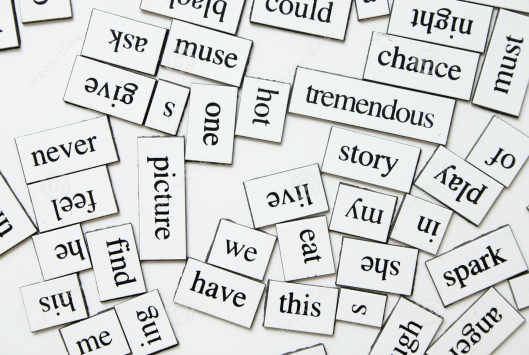
Start with fridge magnets and madness. before you take one step towards the workplace, make some shit up out of a load of words on the fridge. Set your mind free. Gobbledegook is good for the soul. Have a BFG day. Using phantasmapoppingful words. Go Yoda and reorder a sentence – like someone’s put a Germanic grammar filter on your English. Pop some nonsense in a sensical world. Embrace puns at every opportunity.

And if you’re in business – especially one that involves speaking to ordinary people – use pub speak in board meetings. Ask a 70 and a 7 year old to edit the CEOs keynote. And see the tyrannical use of language for what it is. An ugly veneer behind which mediocrity and insecurity can often lurk.

If you are working with multiple nationalities there has to be some common ground. But at least allow every one to bring a little of their own cultural idiom into the room before you set out on some highly controlled over strung and soul-less corporate conversation. Allow their free mind out as a matter of course. Build a ‘Sling Some Slang’ into every meeting. Allow each nationality to ‘play’ in their own language and share it. You will be far more likely to find yourself with human beings in the room. Much more helpful to collaboration and co creation.

Innovation starts with language and how it is used and embraced. Rote cultures create Rote people. And innovation and creativity withers on the vine. The confidence to ‘mess’ with language shows an ability to break from the norm, to turn something upside down and the wrong way around to take a different view. Mistakes are the fuel of invention. Failure is a central tenet of Kaizen. We should embrace failings in language. Before dispensing with them, check to see if there is anything good hidden in there.

So can everything be chaos and subversion? No. Like anarchy, it only exists meaningfully if there is a counterpoint to it to keep it relevant and focused. If everyone is an anarchist. Their is no anarchy. Just conformity.

A perfect example of deconstructive/destructive language play was to be found in a conversation I had with a friend of mine. Both utterly child-like far to often, we found ourselves discussing Purpose and Purposeful businesses and the manner in which this word has been taken and chiseled into a corporate straight jacket. It has lost its original profundity; replaced with a pompous self-righteousness. We found ourselves having to use ‘cod’ Noo Yawker accents to continue the conversation with any feeling.

So Purpose became Poiypuss. What! Who knoo! Badda bing badda boom. I gotta poiypuss ‘n’ I’m gonna use it.

Cue more cod accenting until eventually Blackadder and the Prince and The Porpoise sketch prevailed. And so Purpose became Porpoise.

Happiness.

PORPOISE. The prefect name for an agency that believes deeply in Purpose but with a profound dislike for the way in which it has been hijacked; made humourless, confined, dislocated; rendered inhuman and spiritless.

Porpoise. Creating Purpose with a difference: purpose with a human touch. Nice logo. Disney meets Vector with a scattering of fun.

Ridiculous. perhaps. But I do have evidence that this childlike view of the world can sometimes create breakthroughs in communication and engagement.

In a recent project – Socialising the Genome – I worked with Dr Anna Middleton to try and unpack the arcane language of Genomic science and the impenetrable academic and clinical terminology it uses when speaking to ordinary people. The objective? To be able to engage with a greater number of ordinary people around the benefits of GENOMIC science and data gathering to improve individual and collective health care.

We found that in almost every qualitative research group people had a tendency to drop the first E in GENOME, and quickly deconstruct it into something far more friendly and more palatable and less scary. GNOME.

So the massed intellect, discovery and genius at work in the world of GENOMIC science and discovery – and the gateway to understanding our most precious personal selves and the data that defines it – was enshrined in a picture of a small bearded man with a fishing rod. Cue Double Helix fish and chats about fishing in our DNA for answers – and the idea that sometimes that fishing just comes up with an old shopping trolley and river bed junk. And sometimes with something more remarkable and enlightening.

So language – a beautiful technology accelerated by newer ones. But it is not sacrosanct. It demands that we flex with it, play with it, mess it up, test its edges. Because in doing so we test our selves and the ideas we have – and through it we find new iterations and expressions.

Which is a good thing, No?


LANGUAGE NOTE: My use of No? at the end of the final sentence is in homage to the idioms of the French “…, nest pas?”, the Spanish “…, No?”, the Scandinavian “…, Nej? and the Glaswegian “know whit ah mean, big man, no?” and ending one’s sentence with an upward inflection “No?”.

And because it really, really irritates purists – as does the doubling up of adverbs like ‘really’.


Saviano, Populist Poisons & the Rise of An Ugly Society

04 Sunday Dec 2016

Posted by Thin Air Factory in Uncategorized

≈ Leave a comment

Tags

Aquila, Barzini, berlusconi, BREXIT, Camorra, Care In The Community, City Of London, Drug Cartels, Gattopardo, Global Financial Corruption, Gonzaga, Jo Cox, Krays, Mafia, Margaret Thatcher, Mental Health, Ndrangheta, Offshore Banking, Pax Romana, Rome, Saviano, Sforza, Tancredi, Trumo, youth

5760.jpg

I have just finished reading Roberto Saviano’s My Italians: True Stories of Crime and Courage. A hugely redeeming yet desperately saddening book by a master of investigative journalism.

I read books such as this – and The Dark Heart of Italy and Illustrious Cadavers (and even Barzini’s comprehensive yet slightly sentimentalised The Italians) with a bitter sweet sensibility.

It is a sensibility born of being someone who, though bred and raised in England, is by blood pretty much wholly Italian with a smattering of Yar French – a product of the Piedmontese and Ligurian bloodlines that shaped me.

I am therefore still firmly attached to Italy, the umbilical cord un-cut. I love Italy. Which is why I feel a sense of creeping shame, sometimes frustration and sometimes rage at the dreadful toxicity, cruelty and self-serving nature of some of its leaders and its population.

These books I have mentioned focus on the medieval nature of Italy’s power structures, the darkness of its feudal and criminal heart, and the complicity of the people who are either too scared to act against it, or too indifferent to others to care. Something that until recently had seemed another country to how we live in the UK.

As I explained to someone a few days ago, Italy is more than corrupt. It is Beyond Corruption. My belief is that this issue arises because Italy is an old world culture – its modern civic and political infrastructure is built upon ancient foundations.

This has given the opportunists crooks and toxic tribes amongst its people over 2000 years to explore and exploit the structures of bureaucracy and power – studying their shifts and flaws – inveigling themselves but more importantly inveigling their nature, intention, motivation and desire – building it into the structure and the fabric of Italy.

Rome and its Pax Romana, administrated via favour, tax and violence, the centuries old corrupted relationship between Papal church and State, the internecine wars of the Ducalities and Principalities – the birth of the chiaroscuro of Diplomacy – a truly dark and light art –  in the era of the Gonzaga and Sforzas. Every one of them an opportunity for the shadiest and most self interested to set their chair at the table and systemically expand their influence and network.

In Il Gattopardo, Tancredi states this simple tenet – that ‘To remain the same, everything must change’ – a tenet that underwrites Sicilian Culture: riven, over run and over lorded so often by so many. To maintain real power and status, you must offer the illusion of change as the fuel of advancement – while behind the scenes securing even faster the immovable truth of who rules.  This is equally true to wider Italy.

These books of the dark heart of Italy project Italian society as a Commedia Dell’Arte – a society populated by slippery clowns, tortured psychopaths, stooges and idiots. The characters that populate the stage of this bizarre human theatre and their painted grins always hiding a darker truth.  They seem to prove the rule.

And the courage of the people who write them should not be underestimated, given the forces they are more than likely to unleash in doing so – especially those of the likes of Saviano.

He has rightly pointed out that his books are dangerous to the dark forces buried into the earth of Italian society because he does not take the pose of an academic distant observer. He speaks as someone who loves his country and its people, who writes as one of them, telling real stories, stories that join the dots and point fingers. His books make people not only angry about those that mock them but also names names, to create a focus for the people’s anger.

We need more of these books, books that real people read, not just the academics and the Demi Monde. But we need them to be not just of Italy.

The UK is the place where I was born and bred. And it has my heart and my loyalty. But it is smug and complacent when it comes the darker side of human nature. Simply put, our Norman-Saxon culture is written through with complacency and smugness.

Couldn’t happen here.

We still act as if this blight of crookery – the gangsters, the traffickers, the double dealers, the pimps and the tyrants – are all another country. If one is to believe the golden Norman courtly myth, none are home grown but hark from across the channel, travelled up from the Mediterranean and the Levant, the Arabic traders and merchants, or across the steppes and along the silk road.

But recent events have shown that the dark hearted clowns of Italy are merely the pre shock of a wider truth.

Berlusconi was for a me a cartoon version of a rather frightening, avaricious and problematic pseudo political creature – that of the trickster business man riddled with deceits and back room plays holding up the shining glow of ‘business’ as an alternative to the ‘old political guard’ – rallying the people away from the traditional self-serving political class and towards a golden future of a country run like a company. And who better to do that than a ‘successful’ businessman.

The repulsion I feel for people like Berlusconi, and the way he has been trumpeted in Italy and fawned on puts a rip in my soul – and rents my passion and love for a country that shaped beautiful memories and a sense of belonging.

All I could do was watch from a distance and sigh and wonder why a majority could fall for such idiocy and blatant self-interest.  But the problem with the Clown and his burlesque is that he takes your eyes off what is going on around him, the tendrils at work in every corner. The clown is also the master of obfuscation.

The redemption in Saviano’s book is part philosophy and principle – but it mainly points to the courage of a rare few people and their compulsion to act against these dark creatures– and how these creatures in turn despoil the names and destroy the lives or if needs be, snuff out the people brave enough to do so.

BUT as Trump and Farage have demonstrated more recently – until the professional political class stop talking to themselves and paying lip service to the people and their very real trials and tribulations – the chancers and the tricksters like Berlusconi and Trump – with their Boy made good, one of the people masquerade will win turnaround votes and shock nations.

There is a stark similarity between the Italian communities and the dynamic of their relationships with the Mafia, Camorra and Ndrangheta criminal families featured in Saviano’s book and those who vote for people like Berlusconi and Trump.

By voting for the ‘shiny’ successful businessmen of politics and their political stooges we create a contract between us and them that says ‘do what you need to do’ – just don’t shove it in my face.

Yes, people are scared. We live in very volatile times. Yes, the professional political classes have lost the trust of the people. But we need to be wary of what we think we’re buying with the others. And more importantly we need to be held accountable for what gets done in their and our name.

We have to take responsibility for unacceptable acts inflicted on innocent people under the guise of the politics we collectively support.

Every BREXITEER who has dismissed or not recognised the random acts of violence and rise in hate crimes directly attributable to their cause and not acted against the perpetrators, or make excuses for or exceptions of them are saying Do This In My Name.

How ironic that it is usually these people who are the first to question and pillory an Imam for not immediately damning and casting out the terrorists and hate peddlers in the midst of their communities – and we damn them with charges of complicity and harbouring.

The truth is, with the likes of Berlusconi and Trump and to a far lesser degree Farage, there is a collateral damage strategy being condoned here as part of a Necessary Act – like those that excuse the taking out the odd hospital while bombing an I.S. enclave.

Some people in post BREXIT post TRUMP world are going to ‘get it’ – they are going to be that acceptable collateral damage that happens when people want to bring about seismic change.

This is the simple human truth of the contracts we are happy to make to secure our immediate interest.

This culpable relationship is little different to the nature of the relationship that existed between the Krays and the East End community they called home. Boys done good. Smart. Nice clothes. Money. Businessmen. And they took care of their own.

“You could walk the streets when the Krays ran things around here.”

“They loved their mum.”

”Things were better then.”

You certainly could walk the streets. They certainly did love their Mum. And they also terrorised people and unleashed a particular and sadistic rule of thumb on all about them – but while they do it to others like them – and it didn’t touch the edges of ordinary people’s every day, so be it. It is acceptable.

The logic goes – If I am afraid, up against it and feeling vulnerable I will support the scariest creature who claims to act in my interests – at any cost, even that of my personal liberty and pride – and some collateral damage on the way.

Collateral Damage is so often in these cases a euphemism for human suffering and pain. Destitution. Cruelty. Fear-mongering. Bullying. Threats. And often, death.

As I have said before, the ‘people’s vote’ has on many occasions throughout history unleashed tyrannies to which they happily ascribe if the tyrant protects their interest. We’re not talking news here.

As we have seen, there seems little to separate the sensibilities that exist between marginalised communities and the gangs and criminal networks that thrive amongst them – and ultimately the kinds of politician they will support if they are provoked into having to make a political ‘point’.

The key word in the previous paragraph is the words ‘seems’. Smudging the line between the desires, integrity, morals and motivations of the ordinary person and that of the political trickster the shark and the gangster is a purposeful strategy.

This is a reoccurring theme in Saviano’s book. The blurring of the distinction between those who are compromised and those who are doing the compromising. To draw everyone into a web of complicity is to have to make them like you, you like them. You have to have created a sense of ‘We’.

That is how you get people to accept the Collateral Damage and the toxic underside of what you’re doing. By removing the vantage of morality or judgement.

To accept the toxic contract between ourselves and those who would twist the world in their interests while pretending to support us, the common people – to find this state of affairs ‘acceptable’ and to be complicit in their existence, we have to have decided and accepted that everyone is broadly the same – and that there is little difference between the self-interest of a person looking for a leg up into a job in hard times and the nature of the ‘fixer’ and the ‘spiv’ – the politician gangster or local face – who can make it happen for that person through their contacts and influence.

Saviano states that to not be complicit, we must first recognise and reject the idea that we are all the same in the end – flawed human beings who will do bad things in extenuating circumstance – for example, due to personal duress, war or extreme poverty.

We are not the same. We do not all take the slippery road – to crime, or graft, or the inflicting of human pain and misery on others in pursuit of our own gain. However hard it becomes for some people. This is not the only answer. Just one answer chosen by a certain kind of person or group.

He sets out that the greatest power we have is to say I am different. We are different. We are flawed perhaps and human. But we are not like these people. And never will be.

We will not accept that what they do is acceptable in itself or as part of greater transformation strategy.

So in the UK when we see the dark materials of BREXIT played out in acts such as the one where a Polish worker is beaten to death, we have to say I am different. I am not complicit with the people who do this. I will not hide from them. Or gift them my silence – a soundless ‘understanding’ of why they do what they do to others under the guise of defending the culture or their nation. I reject that ugly contract of collateral damage for better.

It also requires us to join the dots. To see how things interrelate and intertwine. How one act can lead to another. It demands that we interrogate how things connect – the levers and pulleys of how our decisions and those of the leaders we support play out. Not just short-term, conveniently useful snap-shots that allow us all to turn back to our own little bubble.

Jo Cox was killed by a man shouting Britain First – a man fired by the madness of the political zealot. But even here the old adage of be careful what you wish for and careful who you Vote for comes to the surface – both as cause and effect.

The key word here is ‘madness’. The ‘insane act’ of the political or religious activist, terrorist or assassin is rooted not in their belief systems but in how their existing mental condition or illness warps or allows beliefs to be twisted to acts of callous barbarity and murder.

In that way Jo Cox’s death just may also be attributable to a culture and society we choose to lobby, support and vote for. And the policies they put in place in our name.

Why? Because the fundamental flaw in how we identify and manage mental health issues in the UK. The systems in place to manage extreme mental illness are simply not fit for purpose – and they are more than less likely to leave people like Thomas Mair unchecked, un cared for and at large.

The desperate state of Mental Care in the UK can be traced back to a very particular point in time.

Jo Cox’s death is not only attached to a current populist zealotry but also by a long thread to a populist Tory movement that thrived in this country for over a decade and whom the new noisy BREXITEERS hark back to – a Tory movement that put some very anti-social policies in place.

Care in The Community began with the best intentions, removing people from the crumbling victorian institutions commonly known to offer substandard and sometimes subhuman care for their ‘inmates’.

But in the hands of the administrators it dies the death of a thousand cuts and for some it is now viewed as an utter abdication of responsibility by the people who govern us for those in our communities blighted by mental health.

It was was undertaken by a populist Prime Minister who was pro Britain and all about backbone and making one’s own opportunities – and being for the simple people of Britain.

But she also demonstrated the trait that accompanies this self-made mentality – a dismissive dislike or sometimes explicit repulsion towards those who are weak and flawed.

Let their families take care of them. Let them be cared for in the hearts of their community. It’s a better way.

Agreed, as long as government delivers the support systems and funding it promises to enable those families and communities to take back responsibility from the state. The idea of letting us return to a time when we take care of our own, intimately, with all the human discomfort that comes with it is laudable.

But the underlying systems that were meant to support that belief and the communities living it out were systematically diminished and dismantled within a matter of years – leaving the mentally ill to stalk like the dead through their communities, barely held in place by the kindness of strangers and an overstretched social system.

Populists governments have a tendency to not keep their promises if the promises do not serve their evolving agenda.

The reoccurring theme of the mentally ill and vulnerable amongst us struggling and often failing to avoid violent encounter, drug abuse, alcoholism, prostitution and dereliction is there for all to see.

And it just gets worse. Mental Health care for the Young is on its knees – at crisis point. In a hyper connected accelerating world, the fragile amongst our young and old will suffer and we have no safety net for them.

All roads as they say lead to Rome. We are the cause of the policies our elected government enact. Unless we stand up and say otherwise. In some quarters the silence is still deafening.

Those whom we elect to run our countries and the webs of interest and shadier nature of those who support them throws a long shadow that we rarely take any responsibility for.

In Saviano’s book a similar point is made. He tells a story of Aquila, the university town, and of the young people who died when the earthquake struck. The building in which they died collapsed because it was found to be shoddily built with watery cement and insufficient structural integrity and no screening for earthquake resilience in a region renowned for tremors of varying magnitude. The local politicians weep and despair at the loss of life. The Christian Democrats roar at the iniquity. But they are complicit in awarding the crooked contracts that built the building that killed their young people. They have to take responsibility for the cause.

On one last point, at the Hay Festival this year Saviano stated that if we want to know the capital of global financial corruption, look to the City Of London and the UK.*

“Ninety per cent of the owners of capital in London have their headquarters offshore”

“Jersey and the Caymans are the access gates to criminal capital in Europe and the UK is the country that allows it. That is why it is important, why it is so crucial for me to talk to you because I want to say: this is about you, this is about your life, this is about your government.”

He makes a direct link between ordinary people of Britain and the environment and opportunity our political class create in our name.

So, does it prove what the BREXITEERS have been saying all along? That the southern biased political elites have little interest in the rest of the country and its woes, blinded as they are by London and its skyward ascent.

Does it prove that the City of London and its powerful political friends are a self-interested gold-plated throng throwing us to the dogs? – allowing as they do the foreign stain of corruption and criminality to seep across our borders through their personal avarice and their pursuit of neo-liberal financial policies and the removal of regulation to enable them?

Perhaps.

What is interesting is what Saviano went on to say. He ventured that leaving the EU would in fact undermine joint attempts to fight illegal economies but removing the bigger picture.

“Leaving the EU means allowing the Qatari societies, the Mexican cartels, the Russia Mafia to gain even more power,”

 “We have proof, we have evidence. Today, the criminal economy is bigger than the legal economy. Drug trafficking eclipses the revenue of oil firms. Cocaine is a £300bn-a-year business. Criminal capitalism is capitalism without rules. Mafia and organised crime does not abide by the rule of law – and most financial companies who reside offshore are exactly the same.”

Saviano pointed to the fact HSBC had paid $1.9bn in fines to the US government for financial irregularities in dealing with money that had come from cartels.

I find it interesting that Saviano has also become a Distant Son to Italy. He has been put behind glass, an observer now. His armed guards and two bullet proof cars proof that he manages to speak to the heart of the matter. Otherwise the mob would not mark him for death and the politicians would not publicaly diminish and de-legitimize him.

We need to grow up in the UK. And start to see what is really going on in our midst. This is not about being anti Tory, anti Farage, anti Money or anti Business. This is about being pro-people.

There are many, many people in the UK who are both successful and soulful, who ‘give a chuff’ as one such person said to me recently – people untouched and uninterested in the gilded cage of super money and its slippery bedfellows.

Surely that is good. Thriving does not need to equate to graft and back handers and crooks as it now so often invariably does in Italy.

BUT I worry that the more we skate over the issue -seeing a BREXIT vote as job done – and the more we ignore the issues in our society, the greater the chance that we will breed the opportunity for a situation like the one Saviano refers to to thrive and survive unbothered and untouched.

I worry that – though only measured in hundreds and not thousands of years – the administrative infrastructure and the increasing interrelatedness and interweaving of the political and capital classes, both socially, culturally but most importantly systemically in the UK will create a web of complex self-interest similar to the one in Italy – one which becomes increasingly in thrall to and manipulated by the staggering scale of criminal money washing through its coffers.

It may be a wholly anecdotal assertion when I say that the bed-fellows nature of ugly money is an absolute truth but I challenge anyone to go to a Top Tier art happening in London’s Hanover Square and not find the elite gathering swollen by a number of Asian, Russian, European and Middle Eastern ‘businessmen’, and their super banker and fund trader friends, and the Politicians and Influencers who are party to their cause.

The more that the gap between the haves and have nots visibly and palpably grows, the angrier the people will become. And the more disenfranchised and disenchanted they will get until eventually, in extremis, people will look in greater and greater numbers to make those toxic contracts, bury their heads and turn a blind eye – and we will all be the worse off for it.

SOURCE: Roberto Saviano. London is heart of Global Financial Corruption. The Guardian On Line. Dan Carrier. May 2016

Speaking loudly in a Public Place & The art of conversing sustainably.

28 Monday Nov 2016

Posted by Thin Air Factory in Uncategorized

≈ Leave a comment

Tags

80s Casuals, BREXIT, cars, Class War, Education, fashion & Beauty, Fotball, gene Pool, Genetics, Golf, Harry Enfield, Hilditch & Key, Holidays, Identity, Living The Dream, Llandeilo, Macclesfield, MAMILs, mobile, Notting Hill, Petworth, Prince Regent, Rugby, Semi Detached, Sex, Skiing, Sustainability, Tacchini, Tech, Trainspotting, Trump, Withal & I

19af089861d58143e7bcffbf177b0f51.jpg.png

Love us. We just can’t help ourselves.

For all the homespun wisdoms and studies around how being more socially aware of, sensitive to and inclusive of those around us creates a more resilient society, we just can’t help banging on, sounding off, shouting out, and blahing about  – loudly, relentlessly and shamelessly – about us, us, us.

There’s a touch of Blackadder’s Prince Regent’s about us.

In Blackadder the Third, Sense and Sensibility, Rowan Atkinson’s eponymous butler is trying to coach Hugh Laurie’s roaring roistering and very shouty Prince Regent in the art of public speaking, unhelpfully aided by two ‘actors’.

‘Unaccustomed as I am to speaking loudly in public place…’.

Yup. That’s us.

We’re simply oblivious to the cascade of fog horning we actually do. Or simply don’t care.

Perhaps it’s all part of our genetic makeup. Not happy with our messenger genes working furiously, invisibly, silently on our behalf, perhaps we need to openly trumpet our superiorities and assert ourselves on something, anything, to demonstrate our fitness for gene pool ascension. A sort of oral chest beating. A belt and braces approach to social assertion.

We’ve certainly got plenty of topics to choose from with which to do it:

  • Holidays (boutique off beat long haul 6 star glamp “please find me interesting” and package all-inclusive entertainment included “… but it’s great for the kids…” meets the urbane city break couple with an ironic burlesque trapeze in their suite)
  • Homes ( and the whole region meets post code fascism thing that goes with them  -you know who you are London)
  • Fashion & Beauty (naked stripped back Paraben and orang-utan free meets hi bake crusted fake slathered super gloss with a centre ground of super-drugged over doses of buy 3 get none free )
  • Cars (muscle car versus hot hatch versus electric versus petrol head versus bike versus Classic versus Zip)
  • Sex (socially this is open season – from “euughhh no thanks!” princesses and the blank-eyed cote d’Azur lizard lover to semi-detached Tudored, Tweezered and GoPro-ed all-in wrestling and Breezer bus-stop procreation)
  • Education – (Toffs going state-side leaving the Publics to the oligarchs and bankers , the rise of the Old grammar, and the Churchy state scrum versus post code lottery shitsville Secondary in an over-pressured catchment area kind of thing)
  • Sport (especially things like Golf and Formula 1 – but Rugby versus Football is good for a class fight – but then so is Union versus League – yikes – and cycling’s for MAMILs)
  • Technology (is that the latest super triple upgrade diamond encrusted razor thin i-phone meets digital poverty and second hand devices with digital dementia)
  • Drugs (council estate pill heads, skunks and suburban speed freaks rub up against school study stoners and coke horse fashionistas – with a sprinkle of Withnail and Trainspotting for good measure)

There is endless fun to be had for anyone with a Class calibrated slide rule and an eye for an accent, a shabby cuff, an overturned trainer instep in whitest white and a social smoke machine.

All of the above and many more subjects besides can offer multiple signposts to our ability to secure, protect and expand the gene pool – as a mate and provider –  and more importantly, where we think we currently are and hopefully wish to land on the great ladder of Life.

But many of these subjects are impenetrable to most of us in the flow of our accelerated lives – and carry a complex and subtle range of degrees not immediately obvious.

Impact demands some quite bloody and explicit sign posting and you’ve got to pick the right ones if you’re going for the ‘speaking loudly…’ option.

If chosen properly, to suit both the environment and the audience, the best ones can be a source of endless amusement for the seasoned observer are the ones where our social anxieties, bombast and terrors come rolling boldly into view unmasked and unfettered.

Now before we go on and just to clarify, on the technology front, there is of course a whole sub section beyond the basic noisy snobberies and tribalism of who’s got what “look at my device” technology, rooted in a whole new behaviour – that of a Life lived like an open wound on mobile loudspeaker.

Who has not had the unmitigated pleasure of listening to someone blah on in full voice about riveting subjects such as the process of returning the cardigan they bought on sale for £7.39 …but I had to return it  but then I find out that the sticker bar code had rubbed off so I had to go to the second counter, yeah the one across the other side in charge of bar codes, who’s that?…in the background?….ahhhhhh….how is he….anyway, and you wouldn’t believe it they only sent me back to the first one…ooh…he’s always dropping things that boy….and anyway that snooty cow was there you know the one and anyway…bip bip….oh sorry thought the bus was being re routed so anyway they put a bar code on it and scanned and then the machine woudn’t w…

SHUT UP!!!!!!

Why anyone thinks that listening to the utter banality and mundanity of them honking on about everything from Cheese and Onion crisps to their bunions holds the slightest bit of interest for anyone else within 20 yards of them beggars belief. Do they care. No. On and on they go. At top volume.

Perhaps fog-horning into our mobile while staring listlessly or sometimes cluelessly out of train or bus window makes us feel more alive, or alternately, less dead, or inert.

Or perhaps we all blah on because we’re afraid of the silence. Silence is very scary. Especially in the glittering noise of our conspicuous consumption world. The Silence gets filled up with stuff like thinking about over-drafts, and unpaid bills, and the car we can’t afford: the person we aren’t. And the fact that your other half seemed to pay far too much attention to old slippery bollocks with the ‘hot hatch’ at the pub AGAIN. Oh no. Fill that silence RIGHT NOW.

Or maybe it’s just a sign that we are lonely creatures relentlessly reaching out with any excuse to just talk to someone about something anything. Nail clippers. The benefits of GREGG’s foot long sausage roll (which to be fair does demand quite a lot of conversation).

Who knows. Anyway. Ear plugs in. Crack on.

So where was I? Oh yes. The deafening hawk, crackle and scrape of social laddering grinding across the room at full volume is a wonder to behold, especially in England, that bastion of crippling class consciousness and the emollient cold eyed Cheshire cat smile of its courtly Norman culture.

Now whether these conversations happen in a semi in a cul-de-sac in Macclesfield,  a terrace in Llandeilo or a townhouse in Petworth, the broad trajectory and oath is the same.

I – the fog horn – being of sound mind and body – shall peak loudly in such terms as to clearly communicate to those gathered within ear shot what level of lifestyle I have, the laissez faire with which I take or leave ‘work’, the shade quality or quantity  of leisure time I have and how I spend it – and ultimately – really really – whether I am, to quote the great Philosopher, Harry Enfield, “considerably richer than yaow”.

 (NOTE: This dynamic becomes doubly interesting with couples who might in the secrecy of a closed conversation or room be accused of marrying ‘below’ or ‘above their station’: as this creates an explicit external dynamic – between the individuals and those outside around them – and the implicit internal one between two people in intimate contact and with an intimate knowledge of each other’s foibles and failings in the class department)

So, for example: hands up who’s sat in a restaurant or bar listening to the rallied ranks cawing about a skiing holiday they have just been on or upon which they are about to embark?

Amazing. It is such a perfect storm of social drama. Which resort? Which slope? Drive or Fly? What grade? Mogul? Age of Youngest on Skis? (since he was 3 months old…Obvs). dangerous off-piste-er? French skier? Snowboarder?

And up diddly up up it keeps going. Heli Skiing. Cloud skiing. Rain Skiing. Skiing across a killer whale’s back juggling a bottle of fizz and a Grey Goose chaser.

“Ohh Jasp, you ARE a just SO fucking OUT THERE”.

The ratcheting upwards of who’s the biggest cock in the skiing conversation is a great example of a topic hijacked by our social and genetic need to assert ourselves and is a miracle to behold.

And when I use the word ‘cock’ please do not think I am removing the female gender in this. Social climbing and social fog-horning reaches its apogee in the open mouths of some of the women in these conversations in much the same way with the men.

Don’t get me wrong: I really enjoy skiing. I am not terribly good at it. But I have fun. Moving from bar to bar at high speed across snow is a right laugh. But life’s too short to spend more than 15 minutes talking loudly about it. Isn’t it? And let’s be clear. I am not referring in this piece to people who actually really do LOVE skiing. The die-hards any-weather, can’t live without it addicts. I could listen to their stories all day long.

No. I am talking about the people who haul themselves and their families up a collection of slopes every year, more out of social terror for what not doing it might mean to their school run dinner party schtick than the actual pleasure of doing it.

Golf has a similar schtick. Come on. We’ve all witnessed it. The arcane yet very loud golf-speak followed shortly after by ‘the swing’ with invisible iron finished off with a tongue on roof of mouth ball ‘TSCHH” sound  effect. Marvellous. And what’s interesting in the social malaise is that someone using Golf to publicly assert themselves socially may not even realise that someone else might be judging them silently for the fact they actually pronounced the word GOWLF instead of saying GOFF.

(Careful out there. The issue with social ladders is once on them, there tends to be people both above as well as below you. And the same rules apply. ‘Betters’ are like Bosses – everyone has one – somewhere – somehow – even if they are not immediately visible. They are there.)

Christmas is also a mine field of social fog-horning as it allows the social fog-horner to draw string together a whole host of levers and pulleys.

Consumption and exotic gift purchasing. Rare party invitations. Travel – preferably long haul. Higher order experiences. Exceptional distance from ‘here’ (everyday life)

Witness in a Notting Hill coffee shop three women, all American, just at the ordering point, a casual collision while all on their different morning threads – to work, to yoga instructor, to next coffee shop – living the dream, replayed in coffee shops up and down the country at every rung up and down the social ladder.  (You do not need to have a banker for a husband or as a job to pretend that you can live like someone who does. What are credit cards for!)

So the first asks the second:

“So hey, when are you heading out?”

“Oh gawd, we HAVE to go to New York first, some dull party but then up to the Cape, and then straight to Vale as soon as his mother lets us escape. How about you?”

“Yeah pretty much the same. He’s on his got to get away tip at the moment. Dunno. Might go to St. Barts over New year but that’s about it.”

The deafening silence of the third woman is palpable. Both turn to her and one speaks.

“Hey what about you guys?”

VERY LONG PAUSE.

“Well, think we’re going to have to stay put this year what with John’s work …”

BIGGER PAUSE – SILENCE – and she turns to the server.

“…can I get a Grande decaf cappuccino please…”

SHUT DOWN – SMALL COMPRESSED SMILE – OUCH.

The pause and silence is deafening. All the signs are big: really, really BIG – and not in a good way.

The two ladies look at her, shuffle a little, small smiles to each other.

This is uncomfortable. Not this is AWKWARD.

Three large klaxons have sounded above the lady’s head accompanied by flashing neon.

STATUS ALERT – might not be able to keep up/social death/slightly embarrassing

MONEY ALERT – might not be able to afford shiny life this month or year – do we invite her?

JOB ALERT – husband shaky job position or worse – NO ONE stays in London over Holidays.

Hopefully her remarkably over-priced hot, wet frappecrappachaiccinolate will take the edge off the moment. Nothing says Everything is Awesome quite like an over-priced coffee.

That much cow product in one over glazed cup would put most people into a cow coma of dairy proportion – something that I think she may well appreciate at this very moment.

Sometimes things scream louder in public than any raised voice – or should I say sometimes the world of logos and marques SCREAM louder in public that any raised voice but to much the same effect.  And of course there is the collision of semiotics and invisible gesturing that needs to be folded into this.  Social sign posts come in all manner of variants

In one conversation with a very sartorially obsessed man, I noticed the usual scoffing at a large bloke in a Tacchini sweatshirt – 80s Footie Casual FLASHBACK.

The gentleman pointed out that it was a larger than life example of crass status making –vulgar logo bright colours – gaudy etc.

When I mentioned that he and the Tacchini man were no different he looked aghast. The higher order pomposity of him was firmly pricked.

My point to him was this. I ‘knew’ that the shirt he was wearing was from Hilditch & Key. I had one in a similar fabric, French cuff, cut away collar. His shirt SCREAMED Jermyn Street – in much the same way that Sergio Tacchini man’s screamed Wembley Market.

This stuff matters – to everyone. No-one is immune. This stuff – this pointless scrabbling for identity and the scatterings of ‘things’ that prop it up – it’s part of who and what we all are – whether the ascetics of the Sustainability world like it or not.

(To be fair our ability to wield the Luxury Of Conscience as a day job is a massive assertion of status, identity and educational favour in itself – one that few on this planet, even those in the emerged western cultures, can dream of let alone afford to pursue.)

We need to be really careful when we incite people to stop consuming shiny things they can’t afford and that damage the planet.

So, when someone tells me they’ve developed a new sustainability methodology, garnered some new insights or developed a campaign that involves the words or sentiments ‘stop, reduce diminish, lessen’ and all of the other reductive words we use in sustainability communications, I think of all of these people speaking loudly in public places – sometimes shamelessly, sometimes unconsciously but always slightly desperately asserting their social ascension or at its very least their social survival on the ladders of the ‘look at me’ gene pool.

If we stopped trying to mitigate and compress their competitive genetically fuelled need to assert themselves in the world – and equally stopped trying to erase their ‘terrible’ world view (good luck with that)  perhaps we might be quicker to find a language of human resilience in which we can all share and take part – and somehow get more than the usual 7-13% depending on your think tank or academic referencing to give half a crap about how we live and what we consume.

NOTE This piece was sparked by my reading yet another recent and of course exhaustive Sustainable Lifestyles White Paper Report while sitting in a pub in East Sussex populated by a rather noisy cross section of society.

They were all outwards and upwards – celebrating their very survival in the game called life. They were all at the end of their week, sweeping grumps and whines away with pints and wine and thoughts of pies, curry, pizza, pork scratchings, or clubbing and gear followed by lie ins, golf, swimming, mountain biking, shopping, shooting (birds not films), movies, football, rugby and then what form of Sunday they might have before the shitty bitty day job and weekly worries heaved back into view.

I can safely say that not one of them was at any juncture discussing climate change, acidification of the oceans, human suffrage or equality and diversity – and until we find a way or theme or thread that brings these conversations into the pub meaningfully and without sounding like the Vibe Killer has just turned up  – we’ll stay on the margins wondering how ‘terrible’ things like BREXIT TRUMP and the rest of the sorry shower of deniers and their master plans manage to get the thumbs up in this world  

Clinique, Morgan Freeman & a search for Certainty.

24 Thursday Nov 2016

Posted by Thin Air Factory in Uncategorized

≈ Leave a comment

Tags

Baileys, Bruce Almighty, certainty, Christmas, Christmas Sales, Clinique, David Attenborough, Donald Trump, face Serum, ferrero rocher, Frasier, gogglebox, Gucci, John Lewis, Life On Earth, Living beyond Our Means, Living The Dream, Morgan Freeman, orang-utans, Pam Oil, Shawshank Redemption, Simon & Garfunkel, Social Contract, The Holidays Are Coming, Warren Buffet

Unknown.jpeg

I was trapped at the roundabout at the bottom of Fulham Palace Road, going nowhere. This gave me ample time to admire the sharpness and surety of a Clinique Bus Side communicating  yet another miracle creme.

It was a master class in the art of communicating Certainty.

It was less the actual nature-defying aspect of the crème itself and the certainty of what promised and more the surgical certainty of its sense of self – its absolute right to be on the side of a bus telling me everything’s going to be OK. The precision and fixedness of the way it looked and felt – the production values – and the voice with which it spoke that seduced me.

Everything about the bus side, the clarity of the type face, the exquisite finishing on the photography – the meticulous attention to detail and the inherent balance carried a confidence and absoluteness that screamed Certainty. Even the white background was more certain of its whitest whiteness than any white background around it.

Surely nothing bad can happen in a world where Clinique exists. Not really. Clinique exists in a world where YouTube beheadings don’t happen. Where the Far Right is merely a reference to which end of the Front Row you’re seated at when the GUCCI show comes to London fashion Week.

The CERTAINTY which the bus side imbued me with, even just fleetingly, was mesmerising, desperately delusional but boy it felt good.

Thankfully the news on the radio reminded me that I do in fact live in a world where places like Aleppo exist, along with the pain and human suffering and outrage that seem to accompany our species on our journey to self-determined extinction.

In Clinique World Baby Orangutans don’t get ripped from their dying mothers in a rain forest and sold for a couple of dollars – all for the want of some palm oil to grease the palm of western vanities. You can be certain of that. Not here. Not us. Not Right Here Right Now.

But that’s escapism for you. It doesn’t always have to be a movie or a song. Escapism comes in many forms. And at the beating heart of Escapism is certainty with a dash of hope. Hope of better. Hope of something else.

Certainty can be consumption; even the toxic kind. Especially the toxic kind. The kind that helps me forget even just for a second that I am simply surviving with stickers, unlikely to ever reach the giddy heights of just Being, free at last to unclutter my life of all the ballast of Certainty I’ve been propping myself up with along the way.

Hiding inside a lifestyle we couldn’t otherwise afford without racking it up on credit card – and living the dream of Having It All seems to be the order of the day. Shiny skin creams are Us. Gorgeous smells and not thinking too hard about stuff.

Kind of understandable now that our always-on news feeds relentlessly bombard us with the exceptional output of human madness and cruelty.

As long as I can use my swipey app to order EXACTLY what I deserve in the take away department and be certain that it will arrive, piping hot, aromatic, and with a roll on reward offer – as long as I can treat myself because I’m worth it – hell I’m alive aren’t I? Give me a break.

Certainty is one of those things that acts as a much needed corrective for ordinary people in an increasingly volatile world – a world Warren-Buffeted by collapsing and soaring markets and share prices, the death of the social contract, strange political shifts (has no one noticed the correlation between the rise of tyrants and the exercising of the Populist Vote – or is that just me?) and the onslaught of some rather crazy weather.

The future is indeed bright – the future is Donald not going out for a duck; the near future at least.

I have a theory that there must be a set of scales somewhere – scales that will illustrate that the more screen time Donald gets, the more people will (in the absence of God) crave and stream Morgan Freeman movies.

In times of trouble, Certainty can also be a voice – like Morgan’s, or that of David Attenborough. When the day closes in and stuff gets dreadful, and the reassurance of watching Frasier re runs isn’t working anymore – cue Attenborough’s salving voice and his pictures of beauty – of a world where we are still richly interwoven into something more sublime and greater than ourselves, rather than hovering above it like the sword of Damocles above its head.

As Simon & Garfunkel might one day sing:

“When you’re weary, feeling small

When tears are in your eyes, I’ll dry them all (all)

I’m on your side, oh, when times get rough

And friends can’t be found…

Watch Morgan in Bruce Almighty”

 Certainty can also be a season.

As Christmas roars towards us – having started its mighty yawp on November the 1st, we all start to feel a little more certain; because Christmas is certain.

Christmas lights up the darkest night in the deepest black of the year.

Ping! Gorgeous.

Year in and Year out. Unwavering. Immutable. Unmovable. Christmas allows us to embrace the certainty of it and all that comes with it.

The world lights up (the western Christian one specifically). And life is good.

Who cares if the brands get to milking the Purse of Human Kindness, ferociously pick pocketing every ounce of insecurity in us and replacing it with a rather shiny bauble to give or receive. Love that.

The certainty of Christmas doesn’t just start early because the brands and businesses make more money out of it.

Christmas lasts for two months because we need a new super charged amount of its glorious twinkling certainty to off-set the all the awfulness we have to consume the rest of the year.

We simply aren’t capable of crawling the last few yards to something like a more respectful December 12 or 13th Christmas start.

We would fold into a despondent mess way before then. We are ravenous for the exquisite promise of Certainty that Christmas begins. (And its Sales – because they’re different to all the other all year round sales aren’t they? Of course they are!!)

Even the commercials that the big retail brands produce have become a pillar of that Certainty. John Lewis. Thank-you for redeeming me with a gold plated you-tube film featuring furry creatures on a child’s garden trampoline. Bless you for that.

A sugar coated filmic hit of Certainty.

In a world where a boxer dog’s ears flap up and down with merriment as we ding dong our merrily on high – what could possibly go wrong?

Who cares if there’s a shed load of brands and businesses out there relentlessly reframing their value as some salve ‘in an uncertain world’. We’ve got formation dancing, leaping creatures, red Starbucks cups and for chrissakes, THE HOLIDAYS ARE COMING.

In fact, even in this volatile roller coaster life of ours, of one thing I can be almost certain. Christmas is the bomb when it comes to CERTAINTY.

If I find myself on Christmas Day parked in front of the telly, my face soaked in Clinique For Men Anti Ageing Serum, the milky sweet of Bailey’s buttering my lips, a scatter of walnut casings and Ferrero wrappers peppering my technicolour Ted Baker gilet, watching the Shawshank Redemption, followed by a Life On Earth Double Bill, all to the accompaniment of the chirrup grunt squeak boing of a quality-street assortment of furry creatures bouncing up and down on the  trampoline outside my triple glazed bullet proof conservatory windows – I may just explode in a cascade of tinsel twinkling Certainty.

Heaven.  (If you happen to believe in that sort of thing.)

Silvio Berlusconi to be Italy’s Ambassador to the U.S.A A HELLO MAGAZINE WORLD EXCLUSIVE

24 Thursday Nov 2016

Posted by Thin Air Factory in Uncategorized

≈ Leave a comment

Tags

berlusconi, Bunga Bunga, farage, Refugees, Republic of Italy, The Future is bright, Therapy, Trump, US President

Unknown.jpeg

Silvia E’Salvia, Hello Magazine’s woman ‘on the inside’ of the sacred ring that is Italian Politics has excitedly revealed that Silvio Berlusconi, ex-prime minister of the Republic of Italy, has been notified by the office in waiting for the White House and President Elect, Donald Trump, that he is to be invited to Capitol Hill to begin formal negotiations for the acceptance of the post of Italian Ambassador to the United States of America.

It seems that President Elect Donald Trump has exercised an obscure amendment which allows him to circumnavigate International Law, Diplomatic etiquette and most importantly the Italian Parliament and President to invite Mr Berlusconi directly to the Post – a right recently also xercised in his wish to draw the sage and deep counsel of one Nigella Farage, from the  United Kingdom, to the White House front lawn .

We are told that the news was communicated to a stunned and rather emotional Berlusconi whilst he was undergoing an intense form of Moldovan Rhythm Therapy  for a ‘thrown hip‘ condition.

Berlusconi, renowned for his relentless support for Improving Lives For Refugee Minors  immediately rose to the occasion and the opportunity.

The world famous philanthropist, champion of Women’s Rights and a fair economy for all: the Lupo Di Popolo, white knight for the working people’s right to justice, spiritual shamen of Bunga Bunga, and a fierce advocate for the removal of graft and corruption in all corners of Italian daily life sees the similarities between his own beliefs and morals and those of Mr Trump as a great advantage in creating a superior relationship between Italy & The USA

“It is a great honour to serve my country in ‘cementing’ the relationship between Italy and The United States Of America – and in reaching out directly into the inner court of a man who positively ‘glows’ wth integrity”.

“Donald speaks for the people, sometimes even when they don’t want him to. He says things they feel ashamed to say. Or even think. BUT. Nonetheless. The burden of Power is great yet he wears it like a Valentino neck scarf. I salute the shining azure blue of his politic. He is a giant – a man of small feet yet great intellect.”

Once he had replaced the towel and dismissed the therapist, Ex Prime Minister Silvio Berlusconi went on to tell the insider:

“I am also here to support and defend Mr Trump’s decision to run his business empire from the inside of the White House, using only his closest advisors and family to ensure 100% commitment to the cause. We in Italy know the power of ‘family’ and how one must always keep ‘the family’ close to you when taking and distributing power.”  

In her last SMS to us before Silvia Di Salvia was whisked away by a highly attentive Mr Berlusconi to a small palazzo outside Rome for a intense man a mano, to wrestle with the thorny political issues of 18th Venetian Lingerie and Tiramisu, she imparted the closing words of the soon to be Ambassador Silvio Berlusconi:

“One must remember, Opportunity is like a mistress – best treated nicely, well housed, holidayed often and regularly attended to.”

The profundity is overwhelming. As is the cologne.The future looks bright for us all.

Queens, feeling it & The Art of Listening

04 Friday Nov 2016

Posted by Thin Air Factory in Uncategorized

≈ Leave a comment

Tags

ABBA, Beyonce, Bizet, Bowie, Brixton Academy, Dave Grohl, Eek A Mouse, Heloise Lettisier, Iggy Pop, John Foxxx, John Paul Jones, Kraftwerk, Landscape, led zeppelin, Les Negresses Vertes, Listening, love, Madge, Michael Jackson, Morcheeba, Patti Smith, Pretty vacant, Puccini, Rocky Horror, Schubert, Sinead OConnor, System Of A Down, The Cramps, Them Crooked Vultures

images.jpeg

I experienced an epiphany last night. A small one.

Yes, bright lights from above were involved. Choral throngs. A shift in the cosmos. But so was a small French chanteuse. 3 musicians. 3 male dancers. Some sparsely choreographed neon tubes. Some Somersby cider. And few thousand people.

Christine & The Queens quietly smashed through the musical panic room I have patently been living inside.

It wasn’t until half way through the gig that I realised that the mesmeric and seductive nature of her and the music was actually relentlessly delicately tap tap tapping against the walls until smash. Revelation. For various reasons, some particular to me and the recent years of my life – others universal and just to do with age, I had forgotten how to listen.

As a man, especially a 50 something white one, that will come as no surprise to many. We are apparently renowned for our inability to listen.

But clichés aside, I have always had the deepest and greatest love for all forms of music. From the velvet of Puccini to the Twin Tenor Aria of Bizet’s the Pearl Fishers, to reggae blues parties ting a ling-a-linging to Eek A Mouse, the rocky horror psychobilly of the Cramps, smash in some black country Led-heavy rock, season with System of A Down,  Move On Up to disco, cross the White Lines of Hip Hop, turn left at ABBA, drink in the pretty vacancy of punk and back into deep folk, all rounded off with some heavy house and a little drum and base. Nenah Cherry’s Red hot and blue Monday. Hoagy Carmichael to the power of the killers.

And I hadn’t even got to Bowie, Pop & Reed, and the art fag beauty of shape shifting artists and icons in bleeding light landscapes. And then there’s the expanses of Ode to joy and Trout Concertos for cello and violin with a little Gregory Parker and Ella Fitzgerald for the sheer hell of it. The colour is endless.

I just love music.  And I can find the delicate cadence of a Gregorian chant in the heart of Face A La Mer by Les Negresses Vertes.

But therein lies the problem. Listening too much becomes Not Listening. It becomes interrogation.

I am also a drummer which means that the musical verticals are cut with the horizontal of particular musicians (always a tricky word to use when talking about drummers). The interrogation is not just genre. It’s now cut by skill set and value judgements. Not only am I interrogating the vibe and output of Crooked Vultures, I am also listening to the relationship between Jones and Grohl in comparative terms – given the seamless fluid and world shaping nature of Jones’s previous relationship with John Bonham.

Listening too much and having too much of a back catalogue in your head and heart in one way is divine and defining. But it is also a tyranny when applied in the wrong way.

As Christine, real name Héloise Letissier, moved through her set, I did what all over music-ed under feeling people do. I started cataloguing every nuance and inspiration. Mining every song for influences and steals. Creating collisions and comparisons, like some dreadful two penny film pitch. In her physicality she had the punk animalism of Iggy Pop fused with Michael Jackson; with a smattering of ‘Madgey ‘Vogue for good measure.

She had the fractured roar and vocal soar and musicality of Sinead.

The musicians that back her were like someone had taken Daft Punk and sent them to a musical un-finishing school run by John Foxxx, Landscape and presided over by Ralf Hutter and Florian Schneider, two discrete computational Professors from Dusseldorf.

The pulsing and strobing of samples was text book White Lines – and the tip toe keyboard of Tilted was pure Einstein a Go Go rolled in a little sparks with some deep house and Morcheeba for good measure.

Stop. Whoa. And the whole Bitter Pill Alanis moment cannot be ignored. Which bled into a Red Dawn landscape of Peter Gabriel like making.

The elegantly choreographed neon installation dancing above her head – and I am remembering Gary Newman and the Tubeway Army’s bleak black and strip lights.

And then the soaring above all of the others: Patti Smith rushed up into my head.

But as the gig went on the snippets, influences and collisions came thicker and faster, speeding through my head.

Trying to stay focused on each one of these flashes became akin to watching a subway train pull out of the station. At first each window, each carriage and the people inside them are distinct but as the train speeds up they begin to smudge into each other faster and faster, until they are a strobe of light a roar and a feeling: a feeling. Until they just ‘are’.

And that was my epiphany. The Broken Beyonce. The Half Woman. Became my Jean D’Arc.

As the music overflowed it became impossible to keep interrogating. And I started to listen. I slowly remembered what it was like to just listen and feel. Stop thinking stop talking.

I realised that I was trying to control the emotion of the music and her through the deconstruction of it. And the falling away of that felt transcendent.

I don’t mean to put too much on her shoulders. Perhaps I was also overwhelmed by the LOVE in the room. Because it was LOVE. All these people calling her name. It was kind and generous and messy. It wasn’t obsession, or trending or fetishizing. She seemed very very LOVED.

So unusually, even for this whiter shade of male, I found myself listening and being moved once more. And feeling exhilarated by the feeling of that.

I remembered how I feel about music. Not what I think about it.

Merci Heloise.

SAIL – Arboria, Stuntmen & Foreign Fields

22 Saturday Oct 2016

Posted by Thin Air Factory in Uncategorized

≈ Leave a comment

Screen Shot 2016-10-22 at 23.26.55.png

Chapter 22.

Tom’s dad had pulled the car over to the side of the road because Tom’s feet had started kicking against the backs of the front seats.

Tom heard the weird noises coming out of his mouth but they were some way away. He was too busy sitting in the deafening shock to pay too much attention to the weirdness his body was coming up with. Madness had come out of Tom’s mum’s mouth.

His dad had seemed a bit thrown himself about the revelation which in itself took Tom to a whole new level of freaking out – as if the first level wasn’t bad enough.

Tom was currently experiencing what he had previously only imagined, though in fairly great detail it must be said.

His spy/stuntman persona had on a couple of occasions previously become involved in plots that reached beyond the usual trapped in the underwater bunker forward slash laser torture forward slash fast filling air tight chamber forward slash fall from very high rocket fuel silo dot com.  But this was a whole new level.

Tom had charted an emotional response matrix that he could draw on – a sort of Def Con 1 2 3 4 and 5 with 4 and 5 delivering the more complicated Luke/Darth I am your father type show stopping revelation

But to be fair that was movies; and what his mum thought she was doing swinging this bag of madness at him was beyond him currently.

One part of Tom had come over all Morgan Freeman for a moment – really chilled out and circumspect about everything. Doing the God thing. But that suddenly seemed a little over the top given the slightly biblical nature of what he’d unleashed.

It was the other part of him though that was making all the noise; doing all the heavy lifting and having the noisy and openly expressed nightmare.

The blood was pumping through his head so loudly that he felt like he was living inside an espresso machine.

Tom had thought his ‘mum’ was mental at first, like properly ‘lost her marbles, call an ambulance’ mental. So he decided to go into laugh hysterically in a rising pitch mode

Then the small tear cutting a tiny valley through her foundation told him that perhaps she wasn’t mental. Or funny. Tom had never seen pain in someone’s eyes before. He had read it in a book.

There’s tons of it in his mum’s eyes now. And fear – like she was being stalked by something.

His freak-out had eventually subsided, closing out with a bit of glass half full as his father calls it. In kicking the rear of the seat so hard that it suddenly jerked forward on its runners, Tom inadvertently revealed a Lego character he had thought lost or stolen by his sister.

Note to self: apologise to Jaqui for trashing her troll collection in revenge.

Jaqui.

Careful what you wish for. All those spiteful rows. ‘I wish you weren’t my sister/brother. I hate you’. Would she be pleased? Dunno. That she might be made Tom suddenly terribly sad and also a little claustrophobic.

They continued to sit, parked weirdly at 40 degrees of the side of the road, All three of them, stock still, staring out into the field beyond the corrugated warehouse next to the roundabout.

After an hour a rather disembodied voice had appeared in the car. It was Tom’s. Slightly spooky as he wasn’t aware of either his mind or his mouth moving.

“I want to go to Bea’s now”.

Note to self:
‘What do I call her? Can’t call her mum!’

He didn’t mean to be nasty about it or hurtful. He just felt knackered all of a sudden. Very, very tired.

Extraordinary was exhausting business. No wonder Superman got pasted in the end.

They drove off, radio on, more news of the effects of Tom’s extraordinariness pouring into the middle of the car unnoticed by all three of them.

Shazam. Suddenly Tom is standing in Bea’s doorway. He steps forwards and draws the door up behind him. Tom feels sick. His legs feel funny. Jelly. Jelly legs.
Tom has jelly legs and a bomb for a heart that had just blown up.
He looks at Bea and everything and nothing makes sense.

Who are you?

You lied to me?

Who do I look like?

You look fat

Lots of things hurtle through Tom’s mind. The last one just popped up out of nowhere. She doesn’t look fat. It was a spiteful flash. A moment of hurtfulness. See how you like it

Is Tom happy? Yes. Painfully.

Truthfully? Yes.

Does he love his mum? Yes.

Is Mum his mother? No.

Is Aunt Bea his mother? Yes. He thinks.

Is this all a joke. Yes. And No.

Does he love her? Yes. And no.

Does he trust her? No. Don’t know.

Does he believe in her? Yes.

Is he ashamed? Too bloody right.

Does it matter? No.

Jaqui isn’t his sister. Now he wishes she was.

Will Kathy like Bea? Yes.

Does he want Kathy? Not really.

Why did she dump him? Who knows?

Does he care? Yes. But he wasn’t really going out with her so…

Who’s his father if it’s not Dad? Ask Bea?

Is she crying? Yes.

Is everything all right? Don’t know?

Is that Bea’s favourite song playing on the radio? Yes.

Does it make him cry? Yes.

Should it? No. But he is crying too.

Their unspoken ‘yes’s and ‘no’s’ and ‘I don’t know why’s’ ping between them and the music in her ears and the feeling in his heart fill the space between them.
As Tom and Bea stand in the cat’s cradle of their lives, twelve years of ‘why’ sitting in the middle of the Kitchen between them.

The doorbell rings.

Duh. Brilliant. Mum. (Or the woman known as Mum who is in fact his Aunt if the lunatics are to be believed.) Always forgets something. So rubbish like that. Tom harrumphs. Surly face. Snorts. Shifts slightly. And shakes one arm out. Shakes his sleeve down. It won’t go down. Half way up his arm. Loser.

He looks at Bea’s face. Nope. Not Mum. And a weird expression. Something moves behind her eyes. Who then. And the air changes colour.

Where’s she looking. At the floor? No, the door. The bottom of the door. Yes. Blimey. Never noticed that before. The door was old: cottage old. The number of times the wooden panels has been sanded and repainted could be measured in generations. The whole door bowed outward in the middle and to be fair resembled a rhombus more than a rectangle.

The light from the hallway spills in under the door. A flush of light, broken in two places. Toms life was starting to resemble the intro to one of John’s Zombie games. Creepier still was the fact that Bea never leaves the hall light on. Apart from Christmas when she was expecting a random set of visitors from the pub.

Tom reaches around and pulls at the door. The door is stiff. He can feel the tension run up from his arm into his neck. This is because contrary to the twist in his body, his eyes are still locked firmly on Bea.


Facebook.

Michael supposed that he knew it would come somehow. He was just a little surprised at the how.

He wasn’t a great one for the modern world of devices and screens. They seemed to suck the life out of people, purposeless vacuums that sucked everyone that used them into some feeling-less void of otherness.

Facebook. He understood the principle of it. That was simple enough. But it was the fetish of it, the addiction of it that surprised him.

He had against his better nature gone on line – the IT room at the school was ‘very good’ and the headmaster had always said, ‘please use it, just be respectful’. So, in a fit of modernity, Michael had gone into the musty room of electrified dust and exposed wires one day in the Easter break and ‘logged on’ or ‘in’ or whatever it was.

The small card with the passcode had been handed to him like some precious jewel, almost begrudgingly, as if this were the portal to a precious world that the likes of him wouldn’t know what to do with. Or perhaps they just didn’t trust lonely men with no seeming life who lived at the edge of society, thinking all manner of ills of him and what they might do with a passcode.

The process had been straightforward enough. Though he wondered how people found time to fill these screens with so much stuff. And all so personal. Like some permanent photo shoot – pictures of food, a foot in new shoes, smiling babies, another we’re at a party outside a club look at us doing stuff.

Was nothing hidden anymore? Was there no mystery? Or perhaps Michael just had lived inside so many mysteries and secrets that it had coloured his mind against anyone living an open-hearted life.

None the less, this still looked as if people vomited up their lives onto every screen and to every person they could.

Social bulimia. Millions of people bingeing on every experience they could, voraciously, ferociously, filled to bursting, a tsunami of immediate gratification, look at me look at me.

That was a lot of narcissism to consume. Perhaps that was it. Perhaps the social vomiting had to happen. Perhaps that was the saving grace. That to remain a vaguely functioning empathetic human being, you had to purge the toxic bolus of narcissism from you, lest it choke you.

Perhaps that was it – millions of people, incapable of keeping it inside, processing it, would bring it up, spraying it into every screen and onto every network they could. But sadly only to find the need to binge again, locked in the cycle of binge urge binge purge.

Michael had grown quietly used to tapping in. He had searched a few old regimental friends on it. A few had popped up. And he friended the regiments facebook page. Never engaged with it. Just observed from the musty room at the far side of the school.

Saw their kids and grandkids. Their holidays. The astonishingly normal lives posted by their wives and girlfriends.

How did they remain so unscathed buy what they did?

And Michael came to the conclusion that the more unscathed you were on the way in, perhaps the more unscathed you came out. Not much of a theory but it suited him.

Which is why when the world turned Michael wasn’t surprised. It made things make sense. It made Bea’s decision make sense. She wasn’t a coward. She was just waiting. Her irrepressible faith in the  fact that the day would come, travelling through time, wholly intact. She went in with her belief unscathed. Even in all the turbulence. And the awfulness. Untarnished. Unsoiled.

But Michael was a believer now.

Prrp prrp

It had finally rung. His archaic Nokia 95. With its old school ring. Someone in the caff had told him he was fashionable again. Whatever. Christ. He’d even started using their slang.

It was a perfectly good phone though. Michael didn’t need Gigs of memory, the interweb, swipy interfaces or 4G. He certainly didn’t need a state of the art camera. What was that all about. If he was filling up his facebook pages with endless stuff perhaps. But no. Michaels photographic exhibition would probably concentrate on perfectly compressed tea bags and cracked lino.

He knew the phone was going to ring at some point. Not as a premonition. God no. Mysticism and spirituality were a luxury Michael had never riches enough to afford.

His facebook page had warned him. One day there was a message. Threw him rather. Boatboy7. Christ. He’d made it his facebook name. The Boatboy. But not so much the boy now. The really startling part was as he scanned the page the word Bear leapt out at him like a hammer fist. No-one ever called him Bear. Only precious Bea.

‘The world is turning Bear. Upside down inside out. Its turning and its time.’

The Boatboy had asked him for Bea’s address. He didn’t have it to give. But he was sure that he could find out somehow. The interaction was sparse, formal; but there was a gentleness in it. No, kindness. Kindness was a better way to describe it. Both men had tired of the alternatives and seemed happy to embrace a gentler demeanour in the world.

The address and the telephone number was duly found and duly sent.

Michael felt something strange inside him. Odd. If he didn’t know better he’d say it felt like something inside him had unbroken.


Chapter 23.

The earth had only ever moved once for Doug. Just once. Instantly and irrevocably. After the concert, he and Bea had snaked their way back to a room, the jumping sweat inside their clothes, in a hostel, secret as mice.

The small room bought with it a rush of fear in Doug. The room was just large enough for a single bed and a ply wardrobe, a wardrobe he sensed was about two joiner plugs short of full house, its top sloping a few degrees further to the right than its bottom.

On the chair to the side of the single bed there was a small temple to the world she came from. The hold-all bag looked expensive: knackered and well-travelled but expensive. This was no LV knock off from the local market. The small white earphones were top class. And the purse in faded milky green hide with a clasp and pink innards was neither cheap nor every-day.

Perhaps that was the source of the fear – while they were outside it didn’t matter, where she came from and who she was to others – she was without context, without past or present or family or friends – just the bare-foot girl with the green glow eyes and an attitude that reached into his middle and grabbed a handful of everything.

But in these clues lay a large screaming sign – he was out of his depth – he was treading water in a great big sea of her – and he was way out of his depth.
As a small delicately fingered hand reached out and touched his neck tracing upwards to his face the trance like state of quiet fear popped, his cheek suddenly twitching, the affection in her touch hitting him like a cattle prod.

Some boys crave affection without ever knowing what it actually is – what actions and intentions form and shape it. Some learn to forget what affection feels like, the world prescribing that they jettison it on their journey to manhood. Some never know it at all, and others spend their years in terror of some perceived magical and dark natured power hosted within it – one with which they will be manipulated and coerced.

Doug simply collapsed – the valve popped open on his sea-soaked bouncy castle of a coping mechanism.

Suddenly he was swimming in the sea of her – shape and form lost their bearings and his compass of what was real and what was imagined left him – everything suddenly passing into rolling abstracts just beyond his field of focus.

They had agreed just one thing as the mist broke the following morning, the boy from the boats and the extraordinary bare foot girl (well, the bare foot girl had anyway).

In the months following he had pursued her, even after having promised he wouldn’t – because something inside pulled him towards her. The man, Michael, or Bear as she called him, had been sent to meet Doug.

He had passed on Bea’s words to Doug.
Now was not the time: but that the time would come when the earth would turn, move again. When hope carried a flag and the shame was gone. And this time it would be amazing, extraordinary and revealing. And hope would free them both. He just had to be patient.
Well he had been patient.
Especially given that Doug had sensed that there was something beautiful about that night together.
He just never realised that the beauty had a name: this sharp, funny awkward boy who fell to great heights; who dreams that the world will turn if we really wish it; and that our hearts are built only for beginnings.

Funny how you only need to move one small thing and you can change the world – and the people in it. Sometimes to go beyond dotting an ‘I’ and crossing a ‘T’ and you can do great things. Take the ‘I’ and move it two places to the left and Untied becomes United. Funny.

And the world turns and three people collide in the middle of a kitchen in a cottage by an AGA – a tinny radio ringing in the background.

Tom looks at the weatherworn man with the saline squint standing in Bea’s doorway. There’s something about him the makes the feeling in Tom’s middle flare and pop.

The finches scuttle through branches and fence posts. Sunlight dances across the scabs of peeling Plane tree bark.
The American Collared Dove swoops from the roses to the beech, chortling to itself as it does so.

The un-ironed man looks out across his garden.
His chair now sits under the open sky, no branches or vantage points above him from which small pungent criticisms can be dropped on his head.

The peaty soil has presented a beautiful thatched green lawn this year, stretching down on a slow slope to the babbling brook just out of sight. Sparks of fractured light splinter through the willow.

The sun is in the east now: it was the west but things have taken a turn for the worst recently: though he seems to be the only one to think so.

Satellite pictures paraded on the BBC had shown how England having turned on its Black Country axis as it approached the west coast of Norway wheeling around and then forging south.

Such betrayal.

The mid-Atlantic swell from the Americas now buffers the not so East Anglian coast. And suddenly everyone was OK with it: OK?
What could possibly be OK with this dreadful human burlesque.

Typical, the man thought. No one has any allegiance any more. They’d turn on a sixpence if it benefited them. No wonder the country was going, or should he say floating, to the dogs.

Once people would have listened to Peter Davis, but not any more
John-O-Groats is the new Penzance. God help us.
The garden now facing due West had put paid to any triumphant Azalea growth in what was the most splendid corner of the garden.

He looks to the far end of the garden where two full-blown arboreal Rhododendron squat on their boughs. The long shadows of the two girls who once ran laughing around the young arboria are long gone, though the memory of them is sharp and clear.
Those summer shadows would doubtless fall in different directions now to the ones imprinted on the sun-burned celluloid of his memory.

Death comes slowly as a rule, the light strangled out of the beautiful and the living in the end. Parts of the garden once bathed in beautiful light now lie damp, flat and shadow-less.
The Nilotic tribes of Africa believed that to lose your shadow was a portent of death. And those people and things that robbed you of it were themselves evil.

Then again, if you were mad enough to be standing in the middle of the desert at Noon you would indeed lose your shadow, the sun directly above you. You would also lose your mind and soon after that, your life.
Mad Dogs and Englishmen indeed.

The whole isle is slipping through its own wake at a gentle 16 knots now. The gulf-stream laps at craggy Pictish granite cliffs, the shadow dwellers tucked into their folds and wrinkles now startled by the brash, warm southern sun.
The idea beggars belief. To the Indies – south towards the Wind-rush islands.

Bea’s words echo in his ears, the picture of her face as she said them clear in his mind. Careful what you wish for Daddy.
He wonders how they are doing. The girls. Viv’s children or child to be precise must be quite grown up now. And Bea, his beautiful Beatrice: what of her? And that baby boy. What Viv had thought she was doing was beyond Peter.

He wondered whether Bea had made anything of her life. He wondered what had become of ‘that’ boy; the boat boy.
So different both of them, in so many ways, and so tightly bound together in others: both polar points of his own compass.

His once-new-wife clatters crockery in the kitchen at the farthest point across the garden from where he sits.
She still seemed to find quiet pleasure in cracking his first wife’s crockery – an act of joyous splintering passive aggression: though she was now down to three plates, two side plates, one serving dish and a soup terrine so a little economy would need to be applied in the therapeutic breakage area. Only a few to go but not a bad effort from a 60-piece set.

It had taken them sometime to rediscover some equilibrium after the tumult and the conflict of ‘The Great Divide’. She patently held him responsible. It was all ‘just ghastly Peter, the whole thing. I hope that you’re bloody well happy now. You’ve got what you wanted. Great. We certainly got rid of the fucking foreigners haven’t we. Won’t be getting any cheese eating surrender monkeys despoiling our precious shores now and telling us what to do. And we’re a lot closer to those bloody rib chewing soda slurping goddammit special friends of yours and their dreadful bloody chino shorts than we’ve ever been before.

The conversation had rolled on it that manner for a few weeks punctuated by some rather exceptional sugar bowl lobbing. There was even an incident involving his socks that didn’t bear repeating. She was not the most creative of people but her vengeances were sublime in their planning and execution.

Eventually they had wheezed their way into a comfortable stupour of routine again. The odd flare up but nothing too serious.

To potter through a life untouched by fierce emotions was quite an acceptable destination for all involved really. Well, for Peter anyway.

The fire had gone out of Peter Davis long ago.

The destination he sought was comfortable and without schism and fracture – irritatingly it was also a destination that echoed with the absence of the two things Peter held most dear.

In some ways he was glad that events had conspired to bring Viv and Bea together against him.

In a strange way it made him feel secure in the knowledge that when he wasn’t there any more at least they would still have each other, bound together, unlikely to drift apart and desert each other’s hearts, as so many people do.

He turns in his chair, the striped canvas creaking at the tilt of his weight. He raises the large heavy-based blue-green glass jug of lemonade. He pours the lemonade into the tumbler. His finger runs a drip of lemonade back up towards the glass’s rim.

He smoothes the rucked material in his trousers down towards the knee, then pitches one foot up and over the smoothed knee to descend into the snug of crossing.

The radio in the kitchen tips tinny music across the lawn towards him.
It’s an old tune; one he particularly liked once upon a time – an anthem of ‘happy’ repatriation to be sung with ironic joy by every one of them as they left the sceptered isle, never to return.

“Whoa, I’m going to Barbados, Whoa, Lovely country,
Whoa I’m going to see my girlfriend, In the sunny Caribbean sea”.

Music took you backwards at such a speed as to make your nose bleed and your head spin. Though some, as Peter now realised, took you forwards. Even when that was the last place you wished to go.

And then something quite particular happened. A small ripple ran along the rutted lips on the old man’s face. His eyes pictured a bare-foot girl dancing around a garden.

A long invisible piece of rope that had hung slung slack for so many years had tightened recently – noticeably and with purpose – and now the overwound fibres that ran between where Peter sat and the not so distant and confused young heart of a young man standing next to an Aga had started to do something remarkable: they had started to hum. Something twitched at the corner of Peter’s mouth. A smile.

Extraordinary.

Miraculous snacks.

Michael’s booted feet scuff through the last vestige of swept leaves gathered in a pile by the fence. (The rest had been dispatched either by buffeting breezes or bored trainers within ten minutes of Michael gathering them.)
The sun has arched high across the school and is currently bathing the once dim and dank far corner of the playground in front of him where one of the pre-fabs abuts the fence in a brilliant warmth.

The mesh fence dividing the sprawling mercurial mess of pupils from the outside world turns up in various places along where it meets the ground, pushed up either by unknowing nocturnal creatures trying to get in or the feral kind trying to get out.

Michael’s long handled litter prod seeks out random detritus amongst the longer grass sprouting around the bottom of the fence; forensically tipping and scratching at the underbelly of various chocolate and sweet wrappers, crisp packets, pizza flyers, condoms, cigarette packets and stubs and the scatter of DS game card boxes, patently procured at some point in the recent past via light criminality.

One wrapper catches his eye. Years of training had honed his ability to identify even one micron of difference in the landscape confronting him – one shred of vegetation disturbed, one stone on a path displaced, one leaf on a bush disfigured, one door curiously shut, one window curiously ajar.

There was something about this luminous red green and blue wrapper that drew his eye – something of its madness that attracted him. He leaned in, the muscles across his back flexing and then tightening like a strap run up from his hip to his neck to secure the teetering tension just so.

The words on the wrapper were a little scratched and buffeted now – the luminescent ink fading slightly in patches here and there. The language was foreign he knew that, the topography of the words and the horizons of the sentences clearly different to the Anglo Saxon shapes and metre.

BraCao Ping. Bloody silly name.

Michael leaned in a little more towards the dark hollow where the wrapper sat, partially buried. He fixed his position again, a hand running down the side of his outer thigh, reassuring the bunched muscles that they should hold fast for a little longer.
Strange world. Strange matters.

He would have once wondered how this sun-starched, sea-salted foreign wrapper from a foreign land fringing the Atlantic Ocean had come to be buried in this dank little playground corner of a playing field on the east coast of England facing the North Sea. But this dank little corner was now newly bathed by a sun it had until recently never seen before or even knew existed.

The shadows had changed and its north had become south and its east had become west. Now the traveller and the host had become one and the same in this transient existence: simultaneously capable of receiving new travelers while travelling oneself.

If geographic alignment, the latitudes and longitudes of bearing defined your sense of self then they had all become, by his reckoning at least, a foreign land and foreign people to themselves.

Indeed it was the wrapper that had travelled but a short way compared to them.
To travel far while stationary was indeed a conjuror’s trick – but one that would open doors of perception and determination that would prove overwhelming, confusing and liberating all at once.


Michael was reminded briefly of a story he was once told; of an old woman who, even though she had lived in the same west country village for the ninety three years, two months and twenty days of her life, and had as a matter of certifiable fact never strayed more than 400 yards from the bed in which she was born and in which she also drew her last breath, an old woman who held more worldly wisdom within her; a more expansive understanding of the human condition and greater insight into the universal truths and machinations of our mortal existence than any diplomat, explorer, ambassador, adventurer or trader ever encountered.


So in their new mobile life; this land locked caravanserai, going nowhere had finally become windswept and interesting. Standing still was now rewarded with a new GPS location reading every second.

Michael looked at the wrapper one last time and then up and out across the playing field with its alien shadows and pools of light.
As he did an extract from an old poem came to mind: one of the Old Man’s favourites, and it had taken on a rather unexpected twist.

“…That there’s some corner of a foreign field. That is for ever England.”

Michael smiled. Extraordinary.


THE END


JulianBorra©2016

AUTHOR’S NOTE: In the process of publishing this story to the blog I am altering the original text of the Kindle Version. The blog published version will be the most up to date edition.

Purpose-driven, Mission-led, & the knit one pearl one of business speak

21 Friday Oct 2016

Posted by Thin Air Factory in Uncategorized

≈ 1 Comment

Tags

Beyond Profit, business strategy, Charitable, Do Good, Feel Good, HBR, Make Your BLOODY MIND UP, marketing speak, meaningful Businesses, Mission, mission led, Not For Profit, Orgs, Porter, purpose, Social Impact, Values, Vision

Screen Shot 2016-10-21 at 18.45.59.png

EAT MY MISSION!

Yeah baby – I’m mission led

I think

Or do I have Purpose?

Bugger. Remind what Purpose stands for again. Yup. Yup. Mnn. Beyond Profit? Yup. impact in the world, yes, yes…focused on the WHY. Brilliant. So I love the WHY thing.

So maybe I’m a purpose type of mission led person then.

Ermm hang on No. I’m a mission led Purpose Driven business. Dot Org. Dot Me. Or does that sound very selfish. Not very social really. The Me bit.

Visionary purpose led mission driven then? mmmm. Sounds a little weird.

Uh, wait. Is the mission that I’m being led by the same as the Mission that sits on the wall next to the Vision in the terribly deconstructed boardroom that’s really a lounge pretending not to be a boardroom with beanbags?

Well, no.

Oh now you’re interested. Now you’ve got something to say. You could be a little more helpful.

Mission & Vision are classic strategic constructs that have been in use since mmmm ooooh Porter said them…or updated them at least.

OK. Good. So Mission & Vision – yup got those – wearing the T Shirt – and have checked into my HBR definitions reference library of Death by A. (P.S. That’s an anagram for Anagrams.)

No its not.

OK an abbreviation then. Jeez. Right, where were we?

The Question is: when you say mission led are you referring to the universal mission on the wall… be the world’s greatest chicken frier… relentlessly making good high quality stuff kind of Mission?

I think so.

OK that’s not what Mission-Led is defined as. If you can call it a definition.

Bloody hell. What is it then?

A very specific kind of business: somewhat like a social enterprise but not, and not necessarily charitable. With social impact as one of its primary goals.

Got IT! Heh heh heh. Of COURSE I meant socially impactful mission led. Cuh, Would I be anything else? What do you take me for?

Really?

Yes really.

I thought you were a Purpose Driven business.

Nope.

Yes you were?

No I wasn’t. You’re getting me confused with someone else. I was a Values Led Business for quite a few months about 7 years ago.

Right.

I’m a mission led (social impact) purpose driven visionary business.

Purpose driven.

Yes.

Not purposeful?

Nope.

Right.

What’s the difference?

Apart from the Noun Adjective thing?

Throw me a bone.

Some believe that to simply have Purpose is inert. To be a purposeful business means that you pursue things with a relentless intention. So perhaps purposeful is a better thing to be for a company.

Right smarty pants hair splitter. So why don’t I just say that I am purposely mission-led? Mmmn?

Whatever you want to be.

Blimey. I’m tired. I know. What we need are some VALUES to crack under that mission led purpose purposeful thing. Things that we purposely apply in the world.

Are you asleep?

Almost.

Ok one more question, before I turn myself and my business into an UBER shaking GOOGLE destroying profit machine…with social impact…is it better to be driven or led?

hello? HELLO? Sod you then. Wheres that brand agency?


SAIL – Slippers, Oceans & Crash test dummies.

16 Sunday Oct 2016

Posted by Thin Air Factory in Uncategorized

≈ Leave a comment

Screen Shot 2016-10-16 at 19.10.01.png

Chapter 19.

Tom hates his mum’s driving because it really embarrasses him.

He and his mum once drove down to the shops and, right outside the main doors of the supermarket, his mum reversed into Kathy’s mum’s car. She was talking too much and not paying attention. That was a bit crap.

But then she drove off without getting out or saying anything which made Tom so ashamed he felt sick and had a cold tingly feeling all the way up his back and behind his ears for at least an hour.

They are in the last stretch leading up to his auntie’s village but the traffic is bad for some reason. Tom wonders whether the traffic jam is another by product of the untie-ing.
Tom likes the idea of the traffic jam being caused maybe by a farmer driving his cattle down to the sea to drown them in a fit of ‘end of the world’ madness.

Or maybe there is a huge exodus of people from the area, trying to randomly decipher which bit of coast will end up being the desirable bit before the island even comes to a halt. A mass of them making furious spurious calculations and frantic Google searching, all with a mind to property purchasing.

One effect of the shift was that the weather had turned; literally. Parts of the UK experiencing weather like never before. The gentle rolling hills and beaches of South Devon had never had to face off an North Westerly marauding across the North Sea – and the trees, creatures, wave tops and locals looked all the more surprised for it.

For a while it was chillier in the morning and the days were losing light with almost Nordic efficiency. That was, until we turned left again. rolled around and started heading south again.

Nonetheless, everyone agreed, ‘the sunsets had improved immeasurably’ so said Charlie whatsherface from her lovely, lovely garden on the television at least.

Who knew where they would end up. He knew. No. Tom didn’t know: though he thought that maybe the world would expect him to know, given that he’d untied the country in the first place.
 As they round the bend on the dual carriage way at an unimpressive 23 miles an hour Tom feels a little disappointed. There are no cattle flailing wildly down the hard shoulder pursued by a foaming-mouthed farmer; just more cars.

There was surprisingly little hysteria to be found anywhere. In fact, you could hardly believe that there was anything unusual going on at all sometimes bar the odd confused goose trying to migrate somethingwards and some unexpectedly long boat trips.

Many had reacted in a very British ‘ah well, best make the most of it, eh! Is that rain I felt just; best get a brolly’ kind of way.
 Except Kathy of course.

(Careful what you wish for.)

Earlier in the day, Tom had been practicing rolling his hips – part of a ‘walk like a cool bloke’ thing he was trying out – as he walked from Science to Double Maths.

The journey took him around Block 1 (Powder Green & Summer Blue plastic panels set into cream painted steel frames hung in concrete with cantilever windows) towards the back of the school, scuffing over the drive, the grass verge and past the edge of the canteen.

As always Tom had been toeing and kicking the odd item as he went, including a strange ball of material at the kerb.

Luckily for Tom it turned out to be a girl in 4c’s pencil case, edged in purple fur, the name of a band he could not read scratched all over it.

‘Luckily’ because the girl’s boyfriend delayed Tom a short while. The pause was due to the boyfriend gently convincing him to pick up the stuff that he had kicked halfway across the tarmac by applying a small amount of pressure through his knee to the small of Tom’s back while pulling Tom’s chin upwards at the same time.

Task completed and Tom was back on his way. Scuffed but mobile again.

The short delay meant that he walked straight into Kathy as she walks around the side of the canteen.

It had taken Tom five minutes to pick up all of the scattered items. These included: pencils (two HB’s sharpened to half their length, 1 B, 2 3B’s and one 2H heavily chewed – an artist!), pens (three biros, one rainbow multi-head pen and two felt tips), an assortment of pencil top rubber animals shaped like fruit, a tampon and one slightly bent cigarette, partially smoked- five minutes that made the difference between Tom missing Kathy entirely and him bumping into her.

Tom was aware that the front of his trousers were slightly damp from the grass verge he’d been held down on and that a rogue piece of chewy has stuck itself to his crotch like a bright white blobby button. Unlike the old days, Tom did not really care.

Tom smiles at Kathy. The fiery ring in her eyes is especially bright today though he senses that she is a little nervous.

“So looks like we’re all going to drown in the middle of the Atlantic then.”

Tom wasn’t sure why he blurted this. Gallows humour Rob Hughes had called it in Biology class. Rob also said that girls find it enormously attractive.

Kathy bursts into tears.

Tom desperately wants to embrace Kathy in her moment of need. A Feeling shifts inside him, stretched the length of his body now; he feels like he is buzzing as if cloaked in some sort of laser field.

Tom is frozen, stuck; can’t move.

Kathy is inches from his body. Must do something, must do something. Tom reaches out and takes Kathy’s arms, currently unemployed down by her sides, dangling in rhythm to the sobs being transported down her shoulders from the top of her neck.

The feeling inside him turns and warps, has a bright flash and then coils like a rope through his arms and into Kathy’s.

Tom feels nervous. This is it. All he ever wanted was to be extraordinary, just once. Just once to be written about in a book; to hear the newscaster say his name on the news using a very particular intonation; to make Nigel’s mother look at him the way she looks at  Sports-car Roger.

If he was extraordinary the girl at Mr. Sharpa’s would want to hang with him, even though he didn’t really fancy her. If he was extraordinary, his stealing would become a small forgettable example of a colourful highwayman past – and West would nod and say ‘nice one’.

If he was extraordinary, boys in trainers more expensive than their houses would know who he was and Kathy would think the world of him: he would become her hero, smiling, the bloke in the movie of her mind; the supreme stuntman who fell to heaven; the man who set everyone free.

But him being all of those things to her relied on Kathy being extraordinary enough to understand all of this – which it seems she is not. Well, Bollocks to extraordinary thinks Tom. The warm pebbles tumble about in his trousers.
 She falls forwards and hits him like a wave over rocks.

He sees her as if for the first time. And his lips choose to start doing things that the words he is not brave enough to say would do otherwise.

They kiss. But this time he’s ready.

His tongue pops out mimicking how she had kissed him last time. Small problem is, hers stays firmly in place. Kathy recoils. Her eyes seem to hurt. Why do they hurt. Shouldn’t they be kissing? Kathy retreats. A step back. Tom shrugs. Why does he shrug. He  isn’t shrugging inside. She looks at the floor and back to him. Her head does a half shake. Then she is gone.

Tom is now firmly moulded into the lower part of the car seat.
 His mind is so full of the memory of Kathy that he does not notice the tyre screech. He does however notice the bang; and the groan of metal twisting, the distant (and quite pretty) tinkling of shattering glass and the blue car immediately in front of them rising and then falling ever so slightly.

He notices that his eyesight wobbles. He also notices that his head hits the windscreen first before dropping to plant his lip on the dashboard where it promptly splits in a way that is a bit slow motion and probably like a movie.

He notices that he slumps back (not unusual) and to the left hand side (quite specific).

Genius.
 22 miles an hour on a straight road in a traffic jam and they have an accident.
On today of all days, when he’s late to see Bea, who’s the only one who’ll get it, because the country’s sailing off into the wild blue yonder, and he made it happen, and he can’t tell Kathy, because she’s scared and it’ll be his fault; he’ll be a freak, and she won’t like him, but he’s not sure that he cares any more, and his lip’s bleeding, and it really hurts; and he’s fallen out of the car door now, which has opened somehow, and his face is lying against the tarmac, which is quite cool and comfy, bar one piece of grit, and now he’s standing, and his mum’s crying, and a nice man is sitting him on a low wall by the side of the road, because they’re right next to a warehouse forecourt on an industrial estate by the dual carriageway, and he feels a little sick, and falls backwards, which hurts even more because the wall is higher on the other side than it is on his side, and he smacks his head. And his trousers have pulled down slightly showing his bum.
Double Whammy. Double Cheeseburger. Shit.

Chapter 20.

Bea hears the scrunch of car tyres on the gravel.
 She is pleased. Viv had called from Out Patients. Tom’s lip was stitched and his head bruised but he was OK. It ‘rattled his ears but not much more’ and given that Viv thought he needed his head read anyway it wasn’t such a bad thing.

It was dark outside. The fat, warm evening had wafted off towards southern (well western-ish) climes leaving a slightly damp, English summer evening.
Bea loves dusk now, and bright sunny days; because all of the shadows are in the wrong place. Chuck out your sundial: though if this carries on like this she may have to move her bedroom across the house and the sitting room vice versa.
The world feels different and that’s a beautiful thing. And everyone seems to be pulling together to enjoy it, the United state Of We.

Bar the odd riot and outpouring of regional madness (Kent has threatened to move lock, stock and smoking barrels to wherever the South East ends up being, as a matter of principal – being Kentish is obviously only the half of it – a sense of belonging seemingly only verified by its being inextricably rooted in the ‘south east’, wherever that might end up being physically.

This currently looks like being somewhere just north or south of Ullapool.

Having got some whiff of this the Ullapoolians, not keen on the rest of Scotland at the best of times let alone the auld enemy, have been building barricades for the last week or so and have called each other to arms; well, just pints for the minute but arms if needs must.

Bea finds that she is standing in the middle of the kitchen her eyes playing across the Aga and the radio. It seems as if she has stood there for all of the twelve years that have passed.
The door creaks open, the small rasp of its bottom against the one upturned floor tile putting a full stop to its opening.

Tom stands in the door. His eyes are bright and wild, like his father’s.
 She’s told him, thinks Bea. A road accident followed by a life-changing piece of news about whom you really are.

Who needs celebrity BB on rails!

Her sister had never really been very good with sensitive moments – those moments where the outcome where the consequence of life hangs in the balance, with the slightest tweak one way or nudge the other could have cataclysmic effect.

Bea and Viv had agreed that if the moment presents itself, then they shouldn’t hold back – and it seems that the moment had arisen.

The occasion had presented itself at the hospital while Tom was being checked by a nurse. Viv said that she had been fussing around him, teasing him with ‘mum-kiss-it-better’. She said that Tom had reacted badly. The nurse was quite young and quite pretty.

She thought that her fussing around him had made him all self-conscious and he’d barked at her:

“God mum…  just leave it!”


She had moved to cuddle him but apparently Tom had pushed her away.

Viv had said that wasn’t surprised: she knew that she wasn’t the most demonstrative of people. And even though she had some sense that the boy standing in front of her had something to do with this extraordinary journey they had all begun, and that perhaps he was quite confused inside, she wasn’t expecting what was to pour out of him

Tom had suddenly puked his heart into the room said Viv. Her voice had audibly trembled as she repeated the phrases. Truth like bullets.

“Why do you have to be so…”

He stumbles for the words. He slips from the trolley bed.  He reels across the room. Viv realizes that it is not the right time to mention his hospital robe is untied at the back.

“20 miles an hour mum. I mean blimey.”

Viv watches him closely. She doesn’t really hear the hurtfulness of his words. She is too busy seeing the twitches and tics as he tries to form his feelings into something close to comprehendible and more importantly communicable. It’s is as if he is possessed by a million thoughts all trying to pop out of his skin at once. His eye is twitching badly and he is having trouble shaping words. He starts to speak and then turns and shrugs of the sentence he starts and then tries again.

He realizes that speaking at her directly is the problem. So Tom turns half towards the wall of the room and speaks as if to an invisible self

“Why can’t I have a mum who doesnt crash a car in a traffic jam… a mum who isn’t so… … who doesn’t …doesn’t…”

He gestures off handedly to where her feet are firmly planted (and shoed) on the cracked vinyl floor.

“…why d’you wear your slippers with your work clothes…it’s just weird”

“I dunno I mean you just don’t get it don’t get it…Bea gets it…”

(Careful Tom. Some things can’t be unsaid. Careful what you wish for.)

Tom had apparently circled around the little room, his bottom peeking through the untied gown. And had then just stopped. Viv said that it seemed like he sensed something, all of a sudden. Stopped in his tracks.

Bea looks at the boy.

Does she love him? Really. How could she have given him away so easily? Was that because she loved him so much she knew it would be easier?

Why was Viv in a position to be a young single mother and not her? Precious windswept Bea.  Once you got beyond the romance of it all, it was a bit shit really. She remembered Bear’s face when she had told him about Doug and what she needed him to go and tell the boat boy with oceans for eyes.

She could see that Bear was disappointed in her. And that was unbearable. Not because she had fallen pregnant. Not because of the young man she’d chosen to do it with. Not even that she had chosen to do it. Or even that she was passing up the opportunity of a lifetime gto stick it to The Old Man. No. It was for the very opposite. She knew that Bear was disappointed in her because she didn’t pursue it: the oddly shaped mismatched happiness she’d made. He was disappointed that she allowed Viv to bail her out – again. He was disappointed that she was…say it…a coward.

Chapter 21.

‘Bea gets it.’

Viv’s lips compress.

She had tried to hide the moment but she had sensed that he saw the shift of light move across her face. The tectonic plates of lost emotions and hidden secrets shifting behind her eyes were hard to conceal.
He had suddenly looked at her in a way quite different to the way he ever had before.

He had suddenly become, cautious, circumspect: hurt but most importantly crushingly curious at what had passé for what seemed to him like his mum having a fully paid up nervous breakdown disguised as a silent burp.

Viv had no choice. She had told him in the car, in the middle of handing him a boiled sweet.

The truth had just fallen through her lips, softly, quietly.

She had been overwhelmed she told Bea, the sheer weight of the twelve years and all of her fears and doubts about herself, about Bea, about what they had done, the decision they had made and what would happen when it all unraveled.

Is that why she did it? For the boy. Or was it because at that moment beautiful brilliant Bea needed to become flawed, fallible, fractured. Imperfect in a real everyday way, as opposed to some windswept, abstracted off beat cool way.

It all suddenly felt like a bad piece of psycho-babble – that everything must be deconstructed before it can be reconstructed – unstained and free of the labyrinth of feeling, trauma, hurt, collapse, coping and silent endeavor that confected its original.

Perhaps Viv was scared that without the complex cats-cradle of ‘making’ we might all become lesser for it: less rich in our being and more one dimensional in our existence.

Viv sometimes wondered how she ended up with the reputation for ‘still waters’ given that for one, hers were not still, far from it, they were in fact quite patently rough most of the time.

Equally a facility for labyrinthine complexity and machination of an almost medieval degree was utterly absent in her – her one dimensional ‘does what it says on the tin’ approach to life delivering the polar opposite even when a far greater degree of sophistication in thought and action demanded otherwise: well, apart from just once. But to be fair that was almost the death of her.

But now, well now it was payback time.


JulianBorra©2016

AUTHOR’S NOTE: In the process of publishing this story to the blog I am altering the original text of the Kindle Version. The blog published version will be the most up to date edition.
SAIL – Schist, fists & barefoot beauty

08 Saturday Oct 2016

Posted by Thin Air Factory in Uncategorized

≈ Leave a comment

Screen Shot 2016-10-08 at 10.36.34.png

Chapter 16.

Scarborough. 13 years earlier.

Doug shrugged. Whatever. They’d been in the bar for a wee while and he was hungry but not fussed. Micky wanted to get a pie at the pub but Gordo demanded Fish N Chips from the chippie: like they didn’t see enough fish.

It had been a bright day for December. Last year’s storms hovered in the back of his mind. Bloody awful. And he wondered whether this year would be any different.

A north-westerly coming in over the top of the bay kept the clouds high and light. A wee bit of rain in the morning but nothing to write home about.
Doug lazily kicked a stone perched on the edge of the kerb. He winced as it picked up speed down the hill, suddenly scudding left, towards a girlie. It clattered by her feet but she seemed oblivious.

Her feet: Doug was in the middle of thinking this half odd when he was distracted from his train of thought by Gordo punching him in the upper arm.
Bastard. Since they started on the boats Gordo had become more of a kid than ever. Doug didn’t really know Micky but Gordo and he had kicked around since they were about six or so.

Every now and then a thought crossed Doug’s mind that made sense of something or other. This wasn’t one of those occasions.

Gordo was a wiry, blue-skinned fisher boy. His coppery hair was a slathered-over slick of cow-lick meets Oasis (pick a Gallagher any Gallagher). Much like his hair, Gordo spent most of the time just slightly out of control.

Recently though it was starting to get out of hand. It usually started with a glance and an exchange between Gordo and some bloke or other: then one’d have a pop at the other and before you knew it they’d all be rolling around on the ground like someone in a Die Hard movie.

Gordo had a tendency to spout phrases from his favourite films while having the fight, all part of some rolling movie in his head.

The most confusing of them all was when Gordo used a line from his favourite old movie Lawrence of Arabia.

Seeing Gordo wade into a load of pilly pin-eyed Scallies and Mancs shouting ‘we’ve taken Akabar, me and the wogs…’ was one of the most surprising things that Doug had ever witnessed – but not quite as much as the tenement boys Gordo usually chose to take a run at.

This usually gave Gordo an advantage in the fighting department because the poor bastards were either so confused or wrong footed by his ramblings that they usually forgot to get stuck in right away.

Doug would, as always, have to go and reach into the frantic twisting of what was Gordo and his current victim, lifting them off and putting them to one side.

He would then dust off Gordo, berate him, usually while trying to hold the now risen victim at bay with a large calloused hand, until he, Gordo and whomsoever was with them kicked off down the street with the other man’s curses hot in their ears.

Bloody fighting all the time: Doug thought the exertion of the Boats, the sheer freezing brutality of it might have put some lead in those flailing hay-maker arms of Gordo’s: but it just seemed to make his fists heavier and faster in the swinging.

Doug hated fighting; surprising for someone who was so good at it. He did not see the need to recreate your own little hell every Friday night.

Two nights; they were in for two nights until they set out for The Hook. Two nights – and out of their depth in another world.

They are a dead breed here – the fishing left a long time ago – and apart from the rare boat like the one they were on, the big fishing was further north and hard to come by.

Gordo had been warned by the Skipper that his apprenticeship was over if he ended up in the Nick like the last time.

(Gordo had been arrested for brawling with most of the bar down the Legion. The police report stated that Gordo attacked a man armed only with a lady’s blue plastic handbag, half a light & bitter and the glass it came in. Thankfully the most serious injury had been to the Club Secretary’s eye when the clasp on the bag broke mid-swing, scattering the contents like daggers across the room, one hair clip in particular.)

Doug wondered whether he could get away with just one shore leave without Gordo ruining it.

The punch in his upper arm hurt like bloody murder. Girl’s feet. The girl’s feet were bare. She’s off her head he thought, only half realizing that he was in fact walking towards her in a slight daze.

A noise; a familiar noise. His name. Mickey calling his name. Mickey had spotted the chippy. The three of them wheel right towards the bleak bright light shining through the fat, flat, blue-painted letters.

Scrapings. A bag of scrapings and chips. Battered saveloy for the brave.

Doug looked away from the acidic fat fry to his feet. He did this a lot for very little reason. It just felt quite comfortable to drop your head and feel the muscles through the back of your neck stretch tight. Next to his steel-toed boots, the right one pitted and scarred from where he kicked the lever on the winch, stood two small pink, dirty, pretty feet.

Dirty pretty.

His eyes followed up the line from where the turn-ups revealed the stitching, up the seam, indigo jeans stretched tight over muscular but well-formed legs. Beyond the legs – midrift – and the beginnings of a jumper, ribbed, thick; but waisted and short like the fashion had them wear.

(Doug looked away to the door and back again – possibly just to check that it really was the month it was and he really was in the same freezing cold place as the inhabitant of the mid-rift revealing sweater.)

Stuck on top of the jumper, punctuated by two of the deepest ultramarine eyes he’d ever set his own grey-brown pools on, sat the face of the woman he would love forever.

Her face, still and pale at first, seemed to open like curtains on a sunny day. Her smile folded over his heart in a red wrap of happiness.

Doug felt something at the centre of him – a feeling – turn and expand.

“hello”

“hello”


‘how y’ doing?’


“good, nice, yeah. How y’ doing?”


The girl pauses and looks at him with a small tilt of her head.

“Do you just repeat everything or do you make up your own sentences?”


“what?”


”Sentences: are you just going to repeat mine or will you make up your own?”

The smile belied the sharpness of the question: and Doug was a bit lost to know how to respond.

The women where Doug came from either put drunk hands on you or curled them into a fist and stuck them in your eye. Or hit you with a heel if they were at the ‘heels off’ end of a night out.

They rarely used words to bite; they had teeth for that.

Her voice was southern; soft; different to the guttural crawl of words that poured out of the mouths of the mothers and sisters of the boat boys in the bay he came from.

He fidgeted. Then spoke before thinking.

“I’ve a mind”

“A mind to what?”

Bollocks thought Doug. A smart arse. But mother, those eyes.

“It wasn’t an accusation.”


He looked at her and panicked. Hot fingers of shame crept up his throat and he collapsed backwards through the years to a birthday: he was five and they said ‘sing ye bastard sing’ and he couldn’t. Nor could he run away. He wanted to run away.

He began to apologise for being, well, not what he thought she might have wanted him to be.

He was so busy apologizing to her in his head he didn’t hear the soft words tumble over her lips; he just felt the cool fingers of her hand on his throat. The lava subsided and his heart lurched to a stop.

“Shall we eat”


‘What?’


She pointed to his food, now resting in a freshly staining paper wrap on the counter.

“We in a rush then?”


“Yes”


“Alright then”


He slipped the wrap off the counter and turned out towards the door with her.

As Doug trailed out the door he passed Micky and Gordo who seemed oblivious to his leaving.

It was as if she’d spirited him out of the chip shop in an invisible wrap of staining newspaper and her smile.

He watched her feet as they stepped in front of him. The soles were black and slick with the rain salt spit from the granite paving slabs.

“So where we going then”.

“LTs.”

“What’s LTs when it’s at home?”

The last part of the question took on a woofing like quality as the chip he bit into deposited its incendiary fat sodden middle onto his tongue.

“Kind of a club – bands – live music.”

“Who’re we seeing then? Someone big?”

“Little Angels.”

Fuck knows who they are thinks Doug. His tongue has started to cool a little. So he tries talking.

“Where’s your shoes?”


She looked at her feet, as if it had just occurred to her that she had no shoes on.

She stopped.

“I gave them to a man with none.”


“A man? You gave your shoes to a man?”

“Yes.”

He wanted to say you’re truly out of your mind; it’s December and it’s freezing; and you’ve no shoes; and shoes are important.

If you’ve got a pair of boots or trainers that you’ve coughed up for you should wear them with pride.

People got mugged for trainers.

You’ve got to have too much money if you’re giving the likes of your shoes to a man you don’t know on a cold port night.

But he didn’t: that would be rude; aye, bloody rude; not what you’d say to the woman you will love forever.

His eyes searched the floor in the half-light: there was glass and bottle tops and the crisp bags in the gutter.

“I hope he has pretty feet”

Her aquamarine pools blinked and sparked back at him: and the barefoot girl and the fisher boat boy walked on, he blindly behind her, his mind lost to wondering many things but mainly to wondering her name.
 Hope maybe. Hope. After years of bloody awfulness to meet Hope in bare feet in a back street chippie in Scarborough on a December night would be a beautiful thing indeed. The kind songs are written about.

Doug’s version of hope, the one he kept locked tight in the metal box of himself, was a different hope to the one carried around by the brick thick boys on the boats: with faces like memories and fists like paddled bats of splintered decking and whale thick skin.

Not much had changed for them really – for centuries – and even now, with the world turned upside down and all but over – still much the same. Their hope lived quietly, hidden, shored up in booze, birds and the money they earned out in the leathery black tides of the North Sea. Fixed. Secured. Tied.

Doug thought his hope seemed to come from a different place: a moving place where the lines didn’t matter anymore, or the rattle of your accent or the callouses on your hands or the scars across your heart.

All you needed was some belief in the amazing: and in the kindness that frees people to be truly great: in a world where a man like Doug would forfeit his people’s inheritance and his ‘place’ in the world and follow a barefoot woman out of a chippy to a place where hope sang with barely a backward glance.

That would be extraordinary.

The extraordinary would free you in the end Doug believed; somehow somewhere, but it would free you. No hope and you’re tied to a past and a life not worth living.
Last Christmas as Doug had felt the first heavy weather roll in off the spume he knew that it was to be a special year: a year of extraordinary things.

“What’s your name?”

“B”


“Oh.”


Not Hope.

“Disappointed?”

“Nope.”

“Right.”


“So B then, as in?”

“B as in Beatrice.”

“Oh.”.

Pretty name.

“Sorry”


“What you sorry about?”


She looked at him, smiled that smile and took his open hand and walked on.

“Doug; my name’s Doug.”


Said more to remind himself that it really was him standing there than to identify himself.

“Good.”

Doug’s fingers trawled the outlines of his face – a small loop and Bos’un’s Knot plays through the fingers of his other hand.

The Bosun’s Knot.
 It went with him everywhere: roping and tying his memory to him; a reminder of a childhood spent tying and untying boatmen’s knots for his father to disapprove of and throw back in his face.

Once a particular knot had been particularly bad. His father’s chopped-loin fingers simply pulled it though until it was tight like a fist; and proceeded to beat Doug soundly without any trace of emotion until  it had  woven flaxen patterns across his shoulders, face and back.

Doug turned the knot over through his fingers, feeling its rubbing against his palm.

His poor mother – she had tried to intervene, only to be knocked sideways; as always.

It was the only time his father seemed to focus on her properly, when he was squaring to hit her.
Hitting was what Doug’s father did; between working like a bastard and drinking like something he caught.

There was nothing subtle about Doug’s Da. He was very obvious in every way.

At one point Doug had looked up through the beating and saw his father actually reposition himself – to get a better grip on the rope, and to get a bit more swing on it.

Bastard.

Thorough perhaps, but a bastard none the less.

Doug’s father was a scuffed stone of a man soaked with the sea and colder than the deepest part of it. Doug had never really understood what bought his mother back to that bleak place and to the life and bed of that man.

Scarborough. It tugged at his heart. It was in his blood

Milly, his mother, was a teacher. She taught the young scrapings of the fishing families under the bleak blue of the strip light in small pre-fab classroom that sat just above the old Friend’s Meeting House near the petrol station. The school was mixture of small Victorian school house, prefab 60s bolt on and some outhouses. And a rather rust riddled lean-to bike shed. Milly’s domain was the 60s bit. Damp. Leaking. Bleak.

She had always coddled Doug, the youngest boy. Unlike the other two, Doug was always a little lost.

A dreamer; soft his father said.
 Full of words and rubbish and ideas that would drown him one day – because he’d be thinking of them when his mind should be on the sea.

So, Doug had lived his young life trapped in the screaming cavity between his inside and his out.

He had also learned to fight like a bastard. It was the perfect disguise.
 He hid every word he ever read, every poem his mother had ever taught him and every dream he’d ever entertained behind a curtain of random violence, very quick to fists and flailing lest anybody get the idea that he was a jessie.

That was his entertainment in this fishing land by the sea where weather and time rolled across the water to wash up frothing in the harbour at the bottom of the cliffs.
The fishing village  was made up of a collection of old cottages and new builds that stumbled down the steep hill to collapse around each other’s shoulders in a heap by the quay.

There was one small, singular thick-walled pub, part old, part 1950s build out, its inside a smoker’s lung, fugged with old fags and beer breath, the air cut every now and then by the slick, spilled sweetness of a rum and coke or one of those alco-pop drinks that the lasses tanked through.

Outside, the boats, the ones still working, jostled each other in the crook of the harbour, skittish, straining at their leads, waiting for their owners, the nets spread like webs behind them. Like creatures from a time forgot.

His grandfather had said that the day they slipped the drift nets off and dressed the purses in they killed themselves – as greed got hold of them by the scruff of the neck – them, the Frenchies, the Dutch and the Belgians – and suffocated the life out of the North Sea.

The fishermen had lost their voice in the world. And increasingly their memory – as the generational Alzheimers kicks in and enters them into a time of forgetting.

Doug’s mother had always struggled to be heard. That was because she spoke as opposed to the other women who cawed, screeched and attacked, scared of anything they didn’t know and the world outside the one they ruled.

She had every right to stand shoulder to shoulder with them. Milly was the last generation in a long line of Scottish Lasses, the teaming hordes of bright strong and adventurous girls and women who provided the desperately needed labour – the gutters the pickers and the packers –  to keep the explosive growth of the North Sea Herring Industry and its output on track.

When the fishing industries of the late 18th and 19th centuries were still powerhouses of opportunity, work and profit, thousands of them would edge down the country, shadowing the herring shoals and the fleets that stalked them down the North East coast of Scotland and England.

Milly loved her mother’s Lasses’ stories. Her mother had loved her Scarborough times – days of hard work friendships and freedom. The Scarborough folk had the same attitude to ‘blowins’ that they had in her home village. Just like us. Not showy. Not good with strangers. Not like Hull or Grimsby. Every Tom Dick and Harry there.

Milly had every right to stand tall. But perhaps her mother wanting more for Milly – wanting her to finally step out of the scale-strewn floor and out of the rented rooms and the smell of it all – had severed the chord forever between the her and the old breed of fisher women. Milly wasn’t one of them – one of ‘us’ – anymore. She had set aside her roots and ‘got ideas above her station’. Or her mother had and Milly had concurred.

‘Teacher indeed. Get over yourself lass.’

Their fishing village was as every fishing village. Brined in it. Knowing nothing else. Or wanting to. Even as the corpse of it began to rot.

Every man in the village lived breathed and died fishing, the violence of their lives seamlessly moving between land and sea, rolling off the deck on to the shore like a wave. Doug’s father and brothers were no different.

To stop fighting, even while away from the water, was to leave yourself ill-prepared for the next time she might pick a fight with you.
 But the fishing was all but disappeared– leaving many of the young men locked in a vacuum, propped like side show wax works of a trade that once was, there only for people to point and stare.

The greater the dislocation became between the men and the sea they served, the greater the violence ingrained inside them  flared and burned.
 Doug’s father stoked that violence in his softest son, plying it, teasing it into something bigger. He did it to spite Doug’s mother and he did it to spite the boy. She simply continued to share her dreams and her words with the boy far away from his father’s prying eyes.

Unknown to her, his brothers’ green eyes noted every occasion when she did and passed them on to their father on his return, seeking only to please him and set themselves apart from their Mother’s precious little boy.

Doug’s Father, against his Mother’s best endeavours, triumphed in the end.

One night the violence went too far, sweeping Doug away from his mother, snapped free of her at last by the only thing his father understood.

He had not meant to hurt the man. He wanted to make him see sense. Knock him about a bit. Doug hated the pack animal frenzies that he saw in the shopping-centres at night. Call themselves men?  He always carried his own fights and never set out to do more than shake people up.

This time though he was too much his father and little enough him – and the small, beautiful light that flickered in the corner of his soul was blown to black by the actions of his fists.

Doug’s father made no effort to disguise the joy he took in this Action of his youngest son, his words of pride clattering out of his mouth across his brittle, spittle-flecked lips; plumbing every depth of pleasure he took in celebrating the act of mindless insanity that had cut his son adrift from his mother forever.

His Da’s forensic interest in the detail of what Doug had done to the young man now lying in the hospital, barely connected to his life by tubes and monitor wires, was a crime all of itself.

Doug’s mother had sat in her old peach dressing gown, half slumped and half folded over in the small easy chair by the door.

She already knew what her son had done before he walked into the house. The gossip machine worked at speed in a village as small and incestuous as this. The news hung around her like a thick black wrap. He could not look at her. She could not look at him.

The police had come soon after. She recognized one as a boy who used to be in her class. He could be barely twenty years old and here he was for her boy – her little boy. 
A small tongue of rain spray from the previously open door speckled across the floor and over her bare feet. She’d forgotten to put her slippers on. She hated them anyway. One of the things her husband quietly despised about her. Bare feet. Like a mad woman from an institution. She was a teacher for God’s sake. Set an example he thought

The door was now closed, the departing Doug leaving a still black sadness in his wake so leaden that she could barely lift her head.
 The light warped across her face. Her eyes turned to coal and the light in her heart went out.

Over the following  days and weeks after that night his mother retreated into reading in silence, unconcerned as to anyone else in the house and their needs. She would sing the gaelic folk songs of the Lasses that her mother had taught her word for word, as she had learned them, by joyous rote.

Milly did not leave her job, or get fired.

She just never went up the hill again, the door of her class remaining shut until her replacement arrived, fresh with vigour and egalitarian dreams.

Doug’s mother never cooked another meal again for Doug’s father or his brothers. They never asked for nor expected one. Doug’s father never lifted a finger nor raised his voice again to the woman he had destroyed. 
In exchange she never noticed nor looked directly at him ever again.

Only once, when he moved a small, cheaply framed picture of Doug that she kept on the sill by the chair where she read to provoke her, did she gather herself up, walk across the room to the fireplace, select the poker, walk up to him, and bring it down across his back, fiercely with all her might, in firmly applied rhythmic loathing for twenty or so strokes.

She returned the poker to the fireplace, stepping over his collapsed body to return to her chair, leaving her second youngest son to call the ambulance and report ‘the fall’.
That she had cracked three of his vertebrae, broken two ribs, ruptured his spleen and committed him to a lifetime of excoriating back pain was of no interest to her.

She knew that the pride of his violent masculinity would never allow him to complain or berate. That would be unmanly. That would be to be a jessy in his world.
She simply repositioned the picture frame and took up her book again to read.
She suffocated slowly and quietly over some years, the weight of her disappointment and loss finally killing her quietly in her bed.

The exchange by the door was the last time Doug  and his mother would ever share an intimacy. Doug went on an extended tour of fishing duty on the atlantic boats and then to the ivory coast to work on the wet storage boats moving legal and not so legal goods up and down the coast; just to let the squall pass.

He never saw his mother alive again. She died a year or so later, her funeral a blur. They had waited for him. They were decent enough to do that. But by the end of the afternoon on which she was buried, under the billow of another storm rolling in, Doug was already on his way to Manchester airport, for a three part journey back to the steaming hulls of Cote D’Ivoire. And now he was back. And the few years between then and now feel like centuries.

Doug fingers the noose.
 He made a promise to himself that night and it was one that he fully intended to keep. Promises.

Life was full of them: most of which he ignored for the tease they were. But there were promises of hope locked in the direction of the barefoot girl in front of him. A promise he was happy to pursue for just a while anyway
. They walked on towards a small building with people milling outside.

The band. They weren’t bad if he remembered right. It was a home game for them. This was home. All a bit poodle and hairspray for Doug. But where the bare feet went, so went Doug.

As they stood outside, Doug caught two figures swooping across the road, cawing and soaring in and about each other like gulls turning wheels in the air: Gordo and Micky. And Gordo with blood spotting from a cut above his eye.
Bloody hopeless

Chapter 17.

Bea sits at her kitchen table. Her fingers gently finger the pages of the newspaper. The radio chirps along in the background.
Careful what you wish for her father had always told her.

Tom will be here soon. Is there ever a right time she asks herself? The rhetoric of her thoughts is not lost on her. She agreed with her sister a long time ago that when the time came to reveal the truth she would just do it. They would not discuss it and pore over the ‘hows, whens and whys’ of it all.

Bea felt the pressure on her chest shift slightly to the right. Isn’t fear an amazing thing. The phone rings. She slides out of the chair and walks into the hall. She picks up the receiver, the smell of a hundred old mouths, her mouths, meets her nose.
The line crackles. Nothing. The white noise washes up and down the length of the line like soft, tidal waves.

“Hello?”


Nothing.

“Anyone there?”


Nothing. She puts the receiver down, the sound of the telephonic surf falling into the distance. She returns to the table.

The newspaper’s pages are filled to bursting with theories about which way the country is headed. No change there then.
‘Down the pan’ says the Sun. God bless the Sun.
They had made the momentous step of getting Page 3 to revert to a Sun Stunna collection – with a young lady from each potential new neighbouring landmass. Tops on of course. Never to return to the heyday of  young women’s breasts filling the silences in every workers’ café and van and lorry cab up and down the country.

They had quickly worked their way through the Dutch, the Danish, the Swedes, the Icelanders and the Greenlanders and were, currently featuring any one of a number of swimwear girls from the East Coast edition of Sports Illustrated.

Bea had recently taken to devouring every paper every day, bobbling between sheer terror at the ways of people and the crashing comedy of desperate newspaper flailing. She was never disappointed.

The relentless obsession with the ‘special relationship’ with America, one so close to the English heart, for better or for worse, continued unabated and with a new sharpened purpose. The Daily Express had chided everyone for just sitting there and not trying everything in our power to ‘Not go the way of the Americans’.

A reader’s Poll in the Express revealed that the rather thin and self-congratulatory double meaning they’d applied to the ‘Go The Way’ part of the slogan had been lost on approximately 83% of readers.

The Telegraph had simply reverted, via a few hot stories of ministerial profiteering (and a misguided interview with the gleeful camel-coated one smoking outside the pub), to a pre-1900 editorial stand-point, rummaging in their antique wooden chest of words from the exploratory, expeditionary Victorian past to celebrate and describe everything from the new ticketed petrol vending to cliff perching sea birds: flora & fauna always especially close to their hearts.

They had intended to marshal interest in the destruction caused by the spillages from North Sea pipes rent open as the landmass had bobbed off its latitude mark.
But the growing distance between the people and the problem left the fish and sea beds of the North Sea, previously in very close proximity to the Scottish, coast feeling like so many Darfurians: totally out of sight and very out of mind

The Telegraph had also reignited their old relationship with the National Geographic Society and taken to mapping every movement of the island with expeditionary gusto and military precision, with the help of GPS and its old contacts at the Ministry For Defence & Homeland Security.

They were just happy now to be able to refer to everyone on the island as intrepid, imbued with the rich patina of the pioneering British spirit, each one of us a Shackleton in his or her own right.

Toooot.

Bea slinked across the kitchen towards the Aga where the kettle was now tooting impatiently.
The scuff of her own slippers against the cool flags irritated her. Ironic given that it was an affectation that she’d originally developed solely to irritate her father, flack flacking around the highly polished wooden floors of the family home, making him wince.

She had even managed to talk her sister into doing the same. They would let the irritation build up to deafening as they wandered around the house. The synchronised flacking one could unleash across those expansive wooden floored rooms if you put your mind to it was, on certain days, verging on waterboarding in its application and cruelty.

She could amplify the impact of this at any time by reverting to her barefoot bandit persona for a few weeks, a silent but equally devastating tactic.

Arguments – Bea had mastered every shape, shade and form of them when it came to her father, her single-minded and wild eyed focus was awesome to witness.

Having palmed two, or was it three hob-nobs into her right hand from the grey-green biscuit jar to the right of the Aga, Bea stepped across to where the kettle perched.

She dropped the bag into the cup, and poured the steaming funnel of water down on to it.

She slopped in some milk and left it to swirl around as she flacked back to the pile of newspapers.

She sat and surveyed the scene of countless crumpled leaves of inked polemic in front of her, another catching her eye.
As she hummed and looked further a scatter of crumbs from another bite of the biscuit held in her mouth made patterns on the page immediately below her, punctuating the blocks of text – little baked prompts and markers to random words and sentences.

Strange patterns wound themselves around the page, like fantastical maps, puzzling, codified and waiting to be broken.

Perhaps if Bea could link the words that each crumb pointed some reason would be ‘revealed’.

‘Institutional’, ‘Character’, ‘some’, ‘and’, ‘champfering’, ‘Gran Canarias’, ‘single mindedly challenging’ and her favourite word at the moment, ‘revelation’.

Everything was a bloody revelation at the moment as far as everyone was concerned.
 She bit again, this time sweeping the crumbed punctuation away immediately.

The Telegraph in tandem with the Daily Mail had also developed a role as ‘the voice’ for those Distant Islanders still under the governance of Westminster.

It seemed the Falkland Islanders (plus the odd veteran) and people from the Shetlands had some profoundly disturbing things in common.

The main one being this: if The Floating Island State of Great Britain was to eventually anchor herself up somewhere near Port Stanley, would she, if provoked, unleash her war machine half way across the world to save the Scilly Islanders from an aggressive incursion by volatile Bretons in smart smocks, waggling dangerous sausages claiming it for Belle France?

Or if Shetland was in danger of being recolonized by the Viking hordes of Denmark (though this time to be fair they would be bringing 3 star Michelin eateries, clean energy solutions, modular furniture and an endless supply of small, brightly-coloured and heavily franchised children’s building bricks) would Westminster dispatch the Sea lords to duff the Nordics up a bit and put them in their place?

The strangest comments had come from some random Falkland Islanders who in response to this discourse had mooted that they were a bit miffed at the idea of the Motherland ending up parked somewhere off their shores: something to do with enjoying the distance, all the better to appreciate all things being British while far enough away from the greedy eyes and paws of centralized government and random interference.

Anyway, Devolution had been mentioned which was jaw-droppingly remarkable, thought the Telegraph. Fight a bloody war for them and what do the ungrateful bastards want – devo-bloody-lution. Bad as the bloody Scots.

Bea found herself getting up earlier and earlier and not leaving the house until later and later as the sheer scale of the ‘news’ mounted up on her kitchen table.

It was currently 1.30pm: she had stepped into the kitchen at 7am. There were upsides to this obsession playing out on the table in front of her.

This great event had been the saving grace of the Newspaper industry as a whole.

The hysterical speed at which the smart phone world could deliver atomised news suddenly seemed utterly pointless. The speed of their progress seemed to set the pace for everything. And the dislocated unfeeling tsunami of data pointed ‘stuff’ suddenly felt very cold and distant.

There was something about the tactile pulpy nature, the realness of a newspaper, clutched tightly for all its worth, that reassured the reader.Newspapers smelled of something. They were rather persuasive. They affected how you thought.  Newspapers rubbed off on you.

And people could share stuff over newspapers. Pointing at stuff, comparing things and generally just ‘leaning in’ to each other: you had to get up close and personal with a newspaper. You can’t really hunker over someone else’s crackberry to share in the fun of their news feed.

The internet was great but it was ‘out there’ which was fine when you’re not. But when you become as ‘out there’ as the medium, its attraction seemed to wane a bit.

Bea loved the Met Office – for more than just the obvious reason of the link to the Shipping Report.

The Met Office could always be relied upon to develop a new model for something. In the instance they had developed a whole new continental shift model of weather reporting specifically to cope with the now utterly random weather patterns caused by the combination of weather fronts moving towards around and behind us and us doing quite the same to the weather fronts. Regardless of finding themselves a few thousand miles elsewhere, the weather people still held a pining attachment to the fortunes of the Gulf Stream which, after having a very confused fortnight swerving towards Norway, doubling back towards the Dutch coast creating an unknown spat of decent weather and stopping just off the coast of County Cork, finally slipped back into it old habits with added gusto, inadvertently turning the Scillies into the new St. Barts in the process.

(The other small fly in the global ointment was the matter of time. Now time should be simple and straightforwards – the small glitch was that Greenwich was now quite a distance from its emphatic world clock shaping  position of 51.4826° N, 0.0077° W.  So the world experts in time were currently throwing a few suggestions around  – but hadn’t got much further that the idea of placing a marker at that precise latitudinal and longitudinal position – but which would be used a little like the Plinth in Leicester Square – to exhibit artworks of national and international interest (though even this framing was proving an issue as the EU and the UN were still trying to figure out whether the sovereign waters of the UK were abstracted from the actual material mass of the UK or needed to stay firmly attached to it).

Bea slouched backwards into the nobbled uprights of the back of the kitchen chair and smiled to herself.

Maybe at some point they would float up to a large sign-post in the middle of the Atlantic swell – a sign with two arrows, one pointing to ‘Hope’, the other to ‘Oblivion’, not forgetting that ‘Down The Pan’ would be first right at the lights.

Some people are very excited. And some people are very scared. The unknown is very scary to some. Bea thinks the unknown is the most exciting thing ever.

She had lived here for twelve years now but talked little of the lifetime she lived before it. She’d felt feelings that the people around her, the people that she knew as her neighbours and friends, would never know.

Bea had created the extraordinary from the inside out. Though doing extraordinary things isn’t always the most popular thing to do – as she sensed that the ordinarily quite ordinary boy may just be about to find out.

It had not gone down very well with her father.
 Bea remembered the expression on his face when she told him that sunny afternoon in April. She had been standing half in and half out of the door of the library, diagonally across the room from where he was busily perusing the bookshelf.

She distinctly remembered that the taste of marmite and the burnt edges of toast had played around the back of her mouth as she stood there. (Bea always burned her toast.) The day had come when she could no longer pretend that perhaps the month was being unkind to her and her tummy was just a little bloated.

He had said nothing the day he picked her up from the station a couple months or so before hand, though the light and distant look in her eyes had created an almost unbearable desire in him to ask her what universal axis had shifted between before and today.

Perhaps he was reticent to ask in earshot of his driver.

“Hi Bear.”

“Hello Bea.”

Her father disliked the degree of familiarity that she had cultivated with Michael.

Both the girls had become very firmly fond of him. And their father felt that with every small pull of the rope towards them Michael was pulled just that little bit further away from him.

She had clambered into the back of the car in a highly un-ladylike manner. She knew that his perfect little world disintegrated just that little bit more with every shred of poise that she discarded.
The truth was that her father had been side tracked from this line of questioning by the absence of her shoes.

“You gave them to a man?”

The slightly rising screech in her father’s voice pointed to the fact that he was unable to always remain so passively intellectual about quite everything.

“Yes.”

“OK.”

“How’s Viv?”

‘Fine. Hangs around the house a lot. You know, little Jaqui’s gorgeous. I think things are alright. He seems to take care of her…but…I just wish…’

“He was less common?”

“That’s unkind and unfair…”

“Of course – what am I saying. It could have been much worse – he could have been black”

“Oh please we’re not going to…”

He stopped, either unwilling to disclose what he knew in front of Michael or unwilling to add his own conjecture to an already complicated situation.

“She’s fine…she’s missed you: she misses you.”

The pregnant pause hung in the car’s atmosphere feeling, for once, quite at home given the condition of one of the passengers.

“I miss her.”

Then that pause again, longer now

“Don’t want to know how your mother is?”

Bea had stared blankly out of the window – being Bea.
Michael’s eyes watched her through the rear view mirror, curious to see how she would respond.

“She’s not my Mother.”

Her father loved Beatrice, his perfect little girl: but he hated Bea, because Bea was the woman who had taken all that was good in Beatrice: the gentle spirit and the light and the joy, the sharp curiosity: Bea was the young woman who had taken the child.
She had taken her and turned her into an impulsive, difficult, willful, highly intelligent young woman who would not be denied.

Beautiful Beatrice had slowly over the last year or so turned into Bea. And Bea was the one who openly mocked her father’s politics and his publicly stated opinions. He hated that she had chosen not to be an accessory to his beliefs. Much to his annoyance she also seemed to be doing quite a good job of poisoning Michael against him.

She liked to find quick and easy ways of needling the middle class conformist in him. The recent development of her penchant for disposing of her footwear at the strangest times to the strangest people was remarkably effective in setting off is nervous social tick.

He was not from high enough up the social food chain to be blessed with the luxury of non-conformity. She knew that he quietly loathed this truth about himself. She knew that he dreamed of being ‘one of them’: the disheveled velvet Aristocrats that inhabited the comic society book in his mind.

It was a sign of freedom she said: she “wasn’t a cart horse forced to be shod”.

Her ‘mother’ Ellie, his second wife, hated Bea’s reappearances, viewing them the way some English women were forced to view loneliness or fat ankles: with a creeping resignation to their inevitability.

Ellie believed that Bea should have left home a long time ago: found herself a job; moved on; moved out.

Well, Bea thought; she had certainly moved on.

“She worries.”

“Sure.”

Her father had a tendency to put the words that described his own fears and concerns into the mouth of his new wife.
Bea believed that he did this for a couple of very good reasons.

The first good reason was that it enabled him to hide his own deep wells of fear and vulnerability in someone else.

The second very good reason was that it was his indirect way of humanizing; softening her, this putting evidence of intimate caring or concern into her brittle mouth.

She knew that the witch was far happier when Bea was away. She could hide herself in the inane chop and scatter of Jamie’s bruschetta, some expensive lipstick and the mere physical presence of Bear being in their home from time to time.

Her father was used to Bea following ‘stupid’ bands around the country.
Her father used words like that when he was scared and he was scared because he knew his daughter; and he knew the sheer expressive joy that living generated in her both spiritually and physically.

Everything that loosened the ties that bound them to him scared him.
Scarborough had seemed a very long way away in December. They had let her go because she was going to go anyway whatever they said.

Bea found out that the witch had laughed in his face when he eventually told her about Bea’s ‘condition’.

She also found out that they had fought; bitterly. The witch had mocked him for his soft naivette. To his surprise, a furious anger welled from somewhere deep within him. It was the one of the few times that deeply unpleasant stain he kept hidden deep inside his highly controlled box of a life had leaked out in a fire spit traveling through his hand, forcing him to clutch and squeeze her arm very tightly: too tightly.

They both became aware of Viv, standing in the doorway accompanied by Bear. He had driven her to and from the supermarket at her father’s request while they baby-sat Viv’s little girl, now almost forgotten in her baby seat the mist of raised voices and palpable spite.

Bear had told Bea afterwards what had occurred.

Viv had apparently stared at them for a while, as if taking in the content and cause of their argument, blinked once, slowly, and walked away; away and up the stairs to where Bea sat waiting.

Bear had also intervened physically, walking across the room in four or five sinewy strides, his left hand reaching forwards, the calloused weight of his hand gently wrapping itself around Peter Davis’s right arm, the skin whitening under his grip.

Bear’s other arm moved simultaneously upwards cutting a space between Peter and Ellie, driving a soft wedge between them until they popped apart. 
Bea remembered that day as if it were both yesterday and never.

“Give him to me.”

Viv had walked softly and purposefully to the room at the far end of the house – the room where Bea sat hunched on the edge of the daybed (her favourite daybed in her favourite corner of the house, its comforting blue poplin embroidered with small floral motifs embossing themselves into her legs as she tucked them up beneath her).
 Viv just walked in and said it, directly, without emotion, flatly; it was almost a demand.

Schist & Leaving.

Schist. Michael would happily and without any trace of over cranked-sentiment admit that he loves the word.

Schist Schist Schist.


A guilty pleasure for a man who should know better than to play childish games with the English language – BUT – there was something of the divine collision in the word for him.
Schist was more than just rock. Schist is where Schism meets Glisten. Where the rip and rent of timeless fixing, of rock in the ground ripped through with it, meets a liquid trickle of blackness.
It’s the isthmus of it, the sliver of dark starkness set out against the sea of stone around it. The Christmas dark twinkle in it that he loves.


He vaguely tried to remember once why it had risen to such exalted heights in his mind – people like Michael didn’t really do word play or invest magical or mythical properties into anything beyond ordinance.
There was no particular love at first sight moment that he could pin point.


He remembered the name first popping up in class – though beyond Science’s place as a big word that explained how some things happen and questioned everything else, pure geology was scantily embraced at his thoroughly decent school, as were all things slightly too knowing or academic.


He remembered that there are a few types of schist – a definite picturing in his mind’s eye of some pale-grey and sandy-shale ones next to the black one – Mica Schist – on the Rocks, Minerals and Ores reference chart in the lab block.


And he remembered more recently the reoccurring pictures of dusty hieroglyph tablets and religious icons carved out of the dark stuff in the sheets of cultural back-up notes the Army Intelligence units (he wasn’t even going to go there) dispensed to them to inform and enrich their ability to live, thrive and survive in dusty lands with fragile regimes and fractious tribes for neighbours.


It had taken on a deeper meaning eventually, while he was scuffing around three feet deep in a hastily dug bunker outside the village just near the principal border.
 Schist. Black rock.  A ribbon of it written into the rock strata they had hastily dug into.

What the fuck they were doing there was a small puzzle in itself. But the glistening black schist became his inner horizon line for the hours of cowering in that bunker, his face pressed into its shallow walls simply to reduce the amount of him showing to the armour-piercing rounds zipping over his head.

The low scent of the silent room drew him back from the panoramic black slash that had enveloped his mind
Schist. It had popped up in the paper recently amongst the musing and the science fictions and the science facts.

Perhaps that was what had been quietly and quickly eroded away, leaving us free, cast adrift and floating into the sunset. It sounded sane enough: comparatively.
 Given the number of half-baked, fully roasted ideas bobbing around at the moment it could reasonably take its place without undue embarrassment amongst them and seem quite…sane.

The whole of Britain had been sitting on a massive plate of schist which for some inexplicable reason has just simply disappeared – inexplicable of course unless Arthur C Clarke or the various gods of different cultures and their legion of clerics had anything to say about it, in which case it was all apparently explained in a jiffy.


The room had started to roll in on Michael again. Oppressing him. It had a tendency to do that sometimes – question his purpose there – his right to exist within in its walls.

Rooms had minds of their own of that he was certain – their own personas, quirks, foibles and dynamics. What he was uncertain of was the provenance of his certainty – as to whether this certainty was due to some random and uninvited voodoo infestation in his psyche – or whether it was rooted in the molecular atomic truth that an atom never dies – just reapplying itself elsewhere in our material being existence and environment – and therefore atoms which had been at some point involved in unpleasantness or wholly negative activity – atoms not predisposed to being sociable or positive – could potentially come into a closed room and become trapped, claustrophobic and quickly unpleasant – like people on a cruise or those stuck in a lift.


Was he in fact in bad atomic company? The question unfettered itself and drifted out of his immediate passage of thought, only to be filled by another conundrum of spatial psychology.

There had never been a suitable explanation for the ‘uninvited return’ – a stark and foreboding atmospheric phenomenon that Michael had first identified as a young man.

The Uninvited Return was a unique experience that occurred only when just having left one’s place of abode one realised that one had forgotten something and returned to it ‘too soon’, only to find the atmosphere, the very air in the place quite antagonistic, seemingly both shocked and resentful at your sudden and unexpected intrusion, as if you had stumbled in upon a secret – its desperately needed time of repair or repose perhaps – invading its most intimate and private time – its ‘other’ time – time uncluttered by your needs and expectations – time when its walls could air themselves and throw off the mantle of galleries and securities. Where the windows could stare out happily inert, liberated from having to be the thing through which people seek the succor and the information of the outside world, and by which they light their own. The floors desperately yearning to become solid once more, their hallways and split boards free of the oppression of carriage and journey.

Sometimes when Michael returned suddenly, he found himself feeling deeply ‘unwelcome’ in his own home; its petulance hanging in the air around him.

It was as if he had come upon an indiscretion barely veiled and quickly hidden from him – somehow invisible to him yet palpable and earnest to the space itself.


Leaving his home came to create a deep sense of foreboding in him – as if stepping away from a place in the full knowledge that deep and damaging betrayals would be quickly underway.


At first he felt that it might just be some shocking paranoia that riddled him exclusively. But in time others came to nod and agree – some quietly some gibbering at the sheer release of being able to say ‘yes yes YES! I KNOW that feeling!’


Curious: Perhaps his intimate space was trying to tell him something. Perhaps ‘leaving’ was the glistening schism in Michael’s world.


Abandonment. Abdication of meaning and feeling. Desertion.
 Perhaps the spatial spectre was trying to reconnect him with what mattered most for better or for worse – compelling him to hitch him-self to something of meaning once more.

Or perhaps he really had lost his mind a long time ago. The motes in the lightened air between him and the cupboard shifted.

JulianBorra©2016

AUTHOR’S NOTE: In the process of publishing this story to the blog I am altering the original text of the Kindle Version. The blog published version will be the most up to date edition.

← Older posts
Newer posts →

Subscribe

  • Entries (RSS)
  • Comments (RSS)

Archives

  • November 2025
  • September 2024
  • June 2021
  • December 2020
  • August 2020
  • April 2020
  • March 2020
  • January 2020
  • October 2019
  • June 2019
  • April 2019
  • November 2018
  • August 2018
  • June 2018
  • February 2018
  • January 2018
  • December 2017
  • November 2017
  • August 2017
  • July 2017
  • June 2017
  • May 2017
  • March 2017
  • January 2017
  • December 2016
  • November 2016
  • October 2016
  • September 2016
  • August 2016
  • June 2016
  • May 2016
  • April 2016
  • March 2016
  • February 2016
  • December 2015
  • November 2015
  • October 2015
  • September 2015
  • August 2015
  • July 2015
  • June 2015
  • May 2015
  • April 2015
  • March 2015
  • January 2015
  • December 2014
  • November 2014
  • October 2014
  • September 2014
  • August 2014
  • June 2014
  • May 2014
  • April 2014
  • March 2014
  • February 2014
  • January 2014
  • December 2013
  • November 2013
  • October 2013

Categories

  • Uncategorized

Meta

  • Create account
  • Log in

Create a free website or blog at WordPress.com.

Privacy & Cookies: This site uses cookies. By continuing to use this website, you agree to their use.
To find out more, including how to control cookies, see here: Cookie Policy
  • Subscribe Subscribed
    • thinairfactoryblog
    • Join 28 other subscribers
    • Already have a WordPress.com account? Log in now.
    • thinairfactoryblog
    • Subscribe Subscribed
    • Sign up
    • Log in
    • Report this content
    • View site in Reader
    • Manage subscriptions
    • Collapse this bar
 

Loading Comments...