• ABOUT

thinairfactoryblog

~ A topnotch WordPress.com site

thinairfactoryblog

Tag Archives: Brian Cox

Disney, atoms, spinal tap & the power of the Melancholic hum

21 Saturday May 2016

Posted by Thin Air Factory in Uncategorized

≈ Leave a comment

Tags

Abrahamic peoples, Atomoles, Brian Cox, Bruch's Violin Concerto, Cradle of Civilisation, D Minor, Dissonence, Feed The Birds, Gnostic Chanting, Hebrew Spirituals, Kracow, Lydian Harmoniai, Mach Piece, Mary Poppins, melancholia, Mellin, Octaves, Rad-energy, Robinson Crusoe, Sentimentality, Sherman & Sherman, Spinal Tap, The Crusades, The Law of Harmonic Repulsion & Attraction, The Moors, Theory of Musical Equiliberation, Thermism, Travers, Walt Disney

thenewdaily_disney_290114_mary_poppins.jpg

Why do some pieces of music seem to overwhelm us with emotion?

There are some pieces of music that seem to tear down the defences of even the coolest cucumbers and the most rational beings – stirred to high emotion by the mellifluous cadence of the piece.

And there always seems to be a minor key mooching about in there somewhere with the more melancholic or sentimental pieces of music. Certainly in western cultures those Minor keys are right up there with best of them in the profoundly moving department.

How can we forget Nigel Tufnell and his unforgettable Mach Piece – in D Minor

“I’m working on in D minor which is the saddest of all keys, I find. People weep instantly when they hear it, and I don’t know why.”

hqdefault.jpg

BUT is ‘sadness’ really a universal minor key thing?

Melancholy in the western world may well reverberate through its minor chords. But such is not the case for many other cultures who can find joy and happiness in chords or harmonies that might have western ears sprinting for the Kleenex and a teary lie down.

The minor chord features heavily in both some African and Asian wedding music. Someone recently pointed out that in the Lydian Harmoniai of Ancient Greece which was designed specifically to evoke melancholy most closely resembles our major scale – and not a minor tear to be seen.

To be fair the ancient roots of our musical heritage have travelled a long and complex road – from music or harmony as one of the first human technologies – a way of expressing complex emotion, information and occasion – to their more recent shadings the result of its continental shifts out of the cradle of our current civilisations beliefs and influences.

Music or musical Harmony as we know it has bounced and bobbled around to a most staggering degree, spouting up from the rhythmic heart of Africa, thrown northwards to be strung high on the strings of the pre hellenic tribes to those deep in the Syrian basin; to roar out in the soaring song and melody of the Abrahamic peoples and faiths, via Palestine, through the Monastic Orders of the Crusades, up into the mellifluous discordant chanting of the orthodox churches into the throaty baritone of steppe Russian and Cossack singing and echoing amongst the walls of the ghettoes of Kracow; or carried on the warm, sandy  Gnostic breezes to turn up towards the Mediterranean, clipping the southern rim to meet the war-ish Moorish wails and chants: to vault the seaways into southern Spain and the monastic orders to collide with the Cantorial Melancholy of the Renaissance rendered dissonant by the long Asian shadow of the Venetian  merchant and underwritten by the colder airs and arias of the Middle and Northern European marches.

In a nutshell, harmony has been around a bit – and its been a little loose with its favours. Harmony has found itself sad and happy in so many different contexts that it doesn’t know its major arse from its minor elbow when it comes to the proving of what makes a sad or happy musical sound, note or chord.

You could say that for a broadly consensual idea of ‘sad’ (for that read minor) chords to have percolated to the top of that millennia-long journey shows their immutable and inherent power. But on the other you could say that every sequence of harmonies or notes, having travelled that road, would by now be laden with ‘context’ – the shaper and colourist of emotion in music.

This historic cultural criss-cross, the subsequent assimilation and blurring of musical cultures might explain why the chord sequence of ‘Lord, Hear my prayer’, the French Taize Christian spiritual has a decidedly Hebrew quality in the way in which its chord sequence descends and ascends, and whose chord succession has a remarkable similarity to some of the orchestrations from Disney’s Mary Poppins (more of which later).

In music particularly, there is much debate about how ‘melancholy’ or emotional characteristics are given to certain notes or chords – back to Nigel Tufnell and D Minor, the saddest of chords.

Specialists in this area point to the Theory of Musical Equilibration to explain the relationship between music and emotion. They see notes and chords as not inherently emotional but as a process of Will – a process which sets chords and notes in relation to particular cultural social and temporal contexts. The theory contests that it is these contexts that ’dye’ the notes chords or harmonies with emotion.

An example perhaps of this theory is the song ‘Feed The Birds’ featured in the 1964 Disney film Mary Poppins. Written by Sherman & Sherman. There is enormous contextual substance and potency in this song for generations of western adults and their children (as the adults tend to pass down their cultural ‘mores and memes’ through sharing of the things they loved as children, and the children in turn love what their parents love as an act of belonging – emotional adhesion).

It is said that Travers, the lady who wrote the story of Mary Poppins, on hearing the suggested song Feed The Birds wished instead for Greensleeves (which Wikipedia notes as being in E Minor as is much of Feed The Birds) to be the soundtrack to Mary Poppins – as it was quintessentially English. The quintessence of Feed The Birds I would venture is of a very different tribe.

There is an underlying spirit in the music of Feed The Birds that for me is inextricably linked to the Hebrew spirituals and the eastern European musical traditions. The echo of the yiddisher musical culture of eastern Europe seems to rise up in so many of the composers of these ‘melancholia’ or nostalgia pieces. The Sherman brothers are but one example.

2eps001.jpg

The composer of another great and renowned melancholic piece, the theme tune to the 1960s TV serialisation of Robinson Crusoe, was originally from Kiev in the Ukraine. And though there are some parts of this score that sound more Bond theme than anything else, the core of it, is distinctly eastern European for me. There is a point about 3 minutes and 40 seconds in where it transfers from a bombast Bond-like orchestration to the most heart wrenching solo violin. The echo of the first 60 seconds of Bruch’s Violin Concerto in G Minor is not difficult to hear – and seemingly a similar wish in Robert Mellin to incorporate Jewish inspirations into his music, as Bruch did so many years before.

In much the same way as Feed The Birds, the soundtrack for Robinson Crusoe is quite extraordinary in its ability to overwhelm the listener with feelings of profound emotion – both joy and sadness in perfect harmony.

These both make very good exemplars of the Theory’s concept of how Context (yearning, simpler times, naivete, longing, loss, when the world was young, carefree, endless summer) ‘dyes’ the music with emotion

The yearning in these pieces does seem to reach beyond simple sentimentality though. There was a profound feeling present when I first heard them. This pre-sentimental, pre-nostalgic effect is played out in the numerous comments that can be found underneath their youtube listings – ‘as moving as the first time I heard it’ is a reoccurring refrain. The fact that these pieces of music have become sentimentalised and dyed with emotion is I would suggest a secondary effect: an outcome of their initial impact and the mesmeric effect they had on the viewer/listener.

I would like to venture that they vibrate with something far greater than simple ‘context’ and dyed emotion.

They seem to vibrate with the power of a far more timeless human ‘voice’.

I wonder whether there are certain harmonies that in their vibration come closer than anything else the millennia of musical story tellers could muster to capturing the vibration of life itself.

That vibration – the energetic shaking of atoms on which all animate existence or life is based – but perhaps its resonance, however fleetingly is captured in some of these pieces.

The Law of Harmonic Attraction and Repulsion tells us that atoms shaking or vibrating at between 42 and 63 octaves per second produce a creative force – thermism – whose transmissive force – Rad-energy – creates association and cohesion – creates ‘stuff’ -the ethereal and material world we live in – Oh, and us. So we are in effect vibrating along with everything else. So why would we not recognise and respond to a fellow vibration in the world and feel drawn – to want to cohere with it – even if it is just a sound, note or harmony

It is a long stretch from the measuring of atomic octaves per second to the sweeping choir of the Sherman Brothers piece in Mary Poppins BUT I would venture that as we find out more and more about our existence and how we fit into the world we live in, especially at a sub atomic universal level, a distant and circuitous link between the octaves or vibration of life and those of musical harmony will eventually be laid out, only yo be met by an Uh Duh! response. ‘Of course they’re linked’ we’ll say.’Whoever was stupid enough to think they weren’t ?!’

There will be a quick populist ‘Brian Cox’ rewrite on the  infinite and unchangeable quantity of atomoles, the base of all matter and their state of constant vibratory motion, then the odd deft collision of both pop and high culture referencing:

What piece of work an atomole.  How infinite in extent, how unchangeable in quantity, how initial of all forms of energy; how express and admirable in action, how like a god!

Closely followed on stage by a rip roaring rendition of:

I’m pickin’ up good vibrations
She’s giving me excitations 

Perhaps a far more complex nature is at work in Nigel Tufnel’s saddest of all chords – one that reaches far beyond the influence of the cultures in which the listener was nurtured: in which they exist – one that reaches perhaps into the realm of our very life’s vibration.

Vibration as a signifier of the most profound life force is a reoccurring theme in many faiths and belief systems – not just in the physical, mathematical treatise of atomoles.

And I’ll bet you two finger cymbals, a Catholic Mass bell and a Buddhic gong that music is our way of reconnecting with the vibration of life.

And perhaps the melancholy we feel when we hear certain music is not only the residue of context and emotional dyeing but perhaps driven by a yearning rooted in its ability to remind us of a more profound connection with the vibration of life: one which we were once so closely aligned with; and to which we have now become strangers.


Tuppence a bag and a quick weep is a small price to pay for the key to cosmic connection

Academic Lag, Advertising Jag & the task of Socialising the Genome

14 Tuesday Jul 2015

Posted by Thin Air Factory in Uncategorized

≈ Leave a comment

Tags

Academia, Academic Lag, Acclimatisation, Advertising, Advertising Jag, andy lamb, big data, Brian Cox, conversation, Creative Action Research, Decompression, Demand, desire, DNA, Evolution, Genome, Genomic Science, Guttenberg Press, Hadron Collider, Health, health Screening, Human Behaviour, human essence, Identity, Insight Ladder, Intellectuals, Language, Living The Dream, marketing communications, networks of academic collaboration, NHS, Populists, Sanger Institute, social networks, Socialisation, Syntax, utility, wellbeing

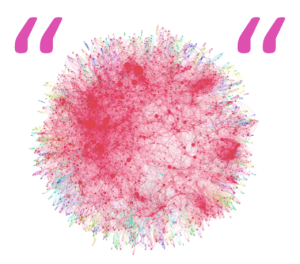
LAG:

A period of time: a noticeable delay between action and reaction –                         Failing to keep up with another or others in movement or development

JAG: 

A short period of overindulgence in an activity: a shopping jag: a crying jag          A stab; an intense and concentrated movement or action
Screen Shot 2015-07-14 at 12.39.29

I increasingly find myself at a very particular and exciting intersection.

I find myself there not by accident but by design: having helped build a methodology that reaps its greatest rewards at the point where applied science and commercial creativity collide.

(The creativity is commercial in that the point of collision is designed to generate pieces of communication to a specific end and utility – functional with tangible benefits – as opposed to a piece of pure art or some material assemblage generated to no end other than to create feeling and effect through its aesthetic – experiential with intangible benefits.)

Over the last year and a half I have been working on a project that seeks simple answers to some quite complex questions rooted in deep science:

  • How do we scale the ‘everyday’ conversation around genome science and DNA beyond the scientists, academics, clinicians and the rare interested civilian party?
  • How do we illuminate the scientific mysteries and wonder of our DNA in such a way that everyone can understand them, embrace them, engage with them, and reap the rewards that come from them?
  • And ultimately how do we help the greatest number of us to enhance the nature, quality and duration of our human tenure through informed choice and enlightened action in regards to our DNA?

This search for a more compelling narrative and conversation at the point where science and everyday humanity meet is not an isolated pursuit.

It is also true of the ‘Living The Dream’ project I am currently helping to steer. The project also seeks to scale the conversation around what constitutes a more enduring model of prosperity and sustainable consumption by finding a more ‘human’ narrative to replace the existing one, rooted as it is in the science, engineering and ‘reason’ of sustainability as opposed to human emotion of it.

In both cases we need to find a way of communicating complex concepts and constructs in the simplest way possible to the largest number of people without destroying the integrity of the scientific truths in the process.

In both cases there are untold rewards for society and humankind both individually and collectively if we can scale these conversations.

So I find myself working at this intersection of multiple collisions: between scientific integrity and human sociability: between depth and structure and lightness and elasticity; between applied science and commercial creativity.

MAKING CONVERSATION

To reap the untold rewards we simply need the communities of science and academia to meet the man and woman in the street and have a good ‘chat’:

And boy do they have some great stuff to talk about: life changing, existence enhancing stuff.

In the case of genomics, simply put, if enough of us embrace the advantages that the advances in the science offer in our everyday lives, using the revelations of DNA in an applied manner both individually and for the common good, we could eventually move ourselves from the old curative model of health care to a new and far more dynamic preventative model: one that will not only just change the way we live but also alter the duration of that living.

Making smarter and easily comprehensible lifestyle choices informed and underwritten by a deeper and more intimate understanding of what makes us who we are can help us to embrace a more positive approach to the lives we lead. Those choices made en masse will equally inform and illuminate how best the health service of the future can better sustain its ability to continue to serve our society both systemically and financially.

Now logic would predict that given the enormous impact and beneficial nature of those potential outcomes, everyone should already be ‘all over that conversation’: chatting away furiously, listening intently, sharing the conversation with friends and reaping the rewards of a better life.

SPEAKING IN TONGUES

The problem is – we’re not.

Why?

The greatest barrier seems to be one of simple comprehension and understanding.

The scientists and academics simply communicate in a different language to the everyday people they are trying to reach. Their particular languages have different vocabularies, inflections, idioms, energies and vernaculars – which is unsurprising given that both parties live in very, very different worlds.

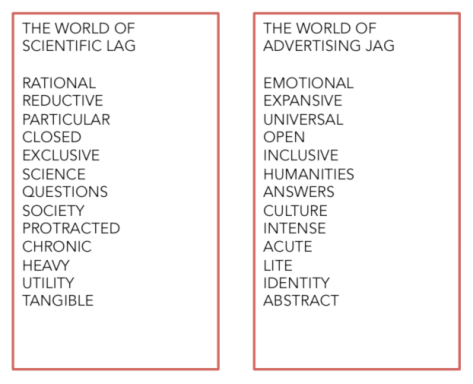
In one world we have the ‘splendid isolation’ of existence required to nurture intense, interrogative and highly rational scientific thought and action – and the codified, particular language and almost impenetrable texts, dissertations and white papers that accompany and support it.

In the other world we find the hyper-connected and hyper-socialised immersion of our emotionally charged everyday existence, fuelled and accelerated by smart devices and sprawling digital platforms of human interaction filled with billions of TXTS, tweets, emojis, memes, slang and banter.

One exists in a mode of hyper dislocation; the other in a mode of hyper socialisation.

And it seems that each speaks in riddles as far as the other is concerned.

A chasm exists between the world of academia and the sciences and that of the everyday person in the street. And as with all worlds of such different ‘atmospheres’, there needs to be a process of acclimatisation when travelling between one and the other.

In the context of Socialising the Genome (and my Living The Dream project) it is the conversational ‘syntax’ – the framing, structure, language and phrasing of these arguments – that needs to ‘acclimatise’ to the atmosphere of everyday needs and desires and the language they speak.

The highly tuned language, intense qualification and proofs of the scientists and academics need to ‘decompress’ on the way up into the ‘real world’ – otherwise they will suffer a bout of the communication ‘bends’ – where they either over compensate and try to hard – become too ‘matey’; the NBF of the person in the street… : ) : )

Or they simply come across like a geek at a fancy dress party – awkward, uncomfortable and so wrong on so many counts.

Putting deep science and academic concepts and truths through a ‘decompression and acclimatisation’ process can of course be undertaken as a one off – but realistically, if our ambition in this instance is to ‘socialise’ the conversation, we have to assume a fluid and escalating dialogue of increasing and expanding value and reach – and for that to happen we realised that we needed to keep the findings, revelations and insights of the academics and scientists constantly ‘in flow’; moving seamlessly and effortlessly between one world and the other: elastic and evolving.

To achieve this they need to be ‘sensitive’ of, keep pace with and be true to the everyday shifts and nuances in the behaviours, attitudes and language of the people whose existence they seek to improve. To be resilient and meaningful they must remain ‘relevant’ at all times.

(There is little point in deep diving for a populist answer only to find that on surfacing with one 2 years later, the question has changed. Herein lurks the danger of the academic lag.)

So, in the process of designing the methodology that would facilitate this we found ourselves with two acute questions to answer:

  • How do we create an offset strategy for the academic lag – one that allows the worlds of academia and the deep sciences to remain ‘present’ – to exist both in the accelerated and socialised Now while still mining in splendid isolation?
  •  How do we design a ‘decompression and acclimatisation’ process that enables a smarter simpler flow of ideas and findings – a ‘conversation’ or dialogue – between one world and the other?

CUE ADVERTISING JAG.

To reap the ultimate rewards that the advances in Genomic science offer us, the screening and storing our DNA as would have to become an everyday part of our health profile: it would have to become second nature to every one of us: a common place behaviour: something that we do without ‘thinking’.

But we’re a long way from a chirpy chat along the lines of:

‘hey Trish. Sorry. Can we say 7.30ish now? Running a bit late at the DNA screening clinic – mines a large glass of DWW! ; ) Jax xxx’

Genomic science tends to only enter our conversation either because we are forced to engage with it or by an accident of revelation.

Even when the more moderated conversations do occur they can quickly tip into ethical minefields around data storage and security, commercial abuses by insurance companies and self interested corporates, elitist tiers and eugenics, socio cultural stratification and the Police Database. There issues around identity privacy and confidentiality are staggering in some of their complexities and contradictions.

The complexities of genomic science are simply not ‘everyday’, not everyone’s ‘cup of tea’ and are at best incomprehensible and at worst quickly controversial.

But Advertising & Communication people spend their whole life not only trying to decipher what someone’s ‘cup of tea’ might be but also how they might get them to drink more of it

The nature of the models and frameworks used by marketing communications specialists to mine and shape insights, propositions and narratives – the intensity, speed and use of both broad stroke universal consumer insight and atomic data modelling – is driven by the voracious desire in corporates to ‘keep up’ with the fluid and ever changing nature of consumer demand and desires. These models have grown ever more agile due to:

  • The direct impact of technology and the social networks across the value chains and markets of the big corporate consumer brands:
  • The age of data big bang: an ever-expanding viral surge of relentlessly dividing and multiplying data on every aspect and dimension of how we live, act, interact and transact.

It is in the intensity, approach and most importantly the creative storytelling aspect of this ‘jag’ of activity that we believe our off set strategy can be found.

ADVERTISING SCHMADVERTISING

One of the greatest tension points in the new methodology we have engineered in Socialising The Genome is the point at which advertising exclamation collides with academic exposition.

There are fundamental and quite combative points of difference between the worlds of the Sciences & Medicine and the Humanities & Arts – in nature, methodology and application; and in their concepts of what constitutes integrity and substance (especially when the latter are of the populist persuader type – the advertising and marketing agencies and their kind).

Many wholly reason-based intellectuals and practitioners harbour a quite fixed (and many would say hugely justifiable) sense of distrust in what they regard as a moral and intellectual vacuum in the marketing communications agencies, institutions and organisations that manipulate and leverage ‘emotion’ and a lazy populism for commercial gain.

To allow the conversation around something as precious and fragile as genomic science to be driven by base desires pumped up on the wisdom of the crowds with no form of enlightened filter or curation, might well be perceived as not only risky but also irresponsible.

“Fine, if you’re just pushing another million or so 6-bladed, swivel-hipped funky junky disposable plastic razors” but matters of this level of human importance are quite a different thing entirely.

Alternately, on the other side of the conversational fence, we have the champions of ‘everyday’ people, the populist movers, shakers, creators and commentators who celebrate them, their language, their culture, their leisure and their past-times, and who shape, shade and distribute the myriad simple pleasures that they enjoy and engage with. For these people, unless science, like technology, is wrapped up in a Brian Cox-like, ‘whoops that’s my Collider’ approachability or celebrity, they are quite disdainful or disinterested in what they see as arcane and impenetrable conversations. They see no point in a dialogue that seems circular and closed in its nature and not of any use to anyone without a PhD.

Their attitude broadly runs along the lines of:

“don’t care – all a bit to serious and arch for me – lighten up, get over yourself – short time living long time dead – if you cant take the banter we’re not listening – and while you’re at it, mine’s a highly-advertised pint of unexceptional lager please!”
Screen Shot 2015-07-14 at 14.45.37

BUT, in a balanced world and all things being even – somewhere between the two polarities lies an answer – midway between the extremities of emotional populism on the one side and high-minded rationalism on the other.

Neither one nor the other can develop the conversation by itself in isolation. Each needs the other to create a full and robust conversation that is both substantial and sociable.

In our particular instance, we needed to go on a journey from the clinical utility of the genome conversation as it is now – closed alienating isolating and impenetrable in large tracts – to a one more rooted in concepts of positive identity and improved existence – open inclusive socialised and empowering.

We realised that to do that we needed to decipher how we could use the tension that exists between the worlds of science and society to most positive effect – to facilitate and accelerate that journey.

MIND THE GAP

To be clear, the absence of accelerated improvement in our human existence through Genomic science is not an issue of supply. (There are a lot of brilliant minds moving the science forwards). This is an issue of demand.

While ‘everyday’ people continue to not understand the real and substantial benefits of that science, they will not demand its benefits as a standard and inextricable part of their everyday lives

Communicating the inspirational, revelatory and highly beneficial impact of embracing our DNA to the greatest number of people in their terms in their world is central to all of this because it will fuel and fire ‘demand’ for better.

TWAS EVER THUS

Demystifying and popularising rare knowledge of a scientific, political, economic or theological nature has always been a critical step in the march of human progress (whether the scientists, politicians, economists and the theologians like it or not).

‘Dumbing down’ as some elevated minds like to think of it is actually humanity’s way of smartening up. And inspiring and wild-firing everyday conversation is a vital lever in that smartening up.

So first things first: we needed to accept that the challenges to easy conversation are substantial – the impenetrable nature of the science; a very human, provincially minded fear of the unknown; the conflicted nature of our feeling towards ‘disease prediction’; a general fear of ‘science going too far & meddling with the cosmos; the primal compulsion to ‘move away from’ any form of human flaw (our own or anyone else’s); either in the form of disability or crippling disease; or those flaws as might potentially be revealed by DNA screening.

We need to accept that none of the ‘conversation’ generated so far has enabled us to move very far beyond our current audiences – and that we have so far failed to present a set of positives that outweigh the existing negatives.

Genomic science and the subject of DNA need to be lightly dealt with or presented in such a way as to find their way into pub banter framed and informed by a ‘did you see? Did you know?’ Intelligence Lite, fuelled by lifestyle magazines, Sunday supplements and the Discovery Channel.

And given that film is the most shared currency in the socially networked world, film needs to be the base currency of our highly socialised cultural economy.

So our key objectives for success were:

  • to create a methodology that enabled us to look up through the emotionally driven human and the everyday insight – not down through the rationally driven science and the clinical language
  • to develop and distribute the seeds of a new and scaled conversation through the power of shareable film.

CREATIVE ACTION RESEARCH

My work over the last year or so with Dr. Anna Middleton of the Sanger Institute focuses solely how we reconcile the perspectives of our two worlds to shape and scale the conversation around DNA and Genomic science to greater human benefit.

And it is in the circular and iterative nature of the interaction between her world – that of the Academic Lag – and mine – that of the Advertising Jag – that we believe will deliver the language and framing for and therefore the scale of conversation that we need to transform the way people see DNA in their lives.

With CAR, we have constructed a methodology where, even when in the midst of the deep dive nature of her qualitative ethical research process, Anna is able to utilize my and my collaborator’s ability to reframe, rephrase and represent science or research fact in more populist social storytelling terms and framings to play beck into and inform the more academic process she is undertaking.

CAR – TESTING THE EDGES OF CONVERSATION

CAR combines traditional qualitative research, rooted in group discussions and in depth interviews and discourse interpretation with quantitative research that introduces fresh  creatively-framed seeds of Genome and DNA conversation into the social networks to provide a simple speedy test of whether those seeds have the ability to inspire and engage people in such a way that they might in turn share it amongst their own social network both real and virtual.

The method we have devised for creating the simple seeds of a new conversation revolves around taking an existing piece of knowledge or scientific fact and creating different types of ‘conversation’ or story telling around it.

We then use these seeds of conversation as foils and flash cards in both a quantitative socialised environment and the more in depth and metered qualitative research groups and in-depths.

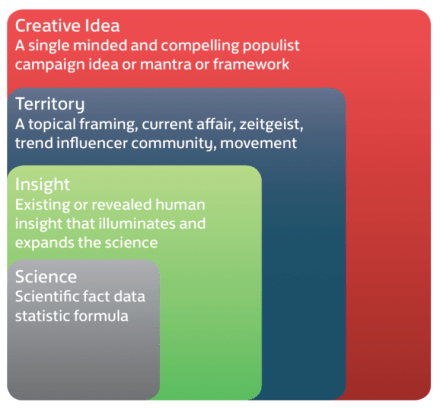
To ensure that in the migration from science or clinical insight to creative idea we did and do not fall foul of confecting, manipulating, misrepresenting and ultimately distorting or twisting the knowledge or facts we are using, every creative idea has to be rooted in an insight ladder.
Screen Shot 2015-07-14 at 14.58.47

The Insight Ladder is a simple proprietary tool that I have developed for this project that aims to lock the more creatively framed seed of conversation to the scientific fact truth or insight that inspired it: a sort of plumb line of integrity that runs through each ‘conversation’.

QUALITATIVE RESEARCH

A number of traditional qualitative research group discussions and some in depths will begin to explore some of the everyday language and insights around genome science and DNA.

A dry Discussion Guide takes each participant in the qualitative groups from a condition of lowest point of knowledge – do you know what DNA is? – through a natural arc of expanding conversation – knowledge of DNA – benefits or not to the individual – its role in improved healthcare – moral and ethical issues around the science – data privacy and security – and at its most extreme – and ultimately, the nature of improved DNA and genome science on a thriving UK PLC as a mark of global leadership in the advancement of improved human existence through scientific and social enlightenment and application.

Once the open and freeform discussion has come to a close we will use some of the seed ideas that we have developed from existing insights to see how opening doors to the subject using more creative everyday storytelling potentially changes or alters people’s disposition, perception and appreciation of the subject.

QUANTITATIVE RESEARCH

Once the qualitative groups have been transcribed we will then select the most potent insights and creative storytelling and framings so that they may be turned into simple animated pieces of film storytelling.

We will use an online research tool to see which film inspires the most attention and why with a representative UK sample, as well as sharing them in the social networks to the same purpose.

Both actions will seek simple responses and opinions through both closed and open data capture.

Ultimately we are seeking one or two ideas with the potential to develop into a greater scale of everyday conversation using socially dynamic communications and advocacy strategies to wildfire those conversations.

BONFIRE OF THE HUMANITIES

The creative jag in CAR endeavours to act like a repeated finger tap in the centre of the academic ‘chest’ – a way of bringing the science into the moment, connecting it in visceral emotional and social terms to the everyday Now – an intense injection of populist framing and storytelling for those somewhat consumed in the Academic Lag.

In that way, the advertising Jag acts as a form of ‘Mindfulness’ for the scientist, academic and clinician deep-diving into the world of the genome – providing a ‘Look Up’ orientation strategy for them to use while potholing in the caves between what is know and unknown.

Therefore Creative Action Research aims to use a complimentary fusion of:

Academic Lag – Reason – utility, interrogation & measure – resilience – the individual

+

Advertising Jag – Emotion – identity, expression & impact – desire – the crowd

to scale the conversation and socialise the Genome.

CAR accepts that there is no simple black & white answer here. It will take time and the attentions of both the Laggers and the Jaggers to get to the scale of conversation this deserves and needs.

In some ways, as with our DNA, it might just prove that the things that unite us are greater than those that divide us.

In finding a way to socialise the Genome we might just find a way to both educate the populous and socialise academia. And perhaps that is not a bad thing at all.

In the meantime lets pop on our Bordieu T Shirt – and be a great destroyer of Either/Or.

Sustainable Human Existence, The D Word & Treading carefully

02 Saturday Aug 2014

Posted by Thin Air Factory in Uncategorized

≈ Leave a comment

Tags

Brian Cox, cary Grant, China Dream, D Ream, Dream catchers, Dream In A Box, Freud, gramsci, Identity, John Stuart Mill, Loveboat, Mad magazine, Martin Luther King Jnr, Morpheus, Peggy Liu, Philosophy, Science, Sustainability, The Ancients, The Civil Rights Movement, Transforming Desire, Walt Disney, Yeats

Screen Shot 2014-08-03 at 00.05.59

Funny things dreams. Profound to some – sophistry to others.
So please mind your language!

I used the word Dream in a presentation once in the UK. Won’t be doing that again in a hurry any time soon: certainly not without a lot of qualification.
Let’s just say I had not realised how ‘spooked’ grown ups can get by a word.

Equally, it served to remind me that my own slap dash use of language and bumbling naivety could do with some heavy spanner work and a healthy dose of tuning fork.

To be fair the D word popped up in very particular circumstance – a discussion about a methodology called Dream In A Box.

The methodology endeavours to reuse and recycle old wisdoms, contemporary cultural signposting, local idioms and vernaculars to write a new narrative – to re-imagine prosperity, reframe sustainability and transform desire – the consuming kind particularly – to a more enduring and sustainable model; all this in pursuit of a more sustainable human existence.

The D word was chosen for its particular resonance with and reference to ‘the American Dream’ and the staining nature of its most recent variant on our beleaguered planet. Not that it was always thus.

The American Dream was one under which all men (and, sure, yup, women, and ok, eventually, if you’re going to push it, with a civil rights movement for example, Afro-Americans) were equal.

In the heady industry-rebuilding, economy-expanding (where waists would surely follow) post-war rush to create the perfect American thriving, surviving white-picket society, that dream took a few toxic turns, until finally, it eventually settled on the perfectly trimmed lawn of the idyllic all-consuming sub Urban lifestyle that we know and love.

Cue Cary Grant movies. Loveboat. Doris Day. And the chirpy satire of Mad Magazine.

It was a dream promising the consumer citizen infinite growth, financially, spiritually, socially and collectively; all merrily based upon an apparently infinite, fecund and plentiful pool of glorious ‘Godly’ resources; material human and physical.

The patently obvious and accelerating realisation of how wrong that immaculate assumption actually was aside, the feeling in the Dream In A Box camp was that the Dream bit of the phrase was reasonably off set by the In A Box bit.

The In A Box part of it made the following particular point: unless you can find a way of containing the otherwise intangible, lofty, unreachable and mildly frustrating dimensions of a Dream and make them real in ways that are meaningful and valuable to everyday people in the everyday thread of life, you are merely peddling opiates.

Even so, for some it smacked of an over simplified homogenous hideous social chimera. A one size fits all piece of social bullying or bluff that was fundamentally anti–social in its anti-individualist bent.

But this vehemence is not a feeling reserved exclusively for the more square cornered sustainable analysts, scientists, engineers underwriting the operational truths of supply and value chains everywhere.

Dreams generally enjoy a dynamic polarity in many people’s minds.

Dreams seem to inhabit a similar place to things like religious fervor, faith and Walt Disney for many of the reason and rationality junkies out there.
To the nay-sayers and doubters, the idea of having a dream (a phrase preferably spat out or sneered through) verges on criminal self delusion and puffery.

The intangible what if nature of them seems to fill them with some form of existential dread.

There is no place for dreams in a reasonable world, especially a scientific one and certainly no place for reason in dreams  – so what if Brian ‘Mine’s Hadron Collider’ Cox’s band was called D.Ream. Doesn’t mean he ascribes to them.

The reoccurring theme seems to be that Dreams, like faith, are dangerous things – dark instruments. Dreams obfuscate the real raw nature of our human existence and all of its incumbent challenges, puzzles and conundrums.

The realm of Morpheus is a confection that far from enlightening us is seen as one that diminishes us.

Its almost as if Dreams are flawed in some evolutionary way: rendering us incapable of basic human survival; stupefied by our hazy, twinkle-filled and fantastical view of the world.
A small rummage around the point counter point arguments of, on the one hand, the evolutionary benefits set out in Anttii Revonsuo’s Threat Simulation theory, and Flannagan’s concept of Evolutionary epiphenomena (dreams as a state that lacks any form of adaptive function) on the other clearly inform us that the evolutionary jury’s out on this one.

And the case for Dreams as a scientifically proven improver of our human condition is never helped in the eyes of the scientist by the presence of Dream Catchers and other juvenile voodoo bric a brac in the windows’ of student houses and hippy retreats.

Perhaps the most virulent critics spent one long night too many at college or university pretending to give a crap as the fragile teen sitting opposite them bleated their dream stories in some desperate effort to seem windswept, deep and interesting.

Equally the phrase ‘to follow one’s dreams’ doesn’t help, in that it implies a sheep-like loyalty: a subservience in service of something intangible beyond your control. And we know how rationalists like a smidgen of control. 

Whatever it is that causes the anger and disdain; it is a powerful and quite corrosive emotion.

But, for the Dream believers, Dreams are a way of allowing people to transcend the bleak sharp cornered truths of what is and embrace the brighter potential of what could be. Dreams allow us to rise above the deterministic absolutes of any given situation and envision something better.

Martin Luther King had a dream that succeeded in helping to shift millions of black Americans from a position of sub human species needing to know its place to a powerful ethnic constituency in search of a spiritual homeland and tangible human rights and respect.
I doubt even the fiercest doubters could ridicule or set aside the power of that dream to change lives and human existence for the better in some shape or form.
There is a sense that, in the USA of the 1960s, the political power elites, intellectual tribes, state collectives, regional advocates and community activists all jostling for position on either side of the colour divide would never have convened their mighty voices into that one immutable, immoveable and deafening roar without the focus of that Dream, voiced so eloquently and publicly.

But equally, John Stuart Mill found the idea of galvanising and socialising a nation through a singular collective idyll – an idea or dream of better – was at best childish and naïve and at worst an aggressive act of hubris and societal hegemony – a social tyranny.
He believed in the axiom that ‘man should judge everything in life based upon its ability to promote the greatest individual happiness’.
“the tyranny of the prevailing opinion and feeling is more formidable than many kinds of political oppression …leav[ing] fewer means of escape … and penetrat[ing] more deeply into the details of life. ”The “tendency of society to impose … its own ideas and practices as rules of conduct on those who dissent from them; to fetter the development, and if possible, prevent the formation of individuality, not in harmony with its ways”

There is a sense in this view that an individual Dream is fine while it is held safe and unsullied in the heart and the mind of an individual. It is a beautiful and highly personal wonder, broadly uncorrupted though perhaps a little influenced by the dreams of others.

(It is worth reminding ourselves that Martin Luther King Jnr. said ‘I have a dream…’; not ‘We have a Dream’. It was his; it just had the potential to move many others within it.)

It seems that while in its unadulterated individual state, that which is most emotionally proximal to its originator, a dream is widely lauded as the profound generator of poetry, music, art and literature.

Yeat’s Cloths of Gold directs the listener to ‘tread gently for you tread on my dreams’. They are presented as the purest, most precious things he has to offer the world.
Mamma Cass’s ‘California Dreaming’ protested a desire for a sunnier brighter life far removed from the cold emotionally bleak east of Fall and Atlantic swells. It is her dream and hers alone: just one that happened to be shared by a generation.

The problem it seems is that when mobilised, industrialised and socialised at scale, a dream becomes The Dream – the Mother of Suppression of the Individual in hot pursuit of the collective good. The Dream quickly becomes the destroyer of intelligent dissent and the brutal editor of different orthodoxies and philosophies that did not quite ‘fit’ ‘The Dream’. It becomes all that John Stuart Mill berated and warned of in his view of one dimensional models of collective happiness as some conjuring trick played on the masses.

Dreams also have an ill-judged and reoccurring tendency of turning up at the very heart of large orgiastic excursions into nationalistic and hubristic megalomania.
Dreams of Empire whether by Georgian and Victorian Britain, Imperial Japan, Fascist Italy or the German Third Reich always seem to bear out the truth of Mr Mill’s perception.

To use a singular Dream in this way is to squash the very diversity and healthy human tension the enables us to evolve as a species. Dreams are a recidivist and controlling mechanism that are worthy of deep suspicion.

The pollutant seems (as so often is the case) to be somewhat rooted in what man has done in the name of dreams; not in the condition of dreaming which in itself is a pretty confounding experience. They are after all an axial mechanism of our deepest mind.

Dreams at their most basic level are the powerhouse of our emotional computing.
They are the synaptic equivalent of taking the big data from every facet and corner of our existence and atomically mixing it up with the narrative skills of Lewis Carroll, Dickens, Spielberg and Plato.

Dreams are the super processor of individual human potential.

They are the transcendence mechanism in us – they are the ‘reach’ mechanism that compels us to perhaps stretch beyond what seems immediately possible or probable to test the edges of what could or might be.

Science clearly sets out the power of our sleeping computations in regards to cognitive ability and capacity.

But given their sleep hosted ‘madness’, flaky associations, the abstracted corollaries that exist within them and Freud’s rather particular take on them, it is easy to set Dreams aside as garish hyperemotional gibberish – or reinvent them as some twist of needy or proving self-identification and elevation.

Most people find the sharing of what one dreams an immature act of identity assertion; usually by those who feel there is little social or intellectual mystery or magic about them. Given that it is a habit that one usually hopes dies out with the arrival of slightly greater intellectual and spiritual surety, perhaps the mere sight of the word makes them run for the hills screaming.

There is a theory that dreams exist in the sleep-scapes of REM Rapid Eye Movement and NREM Non Rapid Eye Movement and do so with a very clear function.

It is believed that the process of sleep to encode and transfer data from the temporary memory store in the conscious mind accesses and activated in NREM sleep to the long term memory store in the subconscious mind accessed and activated in REM sleep – and the continual activation of this flow is what stimulates dreams. So in that way they are a robust and meaningful process of our body science and an enricher of our more adaptive cognition.

It is not just the science of the brain that frames the arguments and beliefs around dreams and their role.

Human history and the texts of the ancients are riddled with expansive philosophical treatise and frameworks. From the ancient Mesopotamians, Chinese, Upanishads, and Babylonians, to the Egyptians Greeks and Romans, the powerful nature of dreams have always held a deep and profound place in our collective social memory.

In some ways perhaps the truth of Dreams lies as with many things somewhere between the two; at the point at which these two distinct perspectives overlap and stitch together; neither being the predominant force but both represented as balanced and weighted in a perfect symmetry with each other. This duality might offer us a more productive way forwards.

Gramsci invites us to apply Pessimism of the Intellect and Optimism of the Will in all things. Perhaps this is the filter through which we should view Dreams and everything to do with them in regards to the ambition of transforming the more toxic desires of the average consumer.

Certainly in regards to the Dream word being used as a way to frame the spiritual social and material vision of a more sustainable form of consumption, Gramsci’s invitation would help balance the two dimensions.
The pessimistic Intellect – the science – interrogating the truths of how we engineer and support these more sustainable lifestyles while the optimistic Spirit – the philosophical – compels a more transcendent human nature be applied at every opportunity – a higher human purpose that might take everyday humanity beyond the impenetrable science and just doing enough to scrape through.
This would liberate the word and the language around it to be both rooted in the deep science that will be required to reinvent our standard forms of consumption and yet elevated by the optimism of a collective human endeavour lived in real time in the real world.

And perhaps if we liberated the word – set it free from the shackles of an Either/Or model of determinative application we might find something richer and more human again in Dreams.

If perhaps we also recognised that in regards to visionary models of human consumption, Dreams can be nuanced, shaded and culturally meaningful even at a meta level.

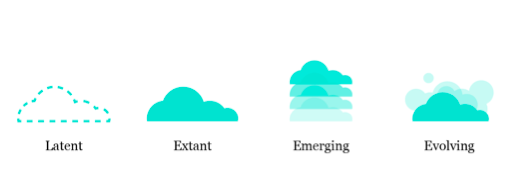
In the Dream In A Box initiatives undertaken so far we already have 5 Shades of Dream – Emerging; Latent; Resurgent; Extant; Evolving – starting to reveal themselves in regards to formulating desirable and enduring lifestyles of consumption.

I am certain that more will present themselves before we are finished.

So here’s to those turbulent, intangible, flaky, studenty, inspirational, nation-shaping, scientist irritating things called Dreams.

If for nothing else they should be considered eminently remarkable purely on the basis that they can elicit so much passionate debate and discourse purely by their mention.

As long as each Dream is considered on its merit – not on some preconceived concept of what it does not fulfil, or on some etymological witch hunt dressed up as rigour and realism we’ll perhaps be fine. Until then…

As Stephen Tyler sang: ‘Dream On’

Subscribe

  • Entries (RSS)
  • Comments (RSS)

Archives

  • November 2025
  • September 2024
  • June 2021
  • December 2020
  • August 2020
  • April 2020
  • March 2020
  • January 2020
  • October 2019
  • June 2019
  • April 2019
  • November 2018
  • August 2018
  • June 2018
  • February 2018
  • January 2018
  • December 2017
  • November 2017
  • August 2017
  • July 2017
  • June 2017
  • May 2017
  • March 2017
  • January 2017
  • December 2016
  • November 2016
  • October 2016
  • September 2016
  • August 2016
  • June 2016
  • May 2016
  • April 2016
  • March 2016
  • February 2016
  • December 2015
  • November 2015
  • October 2015
  • September 2015
  • August 2015
  • July 2015
  • June 2015
  • May 2015
  • April 2015
  • March 2015
  • January 2015
  • December 2014
  • November 2014
  • October 2014
  • September 2014
  • August 2014
  • June 2014
  • May 2014
  • April 2014
  • March 2014
  • February 2014
  • January 2014
  • December 2013
  • November 2013
  • October 2013

Categories

  • Uncategorized

Meta

  • Create account
  • Log in

Create a free website or blog at WordPress.com.

Privacy & Cookies: This site uses cookies. By continuing to use this website, you agree to their use.
To find out more, including how to control cookies, see here: Cookie Policy
  • Subscribe Subscribed
    • thinairfactoryblog
    • Join 28 other subscribers
    • Already have a WordPress.com account? Log in now.
    • thinairfactoryblog
    • Subscribe Subscribed
    • Sign up
    • Log in
    • Report this content
    • View site in Reader
    • Manage subscriptions
    • Collapse this bar
 

Loading Comments...